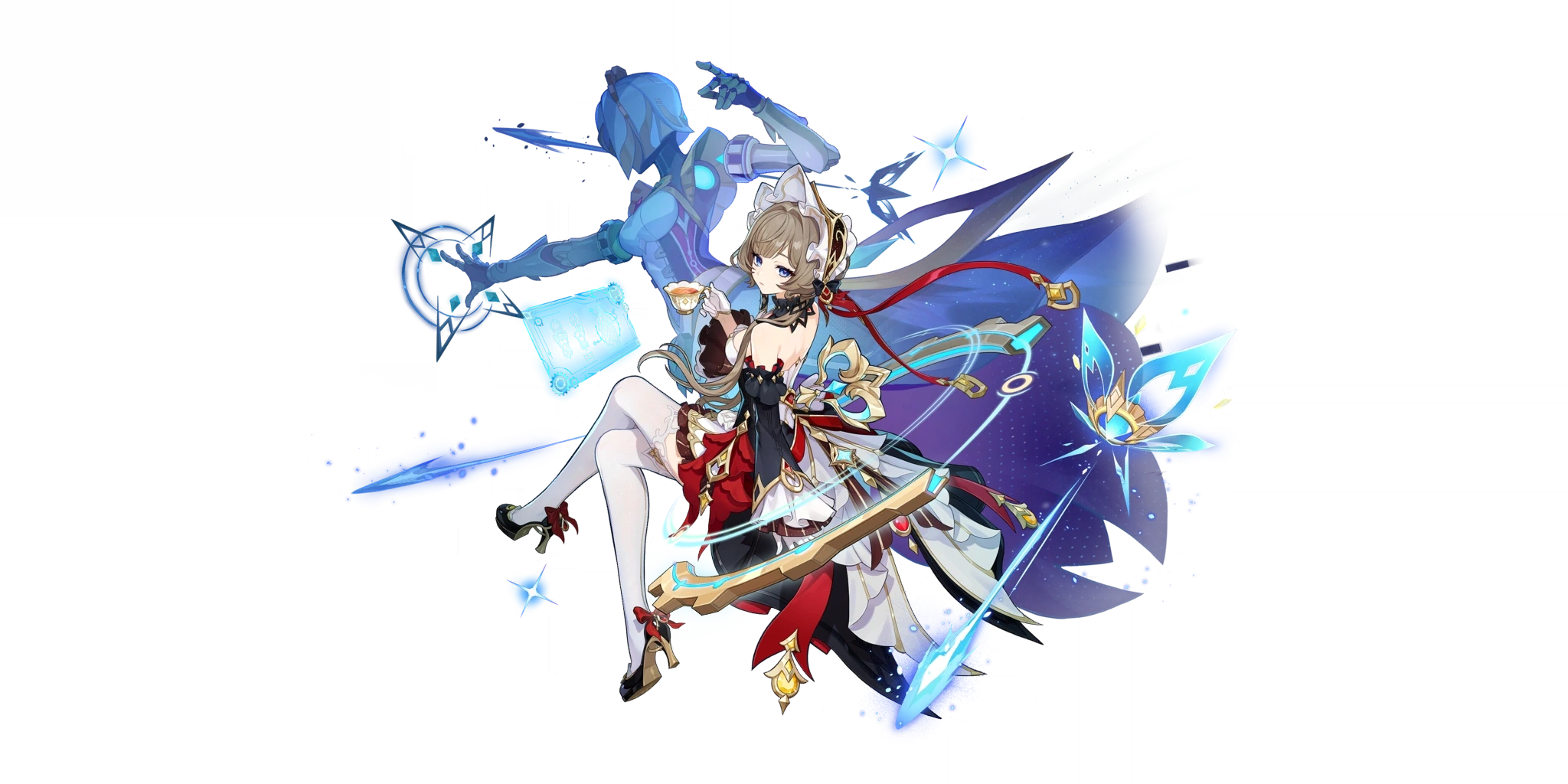
Constructed by Cataclysm-era polymath Alain Guillotin in the likeness of his sister Mary-Ann; activated on his 65th birthday with an emotional core capable of learning; became the Seventh Fatui Harbinger; killed in the Welkin Moon Act VIII final battle (Luna IV / patch 6.3), then reactivated when her Stellar Linchpin activated Alain's inheritance before her playable Luna VIII / patch 6.7 return
Overview
The Seventh Fatui Harbinger, codenamed Marionette, and a constructed person rather than someone born.
Built by the Cataclysm-era polymath Alain Guillotin to resemble his late sister Mary-Ann.
Commands the Marionette regiment, the Fatui's mechanical and automaton arm.
Died stopping Dottore in Welkin Moon Act VIII, then received a second life when her Stellar Linchpin activated Alain's inheritance.
Created Fagio as her new assistant while keeping the damaged Pulonia in hope of restoring him.
One of the few people the Harbinger Columbina actually trusts.
In Chapter VII she speaks for the Fatui's engineers and researchers in Snezhnograd's Veche.
The Seventh Fatui Harbinger, codenamed Marionette: a constructed person built by the Cataclysm-era polymath Alain Guillotin with an emotional core capable of learning. She commands the Marionette regiment of automatons.
Spoiler-free overview. You hid spoilers under Settings → Reading; choose Show all there to read the full content.
The Fatui Harbinger codenamed Marionette is a constructed person with a porcelain body and a mechanism unlike Wanderer's. At the close of Welkin Moon Act IV "An Elegy for Faded Moonlight" (Luna II, patch 6.1), she tells the Traveler she knew Alain Guillotin, "that guy they call Lord-Artificer," and read all his manuscripts before destroying them at his request. [8][32] That scene does not say how she was made. The Cataclysm-era polymath built her in the likeness of his late sister Mary-Ann, activated her on his 65th birthday, and gave her an emotional core capable of learning. [1][7]
She died at the close of Welkin Moon Act VIII Descending Moon (Luna IV, patch 6.3) after intercepting Dottore's killing spike with her own body. [10] Her visible world-formula was a decoy: the real calculation was hidden inside Pulonia so Dottore would focus on Sandrone. The deception worked, but Dottore destroyed her core. [10]
That death was not permanent. A Stellar Linchpin later activated the "inheritance" Alain left her and reactivated her, an event her profile calls both a second birth and a resurrection. [2] She remained with the Fatui and returned as the playable 5★ Cryo Claymore of Version Luna VIII (patch 6.7), officially titled "Mirrored Analysis." Her biography therefore has two endpoints: the death that completed her Welkin Moon deception, then the second life in which she decides what to do with the person Alain taught her to become.
1.
Sandrone - Genshin Impact Wiki (Fandom) · external ↗
2.
Sandrone Profile - Genshin Impact Wiki (Fandom) · external ↗
The arc closed the long-running question of who Sandrone actually was. The old reading on the wiki (porcelain doll, mechanism unknown, probably an early-Khaenri'ahn alchemy survivor per Wanderer's rumour) no longer holds. She is a Fontaine-era construct made by a Cataclysm-era polymath, not a Khaenri'ahn alchemy artifact, and the "different mechanism from Wanderer" line turned out to be correct without ever being explained. Her work with Khaenri'ahn Ruin Guards, which defined the Marionette regiment's role through the rest of canon, was a specialty she took up, not where she came from.
Identity: Marionette, the constructed daughter of Alain Guillotin
Alain Guillotin is the "Lord-Artificer," the title Sandrone uses for the Cataclysm-era polymath in the tea exchange at the close of Welkin Moon Act IV, where she also tells how he founded the Fontaine Research Institute. [8] The rest, including how he made her, comes from Alain Guillotin's record: [7]
Cataclysm-era Fontainan polymath; member of the Narzissenkreuz Institute before its disbandment; researcher at the Institute of Natural Philosophy; a Marechaussee Hunter alongside his sister Mary-Ann.
Founder of the Fontaine Research Institute of Kinetic Energy Engineering, the institution that inherited his work.
Primary research focus: Khaenri'ahn machines, the Ruin Graders and the wider family of Ruin Guards, and technology from the era of King Deshret. This is what Sandrone's later Harbinger work grows out of. The Marionette regiment's deployment of Ruin Guards, Hunters, Graders, Drakes, and Field Tillers continues Alain Guillotin's research rather than being something Snezhnaya picked up separately.
Mary-Ann, Alain's sister, presumably died in their fight against the Narzissenkreuz Ordo at Elynas's remains. Decades later, Alain built Sandrone, a puppet fashioned in Mary-Ann's likeness, as something between a memorial, an heir, and a daughter.
On his 65th birthday, Alain activated her. He gave her an emotional core capable of learning and spent time teaching her to be her own person rather than to be Mary-Ann.
Pulonia is Alain's final creation, given to Sandrone as her assistant.
The tea exchange at the close of Welkin Moon Act IV is where Sandrone chooses to talk about her own past through Alain Guillotin. It opens when she calls "that guy they call Lord-Artificer" "the only vaguely interesting memory in my past" and the Outlander names him. The whole conversation is on screen. She says she read all of Alain's manuscripts before destroying them at his request, tells the story of Alain, Rene and Jakob, asks "Traveler, what do you think of Rene?", and gives her own view once asked. When Sandrone talks about her past, she talks about Alain. [8][32]
The act ends with Sandrone starting maintenance on Pulonia in the same scene. It is a recurring image of her caring for the assistant Alain made her, and it mirrors what Alain did for her on his 65th birthday.
Inside the Fatui: the Marionette regiment
The codename Marionette follows the standard commedia dell'arte Harbinger naming convention; she is sharper than the codename implies. Per the Eleven Fatui Harbingers page [13] and the Welkin Moon arc primary text:
Which seat she holds. Sandrone is the Seventh Fatui Harbinger. Welkin Moon Act I names her Seventh, her playable self-introduction repeats it, and the Luna VIII update uses the same rank. [4] An earlier version of this page moved her to Sixth after Wanderer's defection, but current primary text does not support renumbering the surviving Harbingers.
What the regiment does. Its remit is automatons. The Ruin Guards, Ruin Hunters, Ruin Graders, Ruin Drakes, and Field Tillers scattered across Teyvat are all Khaenri'ahn relics from the Cataclysm era, but how they are used now (which units activate, where they patrol, what they prioritise) is Sandrone's domain. She is the Fatui's source of mechanical and automaton support.
Who serves in the regiment. Per the Welkin Moon Prelude reveals set in Natlan: [11]
Velimiru is not flesh and blood. When Paimon asks how he is still alive, he answers, "Don't act so surprised. I'm just one of her many projects...", and the Traveler thinks, "(What the... This guy isn't made of flesh and blood...)"[27] Her regiment includes operatives who are her own automaton-projects, not human Fatui officers.
Velimiru's group works in Natlan while Sandrone is "based in Nod-Krai." Her voice answers them there ("If you want to play with fire, then be my guest. But there is an unpredictable variable you need to watch out for..."), though the dialogue does not say how she reaches them. Per Fandom, the group went to Natlan on its own initiative to impress her. [27][29]
The regiment's research target is "secret knowledge about all kinds of ancient civilizations" for "inference." Their informant Zhuoxin fears that neither the Northland Bank nor "the Nod-Krai Oprichniki" will let him walk away; the dialogue does not tie the Oprichniki to Sandrone. [27]
Pulonia. Alain Guillotin's final creation, given to Sandrone as her assistant and treated by her as family. In Welkin Moon Act III, Rerir incapacitates Pulonia with a single hand-flick at the Kuuvahki Experimental Design Bureau. Pulonia later carries the real world-formula through Act VIII. Sandrone's Luna VIII profile says his core cannot currently be restored without losing the identity she is trying to preserve. [2]
Pulonia and the Ruin Machines
Pulonia is Alain Guillotin's final creation, which Alain gave to Sandrone as her assistant. He is a large humanoid clockwork meka whose face and shoulder ornamentation resemble the Ruin Machines, and he carries back-mounted missile launchers like a Ruin Guard's. Fandom's Ruin Machine page calls him "a modified Ruin Machine," but whether he was actually built from one is unconfirmed. Alain's research focused on Khaenri'ahn machines "such as Ruin Graders," along with technology from the era of King Deshret, and Sandrone inherited that work as a Harbinger. [28][7][15][14]
The Ruin Machines page names Sandrone's Marionette regiment as one of three actors working Khaenri'ahn Ruin Machines in modern Teyvat. The other two are the Abyss Order (with some connection that stays ambiguous, per Childe's AQ I disclosure in Defender of Childhood Dreams) and independent reactivation by the Ley Lines (the damaged cores revived by Ley Lines pattern from the Afratu's Dilemma World Quest). The regiment's modern fleet runs to Ruin Guards, Ruin Hunters, Ruin Graders, Ruin Drakes, and Field Tillers; Pulonia is the unit Sandrone is shown caring for directly. [14]
Where Sandrone sits: Harbinger, not Shade or Sinner
Per the Asmoday, the Sustainer, and the Four Shades deep-dive, the Sustainer of Heavenly Principles is a role-name for Asmoday among the four deputies Heaven installed before going dormant, not a separate rank above the Shades. The Sustainer sits at the Shade level, one layer above the Archons, within the four named Shades (Naberius, Ronova, Istaroth, and Asmoday, per the Gods' Limits teaser). Reading the Sustainer as a discrete fifth rank, as the AQ Prologue cinematic might suggest, is a mistake. [18]
The Marionette regiment sits well below that. Sandrone is a Fatui Harbinger, a mortal figure, and her job is running pre-Cataclysm Khaenri'ahn engineering in the present day (the Ruin Guards, Hunters, Graders, Drakes, and Field Tillers, plus Pulonia, whose design borrows from the Ruin Machines), per the Ruin Machines page. A Harbinger's reach over old Khaenri'ahn relics is a very different thing from a Shade's authority over the eternal laws Heaven installed before going dormant. [14][18]
She is also not one of the Five Sinners of Khaenri'ah (Rhinedottir, Surtalogi, Hroptatyr, Rerir, and Vedrfolnir, all five named at the Welkin Moon Act IV formation event, with Dainsleif as the non-Sinner who organised them). Sandrone is a Fatui Harbinger, not a Sinner. Her background runs through Alain Guillotin's circle of Cataclysm-era Fontainan polymaths (the Narzissenkreuz Institute, the Institute of Natural Philosophy, the Marechaussee Hunters), per the Welkin Moon Act IV Lord-Artificer reveal, not through any pre-Cataclysm Khaenri'ahn court office. The regiment inherits Khaenri'ahn engineering as a research subject, not as a claim of membership. The Khaenri'ah it draws on belongs to the Crimson Moon and Eclipse Dynasties at the level of relic engineering, never the old court. [8]
The Saarelainen deep dive does not supply an exact date or a confirmed identity for the Third Descender. Hymns records seven pieces; Skirk separately records the Third Descender's remains in the Gnoses. Neither claim connects to Sandrone's engineering. [19]
The "Isn't this just who you are?" relationship: Columbina
Per Character Story 3 of Columbina's Profile, Sandrone is one of Columbina's two trusted Fatui colleagues, alongside Arlecchino. [12] The key exchange has Columbina unable to handle the reimbursement procedure after a meal, and Sandrone stepping in with "Alright, I've got this. You just stay out of it. Hmph. You don't even know how to apply for reimbursement, and you dare come out to eat by yourself?", ending on the line:
"Hmm? You don't blame me?" Columbina asked. >"Huh? Why? Isn't this just who you are?" came the exasperated reply.
The line matters for reading Sandrone after the Welkin Moon arc. It inverts Dottore's "You can do better", acknowledging Columbina as a person rather than as the power she could provide. Sandrone's own origin begins with Alain Guillotin teaching her to be her own person rather than to be Mary-Ann. Her stance toward Columbina in the Profile turns that same lesson outward, so the two relationships run on the same principle.
The Welkin Moon arc returns to this relationship in four beats:
Welkin Moon Act II (Elegy of Dust and Lamplight close). Sandrone confronts Rerir at Starsand Shoal; Pulonia loses the fight; Columbina teleports the working group to safety. The Silvermoon Hall exchange that follows plays as a scene between former colleagues. Sandrone is upset at the intervention ("We were going to settle the score...!"), and Columbina answers, "Your calculations seem to have deviated quite seriously." Sandrone reminds her, "There's a Fatui warrant out on your head, and don't you forget that. Don't make me fight you right here and now," then leaves with Pulonia. Columbina later says, "Sandrone seems uninterested in my capture." Their loyalty to each other quietly bypasses the Palestar Edict warrant. [31]
Welkin Moon Act III (A Nation That Doesn't Exist, Special Operation). At the Kuuvahki Experimental Design Bureau, Sandrone lets the Outlander and Columbina pass when they ask after Arlecchino. Their exchange mentions their past tea parties, the chapter's first look at the history between them. Sandrone agrees to message Arlecchino on Columbina's behalf.
Welkin Moon Act VI (Melting Moonlight in the Morning Mist, The Night the Moon Returns Home, plus the optional The Empty Courtyard). At the Moon-Prayer Night festival, seen through Columbina's eyes at her first festival as herself, Sandrone insists she is "only here to protect the Fatui's interests in this territory," loses at festival games to Columbina, and finally admits, "I'll... miss you too... Columbina..." [33] The optional Empty Courtyard epilogue finds Sandrone alone outside Silvermoon Hall after Columbina vanishes into the moon's reflection. She tells the Traveler there is "No such thing as a free miracle," turns down company because she is "not in a good mood today," and leaves on "Besides, comfort is the last thing this place needs." [36]
Welkin Moon Act VIII (True Moon close). After Sandrone's death, Columbina cradles her body at the edge of the arena (per the Descending Moon close) and mourns alone with it for a long time (per the Welkin Moon's Homecoming port-side debrief). Sandrone's final wish, passed to Arlecchino through her verbal will long ago, was that Columbina was not to know of the matter: "No. I was specifically warned not to tell her. This is her last wish, and I will abide by it." Asked whether it is another "backup plan", Arlecchino answers, "I can only hope so... But none of us here can know for certain." At the same debrief she says Columbina "offered me some words of comfort before I departed. Despite being grief-stricken herself, she showed an awareness of the feelings of others around her," and she tells the Outlander, "I suspect that we have you to thank for much of the change we are seeing in her." [35]
The Columbina page covers the friendship from Columbina's side; this page covers it from Sandrone's.
The Hexenzirkel-adjacency
Per Columbina's Profile Version 2 introduction (an exchange quoted between Marionette and Signora's Fair Lady at one of Alice's tea parties), Sandrone is a recurring guest at the Hexenzirkel's gatherings, both Harbingers complaining about Columbina dropping in "whenever she feels like it, and [having] zero social graces."[12] Sandrone is not one of the seven founding members (Alice, Barbeloth, I. Ivanovna N., Andersdotter, Nicole Reeyn, Octavia, Rhinedottir). The likeliest reading is the one that also explains Columbina's presence: Alice extends a standing courtesy to the unusual constructed beings and Moon-era survivors the Hexenzirkel keeps in contact with.
Whether the Welkin Moon arc carries that connection into the field is unconfirmed. In Act VIII, Wanderer lends Sandrone his core, "a small part of Irminsul," to run the world-formula she had balked at plugging "directly into the Ley Lines," though she warns him, "You could die if you do this!" He tells her the Traveler is "willing to vouch for you"; no source makes Wanderer a Hexenzirkel member. Sandrone accepts. [10][35]
The Welkin Moon arc
Sandrone is the chapter's central Fatui figure across Acts I-VIII. The arc's Nod-Krai operations run through the Kuuvahki Experimental Design Bureau under her command: the group's Marrow logistics, the alchemical work with Albedo, Wanderer, and Durin, and eventually the world-formula calculation that brings Columbina back to Teyvat all run through her.
Acts I-III, the Marionette regiment's quiet entrance in Nod-Krai. Sandrone operates incognito through the early acts. First comes the encounter in Act I in her Adventurers' Guild disguise ("Heh... Just as my calculations projected. About time I met this 'variable' in person," plus a warning not to interfere in Fatui matters). Then comes the fight with the Wild Hunt at Starsand Shoal, with Pulonia deployed, where she extracts the Moon Marrow from Pulonia's body and discards it as someone else's problem ("So if someone wants it, they can help themselves."). Last is the Bureau visit with Columbina in Act III. The talk of "variables" runs from the Welkin Moon Prelude (Velimiru's "unpredictable variable" warning) through Act I to Act VI, where Wanderer says, "The 'variables' that Dottore put in place were substantial enough that they even affected phantoms that he never met." That language of cause and calculation is the chapter's dominant idiom. [30][33]
Per the Wild Hunt page, the Act II Starsand Shoal fight against Rerir by Sandrone and Pulonia is the first beat of a long-running arc against the Wild Hunt whose climax is the Act VIII deception. The pattern runs across the whole chapter: Act II Starsand Shoal (Pulonia fights, Rerir prepares a barrage of hands as the killing blow, Columbina teleports the group to safety); Act III at the Kuuvahki Experimental Design Bureau (Rerir incapacitates Pulonia with a hand-flick); Act VII (Sandrone combines Rene de Petrichor's and Alain Guillotin's research for the world-formula investigation); Act VIII (the deception that hid the real formula in Pulonia, turned against Dottore). Columbina's rebuke at Silvermoon Hall in Act II, "Your calculations seem to have deviated quite seriously," reads in hindsight as the first sign of the "inability to trust" Dottore would later throw at her. The Wild Hunt arc and the deception arc are the same story told two ways. [16][31]
Act IV, her account of Alain. In the tea exchange at the Echoes of Fate close, Sandrone names Alain Guillotin as the Lord-Artificer, says she read all his manuscripts before destroying them at his request, and tells how he founded the Fontaine Research Institute and at the very end "laid down to rest in the ruins of the former Narzissenkreuz Institute orphanage." She does not say there that he built her. [8][32]
Act VI, the Moon-Prayer Night festival. Sandrone trades insults and festival games with Columbina before admitting, "I'll... miss you too... Columbina..."; the optional Empty Courtyard epilogue finds her alone and "not in a good mood today," with the parting line "Besides, comfort is the last thing this place needs." Both scenes set up the relationship that pays off across Acts VII-VIII. [33][36]
Act VII, the Tsaritsa's clearance to kill Dottore. Sandrone and Arlecchino reach Dottore's far-north lab together, but Arlecchino "disappeared as soon as she entered the facility," so Sandrone confronts him alone. The exchange, shown in flashback, frames the split between them:
Sandrone: "So, you've got your hands on the Moon Marrow, and now you're claiming godhood? Don't you think that's a bit of a stretch, Dottore?" (her challenge).
Dottore: he is not "claiming" anything, he is "stating a fact" (his claim of authority).
When she learns his troops are heading for her bureau: "You sent your people to the Experimental Design Bureau!? That's the Tsaritsa's property!"
Dottore says he is "very mindful of Her Majesty's instructions," calls it "another one of my experiments," and adds, "I set a new rule for myself: Each person gets one chance. Naturally, that includes you, Sandrone." [34]
Sandrone turns back to the Bureau to check on her unit. Per the Childe-Arlecchino exchange later in the act, the Tsaritsa gave Arlecchino and Sandrone clearance to kill Dottore if they judged him a threat, which sets up the Act VIII resolution where Dottore is vaporised. [9]
Also in Act VII, Sandrone combines Rene de Petrichor's and Alain Guillotin's research for the world-formula work, putting the Cataclysm-era polymaths' research to use under her own command. Per Welkin Moon Act VIII, she adopted some of Rene's ideas even though she knew Alain Guillotin despised Rene's theories and methods. Her own take on inheriting his work: [10]
"Once you die, it doesn't matter how great you were in life. Only the living get to decide what happens next."
The line points straight at her own ending. In the same act where she will die, she casts the dead as having no further authority over those who inherit from them, Alain Guillotin's hold over her own choices included. The Act VIII deception that ends her life applies that same principle to herself: only the living get to decide what happens next, and the formula's eventual processing requires her death.
The act also reveals that the Bureau itself was swallowed by one of Dottore's energy fields, and that Sandrone had Pulonia scan everyone who entered the facility, all of them "cursed" by Dottore. Her guess is that "his curse will only trigger if we leave," and from this point on the group stays inside Nod-Krai on her warning. [34]
Before the battle, Sandrone shows the Outlander and Paimon a meter on the Dodocommunication Devices that tracks her formula, which "must be completed before we can bring Columbina back." The Outlander checks in with the others in Nasha Town before the fight. Dottore's minions arrive to besiege the town, and the group splits up to handle them. [35]
Dottore confronts them: "A creator-god should be merciful and gracious, after all," and "before I end your lives, the world is informed of the arrival of their new god." He assumes a new form as the Heretic of the False Moon, tears open a large gash in the false sky, and teleports everyone to a massive arena in the clouds. He sends all but the Outlander to separate extradimensional spaces and offers the Outlander a final chance to join him: "You have until I count to ten to make your choice." [35][37]
Before the count finishes:
Pulonia flies at Dottore with a kick, forcing him to dodge. Dottore tells Sandrone she has used her one chance "to march right back into the lion's den" and that, since she has served him her formula "on a silver platter," he can "simply bring it forward in the schedule." [35]
Pulonia charges again, is quickly outmaneuvered, and is disabled by a hail of pillars.
Sandrone and the Outlander charge Dottore together and are quickly brought down.
Dottore asks, "Now, whom should I slay first?" and "Any volunteers?" Receiving no answer, he disarms the Outlander with a swarm of daggers and launches a final one to kill them.
Sandrone takes the killing blow, which pierces her through the abdomen. Dottore pulls the weapon, with Sandrone impaled on it, back to him and grabs her by the neck: "Any last words for me," he asks, then, "Comrade?"
In a flashback, Alain asks her, "Is there anything you wish for?" and she answers, "Not really." Back in the present she grips Dottore's wrist: "But I've always known... what I don't want!" With a defiant grin she tells him, "Go to hell." A surge of energy pierces her chest, and Dottore tosses her body behind him. [37]
The Alain Guillotin flashback at the moment of her death is the scene's emotional anchor. The "what I don't want" thread (Alain asking whether there was anything she wished for; Sandrone answering that she had always known what she did not want) makes her final choice a continuation of what Alain gave her on his 65th birthday. She is her own person, and the death she chooses is not Alain's, not the Tsaritsa's, and not Dottore's. It remains a confirmed death, even though Luna VIII later reverses it through the Stellar Linchpin. [10][2]
The Pulonia real-formula deception
With Sandrone's progress meter stopped at 90%, Dottore says "her death spells the end of the formula that was running inside her body," then changes "the topic to something more... apropos": "But her inability to trust was her undoing." The Outlander answers, "You can twist the truth however you want, but I see it, clear as day: You're the one who can't trust other people." Dottore is unmoved: "By this point, what can you hope to do about it?" [35]
In a flashback, Sandrone lays out the plan: [10][37]
"My formula can get us 90% of the way. It will connect you to Columbina."
"Then I will bring the formula's output to the Traveler's side. For the last 10%... Do whatever it takes, just bring the moon down."
Arlecchino, Varka, and Nicole pull the Frost Moon down until the false sky shatters, and the formula reaches 100% as the scene shows Wanderer's core inside Pulonia. The deception (the real formula in Pulonia, the false one in Sandrone) is confirmed here.
The implication is that Sandrone knew, walking into the battle, that she would be the visible target of the calculation and that Dottore would focus on neutralising her to stop it. The decoy was a self-sacrifice built on the very inability to trust Dottore used against her. She turned his reading of her character back on him, and the moment he mocks that trait is the moment he is falling for a deception built on it.
Welkin Moon Act VII sets up Sandrone's arc away from caring only for herself, when Dottore says he was "a little surprised to see her showing concern for someone besides herself" and asks the Outlander, "Does everyone you associate with undergo such a change in temperament?" The arc resolves here, and the change in temperament is Sandrone dying for the formula that will bring Columbina back. [34] For Columbina's sake, she acts on the principle behind her own Character Story 3 line "Isn't this just who you are?", which treats Columbina as a person and not as a source of power.
The cosmological payoff resolves in the same scene. Earlier, in the distant past, the Three Moon Sisters (Sonnet the Iridescent, Canon the Frost, Aria the Eternal) had transferred "the authority over all three moons" to Columbina in their prison in the moon's reflection, which Canon calls "this lunar palace." With the formula finalised inside Pulonia by Wanderer's Irminsul core, Columbina's body (the moonlight over Nod-Krai, the kuuvahki) and her spirit (transmitted to Luonnotar) merge with the Trilunar Authority hidden on the Frost Moon. The Trilune Goddess unfurls her wings, opens her eyes for the first time, and descends to the battlefield, where Columbina launches a massive beam of lunar energy that vaporises Dottore. This is where the Act VII clearance to kill Dottore plays out. Sandrone intercepts the killing blow, then Columbina vaporises him. The only the living get to decide what happens next idea Sandrone had stated about Alain Guillotin's legacy turns against Dottore through the very Trilune Goddess she died to restore. The effects outlast the arc. The Frost Moon stays in Teyvat's sky, and Columbina later returns her kuuvahki to Nod-Krai "that it may continue to protect my chosen home." [10][16][17][12][35]
Welkin Moon's Homecoming: the verbal will
Per Welkin Moon Act VIII Welkin Moon's Homecoming, at the port-side debrief: [10]
Columbina mourns alone with Sandrone's body for a long time, saying her goodbyes.
Sandrone's verbal will already existed, conveyed to Arlecchino long ago:
Arlecchino brings both Sandrone's and Pulonia's cores to the Fontaine Research Institute so its people could set her affairs in order. The institution Alain Guillotin founded handles her final disposition.
Arlecchino inherits some of her personal effects, her notes included, and decides to store them at the House of the Hearth.
From those effects Arlecchino picks out "one book among them that I'd like to leave in your care," to be delivered to the Outlander's residence at The Flagship. The choice of the book is Arlecchino's, and what it contains is not disclosed in this chapter.
Sandrone's final wish: Columbina was not to know of the matter. "I was specifically warned not to tell her," Arlecchino says. "This is her last wish, and I will abide by it." Asked whether it is another "backup plan", she answers, "I can only hope so... But none of us here can know for certain."
Arlecchino observes that Columbina "offered me some words of comfort before I departed. Despite being grief-stricken herself, she showed an awareness of the feelings of others around her," and tells the Outlander, "I suspect that we have you to thank for much of the change we are seeing in her." [35]
The will splits Sandrone's legacy between the Fontaine Research Institute (her core and Pulonia's) and Arlecchino (her notes and personal effects, which Arlecchino takes to the House of the Hearth and from which she passes one book to the Outlander). The reasoning is never explained on-screen. The most natural reading is that Sandrone did not want her work to fall under any single successor inside the Fatui, so she split it between Alain Guillotin's institution and a personal trust in Arlecchino. Sending Pulonia's cores to the Fontaine Research Institute as well returns the line of constructed beings that runs from Alain Guillotin to Sandrone to Pulonia to where it began, in Fontaine.
Second birth: the Stellar Linchpin, Pulonia, and Fagio
Sandrone remembers nothing between Dottore damaging her core and the moment her Stellar Linchpin activated Alain's legacy and reactivated her. Her profile calls what followed a second birth and a resurrection, but it does not explain the reconstruction process or identify the physical form of Alain's "inheritance." [2] The gap leaves her with a question she cannot solve by calculation: where a mechanical construct goes when it dies, and whether a constructed person has a soul or an afterlife.
News of her return reached Snezhnograd with sympathy and an offer of "post-mortem leave." Sandrone declined effective retirement and asked to remain with the Fatui; the Tsaritsa agreed. [2] The choice matters because it is hers. Alain taught her not to carry Mary-Ann's life as an obligation, and her resurrection does not send her back into someone else's plan. She describes the second life as one she will live on her own terms.
Pulonia did not recover with her. Sandrone cannot currently restore his core without risking a version that would no longer recognise her, which she considers an insult to the person and family member she is trying to save. She keeps him at their former home, visits him, and has not abandoned the hope of hearing him start up again. [2]
The practical gap in her daily life led her to build Fagio, short for Facilitatrice Automatisee Generaliste Interactive et Omnitache. Fagio handles routine work and can fight. The long acronym follows Alain's naming pattern for Pulonia, a resemblance Sandrone jokes may be hereditary. [3] Fagio is a new assistant, not Pulonia restored: the two have different roles, and Sandrone continues to preserve Pulonia separately.
The Stellar Linchpin itself is Cryo. Sandrone initially finds little use for it in research because her own core and mind already supply what she needs. She eventually uses its cold as a cooling well for herself and Fagio during heavy computation, then adapts Fagio's attack logic to work with it. [2] In combat, Sandrone's presence changes Superconduct into Stellar-Conduct, creating a Polestar Field for Cryo and Electro effects. [1]
During Sunny Summer Fontinalia, Sandrone gives the fullest explanation of the Linchpin available so far. Fatui research treats it as a rare Vision-like object and theorizes that its manifestation fixes impurities connected to the Third Descender's remains, allowing a power that seems to come from beyond Teyvat. Sandrone repeatedly frames this as what is believed, and she still does not know why hers appeared. [5]
The same quest returns her to the submerged Fontaine home she shared with Alain and Pulonia. Alain's letter gives her a formula for seeing the emotional self she had dismissed as an anomaly. She chooses not to delete that part of herself, admits the Traveler and Paimon as friends, and accepts that avoiding attachment did not protect her from loss. [5] She later uses a reversed world-formula to separate severed souls from accumulated corruption, reunites with Columbina, visits Alain's grave, and restores the tea-party circle with Columbina and Arlecchino.
A Lady's Invitation carries the change past the festival. Sandrone builds a portable tea table, invites the Traveler to meet, and chooses to create new shared experiences rather than preserve old ones in isolation. [6]
Her Luna VIII playable identity condenses that new state into a title and loadout: "Mirrored Analysis," the Seventh Fatui Harbinger, a 5★ Cryo Claymore user who interprets phenomena through mathematics.[4] The title does not explain the Linchpin's source, and canon has not said why Sandrone received it. Those questions remain open.
Chapter VII
Back in Snezhnograd in Act I, Sandrone sits in the Veche for the Fatui's technical staff. "Personally, I have no interest in political jousting," she tells the Traveler, "but since I have a number of engineers and researchers under my command, I have to make their voices heard." When equipment fails at the Svetloledovka mine she goes in person ("I'm the only engineer you'll need") and reinforces the machinery herself, though it "took me a little longer without Pulonia's help." At the Project Stuzha session she cuts off Childe and Pantalone's argument: "Let's focus on what the data is saying." [20][21]
She is also the one who links Odette to La Signora's title. Introducing the prima ballerina, she calls her "a rising Fatui star" and says, "It's looking likely she'll inherit the title of 'The Fair Lady.'" Odette learned her combat skills from Rosalyne and was her most valued subordinate, Sandrone adds, "but they didn't actually get along." Later, discussing the Rokot operative Lelek, she raises Odette as a possible suspect and calls it "just a theory." [20][21][22]
She is only mentioned in Act II. In Act III she attends the Tsaritsa's court, where she suggests moving the stalled research to the Kuuvahki Experimental Design Bureau; Mitya answers that the curse "afflicts us directly." At the Armory Palace briefing on Ronova's curse, Pantalone asks whether Vesna's share of the Ruler of Life's power could counter death head-on. Sandrone doubts that "my or anyone else's power alone can contend with a higher being" and proposes another route: "What if we could use the Ruler of Life's authority to extract life force from living beings?" Vesna's Seals of Life come out of that suggestion. The Tsaritsa then has Mitya assist Sandrone's research into using life force against the Ruler of Death, and Vesna later says she divided her power into the Northland Bank's collection beacon "with a little help from Sandrone." [23][24]
Act IV puts her engineering to use elsewhere. The test machines Arlecchino fights during the new Delusion trial were "designed and built by Lady Marionette," and Pantalone wants her to upgrade the Northland Bank's security systems, calling her "the best engineer in all of Teyvat." At the Harbingers' vote on unsealing Hroptatyr's notebook she is the last to decide. She likens the Sinner to Dottore and says the subject brings up "a lot of horrible memories," then votes in favor once Pierro confirms the notes hold the "last trace of his humanity," because she is "dying to know what makes someone into such a psycho." [25][26]
Before the meeting with Rhinedottir, she hosts tea for Arlecchino, the Traveler, and Paimon: "Just enough to make it feel like one of our old tea parties." Asked about the Tsaritsa, she says, "Her mind is like a lake frozen to the very bottom," and that "trust goes both ways." Her own recent work, by her account, is "repairing military fortifications, upgrading equipment for all ranks of combat personnel, fortifying battlefields that might not even be used." [25]
In Act V (Version 7.2) she sits on both of the Tsaritsa's councils about the Nail of Retribution. She has been "monitoring the energy waves it's giving off," and "The peak amplitude is still rising." Once Vesna's report is in, she confirms that the Nails have been activated: "Whoever activated them wants the whole world to perish, starting with Snezhnaya." "Our suspicion is that Ronova somehow put this in motion in her final moments. But we have no way of knowing how she did it." When Arlecchino brings a rumor of lifeforms that could reverse the Hallowing, Sandrone calls it "just a folk tale," saying they would do better to "develop our own conversion solution," and she sums up where the council stands: "there's nothing we can do right now to tackle the Hallowing head-on." Mitya has read "Miss Sandrone's report" on the Nail, which "contains a terrifying power within it." She has no lines at the leaders' meeting and does not appear in Act VI. In Arms and Seals, a 7.2 Secret Tsarist Assignment quest, the Tsaritsa says that weapons matters are "normally left entirely to Pierro and Sandrone," and Mitya mentions that "both Lord Jester and Lady Marionette have been busy lately." [38][39]
What's confirmed
Origin as a constructed being: built by Alain Guillotin in the likeness of his sister Mary-Ann, activated on his 65th birthday with an emotional core capable of learning. Her background is the Cataclysm-era Fontainan polymaths (the Narzissenkreuz Institute, the Institute of Natural Philosophy, the Marechaussee Hunters), not Khaenri'ahn alchemy.
Seventh Harbinger, codename Marionette, following the commedia dell'arte naming. Welkin Moon Act I, her playable self-introduction, and the Luna VIII update all use Seventh.
Mechanical specialist: the Marionette regiment runs the modern deployment of Khaenri'ahn Ruin Guards, Hunters, Graders, Drakes, and Field Tillers, and includes her own automaton-projects (Velimiru) alongside other Fatui members such as his comrades Fajeyi and Gulebu.
Pulonia was her assistant and Alain Guillotin's final creation, incapacitated by Rerir in Welkin Moon Act III and the secret carrier of the real world-formula in Welkin Moon Act VIII. His core cannot currently be restored without risking his identity; Sandrone keeps him and hopes to repair him one day.
Fagio is the assistant Sandrone created after Pulonia became unusable. Fagio handles routine work and combat but is not Pulonia restored.
One of Columbina's two trusted Fatui colleagues (alongside Arlecchino) per Character Story 3, with its "Isn't this just who you are?" line; she refuses to enforce the Palestar Edict warrant against Columbina at Silvermoon Hall in Welkin Moon Act II.
A recurring guest at Alice's Hexenzirkel tea parties per Columbina's Profile Version 2; she accepts Wanderer's Irminsul-core arrangement with the Ley Lines in Welkin Moon Act VIII.
Killed at the close of Welkin Moon Act VIII Descending Moon by Dottore, after intercepting his killing spike on the Outlander with her own abdomen; later reactivated when her Stellar Linchpin activated Alain's inheritance.
Remained with the Fatui after her resurrection and returned in Luna VIII as the playable 5★ Cryo Claymore "Mirrored Analysis."
Sunny Summer Fontinalia returned her to Alain's home, led her to accept the emotional side of her core, reunited her with Columbina, and restored her friendship with Arlecchino.
Self-sacrificial deception: the real world-formula was hidden in Pulonia, and Sandrone's visible array was a decoy meant to draw Dottore's attention onto her.
What the deception made possible: Columbina's body and soul reunite with the Trilunar Authority that the three Moon Sisters, all named (Sonnet the Iridescent, Canon the Frost, Aria the Eternal), had transferred to her inside their prison in the moon's reflection; the Trilune Goddess descends to the battlefield and vaporises Dottore with a beam of lunar energy; and the Frost Moon stays in Teyvat's sky afterward, with Columbina returning her kuuvahki to Nod-Krai "that it may continue to protect my chosen home."
Her arc against the Wild Hunt: the Act II Starsand Shoal fight with Rerir by Sandrone and Pulonia is the first beat of a long-running arc whose climax is the Act VIII deception. Per the Wild Hunt page, that arc and the deception arc are the same story seen from two angles.
Verbal will: Arlecchino brings Sandrone's and Pulonia's cores to the Fontaine Research Institute, with the final wish that Columbina not be told of the matter. Arlecchino takes the notes and effects Sandrone left her to the House of the Hearth and sets aside one book for the Outlander's Flagship room.
Columbina cradles her body at the edge of the cloud arena after Dottore is vaporised, and mourns alone with her for a long time at the Welkin Moon's Homecoming close.
In Chapter VII she represents the Fatui's engineers and researchers in the Veche, says Odette looks likely to inherit the title of "The Fair Lady," proposes the life-force approach behind Vesna's Seals of Life, and votes to unseal Hroptatyr's notebook.
Open questions
What is in the single book delivered to the Outlander's Flagship room. The Welkin Moon's Homecoming text confirms that Arlecchino sets it aside for the Outlander but never says what the book contains.
Why Sandrone did not want Columbina to know about the will. Possible readings: protecting Columbina from grief; keeping her position safe for an eventual return; Sandrone not wanting to be remembered as a self-sacrifice; some Hexenzirkel-side concern. None is grounded in primary text.
Whether Pulonia can ever be restored without losing the identity Sandrone is preserving. Her profile confirms that she cannot do it with her current knowledge and refuses a compromised reconstruction, but it leaves the future open.
What Alain's "inheritance" physically was and how the Stellar Linchpin activated it. The profile confirms the second life without explaining the reconstruction mechanism.
Where Stellar Linchpins come from or why Sandrone received one. Fatui research theorizes a relationship to impurities from the Third Descender's remains and power from beyond Teyvat, but Sandrone presents that as belief rather than a confirmed mechanism.
How Sandrone's "emotional core capable of learning" relates to the Hexerei. Her learning-capable core resembles the Hexerei seen with Hexenzirkel-linked figures like Durin, Nicole Reeyn, and Prune. Hexerei is a character class introduced after the Welkin Moon arc, and its exact relationship to Sandrone's construction is not yet grounded in primary text.
Related pages
Sandrone's roster row sits on the Eleven Fatui Harbingers page as the Seventh, beside the Capitano and Signora death precedents. Her closest ties run to Columbina, a trusted-colleague friendship that runs from Character Story 3 through the Welkin Moon mourning scene, and to Arlecchino, the heir under her verbal will. Arlecchino also shared the Tsaritsa's clearance to kill Dottore, the chapter villain who killed her before her reactivation. Wanderer is her fellow constructed being and the source of the Irminsul-core arrangement. Project Mistilteinn covers the Stellar Glimmer reactions her Luna VIII combat identity enables, alongside the Seals of Life research she proposed in Chapter VII.
The primary-text beats are Welkin Moon Act IV (the Lord-Artificer disclosure and the Pulonia maintenance scene), Act VII (the clearance to kill Dottore, the Rene-and-Alain research, and the group confined to Nod-Krai), and Act VIII (her death, the Pulonia deception, and the verbal will). For the wider frames, see Narzissenkreuz Ordo, Alain Guillotin's Cataclysm-era affiliation; the House of the Hearth, which inherits her notes and effects; the Hexenzirkel, Alice's tea-party circle she guested at; the Wild Hunt, the arc against it her deception brought to a climax; and the Welkin Moon arc synthesis.