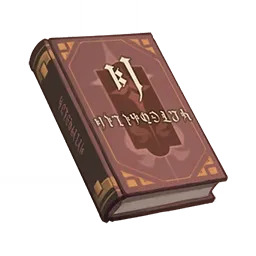
*Hilichurl Ballad Selection* is a 2-volume Book Collection released in Version 1.0. Vol. 1 sits in the library at the Knights of Favonius Headquarters in Mondstadt; Vol. 2 is obtained through a specific dialogue path with Ella Musk, the scholar of Hilichurlian linguistics at the Mondstadt library and a present-day descendant of the Musk Family's academic line. The author is Jacob Musk, an earlier Mondstadt ecologist and an ancestor of the Musk family, whose work earned him the title "Poet Laureate of Hilichurlian," an honorific Vol. 1 notes that "neither the scholar himself nor the hilichurls were particularly fond of," and that Jacob "loathed to be associated with them even in his late years." [1] [2]
How the book was assembled
Vol. 1's standing description states the method: Musk travelled across the continent to visit every hilichurl tribe, "venturing deep into hilichurl settlements" to become "intimately acquainted with their lives." That is what gives the book its reach beyond one region. The published artefact is a Book Collection shelved in Mondstadt, but the ballads it preserves come from all over Teyvat, collected across every tribe Jacob could reach and then annotated from the viewpoint of a single Mondstadt scholar. [1]
The seven songs
Vol. 1 reproduces three songs; Vol. 2 reproduces four. Each is given in transliterated Hilichurlian with Jacob's ethnographic gloss. [1]
# | Vol. | Incipit | Jacob's gloss |
|---|---|---|---|
1 | I | Mi muhe ye / Mi biat ye / Biat ye dada / Muhe dada | Pre-combat battle song; singing it triggers frenzied brawling. Per current Hilichurlian readings, roughly "I triumph over you / I strike you down / Strike you down with glory / Victory with glory." |
2 | I | Eleka mimi-a-Domu / Mita domu-a-dada / La-la-la / Mimi mosi ye mita | Sung while dancing around totem poles; upbeat festival hymn. |
3 | I | Mi muhe mita nye … Gusha / Biat, gusha | Melancholic song heard from an elderly samachurl; literal meaning unclear, but the grief is enough to "captivate the best poets" in Jacob's birthplace. |
4 | II | Celi upa celi / Sada shato lata / Kuzi unu ya zido / Unu dada | A Samachurl song; the chief's reaction implies "special philosophical meaning"; Jacob volunteers the heretical question of whether genuine philosophical discourse exists among hilichurls. |
5 | II | Nini movo muhe yoyo … | Drunken ode of the wind-worshiping tribes; Jacob notes a structural parallel to Mondstadt drinking culture. |
6 | II | Unu, unu / Yaya ika kundala! … | Pious sacrificial ode; percussion is added by beating the backsides of the weakest tribe members with planks, which Jacob notes "must be quite painful." |
7 | II | Mimi movo … Gusha dada | Bonfire ballad; chiefs close moonlit bonfire-exchanges by shouting "nunu" three times, presumably "sleep." |
The transliterated vocabulary (muhe, mita, gusha, dada, unu, celi, mosi, movo) is the same Hilichurlian lexicon recorded on the hilichurls race page, and it underlies Ella Musk's later authored drafts. [6] [7]
Four places the English text drifts
Four places in the English Archive text drift from the original Chinese, all in Jacob's annotations rather than in the Hilichurlian verses: [1]
- Song 1. Chinese: all hilichurls present descend into frenzy after one sings the battle song, spectacle "incomparably intense." English softens this to "two or more."
- Song 5 (a). Chinese: praise to the wind, not the Anemo Archon. The distinction matters, since the sibling Hilichurl Cultural Customs Vol. 2 establishes that hilichurl tribes worship elemental power itself, not Barbatos. The English here collapses that distinction by accident. [8]
- Song 5 (b). Chinese: sung specifically by hilichurl shamans, not by tribe members generally.
- Song 6. Chinese: a sacrificial ode dedicated to the gods, not, as the English reading invites, to the tribe itself.
The Teyvat-language text on the book's cover and spine simply reads "Hilipoetry," a working title rather than an official one. [1]
The three Musk-family books about hilichurls
The Musk family produced three Book Collections about hilichurls, and telling them apart matters for the hilichurls race page: [2]
- Hilichurl Ballad Selection (2-vol, Jacob Musk), this book. The finished body of poetry from across regions: seven songs gathered through fieldwork across Teyvat and annotated with an ethnomusicologist's eye. Verse, not ethnography; collected, not composed.
- Draft Hilichurl Ballads (3-vol, Ella Musk, Jacob's descendant). Original Hilichurlian poetry by a scholar still learning, rewarded one volume per Mondstadt Poetry Exchange Daily Commission. Verse, but authored rather than collected, and marked draft on its title page. Ella works under the shadow of her ancestor's finished Selection. [3]
- Hilichurl Cultural Customs (4-vol, Jacob Musk). Prose ethnography of tribal social structure, elemental worship, the rank of Lawa kings, and the Dadaupa Gorge tribes. Field observation, not verse. [4]
A fourth Musk family source on the Hilichurl language sits outside the Book Collection category: the Handy Handbook of Hilichurlian Quest Item from the Mimi Tomo event line, which works as a vocabulary glossary rather than poetry, ethnography, or original composition. [5]
A Mondstadt book, a continent-wide record
The book is regionally Mondstadt: both volumes are obtained there, and the author is a Mondstadt ecologist. What it records reaches across Teyvat, so it belongs to the hilichurls race page, which spans regions, rather than to any one region. Together with the three related Musk family texts, it forms the set of primary sources behind the race page's reading of Hilichurlian as cultural memory, degraded but recoverable, rather than animal noise. The pathos is real. Jacob travelled the continent for these seven songs and was titled Poet Laureate for them, yet he "loathed to be associated with them even in his late years." [6] [1]