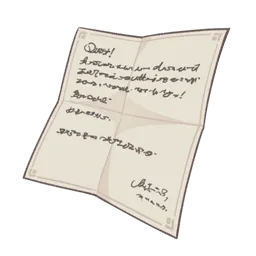
*Draft Hilichurl Ballads* is a 3-volume Mondstadt Book Collection released in Version 1.0. One volume is awarded per successful completion of the Mondstadt Daily Commission *Poetry Exchange*, in which Ella Musk - the scholar of Hilichurlian linguistics resident in the Knights of Favonius Library - sends the Traveler to recite individual draft lines to a tribe of unusually friendly hilichurls so she can validate her own translations from their reaction. [1] [2]
Each volume opens with the same in-universe framing: "A Hilichurlian poem created by Ella Musk. According to her, this [sub-title] is the work of many hands. Still, you can't help but feel that something sounds a bit off when you read it…" The disclaimer is the point. The collection is titled Draft not because the volumes are unfinished outtakes a later edition would polish, but because Ella's command of vernacular Hilichurlian is itself still unfinished, and the book records that honestly. [1]
The three volumes
Vol. | In-universe sub-title | Body text |
|---|---|---|
1 | Recital of Friendship | The only volume the Archive currently displays in full. Body: "Olah! Olah! Yoyo mosi mita! Nye, nye mosi mita, Yeye mosi gusha! Mosi gusha, mosi tiga, Yeye kucha kucha!" |
2 | Stirring Narrative | Currently unavailable in the Archive view. |
3 | Elegant Lyric Poem | Currently unavailable in the Archive view. |
The Vol. 1 fragment is the closest the player gets to seeing what Ella's original Hilichurlian composition actually looks like on the page, distinct from the chants reproduced inside Jacob Musk's finished ballad selection. The recurring tokens are all attested elsewhere in the Hilichurlian vocabulary documented on the Hilichurls race page: olah (greeting), mosi (time-marker), mita (meat, or liked things), gusha (vegetables, or disliked things), nye (no). That is why Ella was confident enough to publish them, and why she still needed the Traveler to field-test how a tribe reacted. [6]
Poetry Exchange - the field-validation frame
The Daily Commission frames the volumes' production conditions. Ella tells the Traveler that her spoken Hilichurlian has improved "by leaps and bounds" since the earlier Language Exchange commission, but that her written Hilichurlian still needs work - she has marked the lines whose meaning she is "not quite sure of," and is "sure I can't be too far off." The Traveler is then asked to recite the queried lines to a friendly tribe: three "good lines" (Celi dada, mimi nunu!, Ye dada!, Muhe ye!) earn the Yo dala? achievement, while two "bad lines" (Ya yika!, Nini zido!) trigger a hostile hilichurl spawn. After validation Ella concedes that "more or less" is still a far cry from "completely," and that there are other verses she still cannot translate into Common "even though I wrote them" - and pointedly spares the Traveler those. The drafts published in the Archive are therefore the safest subset of a larger unfinished body of work. [2]
Not the finished Musk-family Hilichurl books
The Hilichurlian-source corpus is small enough that the volumes are easy to confuse. Three other Hilichurl-language source works sit alongside it in the in-game Book master index: [5]
- *Hilichurl Ballad Selection (2-vol) - the finished, mature counterpart, composed by Jacob Musk, an earlier Mondstadt ecologist who "travelled across the continent to visit every hilichurl tribe" and was praised as the "Poet Laureate of Hilichurlian" for it. Reproduces seven well-known Hilichurl chants (Mi muhe ye, *Eleka mimi-a-Domu, the bonfire ballad, the sacrificial ode) each with Jacob's ethnographic annotation. Draft Hilichurl Ballads is Ella's own draft verse; Jacob's Selection is the collected-and-annotated foil. [3]
- *Hilichurl Cultural Customs (4-vol) - Jacob Musk's prose ethnography of tribal social structure, shamans, sacrifice, elemental worship, and the Eclipse Tribe symbol. *Draft Hilichurl Ballads is composed verse, not field observation.
- *Handy Handbook of Hilichurlian (Quest Item) - the Mimi Tomo vocabulary handbook attributed to the Musk family lineage; canon's closest thing to a Hilichurlian dictionary. *Draft Hilichurl Ballads presupposes the vocabulary that handbook documents.
The collection is also not authored by Jacob Musk. Ella's authorship is explicit on every volume. Jacob is her ancestor in the Musk family of Hilichurlian scholarship, not her co-author. [4]
A document that admits it's unfinished
The Draft Hilichurl Ballads sit in an unusual spot. They are one of the only published in-universe artefacts where a Teyvat scholar admits, on the title page, that the document is provisional. Most other ethnographic works in the corpus present themselves as authoritative, including Jacob Musk's two Hilichurl books and the Handy Handbook of Hilichurlian. Ella's drafts refuse that posture, and Poetry Exchange acts the refusal out: the player carries the manuscript into the field, recites it, and brings back the reaction. That confessional posture feeds the wider reading of Hilichurlian as a degraded but partly recoverable cultural memory rather than animal noise. The language is structured enough to be tested. [6]
A Mondstadt book about a pan-Teyvat language
By region this is a Mondstadt book. The commission, the author, and the publishing setting are all Mondstadt-anchored, and it does not unlock outside the Mondstadt daily-commission pool. [7] The language it draws on, though, is pan-Teyvat: vernacular Hilichurlian as tribes actually speak it. That is why the source it leans on is the Hilichurls race page rather than any one region.
One caveat survives from Ella's own character notes. Her casual greetings to the Traveler, which she glosses as cordial pleasantries, almost certainly do not mean what she thinks they mean; community decoding reads them as insults. [4] The drafts in this collection are the lines she field-tested. The rest, by her own admission, sits in the same uncertain state the title page warned about.