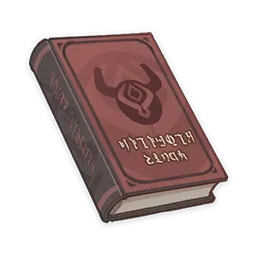
Hilichurl Cultural Customs is a 4-volume Book Collection released in Version 1.0 and located in the Knights of Favonius Headquarters in Mondstadt. Each volume opens with the same standing description identifying the author as Jacob Musk, "Poet Laureate of Hilichurlian" and a Mondstadt ecologist. He is a known member of the Musk Family, the line of Mondstadt academics that has studied Hilichurlian linguistics for at least 400 years. [1] [2]
The book is the single in-universe ethnography of the hilichurls, and the key primary text behind the race page's reading of tribal layers, mask iconography, elemental worship, and inter-tribal cultural diversity. [3]
Vol. 1 - Hilichurlian social structure
Vol. 1 frames hilichurl tribes as "primitive, tribal" units organised as extended family. The Shaman is the oldest member and a parent-like policy-maker, identifiable by a horned smiling-face mask, a rudimentary staff, and an unintelligible chanted hymn. Age, however, is not the only deciding factor: in some tribes the shaman is ousted by a physically larger hilichurl with superior combat skills, producing more aggressive groups led by chiefs of "large stature and ostentatious masks." Resource distribution, per Knights of Favonius patrol reports, is "to each according to his needs," and tribe members are simultaneously gatherers and soldiers. [1]
The volume closes on a question the book deliberately leaves open: hilichurls manipulate elements despite their low intelligence and primitive social structure, and the Shaman's elemental ability is the most striking case. Humans typically require a Vision; how hilichurls bypass that requirement, Vol. 1 says explicitly, "requires further investigation and analysis." The book never answers it.
Vol. 2 - Spirituality and the ruins-affinity
Vol. 2 sets out the claim that hilichurls worship elemental power itself rather than the Anemo Archon. Mondstadt tribes may revere Anemo as their human counterparts do, but they do not recognise Barbatos; they worship the abstract power of Anemo itself, and different elemental beliefs can coexist within one tribe. [1] Shamans dye hair and skin to mark their element, lead song and dance in worship, and place raw meat from the hunt on altars as sacrifice. Even though tribes accumulate Mora and precious stones, raw meat alone is considered sufficient.
The volume also records two important silences. Hilichurls "possess no concept of either the past or future, living only in the present"; they do not commemorate the dead, and their crude attempts at calligraphy are "nothing more than botched imitations of what they have seen in ancient ruins." Yet they have an "inexplicable affinity" for ruins as preferred camp sites, and the book flatly admits that investigations "have turned up nothing which might hint at the true nature of their connection with the lost civilizations to which these ruins belong." The book itself does not name Khaenri'ah; that connection is canon from the Chasm and Caribert, not from Jacob Musk. [4]
Vol. 3 - The Lawa
Vol. 3 introduces a "mysterious, large" kind of hilichurl that combines immense physical strength with elemental control used to further enhance its own body. Smaller tribe members call them "Lawa," best translated "king" or "chief." But the volume's central caveat is also its most-cited line on the race page: Lawa do not actually rule over or lead the tribe at all. They prefer solitude and avoid the reverence of smaller hilichurls, and even seasoned adventurers think twice before entering areas where Lawa may roam. [1] This is the primary text behind the hilichurls race page's gloss of lawachurl / "Lawa" as a title.
Vol. 4 - Dadaupa Gorge: a case for cultural diversity
Vol. 4 is a comparative ethnography, local to Mondstadt, of three named tribes in Dadaupa Gorge: [1]
- Meaty Tribe: focused on feasting and combat; a boar pen with an assigned swineherd, a communal boar-stew pot cooked over a natural Pyro Slime stove, and a sizable combat arena where any hilichurl ousted from it is mocked by the entire tribe.
- Sleeper Tribe: focused on sleep; simple wooden huts furnished with soft animal hide; the most "cunning and devious" of the Mondstadt tribes, with above-average mental capacity the book attributes to superior sleep quality.
- Eclipse Tribe: the most occult of the Mondstadt tribes; instead of an element they worship "a crude symbol that appears to represent an eclipsed sun," and their shamans are more powerful than peers, with a grand throne at the centre of the settlement for the most formidable shaman who leads them.
What it settles about hilichurl society
Two readings make the book matter for the hilichurls race page. First, it documents that hilichurl society is degraded but not empty: tribes, ritual, sacrifice, language, shamanic hierarchy, kingship titles, and inter-tribal diversity all survive the curse. That record is what the race page leans on when it argues that hilichurls are a wounded people rather than a goblin species. Second, it keeps the Eclipse Tribe / Eclipse Dynasty link at the level of theory. The eclipsed-sun symbol is recorded in the book without explanation, and the Khaenri'ah connection comes only from the Traveler's "About the Eclipse Tribe" voice-over line, not from Jacob Musk. [3]
Symptoms, not causes
It is not, in itself, testimony about Khaenri'ah. The origin of hilichurls in the curse of wilderness is canon from the Chasm (Requiem of the Echoing Depths) and Caribert (AQ III Act VI), not from this book. Jacob Musk records symptoms (the affinity for ruins, no past or future, the bypassing of Visions, the eclipsed-sun symbol) without naming the cause. [4]
Nor is it an authoritative ethnological treatise. It is a single Mondstadt scholar's compilation with explicit in-book caveats: language barriers, doubtful ornament-provenance ("highly doubtful that any of the fine ornaments worn are crafted by their own hand"), and the unsolved question of how they bypass Visions. The book frames itself as preliminary observation, not closed scholarship.
It is not the Hilichurlian-language source either. That role belongs to the sibling text by the Musk family, Handy Handbook of Hilichurlian, which catalogues vocabulary and pragmatics; Jacob Musk's book is field ethnography, not glossary. [5]
And it is not scripture. The cover and spine simply read "Hilifolk Study" in the Teyvat language, a scholar's working title rather than a sacred or official designation.