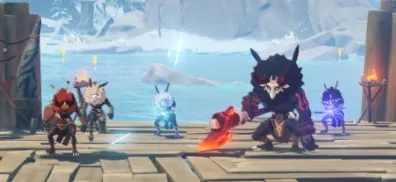
Hilichurls are a cursed humanoid race found across Teyvat. In the game they are one of the first monster families the player meets. In the lore they are the clearest visible result of the curse of the wilderness, which transformed many Khaenri'ahn and Khaenri'ah-associated humans after the Cataclysm. [1]
They are a people produced by curse and degradation, not a list of enemy types. The human side is on the Humans page, the civilization whose fall produced the best-documented group on the Khaenri'ah page, and the event and curse mechanics on The Cataclysm page. [9] [10] [11]
Origin: the curse of the wilderness
The game distinguishes two main curses on Khaenri'ahns after the Cataclysm:
Group | Curse | Result |
|---|---|---|
Pure-blooded Khaenri'ahns | Curse of immortality | They were made immortal. Dainsleif, Pierro, Chlothar Alberich, and other long-lived survivors are documented cases; the curse statement does not define one universal physical form. |
People whose ancestry belonged to the domains of other gods | Curse of the wilderness | They were transformed into monsters. Caribert is the direct named case who became a hilichurl; primary text does not map every other monster class to this group. |
The Cataclysm sequence ran like this: those whose ancestry belonged to the domains of other gods were punished with the curse of the wilderness as they fled, turning them into monsters. Eide then identifies Caribert as the hilichurl before him. That scene does not say the majority became hilichurls or assign Abyss Mages, Heralds, Lectors, Shadowy Husks, and Black Serpents to the same group. [7] [10]
The same core reading holds for the documented Khaenri'ahn group. The curse of the wilderness transforms people into monsters and grants unnaturally prolonged life. Dainsleif confirms that the hilichurls encountered in the Chasm are former citizens of Khaenri'ah, and Eide explains the ancestry distinction before identifying Caribert as a hilichurl. These cases do not erase the pre-Cataclysm hilichurls or settle the origin share of the race as a whole. [1] [7]
Two caveats matter:
- Khaenri'ah is the best-documented origin, not necessarily the only one. Hilichurls have been known for over a thousand years, so some predate the Cataclysm 500 years ago. The game itself keeps the uncertainty: older hilichurls may descend from other destroyed civilizations. The Frostarm Lawachurl Ukko on Dragonspine and textual echoes like Gurabad's keep this reading open. [1]
- The curse runs deeper than appearance. It strips language, memory, face-recognition, and normal mortality. Hilichurls are not humans wearing monster bodies; they are humans forcibly degraded into a new cursed form.
What the curse leaves behind
Hilichurls are degraded, but not empty.
Memories of former life gradually fade, intelligence and behavior degrade, and hilichurls can no longer speak or understand the common language of Teyvat. Yet the game shows several traces of their humanity: rudimentary self-awareness, emotion, social networks, architecture, tool use, agriculture-adjacent behavior, worship, and language fragments. [1]
The most important residue is the mask. Hilichurls wear masks to avoid seeing their own faces, which causes mental anguish. Dainsleif's Chasm explanation gives the core image: they hide their appearance lest they catch sight of their reflection in water, since compared to how they remember themselves it is a terrible sight that causes great despair. [8]
So the curse did not fully erase the human self-image. Hilichurls still retain enough memory of their former faces to experience their current bodies as wrong.
The Chasm pilgrimage: wanting to die
The Chasm material of Requiem of the Echoing Depths is the clearest on-screen case of hilichurls acting in response to the curse itself rather than to ordinary survival. [8]
Hilichurls are unable to die naturally because of the curse's unnaturally prolonged life. As they age, their bodies and minds erode toward a deathlike state without release. In the Chasm, some hilichurls instinctively gather where the curse's effects weaken, ignoring food and defense, seeking only to waste away with some comfort. [1]
This is the behavior of a cursed remnant, not ordinary migration. A people whose bodies cannot finish dying have learned, at least instinctively, where the pain becomes bearable.
Dragonspine and the voices on the wind
In Chapter VII Act VI (Version 7.2), hilichurls build fortifications near Dragonspine, and Paimon notices that they all face the mountain, where the Skyfrost Nail stands, rather than Mondstadt City. Venti hears voices on the wind that "likely belonged to the people of Sal Vindagnyr," leaking out of the Ley Lines because the Nail's power "is attempting to reset the world." He thinks the hilichurls are answering those voices even though they "have no connection to that civilization." When the Traveler asks, "Because of... Khaenri'ah?", Venti agrees: "Exactly. It was a different era, a different civilization, but the fact remains... They were once human, too." Their wits "are only a fraction of what they once were," he adds, and "they probably thought the cataclysm was coming all over again." [14] [15]
This is Venti's reading of one group, and he offers it as a guess; it says nothing about hilichurls elsewhere. He also turns it back on his own people: "We call them 'monsters,' but as our own day of judgement approaches, are we not exactly in the position they once were?" [14]
Tribal society
Hilichurl society is degraded but recognizably social. Hilichurl Cultural Customs gives the best in-game ethnographic source. [5]
Layer | Role |
|---|---|
Ordinary hilichurls | Gatherers, fighters, builders, scavengers, camp members. They share resources roughly by need and function as both civilians and soldiers. |
Samachurls | Shamans, elders, spiritual leaders, and often parent-like policy-makers for the tribe. They organize offerings, worship ceremonies, and elemental rites. |
Mitachurls | Larger martial adults / heavyweights. In tribes where strength overrides age, mitachurls can displace shamans and lead more aggressive groups. |
Lawachurls | Elementally saturated loners with the rank of "Lawa" or chieftain. Younger hilichurls revere them as kings or chiefs, though lawachurls usually prefer solitude. |
Hilichurl rogues | Unusually intelligent wanderers outside ordinary tribal life. They may temporarily help tribes, then leave. |
Three named Mondstadt tribes in Dadaupa Gorge show the range:
- The Sleeper Tribe is sleep-focused and cunning, with soft animal-skin beds and above-average mental capacity by hilichurl standards.
- The Meaty Tribe is feast- and sacrifice-focused, with a boar pen, a massive cooking pot, a combat arena, and a strength culture.
- The Eclipse Tribe is occult; all members know how to draw an eclipsed-sun symbol, and Dada Samachurls may know the reason. The Traveler voice-over suggests a possible connection to Khaenri'ah's Eclipse Dynasty, but the game leaves it as theory. [5]
Language: Hilichurlian as degraded cultural memory
Hilichurls speak Hilichurlian, and it is not mere noise. The Handy Handbook of Hilichurlian records basic vocabulary, pragmatics, time phrases, colors, food categories, and attitude-dependent directional logic. [6]
Examples:
Hilichurlian | Gloss |
|---|---|
Da / Dada | Good / very good / casual affirmation / very |
Mita | Meat, delicious food, liked items |
Gusha | Vegetables, grasses, fruits; disliked things; can express unhappiness |
Unu | One; also a holy word tied to gods and the origin of life |
Boya | Color-marker suffix |
Celi | Hot, fire, sometimes sun |
Aba mosi dada | From waking until lunch |
Unta mosi dada | From lunch until just before sunset |
Mosi aba nunu | After sunset until late night |
Unta nunu | Late night |
The language preserves two things at once. It is degraded enough that most humans dismiss communication as impossible; it is structured enough that Jacob Musk and Ella Musk can compile field glossaries, and Abyss Mages can speak it fluently. [1] [6]
Samachurls preserve the language most visibly through chanting. No official transcription exists for samachurl chants, but unofficial transcriptions indicate at least some chanted words are Hilichurlian. [2]
Religion and elemental power
Hilichurls worship elemental power itself, not the Archons. Hilichurl Cultural Customs is explicit: Mondstadt tribes may revere Anemo much as Mondstadt humans do, but they do not recognize Barbatos as Anemo Archon and worship the power of Anemo itself. Different elemental beliefs can coexist within one tribe. [5]
This has two implications. They retain religious behavior despite the curse, with offerings, dance, sacrifice, altars, hymns, and shamans. And their elemental relationship bypasses the human Vision system: where humans usually need Visions or science to manipulate elements, hilichurls (especially samachurls and lawachurls) can do so naturally or through elemental accumulation. The mechanism is unknown, and the game keeps it distinct from the system that distributes Visions. [1] [2]
Hilichurls also avoid areas of high elemental concentration because those places burden their bodies. The race can interact with elemental power, but it is not free of elemental strain.
Growth path: hilichurl, mitachurl, lawachurl
The game presents mitachurls and lawachurls as stages of development or mutation within the hilichurl race, not separate origins. [3] [4]
Form | Mechanism |
|---|---|
Hilichurl | Ordinary cursed form; can become shooters, guards, grenadiers, or remain basic tribe members. |
Mitachurl | A hilichurl that has grown and survived, becoming larger and stronger. Combat and eating meat are culturally central; young hilichurls dream of becoming mitachurls. |
Lawachurl | A mitachurl mutated by accumulating excess elemental energy in its environment. It rises to a chieftain's rank, enters elemental shield states, and is revered as "Lawa" (king or chief), though often solitary. |
The growth path makes hilichurl society partly developmental and partly environmental. Strength, age, elemental exposure, and local ecology all shape status.
Partial reversals: Caribert and Caterpillar
The game has shown two cases where the curse can be altered without simply being cured.
Caribert
In Caribert, Chlothar Alberich's son was a cursed Khaenri'ahn transformed into hilichurl form. After exposure to Abyssal power from the statue associated with Vedrfolnir, Caribert briefly regained speech and personhood. [7]
This is a partial reversal or reactivation rather than a normal cure. A cursed child can temporarily regain enough human-like cognition and speech to communicate, but the underlying curse remains bound to Abyssal intervention. The case is one of the emotional foundations of the Abyss Order's origin.
Caterpillar
A Fontaine case runs differently: Narzissenkreuz gave an Anemo Hilichurl Rogue sentience, granting him a human form and the ability to speak and understand human language, and named him Caterpillar. [1] [13]
This case is separate from Caribert. Caribert's partial reversal came through an Abyss statue and his Khaenri'ahn lineage; Caterpillar's came through a Narzissenkreuz experiment in Fontaine. Together they show that hilichurl cognition is not lost for good in principle, though the game does not turn either case into a reliable cure.
Relationship to the Abyss Order
Many hilichurls are affiliated with the Abyss Order because Abyss Mages can speak fluent Hilichurlian and command or manipulate tribes. Outside the Order, the Abyss can still control hilichurls directly, as seen during the Abyssal invasion of Natlan. [1]
This does not mean all hilichurls are Abyss Order members. The safest reading is that some hilichurls are Abyss Order assets, some are Abyss-controlled populations without any membership, some are independent tribes living as cursed remnants, and some are older pre-Cataclysm or non-Khaenri'ahn groups whose relationship to the Order is undefined.
The Abyss Order, Khaenri'ah's successor founded by Chlothar Alberich and later led by the Traveler's Sibling, is covered on its own page.
What we know
- Most story-central hilichurls are cursed humans, especially the post-Cataclysm Khaenri'ahn group documented in the Chasm and Caribert. [1] [7]
- The curse of wilderness transforms bodies, memory, language, and mortality, producing a monster form with unnaturally prolonged life. [11]
- Masks preserve self-recognition trauma: hilichurls hide their faces because seeing their reflection causes despair next to their remembered human appearance. [8]
- Hilichurls retain culture: tribes, shamans, offerings, elemental worship, language, architecture, tool use, and social hierarchy. [5]
- Samachurls are the shamans and elders, and mitachurls and lawachurls are growth or mutation states within the race. [2] [3] [4]
- Partial reversal is possible but rare and not a general cure; Caribert and Caterpillar are the two clearest cases. [7] [1]
What we don't know
- Who the pre-Cataclysm hilichurls were. The game says hilichurls existed before the Cataclysm, but their older origin groups are not fully identified.
- Whether all non-Khaenri'ahn hilichurls came from other destroyed civilizations. Dragonspine's Ukko and descriptions like Gurabad's suggest it, but the game does not settle it.
- Whether the curse of wilderness can be reversed at scale. Caribert and Caterpillar show partial individual reversals, not a general cure.
- How samachurls manipulate elemental power without Visions. The game marks the question as needing further investigation.
- What exactly the Eclipse Tribe remembers. The eclipsed-sun symbol may be a degraded memory of the Eclipse Dynasty, but the game leaves it as theory.
Put plainly, hilichurls are not just goblins. The documented Khaenri'ahn cases show what remains when people are cursed into monster bodies, made functionally immortal, stripped of most memory and language, and left to rebuild a rough tribal life out of the fragments. The tragedy is that enough of the old self survives for the curse to hurt; the older groups from outside Khaenri'ah remain only partly explained.