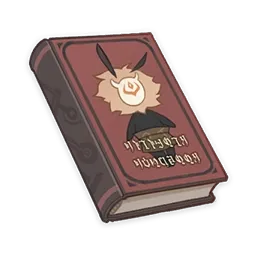
Handy Handbook of Hilichurlian is a Quest Item obtained during the Version 1.5 Event World Quest Mimi Tomo. After the Traveler rescues Ella Musk, the Mondstadt-library scholar of Hilichurlian linguistics, from a group of hostile hilichurls, she hands over the handbook so they can talk with chatty hilichurls and gather clues on the whereabouts of the Unusual Hilichurl. It is not a Book Collection volume: the in-game Book master index files it as a non-Codex item, entirely outside the three related Hilichurl volumes the Musk family wrote for the Book Collection. [1] [2] [3]
The dedication - a Musk-family inheritance
The handbook opens with a dedication that identifies its author as a previous Ella Musk addressing the present-day one: [1]
Dedicated to my heir and granddaughter, Ella. In our family's history, she will most likely be the most eccentric but cutest Ella Musk. >This handy handbook can only offer some basic assistance … (this book is for reference only and cannot be held responsible for any consequences of its use). If you wish to learn Hilichurlian, please use a standard textbook such as my next introductory book.
A trivia note reconciles this with the in-game item description, which credits "the folklorist Ella Musk": the Musk Family has a "long tradition that a prominent member inherits the name El (male) or Ella (female)." Both author and recipient are Ella Musk; the handbook is an heirloom passing Hilichurlian scholarship from grandmother to the present-day Ella of the Knights of Favonius library. The "for reference only" disclaimer and the unattested sequel ("my next introductory book") frame the volume as preliminary. [4]
Greetings, manners, and feelings
The first section lists the basic words of conversation: [1]
- *Da / *Dada*: "good / very good"; also a casual affirmation and an intensifier ("very, completely, most"). *Dada upa means "very tall / large mountain."
- *Ika ya* / *Ika yaya* / *Ya ika*: "bad person / bad people!" Author's field advice: "If you hear hilichurls shout these words and you are confident in yourself, give them a wallop. Otherwise, run."
- *Muhe*: "like, want." Wry gloss: "You will not generally hear hilichurls say that they like you, so translating this as 'want' is sufficient."
Useful phrases - the food / object / color core
The second section is the longest, and is the section the Mimi Tomo event actually drives players to consult: [1]
- *Gusha: vegetables, grasses, fruits; *disliked things. Mosi gusha expresses unhappiness; tone disambiguates a hungry hilichurl wanting fruit/rice/wheat from simple dissatisfaction.
- *Mita: meat, delicious foods; *liked things. Mita movo lata ("meat in the water") is the Day-1 Mimi Tomo gloss for fish.
- *Upano*: a noun affix for upward direction, height, or flight (insects, birds, clouds, patrolling knights, "a small companion sent flying by a larger hilichurl").
- *Celi: hot, fire; occasionally "sun." The idiom *Celi lata* refers specifically to things that emit *light without heat (fireflies, stars, the moon); Celi lata gusha is therefore Small Lamp Grass.
- *Kucha gusha / *Unu gusha*: *seed. The synonyms are telling: Kucha means "small" with a "slightly contemptuous connotation," while Unu is the holy numeric one.
- *Boya: color affix. Per the author's field tests: *Celi boya red, Gusha boya green, Lata boya blue, Nini boya white, Nunu / Sama boya black, Unu boya yellow. That makes a seven-color system built on the same elemental and numeric stems used elsewhere. (And *Sada: solid, hard; *Upa sada = "prepared.")
Numerals - the sacred Unu
The numeric system is given as an aside inside the Kucha gusha / Unu gusha entry, but it carries real weight. Unu (1) is "a holy word that embodies the hilichurls' concept of gods and the origin of life"; then Du (2), Unu du (3), Dudu (4); and Mani (5) "also means 'hands' or 'physical labor.'" The sequence is about the origin of gods, not arithmetic. One is tied to godhood and the origin of life; five folds counting into the body's vocabulary of hands and labor. That is why the plain word for seed, Unu gusha, joins the sacred one to the word for fruit, a construction the curse has not erased. [1]
Time and directions
The third section divides the day into four set phrases and then deliberately omits absolute directions: [1]
- *Aba mosi dada*: from waking until lunch.
- *Unta mosi dada*: "the wonderful time from lunch till just before sunset."
- *Mosi aba nunu*: from after sunset until late night.
- *Unta nunu*: late night.
For directions, the author records the stock query "Du ya zido dala?" ("Where did this thing go?") and deliberately omits direction-words: hilichurls have no absolute directions, and the frame of reference in any directional answer depends on how they feel about you. If they like you, they speak from your point of view; if not, from their own. That is solid evidence for hilichurl social cognition. Directional phrasing encodes an in-group / out-group judgment, so hilichurl speech still carries a social attitude the curse left intact. [1]
What the handbook is good for
The handbook is the primary in-game vocabulary source behind the hilichurl race page's reading that Hilichurlian "is not mere noise." It catalogues a structured vocabulary, degraded but testable: numerals, colors, food categories, phrases for times of day, and directions that shift with the speaker's attitude. That structure is what lets the race page argue the curse of the wilderness scrubbed memory and morphology without quite scrubbing semantics. [5]
The four Musk-family Hilichurl texts
The Musk family has produced four hilichurl-language works. The distinction among them matters, because three are Book Collection volumes and this one is not: [4]
- This handbook: Handy Handbook of Hilichurlian (Quest Item, from the previous Ella Musk to the present-day one). Vocabulary glossary for fieldwork. Outside the Book Collection: a Mimi Tomo event Quest Item, not a shelved Book Collection volume.
- Hilichurl Cultural Customs (4-vol Book Collection, Jacob Musk). Prose ethnography of tribal social structure, shamans, sacrifice, the worship of elemental power itself, the Lawa as the rank of kings, and the Dadaupa Gorge tribes. Field observation, not glossary. [6]
- Hilichurl Ballad Selection (2-vol Book Collection, Jacob Musk). Seven Hilichurlian songs collected by pan-Teyvat fieldwork, each ethnomusicologically annotated. Collected verse, not glossary. [7]
- Draft Hilichurl Ballads (3-vol Book Collection, present-day Ella Musk). Original poetry by the same Ella who gives the player this handbook; rewarded one volume per Mondstadt Poetry Exchange Daily Commission. Authored draft verse, not glossary. [8]
The limits of the handbook
It is not a Book Collection volume; both the in-game catalogue and Honey Hunter file it as a Quest Item ("Non-Codex Series, Non-Codex Lore Item"). [1] Nor is it Khaenri'ahn testimony. The origin in the curse of the wilderness comes into canon from the Chasm (Requiem of the Echoing Depths) and Caribert (AQ III Act VI), not from this handbook, which records what hilichurl speech is rather than why hilichurls speak it. [5] And it is not divine canon: the cover in the Teyvat Language reads simply "Hilifolk Handbook," a working title, and the French localization misspells the granddaughter's name as "Eula Musk." [1]
A Mondstadt heirloom in pan-Teyvat use
By authorship the handbook belongs to Mondstadt, a Musk family heirloom kept by the present-day Ella in the Knights of Favonius Library. By use it belongs to all of Teyvat: Mimi Tomo sends the player to talkative hilichurls in any region, and the vocabulary it lists is the Hilichurlian attested across Teyvat. [9] Its preface, from grandmother to granddaughter, is canon's clearest statement that the family treats Hilichurlian scholarship as a generational project, still preliminary and pointing toward a textbook nobody has written yet.