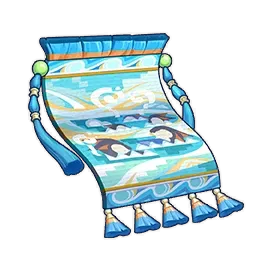
Maawe and Monetoo is a three-volume Natlan Book Collection released in Version 5.0, the founding patch of the Natlan region, alongside the Records of Hanan Pacha, The Tale of Qoyllor and Ukuku, and The Volcano Lord and the Shadow Pins. The volumes are free in-world pickups. Vols. 1 and 3 sit in the People of the Springs settlement along the shores of the Toyac Springs; Vol. 2 waits in the Stadium of the Sacred Flame. Collecting all three earns the "Advent of the Hot Springs" achievement (Mortal Travails: Series V). Each volume opens with the same standing description: "A woven scroll from the People of the Springs telling of how Maawe the Saurian whelp created the hot spring. Different paragraphs of this seem to have been penned by poets of different eras." The book says as much itself, then. It is layered Meztli folk-poetry, set down across many eras. [1] [2]
The three volumes
Vol. 1 - the dragon-whelp who loved Monetoo songs. The frame opens in a time "long past, [when] proud dragons roamed freely across the expanses of Natlan," before humans had formed their tribes, when "dragons were both larger and haughtier than the Saurians of the present day," and "just as humans do now, the dragons had different tribes of their own, each ruled by ancient matriarchs." Hot springs and clear gemstone-bright lakes do not yet exist. Among these proud dragons there was "a young one that was not like the others": Maawe, "which in an ancient, long-forgotten language, meant 'bit of string,'" who "was fascinated by the songs of the Monetoo, and in secret was even given to observing human behavior." Where other dragons cultivated "overweening dignity" and pride forged "through these very fires of tribulation," Maawe preferred "cool moonlit nights and the warm shadows of red cliffs." The dragon matriarch's verdict, "Such blatant indolence! How can this be tolerated in the Dragonlord's Palace? The puerile whelp must rediscover the ambition and fury of its noble heritage", exiles Maawe with the demand to "harden its heart, to become as tenaciously proud as obsidian, and to be guided alone by cruel, lofty ambition." [1]
Vol. 2 - the four-cardinal journey for fury. Maawe and its Monetoo companion set out together. Eastward to "high mountains shrouded in sulfurous clouds" and "the canyons... the pitch-black mines," where Maawe finds its kin "long since accustomed themselves to the still and silence" and "reduced to being creatures that lurked among the mountain rocks." Westward to "the long-dead forest of mirk and gloom" and a "grand palace woven from countless branches," where the kin are "creatures that silently stalked the forest depths" - found chasing Forest Boars. Southward to "the brown prairies where rivers had dried up," where the kin "had fallen into distant dreams among the fog" and invite Maawe to "stay in our dreamland, and join us in dreaming of a wonderful tomorrow." The fantasy "shone forth, lit up by the miraculous luster", but Maawe wakes to the Monetoo's song and leaves. Northward, "past the lavaflow delta, across the silent, blistering wilderness, past the land where burning spirits danced, through the gate of stern black stone," Maawe finally stands before the "wise dragon, sat high upon its throne." The wise dragon marvels at the youngling's audacity and gently refuses: "A heart so artless, yet so audacious, You come before me seeking what I too cannot obtain. Leave this place. You shall not find the fury you seek here." The obsidian gate closes. [1]
Vol. 3 - the sulfur pool, the first hot spring, the first Koholasaur. Descending the mountain, the Monetoo ("having accompanied Maawe all this way") begins "to lose its light and warmth, being far from phlogiston-rich lands as it was. It turned as pale as ash, and its song grew distant and faint." The wise dragon's gate stays shut. Maawe hears the dying spirit's wish ("Scatter me in a pool of sulfur, bury me in the icy depths") and acts on it, even though "Monetoo are unable to speak, but Maawe did not know this." Maawe arrives at "a hot spring full of sulfurous pools. Uninhabitable for living beings, it was a place where even getting close might result in being burned by toxic gases and scorched by boiling acid." But "miraculously, as Maawe scattered its companion's form into the sulfur, the boiling acid transformed into a clear spring before its very eyes. It was from this spring that the first poets of our tribe were born. As we Meztli say, 'Poets and bards are born of sulfur - for their words are scalding indeed.'" Maawe makes the hot spring its home: "Its four limbs transformed into beautifully streamlined fins, its thin body became round, and thus it became the first of the Koholasaurs." And ("of course, Maawe did not forget its companion") Maawe transmits "all of the songs it had heard and learned to the humans born from the springs. That's right - to our ancestors. And to this day, the songs that we Meztli continue to pass down are echoes from that ancient era." [1]
What the book explains
Maawe and Monetoo is the primary text for three Meztli origin-stories that turn up elsewhere only as brief reference.
First, the origin of Natlan's first hot spring. Vol. 3's closing line, "So did the young Maawe create Natlan's first hot spring," is the Meztli account of how the Toyac Springs began. The book frames the act as a transformation, not a discovery. The sulfurous pool was "uninhabitable for living beings" until Monetoo's scattered form turned "boiling acid" into a "clear spring" in a single mythic moment. That the People of the Springs today "live alongside the Koholasaurus and like to bathe in the hot springs with them" follows straight from this founding story. [4]
Second, Maawe as the first Koholasaur. Vol. 3's transformation passage, "Its four limbs transformed into beautifully streamlined fins, its thin body became round, and thus it became the first of the Koholasaurs," is the Meztli account of how the Koholasaur line bonded to the People of the Springs began. It runs alongside, not against, a second legend the Saurians page keeps: "the largest ancient sea dragon could be mistaken for an island when floating on the surface; Koholasaurs are said to be the descendants of that great sea dragon." Both legends sit together under the Saurians page's "Per legend" heading, and this book carries only the Meztli half. The Hydro affinity, fin shape, and Liquid-Phlogiston swimming the Saurians page records all trace, in folklore, to Maawe's transformation here. [3] [6]
Third, where the Meztli poets come from. Vol. 3's close, "It was from this spring that the first poets of our tribe were born... 'Poets and bards are born of sulfur - for their words are scalding indeed'... Maawe passed on all of the songs it had heard and learned to the humans born from the springs... to this day, the songs that we Meztli continue to pass down are echoes from that ancient era," is the origin-story for the tribe's poetry and music, the People of the Springs who "often come together to go fishing, listen to music, or just relax." The standing description's "Different paragraphs of this seem to have been penned by poets of different eras" fits that self-account. The book is itself a worked example of the very tradition whose birth it narrates. [4]
Folklore, not biography
The book is not a historical record. Its own "poets of different eras" note is the in-text disclaimer, and it could hardly be plainer: these are layered folk-tales, not chronicle. The events, dialogue, and cast are folklore, not biography of the ancient dragon civilisation of Natlantea or of any named figure of a Sovereign's rank.
The dragon matriarch who exiles Maawe and the wise dragon on the obsidian throne are never tied to any named figure. Vol. 1's matriarchs "ruling" the ancient dragon tribes sit at the level the Thirteen Sovereign Lords page describes, the Xiuhcoatl-made intelligences each given a Natlantea territory to rule, but the book keeps only the word "matriarchs" and names no specific Sovereign Lord. The wise dragon on the obsidian throne, "past the lavaflow delta" in the volcanic north tied to the Great Volcano of Tollan, sits at the level of the Sovereigns before the Heavenly Principles, as the Seven Sovereigns page describes it, yet the book offers only "the wise dragon" and never names Xiuhcoatl, Kukulkan, or anyone else. This page makes no such equation either. [7] [8]
The four kinds of devolving dragon-kin Maawe meets, the mine-dwellers in pitch-black caverns, the silent forest-canopy stalkers, and the prairie dreamers, line up thematically with the modern spread of Saurian varieties the Saurians page maps (eastern mine-dwellers ≈ Tepetlisaurus / Children of Echoes; western forest-canopy ≈ Yumkasaurus / Scions of the Canopy; southern volcanic-plain ≈ Tatankasaurus / Collective of Plenty). The book's folklore pre-dates the disruption by the Heavenly Principles' Celestial Nail that the Saurians page names as the real cause of the Pyro Vishaps' devolution. So this page does not equate the four-direction kinfolk with any present-day Saurian variety. The match is folk-tradition about ancient dragon-kin, not a claim about where the modern Saurians came from. [6]
Monetoo is a phlogiston-dependent companion-spirit. Vol. 3 is explicit, "having accompanied Maawe all this way, [the Monetoo] began to lose its light and warmth, being far from phlogiston-rich lands as it was," which ties it to the same phlogiston the V5.0 sibling Records of Hanan Pacha treats as Natlan's native fuel. The book keeps Monetoo phlogiston-dependent but never equates it with any named being. The Spanish "manitú" (manitou) and the Hawaiian Ma'awe = "thread" etymology are cross-cultural naming homages, not in-Teyvat identifications. [9]
The title and the layered tradition
The English title keeps both protagonists: Maawe (Hawaiian for "thread") and Monetoo (the manitou-derived companion-spirit name, localised across editions as manitú / Manitu / манит). The standing description's "different paragraphs of this seem to have been penned by poets of different eras" frames the book as layered tradition rather than single-author chronicle, assembled across generations, its own voice shifting from paragraph to paragraph. None of that layering changes what happens in the story. The dragon-whelp's four-direction journey, the Monetoo's fading far from phlogiston, the sulfur-pool transformation, the first Koholasaur, and the songs handed down to the Meztli ancestors all stay exactly as they are. [1]