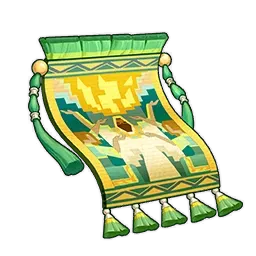
Records of Hanan Pacha is a three-volume Natlan Book Collection released in Version 5.0, the founding patch of the Natlan region, and scattered as free in-world pickups: Vols. 1-2 in the Scions of the Canopy settlement, Vol. 3 in the Stadium of the Sacred Flame. Collecting all three earns the "Chakana's Dangling Bough" achievement (Mortal Travails: Series V). Each volume opens with the same standing description: "A fable, passed down from generation to generation, in which the legendary Sage of the Stolen Flame is the main protagonist. Professional historians, it is said, have analyzed its contents and come to a consensus that this tale has nothing to do with historical fact." The book disclaims itself as folkloric tradition rather than historical or cosmological testimony. [1] [2]
The three volumes
Vol. 1: the theft of phlogiston. The frame opens "in the age when the stars and the moon held the sky, the dragons ruled the land, and Lord of the Night ruled the night realm," before any Pyro Archon had been born or any Vision had descended; humans "wandered the barren lands" and could only be controlled by the elements. In the "red and black lands" lived a vain winged dragon hoarding Pyrophosphorite ("a crystal refined of the primal fire in the depths of the great volcano," iridescent and "shining with dazzling light"), whose radiance bewitched him into proclaiming himself "the sun of this land." The Lord of the Night sent Waxaklahun Ubah Kan, accompanied by the "fool" Chaac, to defeat him; the Sage struck the dragon's eye with a bamboo blowdart, then disguised himself and Chaac as travelling eye-doctors and offered to replace the dragon's eyes, fangs, and claws with bright gems so he would "shine a dozen times more brightly than [he] already do[es]." The vain dragon agreed; the two replaced his eyes, fangs, and claws with grainfruit; the dragon died. "The dragons that ruled the land possessed power far beyond that of humanity, but did not necessarily have more wisdom"; the Sage broke the Pyrophosphorite open, and "thus gained the power of dragons - that which is known as Phlogiston." [1]
Vol. 2: Hanan Pacha raised, the first tribe founded. The Sage and Chaac came to the land of forests and mountains, where human tribes rebuffed the phlogiston gift on the reasoning that flint and firewood suffice. The Sage's prophetic rebuke ("do you not know there will come a day when all plants and firewood are consumed and are no more?... If you can use phlogiston to burn rocks, then you will have solved the problem of obtaining energy once and for all") went unheeded, because "the people then could not yet see their ancestors in the Night Kingdom, and thus they naturally did not think of the future." Chaac suggested making the gift visible by raising a great rock above the mountains. "The land thus raised was none other than Hanan Pacha, the Upper Sanctum of which people today now speak. But unlike today, the Hanan Pacha of those days was still a vast tract of land, whole and complete. It floated above the clouds, and all the humans of Natlan could confirm its existence with a glance." Chaac stood guard at a lake using phlogiston to help the curious ascend; "under the leadership of Waxaklahun Ubah Kan, the people founded the first permanently settled tribe upon Hanan Pacha." [1]
Vol. 3: the alcohol, the expulsion, the scattering. Atop Hanan Pacha the people built a city "of magnificent palaces and temples, all made of rare gems, brilliant feathers, and fragrant flowers," and the Sage decided to raise it "still higher," forbidding the people to eat anything produced on land (only water), "for all the streams of this world flow from the Source of All Waters, and are not subject to the Lord of the Night's control." Chaac could not follow the Sage's reasoning; the Sage spoke only of the "Lunar continent" and "Newark Holy Stone" and other things Chaac could not understand. The people raised fish in the blue expanse and grew ball algae; Hanan Pacha climbed each day. "Finally, the Lord of the Night realized the Sage's intentions" and intervened: disguised as a tribesman, the Lord of the Night gave Chaac "a hundred times sweeter" water than the lake's, which Chaac brought up to Hanan Pacha and shared. "But what Chaac did not know was that this sweet water was actually brewed from the grains grown from the land. In our modern parlance, it was alcohol." When the Sage returned, "everyone was dead drunk." He "expelled them from Hanan Pacha. The scattered people brought phlogiston with them to every corner of Natlan." The Sage set out on "the road home"; an aside from the storyteller notes that the legends "don't actually say just where the Sage's homeland was." The closing line: "after the Sage of the Stolen Flame left, Chaac accepted the guidance of the Lord of the Night, and established permanently settled tribes on the land. The age of the humans of Natlan began, but that is a story for another time." [1]
What the book anchors
Beneath the folklore, Records of Hanan Pacha is the primary text for three Natlan etiologies that surface elsewhere only as compressed reference.
The first is the origin of phlogiston with the Sage of the Stolen Flame. The Cataclysm-era prayer Traore inscribes on the Boundary Marker in Peace to the Slumbering invokes Waxaklahun Ubah Kan as "the madman who stole fire from the throat of the great dragon", a folk formula whose primary-text source is the narrative in this book's Vol. 1: blinding the dragon's eye with a bamboo blowdart, the con of posing as doctors and swapping in grainfruit, and the breaking of the Pyrophosphorite. The formula and the narrative are one myth in two forms. [11]
The second is the origin of the present-day sky-realm, with Hanan Pacha as the Upper Sanctum. Vol. 2 frames the realm in the present tense, as "the Upper Sanctum of which people today now speak," and contrasts its modern fragmented state against the original whole: "But unlike today, the Hanan Pacha of those days was still a vast tract of land, whole and complete." This is the etiology for how the Upper Sanctum reached its present fragmented state: built by the Sage and Chaac through phlogiston-raising, populated by a city of "rare gems, brilliant feathers, and fragrant flowers," then emptied after the Lord of the Night's trick with the alcohol. [1]
The third is the settlement of human tribes in Natlan after the Sage left. Vol. 3's closing line, "Chaac accepted the guidance of the Lord of the Night, and established permanently settled tribes on the land. The age of the humans of Natlan began," is the book's account of how Natlan's federation of six tribes began under the patronage of the Lord of the Night, continuous with the building of the realm, led by Yohualtecuhtin, that the Night Kingdom page records after the Funerary Flame. The book preserves the folkloric form; the realm page preserves the underlying history. [9]
Who the Sage is, by cross-text
The identification across texts, carried in the cutscene of Tonatiuh's memory in Act III of Lost Traveler in the Ashen Realm and in the Kukulkan section of the Thirteen Sovereign Lords page, makes the Sage of the Stolen Flame / Waxaklahun Ubah Kan into Kukulkan: Xiuhcoatl's younger brother, created from an offshoot of the primal flame on the day of Xiuhcoatl's own birth; Regent of Natlantea after the Heavenly Principles defeated the Seven Sovereigns and froze Xiuhcoatl in lava in a false death; a Dragon Prince of pre-Archon Natlantea; father of Och-Kan. Kukulkan is not a Sovereign and not a member of the Thirteen Sovereign Lords; Regent and Sovereign Lord are distinct roles, per the Chamber of Deliberation B-CL-11053 Impeachment Inquiry into Regent Kukulkan record. The book preserves only the "Sage" and "Waxaklahun Ubah Kan" appellations and never names Kukulkan, consistent with its self-framing as a fable handed down through tribal storytellers. Identifying the Sage as Kukulkan rests on confirmation from other texts, not on anything the book itself reveals. [4] [3] [8]
The book's Pyrophosphorite is the substance recovered in the Act III Firestone sub-quest aboard the skyship Tonatiuh in Lost Traveler in the Ashen Realm, the flame-infused variant the Tepetlisaurus Whelp can handle safely thanks to the Flamelord's Blessing he bears. Vol. 1's "crystal refined of the primal fire in the depths of the great volcano" is the primary text for that substance's identity as the phlogiston-source mineral. [5] [10]
The book's own disclaimers
The book is not a historical record. The standing description's "this tale has nothing to do with historical fact" is its strongest in-text disclaimer, and Vols. 1, 2, and 3 all open with that same warning verbatim. The specific events, dialogue, and casts are material from folk tradition, not primary-text claims about the lives of Kukulkan or Yohualtecuhtin or about the cosmological sequence before the Archon War. Its value as primary text is etiological: it shows what later tradition takes the origins of the Sage of the Stolen Flame and of Hanan Pacha to be, rather than biography or history. [1]
The winged dragon from whom the Sage stole the Pyrophosphorite is not Xiuhcoatl, and Vol. 1 says so outright: "In some versions of the story, it is said he was none other than Xiuhcoatl himself, but the gods only know what kind of storyteller would make such a mistake. After all, who could forget that the one who defeated Xiuhcoatl was the very first Pyro Archon, Xbalanque himself." The dragon is "the scion of the great lord of the volcano, Xiuhcoatl", a treasure-hoarding lesser dragon who claimed Xiuhcoatl's reserves when the Sovereign "fell into deep slumber" and proclaimed himself "the lone king." The chronology constrains it: Xiuhcoatl was slain by Xbalanque at the Great Volcano of Tollan in pre-Archon-War inter-dragon fighting, as the Seven Sovereigns page records, so the episode of the Sage and the winged dragon cannot be the same event as Xiuhcoatl's death. [7]
The Lord of the Night acts on both sides of the Sage's mission, but under the book's self-disclaimer these actions are folkloric tradition about the patron-figure, not biographical claims about Yohualtecuhtin. The identification rests on the Night Kingdom page; the in-narrative actions sit at the level of Natlan tribal storytelling, consistent with, but not the same as, the history the realm page records of the Angel who designed it. [9]
The Sage's cryptic Vol. 3 references to the "Lunar continent" and the "Newark Holy Stone" stay unresolved. The Newark Holy Stone references the real-world Newark Holy Stones, fraudulent artifacts allegedly discovered by David Wyrick near Newark, Ohio in 1860, and the reference is "likely a nod to the fictitious nature of this book collection." That nod is authorial framing for the book's fictional nature; the "Lunar continent" is not glossed elsewhere, and this page does not equate it with any named cosmological figure. [1]
Why the title is Quechua
The English title uses the Quechua proper name Hanan Pacha (in Andean cosmology, the "Upper World" or celestial realm) as the in-universe Natlan name for the floating sky-realm the Sage and Chaac raised. Vol. 2 equates Hanan Pacha in-text with "the Upper Sanctum of which people today now speak," fixing the Quechua name at the in-universe level. The naming fits Natlan's broader South-American worldbuilding: Xiuhcoatl carries a Nahuatl name, Xbalanque a K'iche' Maya name, and Sundjatta a Manding-Mali name. The in-Teyvat events (the theft of phlogiston, the raising of Hanan Pacha as the Upper Sanctum, and the settlement of the tribes under the Lord of the Night's guidance after the Sage left) are unchanged by the linguistic homage. [1]