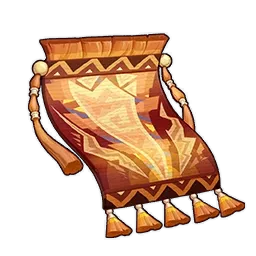
The Volcano Lord and the Shadow Pins is a single-volume Natlan Book Collection released in Version 5.0 and obtained in the Children of the Echoes tribal area of the Tequemecan Valley. The standing description sets its frame: "a woven scroll that depicts the legend of the hero Traore, a favorite among the children of the Nanatzcayan", that is, a Children of Echoes folktale. The volume openly hedges its own scope at the opening line: "This is one part of the story of the Volcano Lord's struggle against the people of the tribes. If we were to start from the beginning, the storyteller might have to spend seventeen days and seventeen nights by the bonfire to finish, and by the end, the children might have fallen into dreamland on account of the lengthy tale… Instead, let us speak of the Volcano Lord and the Shadow Pin that hangs above the Sulfurous Veins." [1] [2]
The legend
The volume opens on Tollan after the dragons had gone: "Our story unfolds in a time when great beasts withdrew from this land, and when the empty Great Volcano of Tollan was occupied by the dark Volcano Lord. The Great Volcano was once the dwelling of great dragons… But when they fled amidst the flames, their dwelling was seized by the devious Volcano Lord." The narrator hedges the Volcano Lord's form in the text itself: "No one now knows what said Lord looked like, but the tribal elders who saw it all say it was a black-and-purple giant with a salamander's form. In ancient times, some conflated salamanders with dragons, but nowadays everyone knows that a salamander is just that." [1]
The list of his menaces to the tribes then runs: "It bathed in the springs of the middle sea, causing the People of the Springs to be filled with smog, and it blew a wind filled with sparks to the Scions of the Canopy. At its worst, it even swallowed the entire Collective of Plenty! That would have been trouble indeed, had the Tatankasaurs and the tribe's warriors not breached its stomach while it slept and escaped." On the day the story turns, the Volcano Lord covets gemstones for his dark belly: "It's just so dark down here under the volcano… I've heard that the valleys of the Children of Echoes to the east are home to countless gems. If I could swallow all those shiny stones, then my stomach shall shine brightly like the starry night sky." [1] [3]
A relay of Natlan's animals passes the news along: "a little Flying Squirrel had heard his words. The little Flying Squirrel hurried to tell the story to a flying Phlogiston Aphid. The Aphid flew on high and told all it knew to a grazing Long-Necked Rhino, who then told a Tepetlisaurus with whom it was best friends. This Tepetlisaurus, in turn, was none other than the Saurian companion of the Children of Echoes elder, Traore." The chain is the source for two things: Traore's bond with his Tepetlisaurus, which matches the Children of Echoes' partnership with that Saurian recorded on the Saurians page, and the way a warning passes cooperatively through Natlan's wildlife in folktale form. [9]
The volume names the Chief who was away: "This was terrible timing for the Children. Their strongest warrior, their Chief Sundjatta, and his companions had followed the hero Tenoch to the island in the far west to halt the giant dark beast, and could not do battle against the Volcano Lord." Sundjatta is the 52nd Chief of the Children of Echoes and one of the Six Heroes of Natlan who joined forces with Tenoch during the Cataclysm, as the book Sundjatta's First Foray records. It is the same window the Shadows of the Mountains quest chain describes, where Titu says "the tribe's leader had gone forth to the lone island in the west to resist the giant beasts." [5] [8]
Traore and the warriors guarding the tribe seek aid: "Traore and the warriors guarding the tribe sought aid from their tribe's Wayob, for all within the tribe knew that the Wayob symbolized all wisdom and the greatest of souls." Under the Wayob's guidance, Traore stages the gem-chamber trap. Traore greets the Volcano Lord at the Sulfurous Veins with deference: "O Lord, O Volcano Lord, long have we heard of your departure. Long have we believed that your majestic form should by right be adorned with our finest gemstones. For this, we have specially built a stone chamber, and placed all our gems within." The chamber gate is "only human-sized, far too small for [a] giant black salamander"; Traore offers his own body as proof against treachery: "See! I shall enter the stone chamber first, and then you can stretch your hand in after me. Should there be a trap to hurt you, will it not slay me first?" The Volcano Lord, unable to resist the gem-pile, "extended his arm after him" and "the fist the Lord balled around the stones grew larger and larger… until it was larger even than the chamber gate." [1] [10]
At the signal from Traore's golden whistle, "the Wayob, borrowing four sewing pins - three short and one long - from the tribespeople, blew them toward the Volcano Lord. The four pins absorbed the power of both the tribespeople's flesh and blood and the Wayob, and so they grew as they flew, turning into four titanic phlogiston nails." The three short pins pin the Volcano Lord's arm to the Sulfurous Veins; before the fourth and largest can fall, "the Volcano Lord, gritting its teeth, severed its own arm and fled." The closing lines give the Sulfurous Veins' Shadow Pins their folktale origin: "That black arm was left pinned to the ground like a shadow, which is why the long crystalline pillars of the Sulfurous Veins are known as Shadow Pins. As for the longest, largest Shadow Pin, it did not completely fall to the earth, for the Volcano Lord had already fled before then. However, so long as that Shadow Pin remains suspended over the Sulfurous Veins, never again shall the Volcano Lord dare draw near the Children of Echoes." Traore's escape is left for another day at the volume's closing line: "there are many more legends concerning him that take place after this one…" [1]
The folktale and the Abyss beneath it
The volume is the source for the embellished folktale, meant to teach vigilance, that the World Quest Beneath the Crystal Rock separates from the historical sealing. As Titu puts it in the opening of the Shadows of the Mountains chain: "Were I telling the children a story, I'd say that the Wayob hung the Pins here to pin the shadow of the Volcano Lord in place… But that which is sealed beneath them is, in truth, the Abyss. That's how most tales in Natlan are. They're embellished narratives held up as warnings, and all their rhetoric is a kind of metaphor." This book is exactly that storyteller's tale: the "story I'd tell the children," whose allegory of the Volcano Lord dresses the Cataclysm-era sealing of the Abyss as a trickster story about a salamander and gemstones, fit for "seventeen days and seventeen nights by the bonfire." The book's trivia confirms the link: "The Quest Shadows of the Mountains reveals the true story of this battle, including how Traore made it out - he was aided by the Khaenri'ahn warriors Zephaniah and Irizar, who sacrificed themselves to hold back the Abyss so that Traore and his people could escape." [4]
The book is also the source for Traore as a Children of Echoes elder with a Tepetlisaurus companion. The Children of Echoes' partnership with the Tepetlisaurus, recorded on the Saurians page, shows up here as far back as the Cataclysm era through Traore's named companion in the wildlife relay, and the relay itself (from the Flying Squirrel to the Phlogiston Aphid, the Long-Necked Rhino, the Tepetlisaurus, and finally Traore) is primary text for how Saurians and other Natlan animals cooperate in the folktale. The Tatankasaurs breaching the Collective of Plenty's stomach is the witness for the partnership among warriors of the Tatankasaurus, the Collective of Plenty, and Atocpan, in line with the Cataclysm-era warrior partnerships the Cataclysm page records: Muhuru-Sundjatta, Kongamato-Burkina, Mahamba-Sanhaj, Holawaqa-Ngoubou-Menilek, and Kayeke-Wanjiru. [9]
The volume is also the source for the Children of Echoes' way of speaking about the Wayob, "all within the tribe knew that the Wayob symbolized all wisdom and the greatest of souls," a folktale framing of the figure the broader Wayob page treats in more detail. The Wayob's in-book act of "borrowing four sewing pins - three short and one long - from the tribespeople" and growing them into "four titanic phlogiston nails" is, in sewing imagery, the same sealing-pillar engineering the quest chain records as Iridescent Inscriptions on solid-phlogiston nails. What the quest chain renders as Traore "fashioning giant stone nails out of solid phlogiston" through the Iridescent Inscriptions, the book renders as the Wayob growing four sewing pins into titanic phlogiston nails. The two tellings sit at the same Cataclysm-era moment without conflict: the book keeps the tribal warning, the quest chain the recorded history. [10] [6]
What the legend does not claim
The figures and elements in this story are not equated with any named Sovereign, Archon, or other established power outside the book's folktale frame. The Volcano Lord, "a black-and-purple giant with a salamander's form," is not equated in this volume with Xiuhcoatl (the Pyro Sovereign of Tollan, whose Thirteen Sovereign Lords the book Records of Hanan Pacha lists), nor with any specific one of the Thirteen Sovereign Lords, nor with the "scion of the great lord of the volcano, Xiuhcoatl" that Records of Hanan Pacha Vol. 1 names as the winged dragon hoarding Pyrophosphorite, nor with any other named pre-Cataclysm Natlan Pyro figure. The narrator's own aside, "in ancient times, some conflated salamanders with dragons, but nowadays everyone knows that a salamander is just that," marks the salamander-and-dragon resemblance as folklore, not taxonomy. The "great dragons" who "fled amidst the flames" from the Great Volcano of Tollan go unnamed here; the volume does not assign their identity. [1]
The volume is also not the historical sealing event. The quest record states it directly: "When the Abyss invaded the Children of Echoes, the hero Traore and the tribesfolk, with the help of the two Khaenri'ahn soldiers Zephaniah and Irizar, managed to lure it to the Sulfurous Veins and sealed it with numerous Shadow Pins." Those who actually sealed it are Traore, the tribesfolk, Zephaniah, and Irizar, not the Wayob, and not the image this book uses of four sewing pins grown into phlogiston nails. Zephaniah (the "Warrior Who Cleaved the Dark Tide") and Irizar are distinct from the Five Sinners of Khaenri'ah; their dynastic loyalty, whether to the Crimson Moon line or the Eclipse line, Khaenri'ah's two known ruling dynasties, is never shown in the primary text, and this page does not assign them to either. The book's trivia points to that same quest as the historical source for the event; the legend and the history coexist without merging. [4] [7]
The Wayob's in-book act, "borrowing four sewing pins… from the tribespeople" and growing them into "four titanic phlogiston nails," is the embellished folktale version of the Cataclysm-era sealing built from Iridescent Inscriptions on solid-phlogiston nails. Iridescent Inscriptions are "the language of the ancient dragons of Natlan," used to wield Phlogiston, and the actual sealing was Traore and his people "fashioning giant stone nails out of solid phlogiston" through them, as Titu explains in Beneath the Crystal Rock. The book's four-pin sewing imagery is the tribal warning; the quest chain's engineering is the historical reality. The two are not the same thing. [6]
The volume is also not a geological record of the Sulfurous Veins. Its closing explanation, that "the long crystalline pillars of the Sulfurous Veins are known as Shadow Pins" because they are "the Volcano Lord's severed arm pinned to the ground like a shadow," is folklore, not geology. In Beneath the Crystal Rock the Shadow Pins are sealing pillars of Iridescent Inscriptions on solid phlogiston, holding the Abyss in place; in Peace to the Slumbering, the Greater Shadow Pin, the "longest, largest Shadow Pin" the book says "did not completely fall to the earth," is the central pillar whose collapse sets off the resolution when Abyss pressure forces it up. The book's "never again shall the Volcano Lord dare draw near" is the warning the tale is "held up as"; the reality is that the seal degrades over time and needed the restoration the Outlander and Titu carry out across the quest chain. [4]
A note on the names
On the Natlan region page, the Children of Echoes, the Tequemecan Valley, and the Nanatzcayan are the tribe and its homeland; the book's title "Children of the Echoes" and its standing description "the children of the Nanatzcayan" both point there. The Sulfurous Veins is the Children of Echoes' name for the crystalline-pillar site where the Shadow Pins hang, in the Tequemecan Valley. Traore is the Children of Echoes elder named in both the book and the quest series, consistently. The Tatankasaurs are the Electro Saurian companions of the Collective of Plenty, and the in-book line about how warriors "breached its stomach while it slept and escaped" is that warrior cooperation told as folklore. The Great Volcano of Tollan, in A Finale Emberforged, is tied to the Pyro Sovereign and the first Pyro Archon after the Cataclysm; the book's "Great Volcano" belongs to the older folktale layer, where the "great dragons" who "fled amidst the flames" predate that later repurposing. The narrator's "a salamander is just that" is the author speaking, not an in-universe quotation. [3] [9]