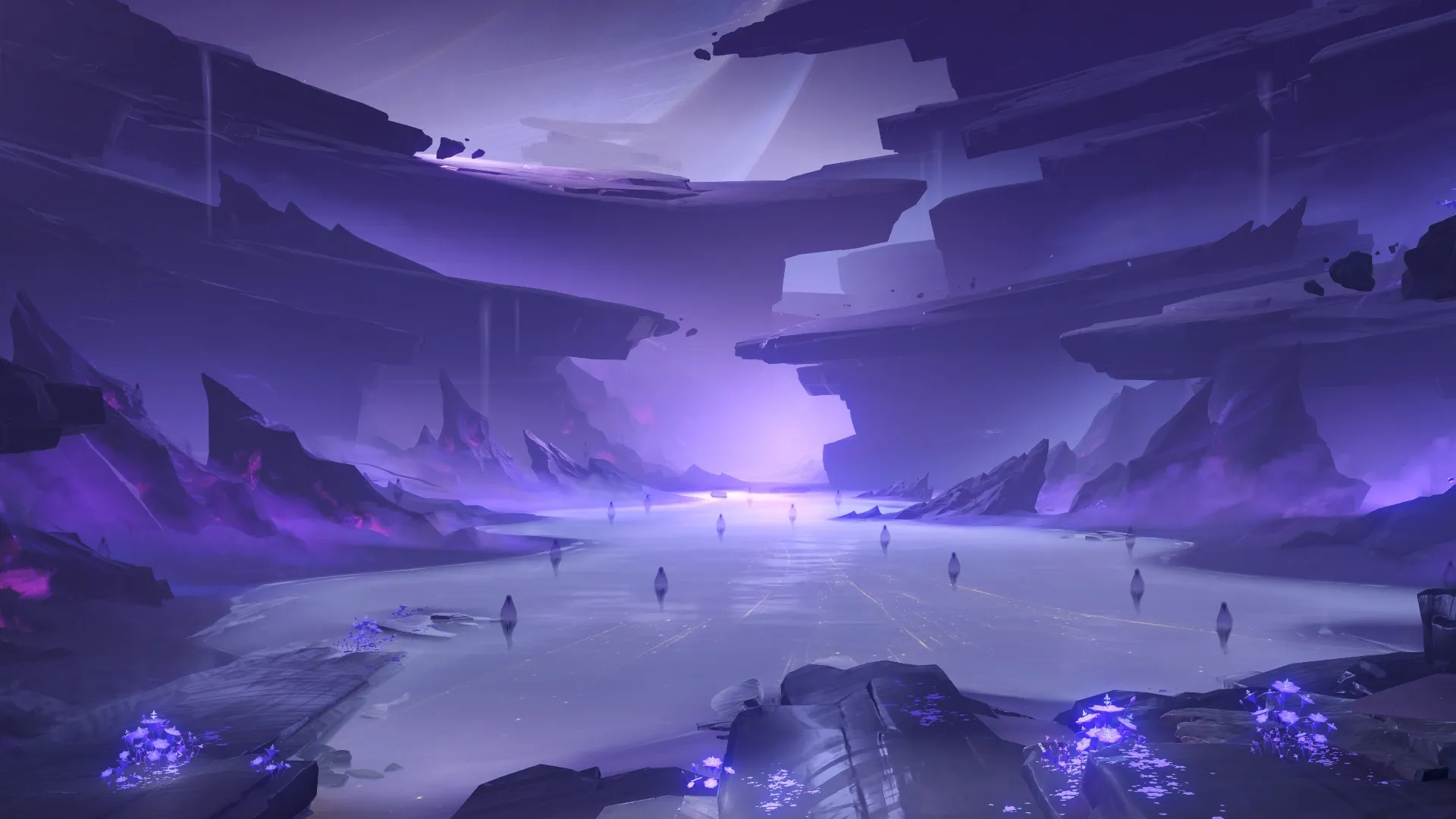
The Night Kingdom is Natlan's underworld and Ley-Line substitute: the realm of the Wayob, the kingdom of Yohualtecuhtin, Lord of the Night, and the place where Natlan's dead reside. [1] It is described as a liminal space between body and mind, life and death, located deep underground. Because Natlan lacks stable, deep-rooted Ley Lines, the Night Kingdom essentially functions as Natlan's Ley Lines. [1]
Creation + structure
The Night Kingdom was created by Yohualtecuhtin, Lord of the Night, a former Angel (the same race from which Seelies later devolved) under the guidance of Ronova, the Shade who controls death. [2] After Natlan's original Ley Lines were severely damaged during the ancient war between the Heavenly Principles and the dragons / War of Funerary Flame, Yohualtecuhtin used fragments of the old Ley Lines to reconstruct a similar network. That reconstruction formed the Night Kingdom; Xbalanque, the first Pyro Archon, later strengthened it. [1]
This makes the Night Kingdom a constructed realm, not a natural cave system. It is a replacement memory/soul network built out of damaged Ley-Line fragments, death authority, and Natlan's own tribal and ancestral material. That is why the realm can simultaneously be:
Function | What it means |
|---|---|
Underworld | Natlanese souls enter after death and eventually lose selfhood into the sea of souls. [1] |
Ley-Line substitute | Natlan lacks stable, deep-rooted Ley Lines; the Night Kingdom performs that role locally. [1] |
Wayob residence | The Wayob dwell there as tribal ancestral wills. [3] |
Ancient Name store | Ancient Name recording and resurrection depend on Night Kingdom memory. [1] |
Combat-power source | Natlanese warriors draw on Nightsouls through Nightsoul's Blessing, Transmission, and Bursts. [1] |
Souls, Ancient Names, and resurrection
When Natlan's people die, they enter the Night Kingdom. Over time, ordinary dead lose their sense of self and become one with the sea of souls. [1] Ancient Name bearers are a special case. If an Ancient Name bearer falls in battle, such as during the Night Warden Wars, the Ode of Resurrection can return them if their team triumphs against the Abyss. That resurrection ability originates from Ronova, whose power Xbalanque borrowed. [1]
The system has limits. If an Ancient Name bearer dies by defeat and is not resurrected, their Ancient Name is lost forever. If they die by other circumstances, they may be reborn in Natlan in a different form. [1] The Night Kingdom also records local memory selectively: while Xilonen works on an Ancient Name for the Traveler, feats outside Natlan cannot help because the Night Kingdom has no memory of them. Both Xilonen and Citlali believe the Lord of the Night's help is required for the Traveler to be recorded. [1]
That is the core distinction between Natlan and other regions. Sumeru's Irminsul problem is global memory editing. Inazuma's Sacred Sakura problem is local root-filth maintenance. Natlan's problem is that names, dead souls, tribal will, and combat resurrection all pass through a deliberately reconstructed substitute for Ley Lines that works through death.
The Wayob
The Wayob are the Night Kingdom's tribal ancestral consciousnesses. They are venerated by Natlan's six tribes and believed to embody the will of each tribe's ancestors. [3] The Dreamseeker Priest interactables call Angakuk, a Wayob, a "collective consciousness and guardian of the past" and "will without form or thought." [4]
The Wayob reside in the Night Kingdom, can see the past and future, choose tribal members to inherit Ancient Names, and protect Natlan's people. Each tribe calls on its Wayob for protection and blessings; chiefs' dreams are believed to communicate the Wayob's will. [3]
The Wayob are not physically present in Natlan most of the time. They manifest through obsidian totems and Nightsouls, appearing as Wayob Manifestations. [3] To the Night, What is the Night's gives the origin doctrine: after Xiuhcoatl awakened from the volcano and Abyss pressure grew, tribespeople perceived obsidian branches in the deepest night, resisted the Abyss with totems, Ley Lines, and elemental power, and the Wayob gradually formed as "totems and consciousnesses created by the congregation of each tribe's living and dead." [6]
The Wayob's protection has a border. They cannot extend protection beyond Natlan without spending power reserved for fighting the Abyss, which is why most Natlan locals avoid leaving and require Wayob approval through a tribal chief if they do. [3]
Abyss crisis + restoration
During the Cataclysm, the Night Kingdom was overrun by Abyssal forces. Over the next five centuries, the Wayob fought the Abyss continuously, losing energy and weakening their connection to Natlan's people. By the time the Traveler arrived, Mavuika estimated that the Night Kingdom would be completely destroyed in less than a year. [1]
Natlan's Archon Quest repeatedly enters the Night Kingdom. The Traveler first ventures there to rescue Kachina after an Ode of Resurrection ceremony fails. Later, during the failed Abyss invasion of Natlan, Gosoythoth flees into the deepest contaminated parts of the realm. The Traveler and Mavuika eventually defeat Gosoythoth, purging the Night Kingdom of Abyssal influence. [1]
The post-war payment is the hardest part. Mavuika had planned to sacrifice herself to restore the Night Kingdom after using Ronova's powers. Capitano intervened, substituting his own death for Mavuika's. The Lord of the Night absorbed Capitano's life force instead, strengthening and rewriting the rules of the Ley Lines. After that sacrifice, people from outside Natlan can be accepted into the Night Kingdom. [1] Neither Capitano's death nor the Night Kingdom's rewrite establishes that the Gnosis was transferred or consumed. The Pyro Gnosis's later disappearance followed Nahida's operation in Sumeru that burned Irminsul, and its current location is unknown. [12]
Resistance to the Abyss in the Cataclysm era reached beyond the Night Kingdom's own walls. In Peace to the Slumbering, the chain that closes the Shadows of the Mountains series, two named Khaenri'ahn soldiers, Zephaniah ("Warrior Who Cleaved the Dark Tide") and Irizar, fought alongside the Children of Echoes elder Traore and the tribesfolk at the sealing of the Sulfurous Veins / Tequemecan Valley. They used a sealing pillar, an Iridescent Inscription on a nail of Solid Phlogiston, to lock down a Cataclysm-era Abyss incursion, and were themselves sealed alongside the Abyss for centuries of torment. [11] On chain release the Outlander is teleported into the Night Kingdom. There a figure the quest calls only the "Beast With Fur Like That of Night" speaks of "the Night" as someone else, a word Fandom links to Yohualtecuhtin; the quest never says what the Beast is, and Fandom lists it among Night Kingdom entities that may be Wayob. It thanks the Outlander for bringing the slumberers "into the Night's reflection" and says that "The outland souls, too, may now return where they were headed," without saying where. It also warns, ahead of AQ V, to "beware the fearful instigators, and the ends plotted by those bearing ill-intent." [11] [10] [3] Nothing in the quest says the Night Kingdom takes the two Khaenri'ahns in. In AQ V Act V Mavuika says that "the Night Kingdom only accepts the souls of Natlan. It's always been that way," and people from outside Natlan are accepted only after Capitano's sacrifice. [13] [1]
The Sibling + New Khaenri'ah hook
After the Natlan war, the Traveler's Sibling meets with the Lord of the Night in the Night Kingdom. The Abyss Order uses skirmishes against the Masters of the Night-Wind as cover. The Sibling asks for space within the Night Kingdom to weave new Ley Lines for Khaenri'ah using the Loom of Fate. [2]
Yohualtecuhtin agrees after confirming the plan will not affect Natlan, but imposes an unrevealed condition. The Sibling then creates the Atlas of the New World, which holds the new Khaenri'ah's Ley Lines. [2] This is the cleanest current example of one of the Loom of Fate's meanings: the Abyss Order's project, led by the Sibling, as a constructed substitute for a nation's Ley Lines. It should not be confused with the speculative readings that tie the Loom to the Heavenly Principles or call it a "Teyvat operating system".
The Nail of Retribution and the Hallowing
The realm also hides Natlan's Nail of Retribution. Getting close to it "would be pretty difficult — not just because of the Hallowing, but because it's hidden away inside the Night Kingdom," Mavuika tells the leaders gathered in Snezhnaya in Chapter VII Act V. [14] [16]
In Act VI the Hallowing reaches it. The Wayob have "suddenly stopped communicating with the shamans of the Masters of the Night-Wind," and Natlanese abroad are losing their memories, so Mavuika goes to the source: "We need to make contact with the Lord of the Night and restore the efficacy of her protection." The Night Kingdom, she reminds the Traveler, is "where Natlan's Nail of Retribution is," and she shares Citlali's view that the Hallowing "is directly affecting the Lord of the Night, preventing her from being able to respond to us." The way in is shut as well, because "The Lord of the Night built the bridge that connects her realm with ours," and with her out of reach, "naturally, that channel is closed too." Citlali can still glimpse the inside and finds "Corrosion from the Hallowing everywhere. It's hard to say if this or the Abyss attack on the Ley Lines was worse." [15] [17]
Even a stable connection for one person is beyond Natlan's shamans, so Mavuika asks, "What if all we need is an unstable connection?" With all six tribes joined in a ceremony and Mavuika charging toward the stadium on her flamestrider, Citlali reckons the link could hold "up to..." "...156 seconds." Inside, Mavuika finds the realm "a mess, just like Citlali said," and connects the Lord of the Night to the Sacred Flame, which "should help alleviate the effects of the Hallowing, at least for now." The Lord of the Night warns that "The Holy Soil phenomenon is spreading ever faster." From there Mavuika answers Natlan's Trial of Usurpation, and its symbol disappears. [15]
The 7.2 World Quest Born Toward the Flame shows the harm easing but not gone. Citlali reports that "the Hallowing's damage to the Night Kingdom is also easing up," and Mavuika warns that "So long as the Nail of Retribution remains in the Night Kingdom, the threat of the Hallowing will persist." [18]
Connections to the Wayob and Seelies
The Night Kingdom is the shared ground for two Natlan race pages that come at it from opposite sides. The Wayob (see Wayob) are the Pyro-coded tribal ancestral spirits who live permanently in the realm. They are non-corporeal "will without form or thought" that each of Natlan's six tribes venerates, and they coalesced from the congregation of each tribe's living and dead during the period of Abyssal pressure after Xiuhcoatl awakened, per Legba's verbatim exposition in To the Night, What is the Night's. [7] That race page is the spirit companion to this realm page; the Wayob did not build the Night Kingdom (they coalesced inside it long after Yohualtecuhtin had finished), and their authority to confer Ancient Names and underwrite the Ode of Resurrection is borrowed from upstream (Ronova via Yohualtecuhtin via Xbalanque), not their own. The Wayob page also covers the sister-page framing to Saurians, the dragon side of the same six-tribe arrangement: opposite cosmologies, same tribal structure.
The realm's patron, Yohualtecuhtin, Lord of the Night, is a surviving non-devolved Angel, the same race from which Seelies devolved. In the AQ V Act IV Beneath the Secret Source disclosure to the Traveler, Paimon, Mavuika, Xilonen, "The Captain", and the awakened Ororon: "In the ancient past, before we died out, we were also known by a different name... 'Angels.' But, adventurers like you are probably more familiar with our devolved form... Seelies. So, Seelies are angels..." The same disclosure adds: "Few angels remain in Natlan, so the same is true of Seelies. Everyone rallied around me and offered their power to humanity to reconstruct the Ley Lines." [8] The Night Kingdom is thus an artifact of the Angels' near-extinction: Natlan's Ley-Line substitute, reconstructed from fragments of the old Ley Lines damaged in the War of Funerary Flame between the Descender and the dragons, and built by the labour of surviving Angels with what the Seelies offered. For the wider story of the Angels across regions, which includes the realm's patron, see Seelies.
The realm's two events after the AQ lead cleanly into adjacent pages. Capitano's life force, substituted for the payment Mavuika owed Ronova, and the rewrite of the Ley Lines that followed do not account for the Pyro Gnosis. The mechanism is a merger of life force, not a transfer of the Gnosis, and the Gnosis disappeared only after the later operation that burned Irminsul. [12] In AQ V Act VI, the Sibling negotiated with the Lord of the Night for permission to weave New Khaenri'ah's Ley Lines using the Loom of Fate, and produced the Atlas of the New World under an unrevealed condition. Of the three meanings of the Loom of Fate, this is the cleanest current example of the device, distinct from the reading of it as the Heavenly Principles' operating system and from the pre-Cataclysm Khaenri'ahn reading of fate engineering. [9] The three meanings are sorted out at The Loom of Fate.
Relationship to other frameworks
- Four Shades. Ronova's death authority is essential to the Ode of Resurrection and to the Night Kingdom's creation history. The page references the Four Shades only as context; see Four Shades.
- Seven Archons. Xbalanque strengthened the Night Kingdom, and Mavuika's AQ V arc triggers the post-war rewrite. The Night Kingdom is not a Pyro Throne page, but it is inseparable from Natlan's Archon line.
- Wayob. The Wayob are the realm's tribal consciousness layer and the closest thing it has to day-to-day operators.
- Abyss Order. The Sibling's New Khaenri'ah Ley-Line project uses Night Kingdom space after Natlan's post-war rewrite.
- Heavenly Principles. The Night Kingdom exists because Natlan's original Ley Lines were damaged after the ancient war between the Heavenly Principles and the dragons, but it now runs on arrangements specific to Ronova, Yohualtecuhtin, and Natlan rather than on direct governance from Celestia. Version 7.2 adds one direct tie: Natlan's Nail of Retribution, one of the Nails that Mitya calls "creations of the Heavenly Principles," is hidden inside the realm. [14]
Deep dive
For the Wayob origin doctrine, the obsidian medium the ancestors used to reach the Wayob, and the Obsidian Tablet warning against Kukulkan's promise, see To the Night, What is the Night's. For Ronova and the Four Shades framework, see Four Shades. For the Abyss Order and the Sibling's Loom of Fate project, see Abyss Order. For Natlan regional and Archon context, see Natlan, Mavuika, and Capitano.