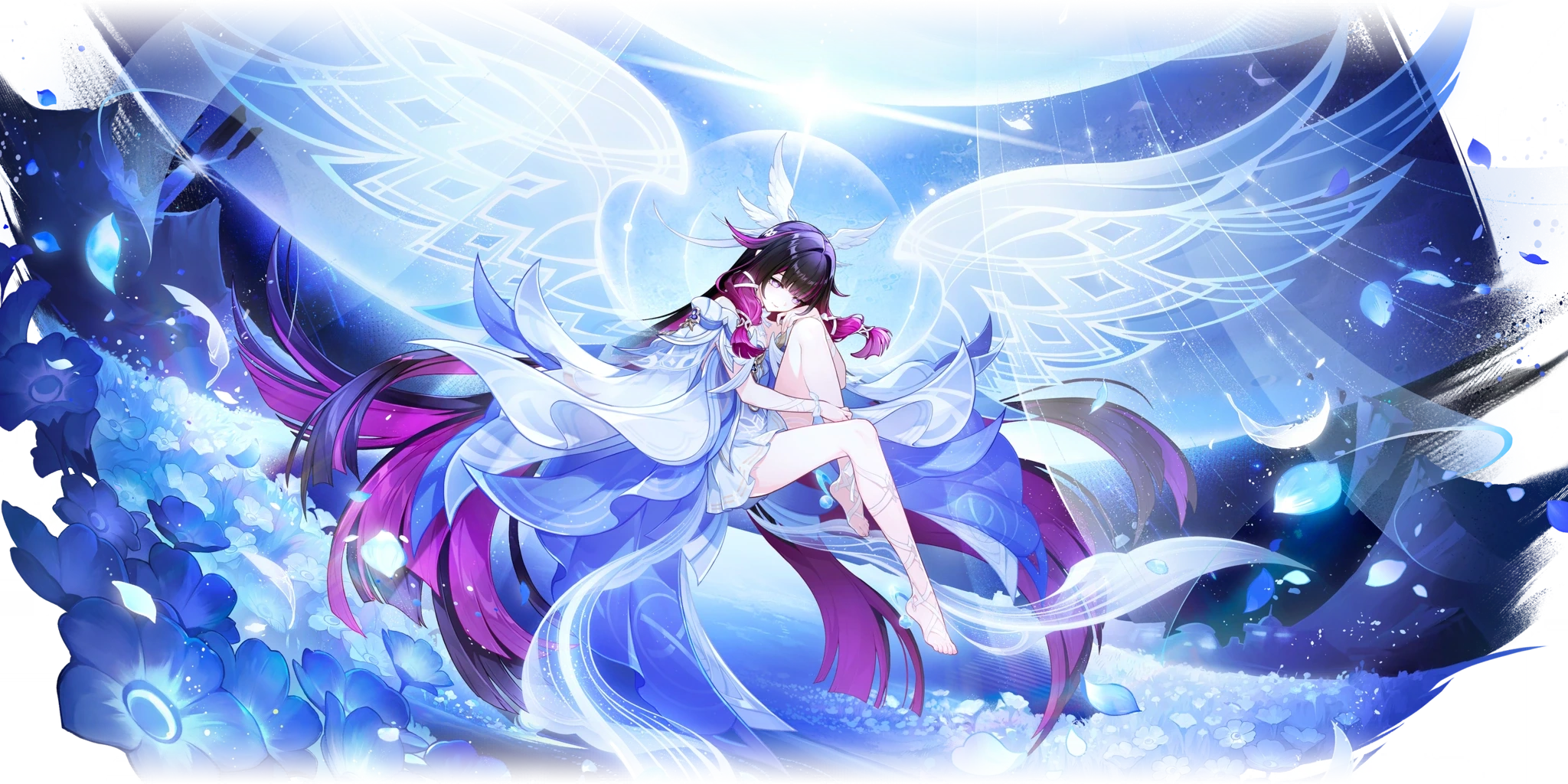


She was the Third of the Eleven Fatui Harbingers by rank. To the Frostmoon Scions she is the Moon Goddess Kuutar, worshipped for centuries; in the Lunar Palace she is the Trilune Goddess, restored to full authority in Welkin Moon Act VIII; and to the few who call her by name she is Columbina Hyposelenia. [1] [6] She was born 400 to 500 years ago and joined the Fatui around a century later. [6] What she actually was stayed the largest open question among them until the Welkin Moon arc answered it. She holds the full Trilunar Authority that Nibelung first granted the Three Moons to govern Teyvat, transferred to her by the Three Moon Sisters in the Lunar Palace. Sweet voice, sealed eyes, no on-screen combat during her Fatui years. No other Harbinger would fight her: Capitano declined, Arlecchino kept her at arm's length, Dottore refused to experiment on her, and Childe, who fights anyone, refused the spar. That was not personal preference. The others sensed she was no mortal of a Harbinger's power at all.
By the close of the Welkin Moon arc she has left the Fatui. The Tsaritsa revoked the Palestar Edict, the highest of the Cryo Archon's commands, originally issued to recover her at any cost. She now lives at Silvermoon Hall on Hiisi Island, returned to the Frostmoon Scions on her own terms. The Tsaritsa recruited her some 350 to 400 years ago, offering her a "second home," and kept her in Snezhnaya mainly for her powers as a Moon Goddess. [6] The Act VIII transfer is anchored in the Welkin Moon "True Moon" event, and the disclosure that the kuuvahki saturating Nod-Krai is Columbina's own distributed body is covered on the kuuvahki page. [7]
She became playable in Version 6.3 (Luna IV) as a 5★ Hydro Catalyst, and her Somnias a Luna wish returned in Luna VIII Phase II. [4] In battle her power only resembles Hydro, which is her gameplay classification. [6] Until Act VIII, which arrived in the same Luna IV version, the Frost Moon remained beyond the false sky and her Moon-Goddess authority was restricted. [24] Act VIII restored the full Trilunar Authority and drew the Frost Moon back within Teyvat's sky; the playable Hydro form remains the combat expression of a being whose story has since moved beyond that sealed state.
Identity: three names, one being
Columbina holds three principal designations, each from a different layer of Teyvat's cosmology:
- Kuutar, her name to the Frostmoon Scions, Nod-Krai's pre-Snezhnayan native population. They worship her as the Moon Goddess of the Frost Moon, the new goddess of the one moon that survived the war of funerary flame, have carved Statues of the New Moon in her image across Nod-Krai, and pray to her for protection. [1] [21]
- The Damselette, her Fatui codename, used across the Harbinger ranks. It follows the standard commedia dell'arte tradition (Columbina is the character name; the Damselette is the title, per the Fatui's masking convention).
- Columbina Hyposelenia, the true name she chose for herself at the Welkin Moon Act VI capstone, with the etymology "born beneath the moon" (Ancient Greek hypo- "beneath" + selene "moon"). The Profile gives the friend-circle usage directly: "Still, her friends call her Columbina Hyposelenia, and she prefers it that way." See the Act VI true-name reveal below for how the power of names works behind it. [13]
Per Character Story 1 in her Profile, Columbina frames her three names as mirrors, "each reflecting a version of her in this unfamiliar world. But those were versions others wished to see. She did not recognize herself in those reflections." The Kuutar / Damselette / Hyposelenia split sits over a deeper question: whether the identities others imposed on her, the worshipped goddess and the Harbinger codename, match the being beneath them at all. [8]
The Damselette codename surfaces in primary text most extensively through the Silvermoon Hall: Selenic Chronicles reputation system, set in the parlour the Damselette curates at Silvermoon Hall, a cavern on Hiisi Island. [28] It builds on Columbina's dealings with the kuuhenki regulars, among them the painter Maalaus, whose old canvases show the Frostmoon Scions worshipping Columbina as their goddess (per the Artist By the Moon's Side (I) gloss), which supports identifying Kuutar as Columbina. Parts I and II run in the window before Welkin Moon Act V, while Lauma shelters her and the Palestar Edict hunts her. The quests are locked from the start of Act V until True Moon (Act VIII) is completed, and then they reopen; Part III requires True Moon. [26] [27] That places Parts I and II before the Lunar Palace transfer that restores the Trilune Goddess and retires the Damselette persona, and Part III after it, where her lines are labelled Columbina. In Parts I and II she has stepped back from active Fatui field work and is sheltered at Silvermoon Hall, but the restoration has not yet happened. This is neither the working Harbinger Damselette nor the later Trilune Goddess. [6]
Origin: born on Hiisi Island 400 to 500 years ago
Columbina was born on Hiisi Island 400 to 500 years ago, from the kuuvahki within the Sanctum of the Oathbearer, in fulfillment of a prophecy that a new Moon Goddess would one day be born. [6] Character Story 1 frames the birth: the first sensations she records are a lullaby ("Sleep, sleep now, my dear little dove"), the touch of fine warm earth, Kuuvahki moonlight drifting through the air, and Kuuhenki weaving that moonlight into garments for her. She opens her eyes, sees the False Sky, and at once reads it as "a veil. A lie." The pull connecting her to something beyond the False Sky is "cut off by this veil of lies." [8]
At birth, Columbina was already severed from her source: the Frost Moon lay beyond the false sky, and she read that barrier as a veil and a lie. That separation limited her for most of her life. Act VIII ended the condition by drawing the Frost Moon back inside the sky and restoring the full Trilunar Authority to her. Moon Gazing then shows her operating from that restored state on the traversable moon.
In the years after her birth she was adopted by the Frostmoon Scions as their god under the name Kuutar. [1] The Scions are Nod-Krai's pre-Snezhnayan native population, the keepers of the Three Moons mythology in oral history, and the setting in which Kuutar's worship was formalised. She lived in the Silvermoon Hall on Hiisi Island during this era, the central site where the Frostmoon Scions venerated their Moon Goddess, and travelled through the Frostmoon Enclave and Glupov as part of that role.
She eventually grew disillusioned with the Frostmoon Scions and left them, joining the Fatui around a century later, some 350 to 400 years ago. [6] The Profile's framing matches the broader pattern in Character Stories 2 and 3: she read the Scions' worship not as care for her as a being but as instrumental use of her for the power she could provide. The departure was a refusal to be treated as a goddess who was only a resource.
Inside the Fatui: Dottore approached first, Arlecchino and Sandrone stayed
Per Character Story 2 of her Profile, the first Fatui colleague to approach her after recruitment was Dottore. The framing was deliberately unlike the Scions' worship: "No one seemed to make unreasonable demands of her. No one appeared to desire anything from her or revere her - at least, not on the surface." Dottore approached as an admirer on the premise of equality, asking for help with "a small task" in his lab. Columbina found the experience of choosing to give help, rather than being obligated to provide power, novel and satisfying. [9]
The relationship soured along a familiar pattern: Dottore's "Not bad" praise shifted to "Not quite enough," "You can do better," or "You're capable of more..." Columbina read the shift as the Frostmoon Scions' pattern returning in a new guise. "What The Doctor was seeing wasn't her, but some version of what she should be, or the level her powers should reach. It reminded her of the days before she had joined the Fatui."
Per Character Story 3 of her Profile, the two trusted Fatui colleagues who emerged for her in this period were Arlecchino and Sandrone. The Sandrone scene, in which Columbina cannot handle the post-meal reimbursement at a restaurant and Sandrone steps in with "Alright, I've got this. You just stay out of it. Hmph. You don't even know how to apply for reimbursement, and you dare come out to eat by yourself?", culminates in the line that anchors the whole relationship: [10]
"Hmm? You don't blame me?" Columbina asked. >"Huh? Why? Isn't this just who you are?" came the exasperated reply.
The Sandrone framing, "Isn't this just who you are?", is the inverse of Dottore's "You can do better": it acknowledges Columbina as a person rather than a source of power. In it she finally experienced something other than being treated as a goddess who was a resource, the pattern she had left the Frostmoon Scions to escape. Arlecchino's role has the same shape: the protective care of the House of the Hearth, without expectation. Both relationships matter for the Profile's portrait of her, as the exceptions to the way the other Harbingers treat her, either as a tool or from a distance.
Why no Harbinger will fight her
Across the named Harbingers, Columbina is the only one no other Harbinger will fight. The pattern surfaces directly: [12]
- Capitano, Commander Thrain, declined. He retains the First numbered rank despite being unable to participate after Natlan; when he refused this fight, he was still active and the most skilled fighter among them, yet he said no.
- Arlecchino keeps her at arm's length, not from hostility but as the protective distance that comes with the care she gives at the House of the Hearth.
- Dottore won't experiment on her, despite being the Harbinger most willing to experiment on anything, his own segments included.
- Childe won't fight her. Childe fights anyone, in any context, for any reason. He won't fight Columbina.
The reading is simple. The other Harbingers sense that Columbina is not a mortal of a Harbinger's power. The Tsaritsa knows what she is; the rest don't know exactly, but know enough to refuse. Their refusal to fight is the visible sign that the usual rules among them do not apply to her.
A guest at Sandrone's tea parties
Columbina generally had cordial relationships with the other Harbingers, above all Sandrone, Arlecchino and Signora, and she took part in Sandrone's tea parties with Tartaglia and Capitano. After the Harbinger meeting at which Pierro outlined the plan to collect the Gnoses, she, Arlecchino and Signora held a tea party in Sandrone's bedroom to comfort her, since Sandrone was visibly saddened over Alain Guillotin. [6]
The Profile's Version 2 introduction quotes a conversation between Marionette (Sandrone) and The Fair Lady (Signora) at a tea party: "She spends her days bumming around and singing, drops in on tea parties whenever she feels like it, and has zero social graces." [9]
What canon has surfaced
- Formerly Third Harbinger by rank (left the Fatui before meeting the Traveler; the Tsaritsa revoked the Palestar Edict after the battle with Dottore); codename The Damselette while in the Fatui; chosen name Columbina Hyposelenia. [1] [6] [22]
- Moon Goddess of the Frost Moon under the worship-name Kuutar; successor in Canon's line. The Three Moon Goddesses framework is now 3/3 named: Sonnet, Canon, and Aria.
- Born 400 to 500 years ago on Hiisi Island; raised by the Frostmoon Scions under the name Kuutar; left them when she recognised the worship as instrumental.
- Cosmologically the new goddess of the Frost Moon, born after it had stood godless for thousands of years. [19] The false sky separated her from it for most of her life; Act VIII restored the connection and her full Trilunar Authority.
- In battle her power takes a form similar to Hydro, which Fandom calls very likely Archaeolune Energy. She is classified as Hydro for gameplay; Fandom's note adds that the seven elements are an adaptation the Heavenly Principles imposed on the Light Realm's primordial energies, so she does not actually use elemental Hydro power. [6]
- Sealed eyes, part of her character design through most of the arc; sweet childlike voice and manner. Act VIII has her open her eyes as the restored Trilune Goddess.
- Closest Fatui relationships: Arlecchino and Sandrone (the protective care framed in Character Story 3); Dottore originally, before his pattern of expectation surfaced.
The Welkin Moon arc capstone: defection, the Lunar Palace, and the Trilune Goddess
Acts I–IX of AQ "Song of the Welkin Moon" cover the Welkin Moon capstone events for Columbina. Act X is not covered on this page. The arc resolves the long-standing origin question by restoring her to the full Trilunar Authority Nibelung originally distributed. [6]
Departure from the Fatui and the Palestar Edict
What Character Stories 2 and 3 describe crystallised into a recognition that the Fatui, like the Frostmoon Scions before them, were ultimately seeking the power she could provide rather than the person beneath the worship. Columbina left the Fatui and returned to Hiisi Island, and the subordinates once under her command were transferred to Dottore. On the island she met Lauma, who apologised to her on behalf of her ancestors and helped her hide in Silvermoon Hall to rest and recover her strength, after she had been made to give up much of her power at the Tsaritsa's behest. [6]
The Fatui, disapproving of her departure, issued the Palestar Edict, the highest of the Tsaritsa's commands, to recover her at any cost. The rank and file prioritised the order, but her closest colleagues (Arlecchino and Sandrone, per Character Story 3) were not as interested. The Edict was eventually revoked after the Lunar Palace events resolved (see below), and the Tsaritsa let her go as she pleased.
Rerir's revival and the pursuit of Columbina
In Luna II, the Lightkeepers and Dainsleif coordinated Rerir's banishment through the Moon Gate (per the Wild Hunt staging in Welkin Moon Act IV). Rerir then returned in a physical body and began hunting Columbina. The reading is that his one-sixth share of Abyssal power as a Five Sinner, carried back through the Moon Gate, gave him the means to return in a physical body. Several threads point to his motive. The Frost Moon's deep authority is the most direct counter-force against Rerir's Abyssal command of the Wild Hunt, and Columbina, as Kuutar, is that authority's living embodiment.
Rerir was eventually defeated in the resolution.
The Act VI true-name reveal: Hyperborean ruins, Nicole's name-power doctrine, and Hyposelenia
Per Welkin Moon Act VI, the anchor of the Hyposelenia identity sits at Welkin Moon Act VI "Melting Moonlight in the Morning Mist," Part 1 "Where Does Her Name Rest?" The expedition into the Hyperborean ruins (the Outlander with Lauma, Arlecchino, and Nicole) found that the Phantom Hyperboreans within knew of ancient moon goddesses but knew nothing of Columbina, who lived long after their time ("When the Hyperboreans speak of moon goddesses, they mean the three from truly ancient times," Nicole says). Murals inside recounted the full Three-Moons history: Nibelung created the Three Moons, later weaponised them during his war with the Heavenly Principles, and the moons were shattered or cast away while the goddesses eventually died, all except the Frost Moon, which alone survived the shattering. Asked why Columbina could be born here at all, Nicole answers, "That is perhaps due to the lingering connection between the Frost Moon, which was not shattered, and this world." Columbina was born 400 to 500 years ago; the answer supplements Character Story 1's account of her creation, in which the False Sky severs her connection to the Frost Moon. [13] [30]
At the lunar-communication platform within the ruins, Nicole resolved the true-name question. She asks, "Is it not also possible that... She has never had a true name? Not at any point in history?", and the instability of her existence across centuries traced directly to that absence. Nicole set out this doctrine of the power of names:
- "Well, just because she's never had a real name in the past doesn't mean she can't have one now!"
- "Names are anchors that connect us to the world. If she doesn't have one already, then all we have to do is create one! No?"
- "When people call you by different names, what matters isn't so much the words themselves, but what they symbolize."
The Outlander called out "Columbina," the name they had always used, and the others agreed this was the identity she resonated with. Lauma's antlers illuminated as the festival moon rose, the signal that Columbina could be summoned back from wandering as her consciousness faded. At Silvermoon Hall, where they had first met, the Outlander spoke her name and restored her fully, and she revealed her chosen full identity: Columbina Hyposelenia ("born beneath the moon," Greek hypo- + selene). The chapter's centrepiece Moon-Prayer Night festival followed; in the closing cutscene the people of Nasha Town greeted her with the line *"Welcome home, Moon Goddess."* [13]
The Act VI Dottore ambush and Columbina's leap into the moon gate
At the Hyperborean ritual site after Moon-Prayer Night, Dottore ambushed Columbina as she stepped into the lunar-return beam. Per Welkin Moon Act VI:
- He manipulated history through "variables," engineering distortions in the causal structure of the Hyperborean phantoms to extract forbidden lunar knowledge.
- He crafted a false moon using the extracted Hyperborean knowledge.
- He seized the power of all three moons, with Columbina's presence required to stabilise his wielding.
- He froze time, leaving only the Outlander able to move, which confirms what sets the Outlander apart as the Fourth Descender.
Columbina realised her presence allowed Dottore to wield the power and sacrificed her chance to return home, leaping into a moon gate of her own creation and disappearing into the same realm where Rerir had been banished. The incomplete ritual forced Dottore to retreat, but Columbina was lost in the moon's reflection. Arlecchino vowed that if the Tsaritsa "will not lift the prohibition on Harbingers drawing steel against one another," she would "fight as Peruere instead," and Varka rallied a multi-faction alliance (Mondstadt, the Hexenzirkel, the Curatorium of Secrets, the Lightkeepers, and the Frostmoon Scions) on one question: "And since he was able to stack these 'variables' up, who's to say we can't do the same?" [13] [30]
Act VII: the moon's reflection and the narrative recursion
Per Welkin Moon Act VII, Columbina woke alive in the moon's reflection, the same realm where Rerir and Tholindis were presumably killed entering it (per the Wild Hunt and Crimson Moon Dynasty pages). Within the reflection, the cosmology runs time backwards, and an ability to manipulate past events with pulses of kuuvahki let her travel backwards through her own past, with an unknown force pulling her back into the reflection between excursions. [14]
Her backwards-in-time excursions resolved two of the chapter's longest-running open threads:
- The Hiisi-Island dome-shield (Act II). During the scene in Welkin Moon Act II where the Boom-and-Blast Kuuvahki Cannon fires, a mysterious dome shield had protected the Frostmoon Scions on Hiisi Island from lethal kuuvahki backwash. Flins asked Columbina (her present self) about it afterward, and she had not provided it in her present capacity. Act VII reveals that the dome was her future self reaching back into the past. She expended most of her remaining moon's-reflection power, pleading for the Frost Moon and the kuuvahki of the land to help her, to raise the shield in time and save the Scions before collapsing.
- The Empty-Courtyard Luonnotar encounter (Act VI). Per the optional Act VI subquest, the Outlander and Paimon had met Luonnotar and the kuuhenki at Silvermoon Hall in the post-disappearance epilogue. Act VII reveals that Luonnotar was created by Columbina's future self ("I gave up a piece of my own soul to create her"), told to "stay by Traveler's side. Guide him/her, and help him/her in my stead," and, on a second instruction, to "bring him/her to the garden where the Moon-Prayer Blossoms grow. There's a little lost dove there who will need his/her help." Luonnotar guided the first meeting between the Outlander and Columbina in Welkin Moon Act I, so the past self was influenced by a message from the future. [14] [31]
She took other actions from the reflection. She left kuuvahki messages on the wall of the Outlander's room at The Flagship, revealable only by moonlight per her Act VI pre-departure announcement ("I shall use moonlight in the same way, to write words that only you can see upon the moon itself"); when Nefer threw a cup at the window and the moonlight revealed the message, the others learned she was still alive, which gave them reason to proceed with Sandrone's world-formula rescue plan. This loop, in which the past self is influenced by a message from the future, runs through the whole chapter, and the Welkin Moon "True Moon" event anchors its resolution at Act VIII. [14] [30] [31]
The Lunar Palace audience and the Trilune Goddess
The cosmological pivot of the arc comes in Welkin Moon Act VIII "True Moon" (Part 1 "The First Sliver of Moonlight," per the Welkin Moon "True Moon" event). Columbina had leapt into a moon gate of her own making in Act VI to deny Dottore the Three Moons' powers. [23] Act VIII opens with her already inside the moon's reflection; moving backwards in time, she reaches the Lunar Palace at the moment Nibelung imprisoned the moon sisters. [7] [24] [20] [21]
The Lunar Palace is the site where time flows backwards, a cosmological inversion that preserves the pre-Cataclysm infrastructure of the Moons' era. Primary text identifies it as the moon's reflection (Act VII) and, in Canon's words, the place "where Teyvat's original ruler, the Dragon King Nibelung, imprisoned the moon goddesses" (Act VIII). Within the Palace, Columbina met the Three Moon Sisters, who had been imprisoned there by Nibelung in the pre-Cataclysm era. Asked if they ever tried to leave, Sonnet says, "Between us, we've tried everything. But no matter where we go, this space will eventually bring us back here." [32] [21] Per the kuuvahki page and the Welkin Moon "True Moon" event, the three sisters together transferred their full Trilune authority to Columbina within that timeless confinement.
Per Welkin Moon Act VIII Part 1 "The First Sliver of Moonlight," the sisters Columbina met inside the prison are named, along with which moon each belongs to, closing the Three Moon Goddesses (Pre-Archon Cosmology) framework at 3/3 named: [15]
- Sonnet, the Iridescent Moon Goddess, the youngest of the three ("our little sister," Canon calls her). [25] [32]
- Canon, the Frost Moon Goddess, whom the Frostmoon Scions call Huurrekuutar. Sonnet's line on meeting Columbina, "You have the same power as Canon", is the primary-text basis for Columbina's status as successor to the Frost Moon Goddess. [21] After the war of funerary flame the Frost Moon stood godless for thousands of years until Columbina was born as its new goddess, so Columbina, as Kuutar, succeeds Canon herself. [19]
- Aria, the Eternal Moon Goddess. In the Act II Moon Marrow disclosure, Columbina says of the original Moon Marrow, "It is the remains of Aria, Goddess of the Eternal Moon" (the Eternal Moon Marrow, per Act VIII). [29]
The Moon Marrow material from Welkin Moon Acts III-IV (the Moon Marrow from Aria's remains and the Iridescent Marrow) falls into place once the sisters are named. Aria's Eternal Marrow, Sonnet's Iridescent Marrow, and Canon's surviving Frost Moon matter together compose the Trilunar Authority the sisters transferred. Nicole's Act VIII exposition adds of the sisters: "They were shadows of the planet, born to wield Nibelung's authority and oversee the world on his behalf. They were extensions of his will, manifestations of his majesty." [15] [32]
The transfer mechanism inside the prison ran like this. Canon warned that concentrating the three moons' powers "could tear you to pieces," and Aria that "No moon goddess can leave this place alive..."; Columbina answered, "What if... I don't leave alive?" The escape plan split her being into three (soul, body, and Trilune authority), drew on the part of her soul she had left in the future (Luonnotar, per Act VII), and dispersed her physical body into moonlight across the Nod-Krai of the past (the kuuvahki distribution, per the kuuvahki page), "awaiting my soul's return in the future." It required the sisters to transfer their authorities at the cost of becoming mortal themselves. They agreed, and at Canon's request ("we would like to spend our final moments together in the only place we ever called home") Columbina sent them back to the real world before her own 'death' in the prison sent her back to Nod-Krai. [15] [21] [32]
Before the transfer, Canon asked, "Why do you cover your eyes?" Columbina explained, "There was a time when I refused to look upon the world. I believed it was full of nothing but lies and falsehoods." Canon replied that the choice may have spared her the false sky but cost her "many true and precious things, like the smiles on your friends' faces," and asked her to promise: "When you return to the future, open your eyes, take a look at the world around you... and see your friends." [21] That oath to open her eyes anchors the imagery of the chapter's resolution, in which the Trilune Goddess unfurls her wings, opens her eyes, and descends. [15]
To escape the Lunar Palace, Columbina split her being into three, soul, body, and the Trilune authority itself:
- Her soul stayed inside the moon's reflection. Luonnotar, the small portion of her soul she had left in the future, served as its anchor, to pull it back to the future when the time came. [21] [20]
- The Trilune authority was hidden within the Frost Moon, and is now restored to her in the Welkin Moon arc resolution as the Trilune Goddess. [20]
- Her body became kuuvahki energy and was distributed across Nod-Krai in the past, earlier in time than present-day Nod-Krai.
This disclosure means Nod-Krai's kuuvahki saturation is literally Columbina's distributed body. The regional energy the entire Luna arc has been built on top of is her physical inheritance from the era of the Three Moons, from the moment Nibelung imprisoned the moon sisters during the war of funerary flame. [21] [19] Lunar Reactions entered the story in the same regional frame, but current sources do not establish that every Lunar Reaction is literally Columbina's matter converted into an element.
Final battle against Dottore and the Dottore-resolution arc
In the battle staging (Act VIII Part 2 "Descending Moon," per Welkin Moon Act VIII), Dottore assumed a new form as the "Heretic of the False Moon" and tore a gash in the false sky, teleporting the group to a massive cloud arena. Sandrone intercepted Dottore's killing spike with her abdomen to spare the Outlander, with the final words "Go to hell" before a surge of his energy pierced her chest. [33] Then Sandrone's deception surfaced: her real world-formula had been hidden inside Pulonia all along (the formula in herself was a decoy). The effort by Arlecchino, Varka, and Nicole, spanning several factions, pulled the Frost Moon into Teyvat, shattering the false sky, and the Wanderer's Irminsul core hidden inside Pulonia processed the formula. Columbina's corpus (the moonlight over Nod-Krai) and spirit (transmitted to Luonnotar) merged with the Trilunar Authority hidden on the Frost Moon, and the Trilune Goddess unfurled her wings, opened her eyes for the first time, and descended to the battlefield, fulfilling Canon's oath. [15]
The arc resolves with Columbina, revived with the Trilunar Authority, returning to confront Dottore. She reclaimed the Iridescent Moon Marrow from him and used it to free Flins, Lauma, and Nefer from their containment; the joined group knocked the Eternal Moon Marrow out of his grasp; and Columbina launched a massive beam of lunar energy that overcame Dottore's artificial Moon Marrow and vaporised him. After the battle she noticed Sandrone lying on the floor and cradled her in her arms. Columbina could not revive her there. Sandrone's later return came through the Stellar Linchpin activating Alain Guillotin's inheritance, not through Columbina's authority. [6] [15]
The remaining Act X material is outside this page's scope. The segment covered here is the final Welkin Moon confrontation that Columbina concluded; see the Dottore page for the earlier Omega-Build context.
Since the Palestar Edict had proven to be nothing more than a means for Dottore to seize Columbina's power, the Tsaritsa revoked the warrant on her, letting her go as she pleased.
Moon Marrow distribution and the elemental-restriction gift
In the Welkin Moon's Homecoming subquest (Act VIII Part 3, per Welkin Moon Act VIII), Columbina distributed the moon-matter she had reclaimed from Dottore:
- The Eternal Moon Marrow went to Lauma, the Frostmoon Scion Moonchanter who had sheltered her at Silvermoon Hall after her departure from the Fatui.
- The Iridescent Moon Marrow went to Arlecchino, the Knave of the House of the Hearth and a descendant of the Crimson Moon Dynasty, whose rescue effort in her own capacity through Acts VI-VIII anchors the thread of friendship between the two Harbingers.
- She returned her kuuvahki to Nod-Krai, "that it may continue to protect my chosen home," the energy the entire Luna arc had been operating on (her own distributed body, per the kuuvahki page). [32]
Columbina also removed some of Teyvat's restrictions on the Outlander, allowing them to use the elements more freely. This gift, given with the Trilune Goddess's authority, supplements the Outlander's immunity to the Vision-distribution system, and the shift in the Outlander's gameplay and story after Welkin Moon Act VIII comes from it. [15]
The Frost Moon spaceship disclosure
Columbina then brought the Traveler and Paimon to the Frost Moon (the home, once sealed beyond the False Sky, that she had been severed from at birth and could now reach through her restored Trilunar Authority) and revealed that their spaceship "has been hidden on the Frost Moon" by "the Heavenly Principles." She could only guess why: "I don't know. Perhaps your ship contains something that is incompatible with Teyvat. Or something that cannot be known." [6] [32] The disclosure matters for the Outlander's broader cosmological arc. The Heavenly Principles held the vehicle by which the Outlander and their Sibling first arrived on Teyvat, and concealed it on the sealed Frost Moon. What this means for the Sibling's arc as Prince or Princess of the Abyss, for how the Heavenly Principles handle Descenders, and for whether the twins can recover their vehicle stays open after the disclosure but is not yet on-screen.
Moon Gazing supplies the Luna VIII follow-through. The Frost Moon becomes permanently traversable, and the twins' ship can be revisited at Traveler's Crater. The quest does not answer why the Heavenly Principles hid it. Instead, Project Moongazer reveals that an earlier transmission from the moon reached the Traveler and their sibling during their journey between worlds. [5]
Present-day position
Following the Tsaritsa's revocation of the Palestar Edict, Columbina lives at Silvermoon Hall on Hiisi Island alongside the Frostmoon Scions she returned to on her own terms. She is no longer the worshipped Moon Goddess Kuutar reluctantly accepting cult veneration, but the restored Trilune Goddess who chose to live among the people whose oral history preserved her name through the centuries her source was sealed. She periodically receives visits from the Traveler and Paimon. [6]
In Luna VIII she returns to the Frost Moon during Moon Gazing. She helps Eggie complete Project Moongazer, shields the transmission with her power as Moon Goddess, and retains the option to erase it if danger appears while it remains within her reach. [2] The episode puts her restored authority into a protective role without making the broadcast permanently safe.
She became playable as a 5★ Hydro Catalyst in 6.3 Luna IV, the same version as Welkin Moon Act VIII. [1] [24] Hydro is her gameplay classification; in the story she uses the power of the Light Realm, and since Act VIII she holds the Trilune Authority. [6]
Open questions
- The exact timing of her Fatui recruitment. Fandom places it around 350 to 400 years ago, about a century after her birth. It infers the date from her joining in the original Zandik's lifetime, after he had made several Segments; no exact year is given. [6]
- When Sonnet and Aria met their mortal end. Canon, the Frost Moon Goddess (Huurrekuutar to the Frostmoon Scions), traces forward to Kuutar, that is Columbina. Sonnet and Aria transferred their authorities to Columbina and became mortal at the cost of the transfer, and Columbina returned them to the real world so they could "spend our final moments together in the only place we ever called home," as Canon asked. [32] Fandom's Canon page says all three sisters perished in the war of funerary flame. [19] The exact moment in the timeline of their mortal end, and whether their portfolios as Moon Goddesses still operate in any way independent of Columbina's consolidated Trilunar Authority, remain unaddressed. (The framework's naming question resolves at Act VIII per Welkin Moon Act VIII: Sonnet is Iridescent, Canon is Frost, Aria is Eternal.)
- Where Columbina ranks as the Trilune Goddess. The Welkin Moon arc resolves the origin question (Trilune Goddess restored to full Trilunar Authority via Lunar Palace transfer) but leaves the taxonomy question open. Does a Trilune Goddess rank above an Archon? Above a Sovereign? Alongside a Shade? The Trilune Goddess does not yet have a named slot in the existing Archon / Sovereign / Shade / Descender system.
- Why the Heavenly Principles hid the Frost Moon spaceship. Whether it was incompatible with Teyvat or simply something they wanted concealed, the disclosure leaves both readings live; primary text has not yet stated which is operative.
- The consequences of the precedent set by revoking the Edict. Columbina is the first Harbinger to leave the Fatui without dying, defecting to a rival faction, or being recovered, and her departure on her own terms sets a precedent the others could in principle invoke. Whether this is a one-time exception for an ally and equal (only for Columbina) or a standing precedent the Tsaritsa might extend to other Harbingers is not yet on-screen.
Three roles at once: Moon Goddess, Harbinger, Trilune Goddess
Columbina sits at the intersection of three roles the wiki tracks, none of which fully captures what she is:
- Frost Moon Goddess, as Kuutar. Per the Frostmoon Scions page, Columbina is the Moon Maiden Kuutar, successor to the original Frost Moon Goddess Huurrekuutar at the witnessing of her birth ~500 years ago by Aila (the first Moonchanter, who offered her the first drop of silver blood via the Moonweaver's Dawn blade). The Frostmoon Scions built the Statues of the New Moon in her likeness across Nod-Krai, crafted from Lunasoul Stone, and worshipped her as Huurrekuutar's successor across the five centuries after Aila, including the years Columbina spent away as the Damselette under the Fatui. The page covers the human ritual-users of kuuvahki who surround her on present-day Hiisi Island. [16]
- Fatui Harbinger, as The Damselette. Columbina joined the Fatui and was made the Third Harbinger some 350 to 400 years ago, around a century after her birth, and resigned before the Traveler met her. [6] [22] Her exit, later accepted when the Tsaritsa revoked the Palestar Edict, is the first instance of a Harbinger leaving without dying, defecting to a rival faction, or being recovered. The Luna VIII line-up of six active Harbingers (Pierro, Arlecchino, Pulcinella, Sandrone, Pantalone, and Childe) excludes Columbina while preserving her former-Third history. [12]
- Trilune Goddess, the restored authority. Per the Welkin Moon Act VIII reveal that named the Three Moon Sisters, and the Lunar Palace transfer, Columbina holds the full Trilunar Authority once divided across Sonnet (Iridescent), Canon (Frost), and Aria (Eternal), the pre-Cataclysm Three Moon Goddesses whom Nibelung imprisoned in the prison of the moon's reflection and whose surviving piece, the Frost Moon, Columbina was born from 400 to 500 years ago. The Trilune Goddess sits adjacent to Archons, Sovereigns, Shades, and Descenders without slotting in among any of them, a position the Welkin Moon Act VIII resolution opened rather than closed.
The three roles operate at once rather than one after another. Columbina is all three together: the Moon Maiden of Hiisi Island whom the Frostmoon Scions venerate, the former Third Harbinger whose codename the surviving Fatui still use, and the restored Trilune Goddess living at Silvermoon Hall. The Kuutar / Damselette / Hyposelenia name structure is the surface of that overlap.
Neither a Shade nor a Descender
The Welkin Moon Act VIII restoration of the Trilune Goddess authority sets Columbina's position against two neighbouring kinds of power the wiki tracks. In both cases she stands apart rather than belonging.
Not a Shade
The Sustainer of Heavenly Principles is Asmoday's role-name among the four Shades, the deputies (Naberius, Ruler of Life; Ronova, Ruler of Death; Istaroth, Ruler of Time; Asmoday, Ruler of Space) whom the Heavenly Principles installed mid-campaign during the war against the Seven Sovereigns.
The Trilune Goddess authority Columbina holds is older than all of that. Per the Welkin Moon Act VIII Lunar Palace audience and transfer, it descends from a line Nibelung granted before the Heavenly Principles ever arrived, through the Three Moon Sisters Sonnet, Canon, and Aria. The Welkin Moon Act VI murals in the Hyperborean ruins place that power earlier still, before the apparatus Phanes set up after the war of funerary flame, which the Shades enforce on the Heavenly Principles' behalf. So Columbina is not a Shade. Her authority works at a different level, and her Act VIII meeting with the Three Moon Sisters is the primary-text anchor that puts the Trilune Goddess beside the Shades, not among them. The Asmoday deep-dive lays out the Sustainer-as-Asmoday distinction this reading rests on. [18]
Not a Descender
Columbina is not an original Moon Sister. Sonnet, Canon, and Aria are the originals; they transfer their authorities to Kuutar / Columbina, making her their successor and the Trilune Goddess. Separately, Saarelainen is only the strongly implied candidate for the Third Descender: Hymns records seven pieces and Skirk records seven Gnoses from the Third's remains.
The Traveler's Vision, Irminsul, astrology, residue, and time interactions are character-specific observations, not universal Descender diagnostics and not properties automatically shared by the Sibling. Columbina does not qualify merely by being unusual or ancient.
The Saarelainen deep dive covers the candidate identification. [17]
The two distinctions run parallel. Columbina receives lunar authority from Sonnet, Canon, and Aria rather than belonging to the Four Shades or the numbered Descender sequence. Her succession does not date Saarelainen or settle the Third Descender's identity.
Cross-references
- Eleven Fatui Harbingers: the Columbina row, the wider pattern of Harbingers refusing to fight her, and the context of the Tsaritsa's recruitment.
- Three Moon Goddesses: the reveal that Kuutar is Columbina; Sonnet, Canon, and Aria at 3/3 named; the restored and traversable Frost Moon.
- Hexenzirkel: one of the factions Varka rallied for her rescue after Act VI.
- Nod-Krai: Hiisi Island birthplace; Silvermoon Hall residence; the context of the Frostmoon Scions' worship; Statues of the New Moon distributed across the region.
- Moon Gazing: the Luna VIII return to the Frost Moon, Project Moongazer, the protected transmission, and permanent access to the Traveler twins' spaceship.
- Frostmoon Scions: Nod-Krai race page; Kuutar as Columbina, the Moon Maiden and successor of Huurrekuutar; the Moonchanter clergy and Hyperborean-descended people whose goddess she embodies; her residence at Silvermoon Hall after the Welkin Moon arc.
- Lauma: Snowland Fae character whose role as host at Silvermoon Hall intersects with Columbina's residence there after the Welkin Moon arc.
- Dottore / Arlecchino / Sandrone: her main relationships with Fatui colleagues, per Profile Character Stories 2 and 3.
- Tsaritsa: the Cryo Archon who recruited her and, as the Harbingers' superior, the one best positioned to know Columbina's full cosmological category.
- AQ Welkin Moon Act VI / Act VII / Act VIII: the primary-text anchors for the Welkin Moon capstone. Act VI has the Hyposelenia true-name reveal, the Dottore ambush, and Columbina's leap into the moon gate; Act VII has her survival in the moon's reflection and the recursion through Luonnotar, the fragment of her soul; Act VIII has the reveal naming the Three Moon Sisters, the Trilune Goddess descent, Sandrone's death, Dottore vaporised, and the Palestar Edict revoked.
- Silvermoon Hall: Selenic Chronicles: the Nod-Krai Reputation system built on the record of the Damselette's parlour at Silvermoon Hall (Part I Luna I 6.0; Part II Luna II 6.1; Part III Luna IV 6.3, after True Moon); the canvases by the kuuhenki Maalaus in , which ground the ; and the lock from the start of Welkin Moon Act V until True Moon, which puts Parts I and II before the Lunar Palace transfer of authority and Part III after it.