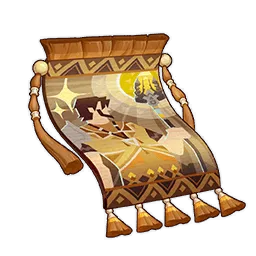
Sundjatta's First Foray is a three-volume Natlan book collection released in Version 5.5. Amazolli sells it at Idukan's Trove, a bookstore on the Masters of the Night-Wind tribe's Tezcatepetonco Range, for 3,000 Mora per volume, twice the usual book price. All three volumes carry the same standing description: "A woven scroll passed down for generations in the Children of Echoes. It tells the legend of a young Sundjatta from 500 years ago." [1] [2]
The framing voice is the singer Djeli Mamoudou of the Children of Echoes, who in Vol. 1 traces his lineage to the first saga-singer Bilali and to Keitan and Bintu Kouyate, who wove carpets and felt. That makes the book an artifact of the tribe's textile and oral tradition, not a chronicled history.
The three volumes
Vol. 1 is the singer's invocation. Djeli Mamoudou names his line, claims authority over "dragon-lords and barbarian kings of benighted ages" and the verbose Monetoo, and enumerates Sundjatta's four titles, Magan Sundjatta, Mali Djata, Sogolon Djata, and Nare Magan Djata, before promising a tale of "a hundred thousand barbarian kings, now forgotten," defeated by Sundjatta and then turned into his allies.
Vol. 2 covers the mining apprenticeship and the misunderstood departure. The volume hedges Sundjatta's parentage explicitly ("no beauty his mother, no strongman his father… Ask the pale light of three moons, and still you shall have no answer"), then names Black-Jade Mbande, "chief of our tribe… the mother of mines and gems," as the chief who recognised young Sundjatta as the tribe's champion. He apprenticed in the mines wielding mountain-carving hammers larger than his body. When Mbande "returned to the Lord of the Night's embrace" and the tribe assembled to elect a successor, the young Sundjatta left alone, not seeking power but a "proud testament to his existence," and was misread by his tribespeople as "a runaway, a traitor."
Vol. 3 brings Lukwata at the lava lake. Sundjatta makes for a "distant lava lake… now cooled" but then "the abode ruled by the evil dragon Lukwata, one of the few survivors of the ancient dragon race." Lukwata is blind, doddering, sulfur-scorched, "inextricably trapped in a delirious dream of battle against heavenly envoys," and "unaware of the human epoch that had come upon Natlan." He claims a "Sovereign's title while forgetting [his] race." Sundjatta mocks him ("I am merely a nameless miner, not some contemptible knave. Just as you are no king - merely a tottering lizard") and beats him to death with the hammer through fang-wounds, claw-wounds, lava-scorched eyebrows, and venom-seeped viscera, until the dragon's soul is scattered and the magma lake cools by half.
The book as Sundjatta primary text
Sundjatta is the 52nd Chief of the Children of Echoes and one of the Six Heroes of Natlan who fought alongside Tenoch against the Abyss during the Cataclysm, partnered with his Stegosaurus companion Muhuru, the historical seventh kind of Saurian no longer found in modern Natlan. He bore the Ancient Name BRK ("Baraka") later inherited by Xilonen. He wielded a heavy bludgeoning weapon, the same hammer Vol. 2 describes, and he died alongside Menilek and Wanjiru in the Cataclysm's final battle, while Tupac clung to life long enough to deliver Mavuika to the Sacred Flame. He first appears in-game as a spiritual projection in Archon Quest V Act IV (Despair Engulfs the Heavens / A Fuel Named "Fate"). [3] [4] [6] [7]
So the book is the main text for young Sundjatta, a coming-of-age story set in the same window 500 years back that the rest of his biography occupies, before he became one of the Six Heroes. It supplies four details recorded nowhere else. There is his origin as a mining apprentice and the hammer he carried out of the mines. There is Black-Jade Mbande, the chief of mines and gems who held the Children of Echoes' seat before him, an earlier link in the line of 52 Chiefs that Sundjatta's own seat closes. There is the departure his tribe misread as betrayal. And there is the killing of Lukwata, his first named feat of arms. [8]
What the legend stops short of
The book is not historical testimony. The standing description's "woven scroll passed down for generations" is a disclaimer within the text. This is the tribe's oral and textile tradition, passed down through a named line of singers (Bilali → Kouyate → Djeli Mamoudou), not a chronicled record. The Vol. 2 hedging about Sundjatta's parentage ("Ask the pale light of three moons, and still you shall have no answer") acknowledges, inside the story, that even within the tradition the founding facts are uncertain.
Lukwata is not identified as a Sovereign Lord. Vol. 3 is explicit that he "would claim a Sovereign's title while forgetting [his] race," a claim the book's own framing treats as false and that Sundjatta openly mocks. He reads instead as a leftover from the old race of ancient dragons before their devolution, one of the few survivors of an "ancient war which had rocked both heaven and earth" that destroyed his tribe. That sets him apart both from the Thirteen Sovereign Lords that Xiuhcoatl created and from the modern Saurians descended from Pyro Vishaps. The book does not identify him with any Sovereign, and neither does this page.
The "Lord of the Night" whose embrace claims Mbande stays as in-text phrasing; the book names no specific entity behind the appellation, and this page does not equate it with any named figure of the Night Kingdom.
Sundjatta's Vision is uncertain. The record notes that "although it is unclear if Sundjatta possessed a vision, he was shown to have the ability to control the Geo element," which fits the mine-hammer and mountain-carving combat of Vol. 2 without confirming him as a Geo Vision-bearer.
A note on the names
Several names in the book point to the historical Mali Empire. Sundjatta is an alternative spelling of Sundiata Keita, founder of the Mali Empire; Magan Sundjatta and Nare Magan Djata reference his father Naré Maghann Konaté, a 12th-century faama (king) of the Mandinka people; Mali Djata references the empire itself; and Sogolon Djata references his mother Sogolon Condé. The homage is authorial framing, not in-universe quotation. The in-Teyvat Sundjatta is unchanged by the parallel: still the 52nd Chief of the Children of Echoes, still a Hero of Natlan from the Cataclysm, still partnered with the Stegosaurus Muhuru. [1]