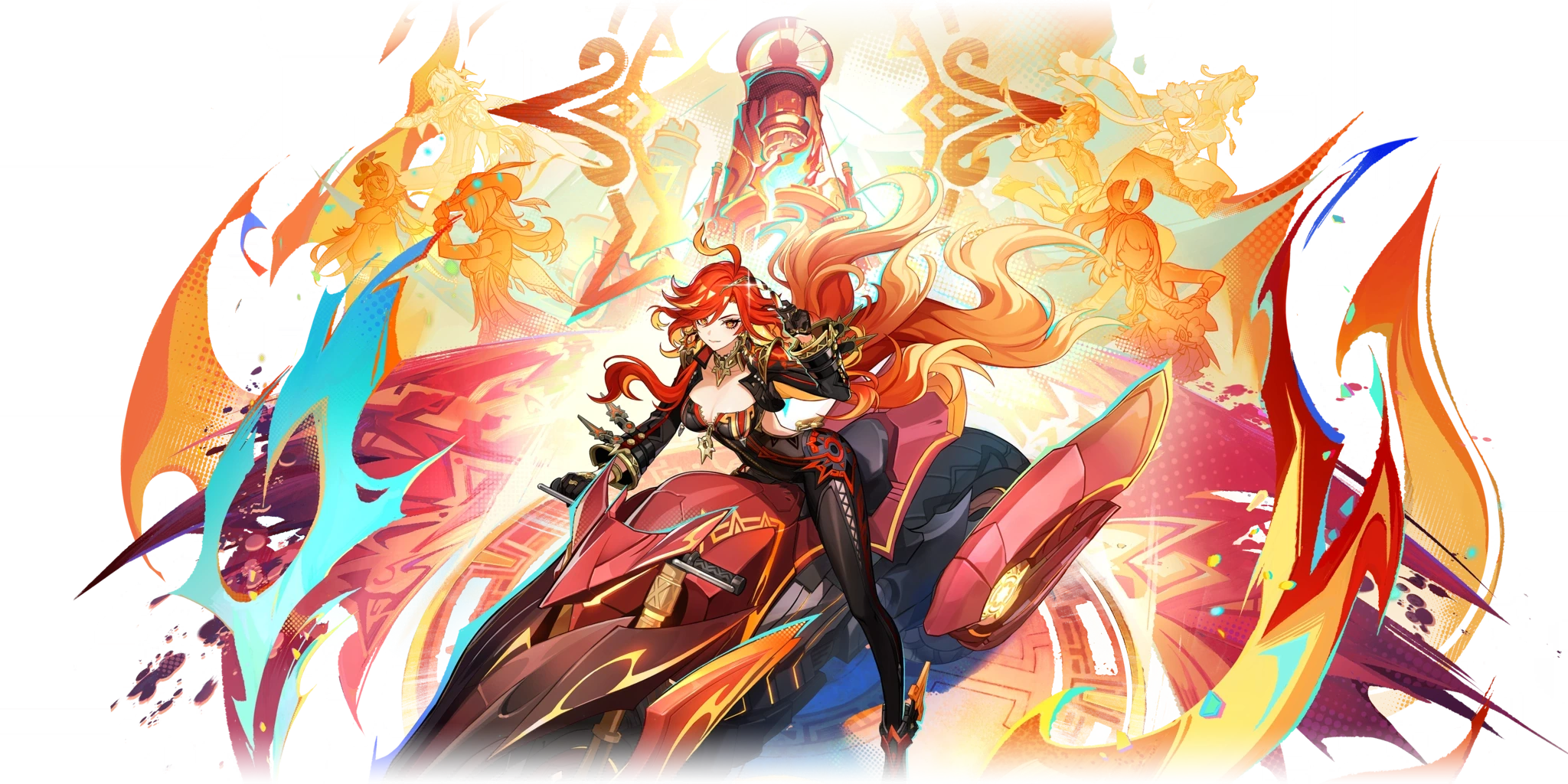


The Pyro Archon spent five hundred years planning her people's war against the Abyss, and Natlan won it. [26]
Mavuika was already Pyro Archon when the Abyss struck Natlan during the Cataclysm, 500 years ago. Xbalanque, the first Pyro Archon, had lived some 1,500 years before her, and other Pyro Archons ruled in between. [7] Her job, the only job by her own framing, was to keep the Saurians alive, keep the tribes aligned, and deliver a strike powerful enough to end the Abyss's encroachment on Natlan permanently. She built the entire culture around that strike.
She did it from a motorcycle. She talks like a coach, and she lifts more weight than a ruin guard. Her authority is genuinely earned. She fought up through the tribal hierarchies before being recognized as Archon, and that legitimacy is the reason Natlan listens to her at all.
Natlan's Archon Quest, Chapter V, runs three plans at once. The first is phlogiston as a weapon: Natlan's elemental fuel can be concentrated into a kind of anti-Abyss munition, and Mavuika has spent decades training warriors to channel it. The second is the arrival of the Fatui Harbinger Capitano, the most honorable of the eleven by Harbinger standards, whose aim of breaking the Abyss overlaps with hers. They cooperate openly, and he pays a price for that alliance the casual reader will want to be unspoiled for. The third is the Saurians' future: the pact between humans and Saurians is fragile, some Saurian factions have been radicalized by the Abyss's pressure, and Mavuika has had to make peace inside her own borders before fighting the war outside.
Like every Archon in Natlan's long line of mortal Pyro Archons, Mavuika bears the Ancient Name Kiongozi and the Goetic Name Haborym, the same pairing of divine names as Venti and Barbatos, Zhongli and Morax, Ei and Beelzebul, Nahida and Buer. [7]
Mavuika kept the Pyro Gnosis through Natlan's war. At the end of Act V she still expected the Tsaritsa to send a replacement Harbinger for it, "since this is the final Gnosis." [19] In Version 6.6 she gave it to Sumeru at Nahida's request, handing it to the Traveler, and Nahida used it to burn the corrupted Irminsul. Nahida's search afterward found "not even any trace of it burning to ash," and Mavuika "sensed its loss." [20] Its present location is unknown, and the Tsaritsa does not hold it. [21] Sol Invictus itself does not settle the question because it predates that later disclosure. See also Seven Archons for the per-Archon roster. [6]
How Natlan's Pyro lineage works
In the Sovereign-to-Archon transition table, Natlan is the case of direct substitution for Pyro, the cleanest of the seven regional patterns. The Pyro Sovereign Xiuhcoatl was slain by Xbalanque in pre-Archon-War inter-dragon fighting (Natlan was never part of the Archon War proper). Xbalanque was resurrected by Ronova and became the first Pyro Archon, founder of the Pilgrimage lineage of mortal Pyro Archons that runs through Mavuika today. The mechanism is direct. The Sovereign was killed, the Authority passed to the slayer who became Archon, and through the founder's resurrection the Archon's seat inherits a Sovereign's authority. Mavuika inherits both the line of divine names (Ancient Name Kiongozi, Goetic Name Haborym) and the Pilgrimage tradition Xbalanque founded. The line of mortal Pyro Archons runs unbroken from the era after Xbalanque to the public ritual at today's Stadium of the Sacred Flame. [8] [7]
The Saurians under Mavuika's patronage are kin descended from Pyro Vishaps, part of the Pyro lineage Xiuhcoatl led before the Heavenly Principles: the Saurian varieties bonded to the six present-day tribes, plus the Iktomisaurs, the exception bound by the Night Kingdom pact. Saurians were subjugated by humanity during Och-Kan's reign about 2,000 years ago, and the present-day harmony between Saurians and humans is a reconciliation built after Och-Kan, anchored by Mavuika's Stadium of the Sacred Flame and the Pilgrimage of the Return of the Sacred Flame. Her relationship to the Saurians is an inheritance through the Pilgrimage (the lineage Xbalanque founded, operating at the Archon level), not the kinship a Sovereign recognises that Neuvillette holds for the post-Cataclysm Melusines. Xiuhcoatl is dead, and the Pyro Authority runs through the line of Archon successors rather than a living Sovereign peer. [10] [11]
Two contrasts with other regions sharpen the picture. Sumeru is the peaceful-sharing exception. King Deshret, Greater Lord Rukkhadevata, and Nabu Malikata held their pre-Cataclysm positions together, with Apep (the Dendro Sovereign) as the 7th Pillar, a member of the alliance. Sumeru ran a triumvirate plus the Seven Pillars. Natlan ran a single Pilgrimage lineage of mortal Pyro Archons descended from Xbalanque, with no alliance like the Pillars and no living Sovereign peer for the present-day Archon to coordinate with. Inazuma had an Electro event of the Archon War proper. Orobashi (the Watatsumi Omikami) is a lesser deity, not a Sovereign, and was slain by Ei (not by the Electro Archon Makoto) at Yashiori Island roughly 2,000 years ago. No released line names an Electro Sovereign. In Chapter VII Act VI Ei recalls another killing, of "a great Thunderbird on the island of Seirai," which she introduces under "the concept of 'elemental dragons'"; no line in the act names it or calls it a Sovereign, but Fandom's table of Sovereigns now lists it as Kapatcir, the "Original Electro Dragon." [26] [34] Natlan had no event of the Archon War proper at all. Xiuhcoatl's death predates the Archon War, the Pyro Authority passed by direct substitution to Xbalanque, and the footing Mavuika operates on as Pyro Archon today is continuous with Xbalanque's founding rather than emerging from a contest of gods in the Archon War. [9] [12]
The question of the Pyro Gnosis sits downstream of all three readings above, and the distinction matters. Xiuhcoatl's death as a Sovereign and the disappearance of the Pyro Gnosis after Nahida used it in the much later burning of Irminsul are distinct cosmological events, separated by the Sovereign-to-Archon transition, the Archon War, the Cataclysm, and the modern regional arcs. Mavuika's present-day Pyro Authority is the inheritance of Xbalanque's Pilgrimage; the Gnosis has a separate line of custody, and its current location is unknown. [6] [8] In Chapter VII Act III (Version 7.1), the Traveler tells the Tsaritsa, "When Irminsul was burned... the Pyro Gnosis was reduced to ashes along with it," and, "According to Mavuika, the Pyro Gnosis has returned to the Ley Lines." No released scene shows Mavuika saying that. On screen she "sensed its loss" and guessed its disappearance might be "a knock-on effect of the impact it's had on a certain strand of fate." The Tsaritsa, who calls it the only Gnosis "whose whereabouts are unknown," expects to "locate it eventually." Its fate is unresolved. [17] [21] [20]
Version 7.2 leaves it that way. At the leaders' meeting in Chapter VII Act V, Pierro admits the Fatui "have yet to locate the Pyro Gnosis," and Mavuika speaks for herself: "I'm probably the most familiar with the Pyro Gnosis, since I looked after it for a very long time. But I can no longer sense it. It's like there's an invisible wall separating us." At the end of Act VI, Paimon blurts out, "But we still don't know where the Pyro Gnosis is...", and Mavuika won't let her apologize. "You only said what we were all thinking." [25] [26]
How Natlan chooses its Pyro Archon
Natlan selects its Pyro Archon through the Pilgrimage of the Return of the Sacred Flame, a national sport and combat tournament held at the Stadium of the Sacred Flame, the public venue at the centre of the reconciliation Mavuika has built since Och-Kan. The tournament does three things: (1) it collects Contending Fire to fuel the Sacred Flame (which protects Natlan from the Abyss as long as it keeps burning; Contending Fire is only produced in battles between the people of Natlan, with outlanders prohibited from competing before AQ V Act V); (2) it selects the strongest warriors to defend Natlan in the Night Warden Wars; and (3) it selects the Pyro Archon, "they believe that the most comprehensive test for a future Archon is performance in battle." The Pilgrimage runs as needed in response to Abyssal threats, has been held more frequently in recent years, and anchors the lineage of mortal Pyro Archons that Xbalanque founded through his pact with Ronova. [13]
Of the seven seats, the Pyro seat is the only one whose Archon is chosen by tournament combat, through the Pilgrimage; the other six follow other patterns. Anemo and Geo came by divine investiture (Barbatos rose from a wisp through Decarabian's defeat and the bard-and-faith framework; Morax rose from mortal standing as God of Geo for centuries before the War formally began). Electro came by sealing and succession in the Cataclysm era (Ei succeeded Makoto after Makoto's death in the Khaenri'ah Cataclysm, then sealed herself in the Plane of Euthymia and ruled through the Shogun puppet as a proxy for 400 years). Dendro came through the Akademiya's Sages plus rebirth through Irminsul (Nahida was born from the purest branch of Irminsul, snapped off by Greater Lord Rukkhadevata, and the Irminsul edit then rewrote the world's memory). Hydro came by Sovereign rebirth (Neuvillette was reborn as Hydro Sovereign with the Authority returned through the destruction of the Throne in AQ IV V, while Furina, the standby Archon and the body and spirit partitioned from Focalors, held the throne publicly for 500 years). The Pilgrimage runs on tournament combat and on inheritance through a life-force loan from Ronova, rather than on Celestia installing an Archon with a Gnosis and a Throne. Natlan has no on-screen installation of that kind for its Pyro line, and the Pyro seat rests on a different footing from all six others. [15] [8]
Xbalanque's return in Mausau's body plays out in the Sol Invictus Chapter Act I "As the Blazing Sun," Mavuika's only Story Quest (patch 5.3, set the day after AQ V Act V Incandescent Ode of Resurrection). Citlali wakes the Outlander with news, passed on through Wayob, that the first Pyro Archon Xbalanque is returning to Natlan. Mavuika re-launches the Pilgrimage as a friendly inter-tribal tournament, partly to bind the post-war peace and partly as a draw. Xbalanque returns by possessing the body of a young tribesman named Mausau, who, Xbalanque says, is unaffected and only dreaming. In life Xbalanque struck a deal with Ronova: she shared her strength so that Natlan could run under new rules, and he also asked to see the new world if Natlan ever won. He calls his return a bet he won, and Mavuika's AQ V Act V victory is what won it. [18] Mavuika finds Xbalanque, inside Mausau, in the crowd after the tournament. He proposes a duel and takes them to the Temple of the Spirit, "the land of the sun, created by my soul," where they fight as "our true spiritual selves" without harm to Mausau's body, and she narrowly wins. [18] Xbalanque offers her the rest of the life force he obtained from Ronova as a prize she could use to awaken, for a time, those she most wished to see. She declines ("Meeting someone we can no longer see again will only lead to more longing."); Xbalanque leaves Mausau's body, and Mausau wakes remembering it as a dream. The arc extends the line of Pyro inheritance: Xiuhcoatl (Pyro Sovereign, slain by Xbalanque in pre-Archon-War inter-dragon fighting) → Xbalanque (the first Pyro Archon, not a Sovereign; founder of the Pilgrimage tradition; the end point of the life-force loan from his pact with Ronova) → Mavuika (contemporary Pyro Archon; patron of the reconciliation after the Cataclysm and Och-Kan). It also presents Mavuika's turning of the Pilgrimage into a purely athletic competition after AQ V as the consequence of Incandescent Ode of Resurrection. The Abyss no longer threatens Natlan day and night as it once did, so the tournament's roles in war defence and in selecting the Pyro Archon pause, though the Pilgrimage itself is not dissolved. [14]
Her tribe and her Cataclysm-era past
Mavuika is from the Scions of the Canopy tribe, the Huitztlan people bonded with Yumkasaurus, whose senior bounty hunter Kinich is also a Scion; the tribe commemorates its ancestors via the annual Turnfire Night, and its current chief is Wayna. Primary text places Mavuika directly among the Cataclysm-era fighters against the Abyss, alongside two named heroes: "during the era of the Cataclysm, the hero Burkina and his Yumkasaur companion Kongamato joined the hero Tenoch and the Pyro Archon Mavuika in fighting against the Abyss." Burkina (then the bearer of the Yupanqui Ancient Name Malipo) died in that war. The tribe tells it as a sacrifice, but Kinich says Burkina "was killed by the Mountain King in an episode of madness" after Kongamato was corrupted by the Abyss, and chose "to not fight back, and instead pass his blood and power onto the Mountain King." [22] Afterward Kongamato's lifespan was enhanced, and he survives to the present day as the centuries-old Mountain King. The stabilising of his Abyssal contamination in the present day is the resolution of the Yupanqui's Turnfire Tribal Chronicles chapter (Version 5.0; Acts I–II plus Act III), covered at length on the Kinich page. Past Turnfire Ritual ceremonies purged "around half of the Abyssal power" inside him, a balance meant "to keep him alive, but also keep him asleep." By Trinidad's account, Kinich, the Scions' senior bounty hunter, asked "an exceptional price" to host the exceptional ceremony, and he instead struck a deal for a Beastly Rift in which to contain Kongamato. [23] [24] After the Cataclysm, Mavuika's sister Hine helped rebuild the tribe (her works did not survive to the present day). Her combat history in the Cataclysm era is distinct from the present-day reconciliation after Och-Kan that the Pilgrimage carries. The reconciliation is the public discipline Mavuika oversees as Archon. The combat history is the primary-text record of her personal fight against the Abyss within her own tribe, the same record that anchors Kinich's Scions lineage and the worked example of the Yumkasaur Kongamato and Burkina on the Saurians page. [16]
Mavuika is the Pyro Archon as war-leader, and the Natlan storyline is the most direct fight Genshin has shown between Teyvat's mortals and the cosmic forces trying to erase them. She's also unfailingly kind to her people and absolutely terrifying to her enemies, in roughly equal measure.
Chapter VII: the Hallowing
Chapter VII takes her to Zapolyarny Palace. At the leaders' meeting in Act V she meets the Tsaritsa in person for the first time ("I've heard the name Anastasya many times in my life"). They could have met five hundred years earlier, but "all sorts of things ended up getting in the way." She is "all for coming together in times of crisis." Being "a human first and a god second," she cares less about the Heavenly Principles' grand plan than about its consequences at home: "Protecting the people of my nation will always be my number one priority." Natlan's Nail of Retribution, she points out, is "hidden away inside the Night Kingdom." Chasca, waiting in the halls during the meeting, sums up her outlook: "Last time, it was six tribes against the Abyss, this time, it's seven nations against the world." [25] [27]
Back home in Act VI, the Wayob have stopped answering the shamans and Natlanese abroad are losing their memories. Mavuika wants to "tackle the problem at the source." She shares Citlali's view that the Hallowing "is directly affecting the Lord of the Night," whose realm holds Natlan's Nail and whose bridge into it has closed. When Citlali finds a stable connection out of reach, Mavuika asks, "What if all we need is an unstable connection?" With all six tribes taking part, Citlali reckons it can hold for "156 seconds." "It's enough," Mavuika says, and charges in on her flamestrider. [26] [28]
She finds the Lord of the Night barely able to say her name and connects her to the Sacred Flame, which "should help alleviate the effects of the Hallowing, at least for now." Natlan could only defeat the Abyss, Mavuika tells her, "thanks to your protection and to the curse shouldered by the great hero, Capitano," and "Now that the war is over, it's our turn to reach out and connect with you." Then: "You once were an angel, but now... you're one of us." Esoptron sets the subject of Natlan's trial, "War," and Mavuika answers with the ancient names. "War is the collective tale told by all these ancient names." Only the victors "have the right to declare the meaning of the war," she says, and Natlan "is ready to take the next step, knowing full well what it will cost." She ends by turning the question around: "it is not I who have a decision to make. It is you." The trial's symbol disappears, "meaning the Heavenly Principles accepted my answer." [26]
Storing the journey's memories in the Sacred Flame, a Pyro Archon's duty, she finds its records disturbed. The Hallowing, she later explains, "released some of the sealed information," among it "that verse we've chanted since ancient times." Fandom's transcription gives the verse in full: "A pilgrimage for a wish; a battle to earn a name... Burnt to cinders for a dream. If the intention yet remains, achieved the allogene's truth he has." One word stops her: "...'Allogene's'? But... I don't understand..." [26] [29]
Celestia supplies the meaning. She flies Furina to the door in Chenyu Vale on her flamestrider and represents Natlan before Nukvah, and when Nukvah shows where Vennessa "is stored," she says, "So that's what becomes of the allogenes..." Outside, the verse falls into place: "I always assumed that verse had something to do with our war against the Abyss. Who would've thought it was referring to the secret of allogenes." "Allogenes are turned to fuel that drives the world in a better direction..." Unlike "Natlan's everlasting flame," she says, the Heavenly Principles' vision "doesn't have any place in it for us... the people living in the here and now." When the Tsaritsa calls fighting their only option, Mavuika's answer is "Definitely." [26]
In optional dialogue that Fandom records, she tells Nahida that "the clues were there all along": "The Lord of the Night created the Ode of Resurrection under the Ruler of Death's guidance, giving rise to the Pilgrimage of the Return of the Sacred Flame," and "The rules that support the allogene system and Natlan's 'war' system are strikingly similar. It seems likely that the latter was built by participants in the former." She suspects that Xbalanque, "or someone close to him, came to learn of the allogene secret somewhere along the way, given all their contact with Ronova." In Chapter V she had credited Xbalanque with establishing "the Ode of Resurrection and the Pilgrimage"; the newer line does not say how the two accounts fit together. [30] [31]
Two World Quests added in Version 7.2 show Natlan, in the words of one quest description, on "the fiercest front of the disaster." In Embers Never Fade she leads the farewell to the fallen ("...Let the departed rest in peace.") before taking everyone back into battle with "...Let's go!" In Born Toward the Flame she thanks the "friends from afar" who came to help, but keeps the victory in proportion: "So long as the Nail of Retribution remains in the Night Kingdom, the threat of the Hallowing will persist." For one night, at least, "the people of all nations will have a night of peace, free from monsters and free from fear." [32] [33]