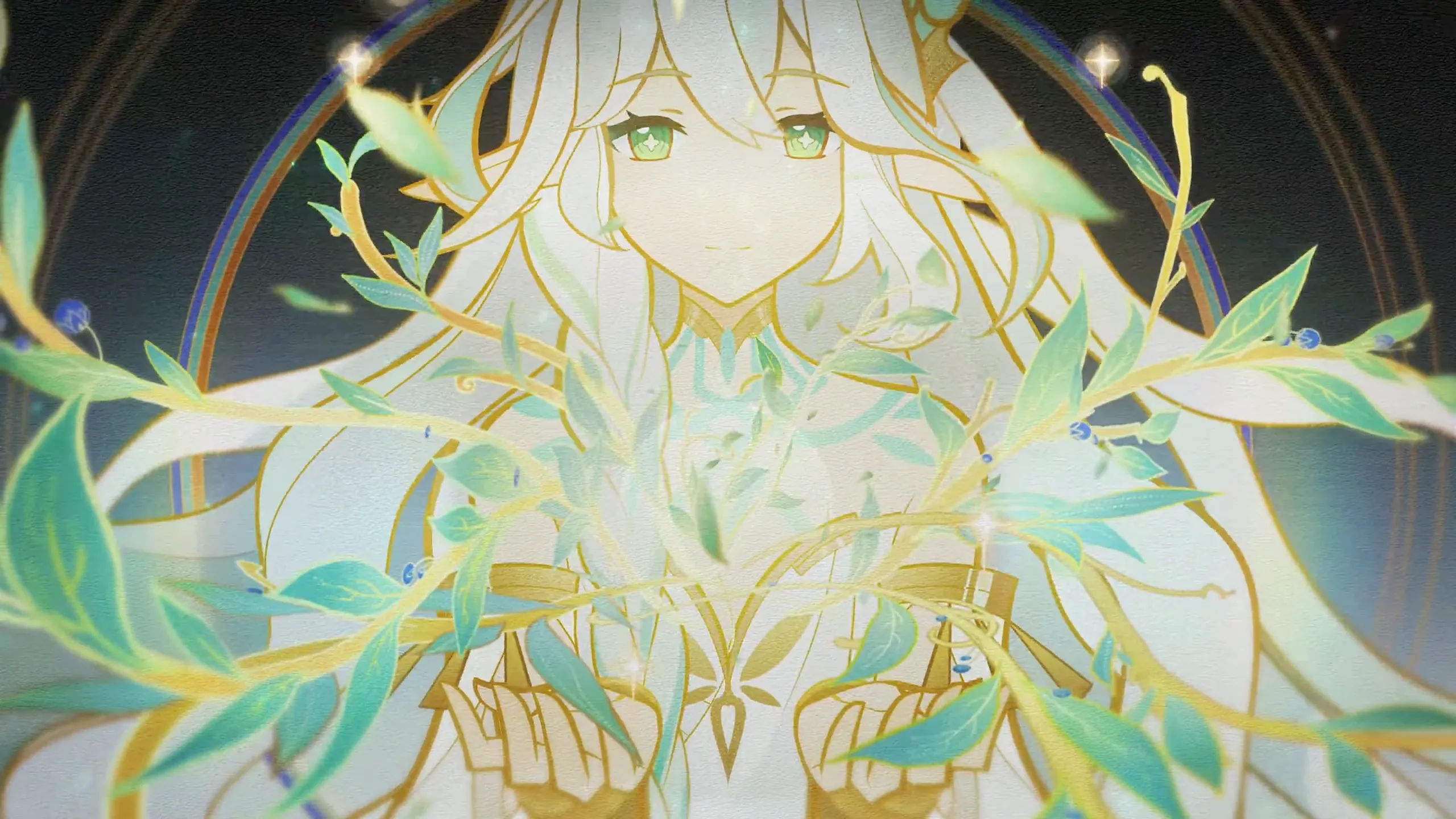
Pre-Cataclysm Sumeru rainforest god; original Dendro Archon of The Seven; avatar of Irminsul; one of the Three Eternal Companion-Gods with King Deshret and Nabu Malikata; died at the Cataclysm 500 years ago at Tunigi Hollow / Irminsul; erased from the world's memory at AQ III Act V by Nahida's edit to Irminsul
Overview
Greater Lord Rukkhadevata was Sumeru's original Dendro Archon and the avatar of Irminsul.
She ruled with King Deshret and Nabu Malikata as the Three Eternal Companion-Gods.
She nurtured the rainforest, created the Aranara, and founded the Akademiya.
She died at the Cataclysm and created Nahida as her successor.
Her legacy still shapes present-day Sumeru, from the Aranara to the Akademiya she founded.
Greater Lord Rukkhadevata was the original Dendro Archon of Sumeru and the living avatar of Irminsul, also called the God of Wisdom, the Lord of Verdure, and Queen Aranyani to the Aranara. She co-ruled with King Deshret and Nabu Malikata, nurtured the rainforest, created the Aranara, and founded the Akademiya, spending much of her power to hold back the forbidden-knowledge outbreaks that twice forced her to regress into a childlike form. She died at the Cataclysm protecting Irminsul, having first made the Akasha System and her successor Nahida.
Spoiler-free overview. You hid spoilers under Settings → Reading; choose Show all there to read the full content.
Greater Lord Rukkhadevata is the original Dendro Archon of Sumeru: the God of Wisdom, the Lord of Verdure, Queen Aranyani to the Aranara, the God of the Woods to those who knew her only by title, and the avatar of Irminsul in the most literal sense the canon offers. She was already old by the close of the Archon War two thousand years ago, when she travelled to Liyue to drink with the first iteration of The Seven. She died at the Cataclysm five hundred years ago. Her successor is Nahida, formerly Buer / Lesser Lord Kusanali, created from the purest branch of Irminsul in her final moments. At the close of AQ III Act V Akasha Pulses, the Kalpa Flame Rises, Nahida was forced to remove Rukkhadevata from Irminsul entirely to purge the forbidden-knowledge contamination her death had not closed; the world's memory of her was rewritten so that no being native to Teyvat recalls her clearly. The only exception is the Outlander, who is immune to Irminsul edits. [1][3]
Six things to get right
Original Dendro Archon, not Dendro Sovereign. Rukkhadevata holds the Archon seat, the avatar of Irminsul whose successor line the Akademiya carries on. The Dendro Sovereign seat belongs to Apep. The Greater Lord title marks her against Nahida (Lesser Lord Kusanali); it does not imply Sovereign-level authority. [1]
1.
Greater Lord Rukkhadevata - Genshin Impact Wiki (Fandom) · external ↗
2.
King Deshret and the Three Magi - Genshin Impact Wiki (Fandom) · external ↗
3.
Where the Boat of Consciousness Lies - Genshin Impact Wiki (Fandom) · external ↗
4.
Akasha Pulses, the Kalpa Flame Rises - Genshin Impact Wiki (Fandom) · external ↗
5.
What Shape Does the Self Hold - Genshin Impact Wiki (Fandom) · external ↗
6.
Khvarena of Good and Evil - Genshin Impact Wiki (Fandom) · external ↗
7.
The Dirge of Bilqis - Genshin Impact Wiki (Fandom) · external ↗
8.
Vourukasha's Glow - Genshin Impact Wiki (Fandom) · external ↗
9.
Flower of Paradise Lost - Genshin Impact Wiki (Fandom) · external ↗
10.
Viridescent Venerer - Genshin Impact Wiki (Fandom) · external ↗
11.
Gilded Dreams - Genshin Impact Wiki (Fandom) · external ↗
12.
Nahida/Lore - Genshin Impact Wiki (Fandom) · external ↗
Avatar of Irminsul. Per Where the Boat of Consciousness Lies, her existence and Irminsul are one and the same: because she was the avatar of Irminsul, when forbidden knowledge corrupted Irminsul, it had corrupted her very existence as well. That is why her death alone could not purge the contamination, and why Nahida had to remove her from Irminsul outright at AQ III Act V. [3]
Three Eternal Companion-Gods. Pre-Cataclysm Sumeru was held jointly by Rukkhadevata, King Deshret, and Nabu Malikata, each holding a different aspect of wisdom. This is the peaceful-sharing exception among the regions: Sumeru never saw a Sovereign-killing Archon War the way Pyro, Hydro, and Electro did. [2][15]
She broke with the other two over Celestia. Per Vourukasha's Glow - Feast of Boundless Joy: when Nabu Malikata and King Deshret began to propagate a plan to turn against Celestia, Rukkhadevata refused to join them, broke ties, returned to the forest, and took up the path of defending life. [8]
She regressed twice. Rukkhadevata is the second god shown to physically shrink after pouring her power into the land: first when she suppressed Deshret's forbidden-knowledge outbreak, regressing from adult to child form; second during the Cataclysm itself, regressing further to Nahida's stature. Grounded Geoshroom remarks did you get smaller again? on encountering her remnant. [5]
She was not summoned to Khaenri'ah. Per Where the Boat of Consciousness Lies, Rukkhadevata was the only one of The Seven not summoned to fight in the Cataclysm-era assault; protecting Irminsul was a more important task. Her Cataclysm-era work was the Akasha System and the forbidden-knowledge purge, not the Tunigi Hollow front. [3][17]
The Three Eternal Companion-Gods era
After the war of funerary flame concluded, one of the Heavenly Principles' Celestial Nails struck Sumeru to mend the land; the strike devastated and transformed most of verdant Sumeru into the desert now known as the Great Red Sand and suppressed the Dendro Dragon Apep, forcing it to adapt to the new environment. The Nail's protrusion remains visible above the present-day Vourukasha Oasis. [9][11]
It is unclear when Rukkhadevata came into being. The earliest legends frame her as the princess of an area where the forest still thrived; as avatar of Irminsul she was likely born from the tree itself. Nabu Malikata (a Seelie survivor, the Goddess of Flowers, co-ruling Ay-Khanoum with the desert king) heard of Rukkhadevata's wisdom, sought her out, tested her with riddles, and forged an alliance with her; King Deshret chose to share his throne with the two of them. The three came to be known as the Three Eternal Companion-Gods, each focused on a different aspect of civilization, their subjects remembering the era as one of peace and ease. A chair inscribed with Rukkhadevata's name still stands in the Orchard of Pairidaeza beside the chairs of her companions; the location's unusual properties preserved it through the edit to Irminsul at AQ III Act V. [1][8]
The alliance ended over Celestia. Nabu Malikata foresaw the coming of the Cataclysm and embraced her own fate: to die leading King Deshret on the path of understanding forbidden knowledge, in hopes of one day overturning the Heavenly Principles. Before that, she entrusted Rukkhadevata with a part of herself, a Khvarena of Flowers. Rukkhadevata found the plan unacceptable, broke ties, and took up the path of defending life. Nabu Malikata waited for her to return; she never did. [8][1]
After the break, Rukkhadevata established her own territory by nurturing a rainforest in a section of the desert. She built the Varuna Contraption, a moonlight-reflecting structure whose labyrinthine image gave birth to the tiger-like divine beast Viaghara, the first lord of the forest. She created the Aranara, small plant-like dream-keepers; together with the lords of the forest they defended the Contraption. With her scholar-followers, who would go on to establish the Amurta Darshan of the Akademiya, Sumeru's academy of scholars, she revived the rainforest, raised Sumeru City on the Divine Tree, and erected the Wall of Samiel at the forest-desert border to halt the desertification. [1]
The forbidden-knowledge incident with King Deshret
Thousands of years ago, long after the alliance of the Three Eternal Companion-Gods had ended, King Deshret's pursuit of his ideal world inadvertently released forbidden knowledge into his kingdom. People heard crazed whispers in their heads; the disease Eleazar, the form the Withering takes on human bodies, began to spread. Rukkhadevata came to the aid of Deshret's people on account of her old friendship with him; she gathered them, had them build temples, and infused the temples with the divine power of life to suppress the forbidden knowledge. The work cost a great deal of her power and caused her to regress into a childlike form, the first of her two recorded physical regressions. Even this was not enough; in the end, King Deshret sacrificed himself to finally end the outbreak. [2]
Deshret's people were saved. His civilization was not. The sudden death of their god, already strained by Liloupar's orchestrated destruction of the vassal state of Gurabad, fragmented the desert into short-lived city-states (Tulaytullah, Saleh, a new Gurabad). The Valuka Shuna fox-folk, formerly Deshret's subjects, survived only by Rukkhadevata's grace and migrated into the rainforest; Tighnari's lineage descends from this migration. After the city-states era, Rukkhadevata reconstructed the Khvarena Nabu Malikata had entrusted to her into the divine bird Simurgh, tasking her with guarding the border between new birth and death. [1][8]
The promise to Apep's creature is the real event behind the story that she wounded Apep, and a faithful reading of it is materially different. Per Nahida's Story Quest Sapientia Oromasdis Chapter Act II Homecoming: in her weakened state after the Deshret incident, Rukkhadevata promised one of Apep's creatures that she would erase the apocalypse, the forbidden-knowledge corruption Apep had taken on due to her consumption of King Deshret's corrupted body following his death. She blessed the creature with enough life force to survive in The Chasm; together they made the Fire Seed, designed to reactivate the Heart of Oasis inside Apep and cure the dragon. Because Rukkhadevata was already weakened, the Fire Seed was unstable, and Nahida completes the promise after AQ III Act V. So Rukkhadevata's relationship with Apep is about the cure, not the wound: Apep was first suppressed by the Heavenly Nail and later infected by Deshret's body. One older reading on this wiki frames the alliance ending as both grievously wounded; Rukkhadevata sacrificed herself to wound Apep further, but the primary-text trail does not directly support it. [5][14]
When the Archon War concluded two thousand years ago, the first iteration of The Seven gathered in Liyue to drink with Rex Lapis; Rukkhadevata attended. That original group has since lost five members (Makoto, Egeria, the Belyi Tsar, Mavuika at her first ascension, and Rukkhadevata herself); only Barbatos and Morax remain. [1][15]
The Cataclysm: Tunigi Hollow, Irminsul, and the Akasha System
Five hundred years ago, Khaenri'ah's increasing use of forbidden knowledge culminated in an overflow of Abyssal powers and monsters into Teyvat. The Withering spread uncontrollably across both forest and desert; the era's name for it was the Black Tide. To end the devastation, Rukkhadevata embarked on a final journey with some of her followers and never returned. The final king of the forest perished defending it; the Aranara only managed to save the forest with the help of the Traveler's Sibling, whom they call Nara Varuna in gratitude. As a result of her death, the grass and trees never spoke again to Viridescent, per the Viridescent Venerer's Determination artifact text, which survived the removal. [1][10]
At Tunigi Hollow, the main rift where the Abyssal creatures emerged, the gods battled the Abyss at heavy cost. When the former Hydro Archon Egeria was killed, her remains formed the water called Amrita; Rukkhadevata grew the Harvisptokhm from the Amrita to anchor Egeria's consciousness (inside the lotus Gaokerena) and to maintain the seal on the Abyssal rift. Simurgh then awoke, drank from the Amrita, and turned into countless motes of Khvarena to purify it of Abyssal taint; the resulting specks created various lifeforms, including the Pari. [6]
Rukkhadevata is implied to have died before Simurgh completed her sacrifice. At the moment of her death she was at Irminsul, not at Tunigi Hollow. Protecting Irminsul was a more important task; forbidden-knowledge pollution had reached the tree and was actively corrupting it. She created the Akasha System to borrow her citizens' wisdom in the form of their dreams and used her divine strength to purge the contamination, as she had during the Deshret incident millennia earlier. [3]
But because she was the avatar of Irminsul, when forbidden knowledge corrupted Irminsul, it had corrupted her very existence as well. Even if she died, she would live on in memories, and Irminsul could not be fully purified of forbidden-knowledge contamination as long as memories of Rukkhadevata persisted. Because it was impossible for Rukkhadevata to erase herself, she created Lesser Lord Kusanali (Nahida) from the purest branch of Irminsul to be her incarnation in the next samsara. She left a trail of clues for her successor and for the Outlander, beginning with the verbatim phrase "Let the world completely forget me." [3]
That she was at Irminsul at the moment of death is direct primary text. The popular idea that her body diffused into the Ley Lines, which some readings tie to Apep, is not directly attested, either in the world quest The Dirge of Bilqis or in the disclosure about the Heart of Oasis in Welkin Moon Act IX. Apep's cosmology in Welkin Moon Act IX covers the broader mechanism (the Ley Lines once flowed with Light Realm power, and the Heavenly Principles refashioned Irminsul and used it to anchor the world's fate) but does not say specifically that Rukkhadevata's body diffused into the Ley Lines. [20] The reading the sources support runs through Irminsul instead: she is the avatar of Irminsul, her existence is one with it, and removing her from Irminsul removes her existence. [1][3]
Aftermath: idolization, sage misinformation, and the Sanctuary device
Rukkhadevata was remembered in Sumeru as the goddess who had protected Sumeru since time immemorial. Her devoted scholars founded the Akademiya; the Akasha System, powered by the Dendro Gnosis, was considered her legacy and was modified after the Cataclysm into the public service for retrieving information that ran across Sumeru City until AQ III Act V. [1]
After Rukkhadevata's death the Sages searched for her. They found Lesser Lord Kusanali, who bore a great physical resemblance to her predecessor, and brought her to Sumeru City. The people initially rejoiced and changed the Sabzeruz Festival's date to celebrate her birthday. But on examination the Sages found the new god was barely any different from an ordinary human child. Disappointed, they locked her in the Sanctuary of Surasthana and shifted their focus back to espousing Rukkhadevata's legacy. The Sanctuary device imprisoning Nahida had originally been built by Rukkhadevata as a personal meditation chamber; the post-Cataclysm Grand Sage reprogrammed it so it could only be controlled from outside, effectively trapping one god with the power of another (per Alhaitham, AQ III Act V Jnagarbha Day). Over the centuries, partly through Akademiya misinformation, the people of Sumeru forgot the true history. Some came to believe a battle between Rukkhadevata and Deshret created the desert; fanatic Deshret followers came to view her as a traitor who took the place of Archon. The primary text calls this plainly a perversion of the truth. [1][3][2]
Removal from Irminsul at AQ III Act V
The Sumeru Archon Quest culminates in AQ III Act V Akasha Pulses. After the Outlander helps Nahida defeat Shouki no Kami and briefly recover the Electro Gnosis, Nahida uses the Dendro and Electro Gnoses together to enter Rukkhadevata's realm of consciousness and learn the purpose for which she was created. Despite her unwillingness, she has no choice but to eliminate Rukkhadevata from Irminsul to completely remove the forbidden-knowledge contamination her death alone could not close. [3]
Afterwards, the consequences of forbidden knowledge, crazed whispers, the Withering, and Eleazar, disappear. Rukkhadevata herself is written out of history. While she still existed, no one remembers her. The Akademiya's motivation for imprisoning Nahida is rewritten as pure disappointment in her weakness. NPC dialogue and Aranara Queen Aranyani references become the Dendro Archon or Lord of Verdure; the forest spirits forget their own creator. Item Archive descriptions of Kalpalata Lotus, Rukkhashava Mushrooms, Harra Fruit, The Boon of the Elder Tree, and The Folio of Foliage lose their references. Nahida herself forgets, and now believes she has always been the original Dendro Archon who lost her memories combating the darkness during the Cataclysm. [4][1]
A few references persist. The Rukkhashava Mushrooms description is rewritten to clarify the name now refers to a giant tree that once existed in Sumeru. One throne in the Orchard of Pairidaeza still spells RUKDVTA in Deshret Script. Artifacts untouched by the edit to Irminsul keep her name: Viridescent Venerer's Determination and the weapon Fruit of Fulfillment. Character Story 5 and Nahida's Gnosis-text were not unlocked until after the removal and so were never overwritten. The Outlander remembers, being immune to Irminsul; Nahida's About The Seven: Introduction voiceline frames Rukkhadevata as a friend who only lives in my memories now... my memories are the sole proof that she existed in this world. The only being native to Teyvat that managed to remember her is the Elemental Being: Grounded Geoshroom in What Shape Does the Self Hold. Its memories from the time of the apocalypse preserved her name in a form Irminsul could not reach to overwrite, though by the Story Quest it comes out distorted and is rendered as a blacked-out subtitled line. [1][12][5]
How she connects
Nahida is the successor made from the purest branch of Irminsul, carrying a fragment of Rukkhadevata's consciousness. She keeps Rukkhadevata's promise of the Fire Seed in Homecoming, where the seed shatters but the Heart of Oasis is revitalized and Apep is cured. [1][5] In Welkin Moon Act IX, Apep repays that help: "to receive aid without repaying it would likewise tarnish a dragon's dignity," she says, and the Heart of Oasis then supplies the comatose Nahida with life force. [20] Apep is the Dendro Sovereign suppressed by the Heavenly Nail and later infected by Deshret's corrupted body; their relationship is the cure through the Fire Seed, not a wounding. King Deshret, the desert king whose forbidden-knowledge pursuit she broke with, and Nabu Malikata, the Goddess of Flowers who entrusted her with the Khvarena that became Simurgh, each have their own page; the Sumeru region page and Nicole Reeyn carry the Welkin Moon Act IX reveal that Nabu Malikata's fragments survive in Nicole. For background, the Seven Archons (Sumeru as the peaceful-sharing exception, and the Dendro line from Rukkhadevata to Nahida), Seven Sovereigns (the Sovereign rank as distinct from the Archon rank, with the Dendro Sovereign's seat held by Apep), Cataclysm, and Irminsul pages carry the rest.
Rukkhadevata was the original Dendro Archon and the avatar of Irminsul itself. She co-ruled Sumeru with two other gods before breaking with them over Celestia, nurtured the rainforest, created the Aranara, founded the line of scholars behind the Akademiya, and tried twice to suppress outbreaks of forbidden knowledge. The second attempt killed her. Before dying she snapped off the purest branch of Irminsul and made it into a smaller, simpler god, Nahida, to carry her unfinished work forward. Five hundred years later, the Outlander helped Nahida finish the purge by removing Rukkhadevata herself from the world's memory. Outside one Descender, one stubborn shroom, and a handful of artifacts the world-tree could not reach, nobody in Teyvat remembers her name anymore.