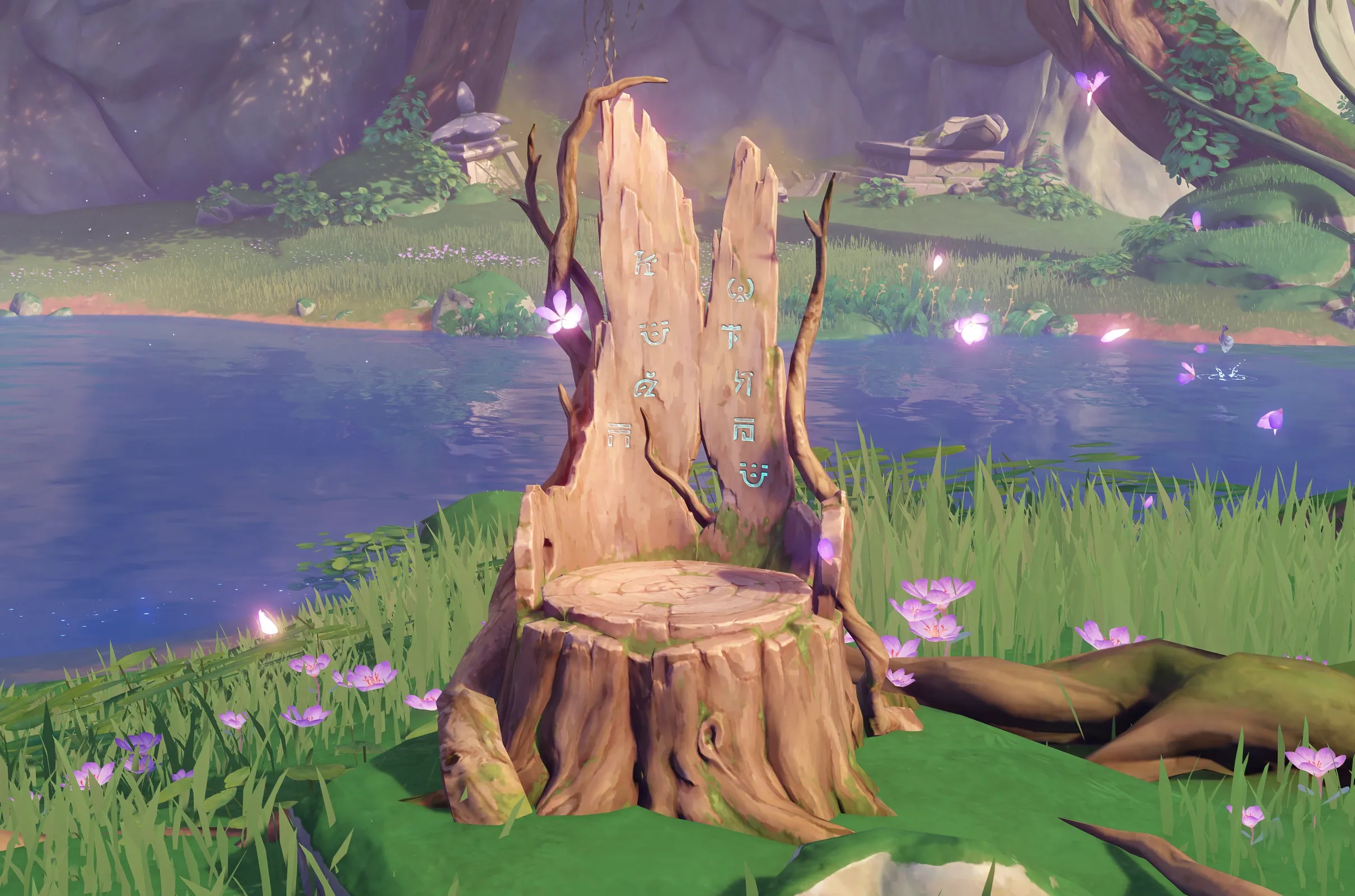
Pre-Cataclysm Sumeru desert; one of the three God-Kings of Sumeru alongside Greater Lord Rukkhadevata and King Deshret. She died thousands of years ago, before King Deshret; the last known fragment of her remains, carried by Collei, was removed in Welkin Moon Act X.
Overview
Nabu Malikata was Sumeru's pre-Cataclysm Goddess of Flowers.
She ruled with Greater Lord Rukkhadevata and King Deshret as the three God-Kings of Sumeru.
She created the Jinn and the Khvarena and originated the Sabzeruz Festival.
A survivor of the Angelic race, she kept her original form when others became Seelies.
She died granting King Deshret divine knowledge; her last known fragment, carried by Collei, was laid to rest in Welkin Moon Act X.
Nabu Malikata was the pre-Cataclysm Goddess of Flowers, one of Sumeru's three god-rulers alongside Greater Lord Rukkhadevata and King Deshret, and a rare survivor of the Angelic race. She originated the Sabzeruz Festival and created both the Jinn and the Khvarena. She died thousands of years ago by her own choice: she used her lingering connection to Celestia to grant King Deshret divine knowledge and was burned to ashes for it, and sandstorms then swept across the kingdom she shared with Deshret.
Spoiler-free overview. You hid spoilers under Settings → Reading; choose Show all there to read the full content.
The pre-CataclysmSumeru Goddess of Flowers was one of the three pre-Akademiya gods who governed Sumeru together, alongside the Dendro Archon Greater Lord Rukkhadevata and the desert god King Deshret. She died thousands of years ago, by her own choice. Per the Flower of Paradise Lost artifact set she used her body "as a conduit" to see King Deshret's "deepest desires be made manifest," and in Welkin Moon Act X Thoth says that for Deshret's sake "she pried into the secrets of Celestia, and for this was burned to ashes by the flames of wrath." Sandstorms then swept across the kingdom she shared with Deshret. A fragment of her remains survived inside Collei, as Nicole Reeyn reveals in Welkin Moon Act IX, until the Jinni Liloupar removed it in Act X. [1][2][21][11][22]
Names and titles
Nabu Malikata is the formal name. Etymologically is the ancient Mesopotamian god of literacy and wisdom, depicted in horned cap, and is a form of the Arabic / Middle Persian meaning . In the Eternal Oasis her name is written in Deshret Script.
1.
Nabu Malikata - Genshin Impact Wiki (Fandom) · external ↗
2.
Flower of Paradise Lost - Genshin Impact Wiki (Fandom) · external ↗
3.
Amethyst Crown - Genshin Impact Wiki (Fandom) · external ↗
Her main title is Goddess of Flowers (Chinese 花神 Huāshén; Japanese 花神 Kashin), used across the Oasis Garden weapon-ascension series, the Flower of Paradise Lost artifact set, the Sabzeruz Festival's Chinese title 花神诞日 Birthday of the Goddess of Flowers, and Nilou's Padisarah voiceover. The longer list of epithets runs: Lord of Flowers and Lord of Joy and Happiness (Oasis Garden's Reminiscence); Mistress of Dreams (Oasis Garden's Kindness); Mistress of Flowers and Oases (Oasis Garden's Mourning); Mistress of Pushpavatika and Queen of All Oases (Dirge of Bilqis world quest); Queen of the Garden (Tanit Camps interactable); Mistress of Flowers (Eternal Dream, Ever Lush). [4][7][5]
Two titles that surface in fan discussion are not actually attested, and the wiki does not adopt them: Lord of Flowers and Moonlight (only Lord of Flowers is attested; the gentle moonlight phrasing from the Honeyed Final Feast artifact is only likely her per the artifact's own footnote, not a stated title), and Goddess of the Three Realms (no attestation, a framing that conflates the Three Moon Goddesses cosmology with her place in the Sumeru triad). Bilqis is a tentative personal name per the Dirge of Bilqis trivia (the world quest unlocks her cemetery, and there is a parallel with the mythology of the Queen of Sheba); the wiki keeps it as tentative rather than asserted. [1]
The Angel-race survivor
Nabu Malikata is a survivor of the Angels, a race Fandom describes as "created by the Heavenly Principles" to guide humanity as envoys of Celestia. [1] In the Amethyst Crown artifact, the Lord of Flowers recalls that "invaders descended from beyond the firmament, bringing with them destruction, overturning rivers, spreading plagues," that they "brought war to my former kin," and that "the master of the heavens, consumed by fear for the rising tide of delusion and breakthroughs, sent down the divine nails to mend the land, laying waste to the mortal realm." The artifact names neither the invaders nor the master; Fandom's annotations link them to Nibelung and the Heavenly Principles. [3] The Angels were cast aside by the heavens for some unconfirmed sin, punished by having their minds stripped. Most became Seelies; Nabu Malikata was able to maintain her original form. [2]
Her survival as an Angel matters in two ways. First, it makes her old: she remembers a Teyvat from before the seven-Archon system, much as Apep remembers the same era from the side of the Light Realm Sovereigns. Second, it ties her to Nicole Reeyn, another surviving Angel who kept her form and power, and the one who recognises the fragment of Nabu Malikata inside Collei in Welkin Moon Act IX. [1][17][12]
The Sumeru triumvirate: Three God-Kings
Sometime during the Archon War, Nabu Malikata met Rukkhadevata and King Deshret. Deshret shared his throne with the other two, and the three were known as the God-Kings of Sumeru, friends who each pursued their own paths towards wisdom. The Sumeru gods of that era were the exception to the rule that gods warred for the seven divine seats: they forged an alliance instead of fighting for the Dendro Archon seat. King Deshret, Greater Lord Rukkhadevata, and Nabu Malikata held the pre-Cataclysm positions together. [1][20][14] Apep, the Dendro Sovereign, stood outside that alliance. In Welkin Moon Act X, Sobek says "The Dendro Dragon despised King Deshret" and that "they fought numerous times, but usually the battle ended in a draw." [21]
The three split their roles across the desert and rainforest. Rukkhadevata held the rainforest, Deshret the desert kingdom, and Nabu Malikata the desert's gardens: the Eternal Oasis, the Padisarah-blooming groves, the dream-world the Jinn would later inherit. The Honeyed Final Feast artifact casts the three as blazing golden sun (Deshret), emerald fields (Rukkhadevata), and bright silver moon (Nabu Malikata, the gentle moonlight the artifact footnote identifies as likely her). [4]
The Sabzeruz Festival
Nabu Malikata originated and gave her name to the Sabzeruz Festival, Chinese 花神诞日 Birthday of the Goddess of Flowers. The festival first marked Greater Lord Rukkhadevata's birthday; after Rukkhadevata's Cataclysm-era death it was redirected to celebrate her successor Nahida (Lesser Lord Kusanali). [1]
The Sabzeruz Festival is Sumeru's main recurring public festival, and AQ Chapter III Act II The Morn a Thousand Roses Brings opens on Sumeru City preparing for it; the time loop of Scaramouche and the Sages, which traps the Outlander, is a fake Sabzeruz Festival the Sages were running on the Akasha terminal. The name survives the handover in the Cataclysm era: Sumeru still keeps a festival of the Goddess of Flowers in honour of a Dendro Archon (Rukkhadevata, then Nahida), so Nabu Malikata's legacy lives on in the festival's name even though it no longer honours her. [5]
Ay-Khanoum and the Jinn
Nabu Malikata built the ancient desert civilisation of Ay-Khanoum with King Deshret as an earthly paradise. Deshret held an unreturned love for her per the Oasis Garden's Truth artifact; whether she ever returned it, primary text does not say. [1][4]
The Jinn are her creation. Per the Flower of Paradise Lost text, after the Angel race was punished by the Heavenly Principles she wandered the barren wastes for 72 days. Springs gushed from her wounds, became streams that flowed into gardens, water lilies grew, and the Jinn were born from those water lilies. The first Jinn begged her to stay, and she relented. Wherever she stopped, purple flowers resembling the moon bloomed: these were the Padisarahs. The Jinn lived in Ay-Khanoum alongside her and Deshret; the Scroll of Streaming Song, written in a Jinn's own voice, opens I am a spirit created at the beginning. [2][1][10]
The Khvarena gift to Rukkhadevata
At some point Nabu Malikata foresaw the cataclysm. Per the Vourukasha's Glow - Vibrant Pinion artifact, she created a shard of Khvarena, which she called her daughter, destined to become the divine bird Simurgh. The Simurgh's fate was to sacrifice itself during the cataclysm to save the Amrita from abyssal corruption, the event the Khvarena of Good and Evil quest chain anchors in present-day Sumeru. She gave the shard to Rukkhadevata because she believed that Rukkhadevata's light was more radiant than hers, a moment of cooperation among the Sumeru triad that today's Khvarena and Simurgh descend from. [8]
The break with Rukkhadevata; the alliance with Deshret
Nabu Malikata warned King Deshret against pursuing forbidden knowledge, the Heavenly Principles, or the mysteries of the stars and abyss, citing the downfall of her own Angel race and the Celestial Nails the Heavenly Principles had cast on the civilisations below as a warning. Per the Amethyst Crown: Deshret remained undeterred and told her about his ambitions. Per the Secret-Keeper's Magic Bottle and Wilting Feast: Nabu Malikata was persuaded by the thought of rebellion and decided to assist him in seeking the hidden knowledge. [2][1]
Greater Lord Rukkhadevata was heartbroken by her fellow God-Kings' plans. She shepherded her own people away to build an oasis in a corner of the desert, leaving Nabu Malikata to wait for a return that never came. The primary text frames the break as Rukkhadevata's withdrawal rather than Nabu Malikata's defection; the rainforest side parted from the desert side here, and the peaceful-sharing triad ended.
How did Nabu Malikata die?
The sources tell one story at different levels of detail: she chose to die so that King Deshret could reach the knowledge he wanted.
The Flower of Paradise Lost set gives the fullest account. Per the Secret-Keeper's Magic Bottle: "I shall fashion you a bridge to allow you to slake your deepest wants. But you must fear not the crystalline sapphire nail..." and Using her body as a conduit and offering the oasis in trade, she let the dazzling radiance consume her to see his deepest desires be made manifest... Sandstorms swept in revelrous havoc across the paradise that was now missing one of its gods, folding the skies with yellow sand, swallowing all in calamity... Fandom links the crystalline sapphire nail to the Celestial Nails. It also says she is suggested to have known she would be punished by death and to have gone ahead so that the bitterness of her death would preserve her legacy, an intention Deshret, who loved her, never realised. [2][1]
Thoth gives the plainest version in Welkin Moon Act X: "All the great changes in Sumeru's history began with the Goddess of Flowers. For King Deshret's sake, she pried into the secrets of Celestia, and for this was burned to ashes by the flames of wrath." Fandom records her as "Killed by the Heavenly Principles prior to the game's events." [21][1]
AQ III Act IV does not tell her death and never names her. The record of Kasala, one of King Deshret's last priests, which that act uncovers, covers a later disaster: the forbidden knowledge Deshret brought into his kingdom, which Rukkhadevata helped contain before Deshret sacrificed himself. [6][24]
The aftermath, the paradise swallowed by yellow sand and one of the three gods fallen, is attested across the Dream of Scorching Might, Honeyed Final Feast, and Tale of Shiruyeh and Shirin texts. A framing that blames the Decade of Thunder famine is not attested for Nabu Malikata at any grade, and the wiki does not adopt it. [4][9]
Post-death legacy
The original Padisarah flower went extinct with her death. Rukkhadevata attempted to recreate the flowers in her friend's memory but was unable to replicate its original shade of purple: Sumeru kept the form but not the original. [1] Per Nilou's Interesting Things - Padisarahs voiceover: "When the Goddess of Flowers danced, real Padisarahs would bloom underneath her feet." That dance tradition is one of the ways modern Sumeru still carries Nabu Malikata's name.
After her death King Deshret deceived the Jinn into becoming his servants: he told them the Goddess of Flowers was merely in a deep slumber, and in exchange for the Jinn's power he promised to help them find her. This is the grievance between the Jinn and Deshret that the Dirge of Bilqis world quest later resolves, freeing Liloupar and the other Jinn. Deshret built the Orchard of Pairidaeza in the Desert of Hadramaveth as a cemetery for her; per the A Moment Congealed artifact text the orchard is the mourning ground he raised in her memory, and the Dirge of Bilqis quest series is the present-day quest that unlocks it. [1][7]
Welkin Moon Acts IX and X: the fragment in Collei
In Welkin Moon Act IX Ancient Shadows Re-Emerge (Luna VII / patch 6.6), a quiet scene with the Sumeru group carries the act's heaviest reveal about Nabu Malikata. Nicole Reeyn asks Collei, "are you aware that there are god remains inside your body?" "...I am," Collei answers. As a sick child sent away on the Fatui's promise of a cure, she was injected with "some strange medicine... which I heard contained god remains." Nicole names them: "Those were the remains of Nabu Malikata... the Goddess of Flowers." Collei says knowing "a fragment of the Goddess of Flowers is inside my body" is "a strange feeling," and Cyno reassures her that, just as the Hermanubis fragments within him do not make him Hermanubis, "you are simply you." [12][11]
The reveal ties together three threads. Nabu Malikata's fragments survived into the present day. After her death, Nicole says, "her remains were scattered across the desert"; King Deshret buried what he could find in the Eternal Oasis, "but some fragments remained unaccounted for," and she tells Collei that of all the children injected with god remains, "only in you have her fragments persisted." [12] It also shows that gods cannot be completely destroyed: her death ended her physical form, but her fragments persisted as divine remains that could pass into a living host. And it extends a pattern across the Sumeru triad: Nahida is the Dendro Archon after Rukkhadevata, Collei carried a fragment of Nabu Malikata, and King Deshret survives instead through the Seven Pillars of King Deshret. [20][15]
That fragment is gone now. In Welkin Moon Act X Your Past Is Like a Garden, the Jinni Liloupar, who asked Nicole to bring Collei to her, tells Collei, "My mistress left her final trace in this world upon you." With Collei's consent she removes the remains of the Goddess of Flowers, and the light fades from her bottle as she disappears. "Now that the remains are gone," Collei says, she does not "feel any different at all." Fandom describes it as Liloupar sacrificing her life "to remove the last fragment of the Goddess' body from Collei, laying her to rest for the last time." [22][1]
What we don't know
How the unaccounted-for fragments reached the medicine Collei was given, and why they persisted only in her. Nicole only guesses: "the Fatui must have found a way to track some of them down... Presumably for use in some experiment," and "I suspect it may be because of the firm will you showed in the face of suffering." [12]
Whether her foresight of the cataclysm went beyond the Khvarena shard. Vourukasha's Glow is the source specifically for the Khvarena shard and the Simurgh; any other preparation for the cataclysm on her part is not disclosed.
Whether the Bilqis personal name is intended. The trivia treats it as suggested, from the name in the funeral song and a parallel with the Queen of Sheba; primary text never states it directly.
Whether King Deshret reciprocated her romantic affection. Per Oasis Garden's Truth: Nabu Malikata was aware of King Deshret's affections for her, it is unknown if the feeling was mutual or not.
Exactly when she died. Fandom places King Deshret's death "thousands of years ago during the Archon war," and hers came before his, so it falls well before the Cataclysm 500 years ago; no exact date is given. [23]
Her threads run out through the Sumeru she helped govern. The Sumeru regional page and the Seven Archons page carry the triumvirate context, while the Archon Quest act King Deshret and the Three Magi shows the record of Kasala, one of King Deshret's last priests, on Deshret and Rukkhadevata. The fragment is revealed in Welkin Moon Act IX, where Nicole Reeyn identifies it inside Collei, and laid to rest in Act X by Liloupar. Apep is the Dendro Sovereign who despised Deshret and fought him many times; the Aranara carry the rainforest tradition of flowers and dreams that she prefigures; and the Three Moon Goddesses are a set from before the Heavenly Principles, kept distinct from the Sumeru triad.
In plainer terms, she was the third of Sumeru's three pre-Cataclysm gods, the one Deshret built the desert paradise with and Rukkhadevata stayed friends with longest. She survived the downfall of the Angels by keeping her own form, created the Jinn from her own wounds, originated the Sabzeruz Festival that today honours Nahida, and gave Rukkhadevata the shard that became the Simurgh. She died by her own choice, using her body as a conduit to give Deshret the knowledge he wanted, and was burned to ashes for it; the kingdom she shared with him fell to the sandstorms that followed. A fragment of her survived inside Collei, identified by Nicole Reeyn in Welkin Moon Act IX, until Liloupar laid it to rest in Act X.