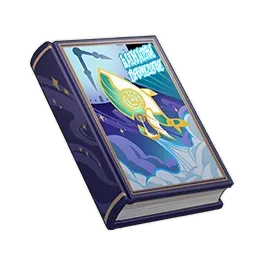
Time Trekker is a 3-volume Fontaine Book Collection released in Version 4.4. Each volume opens with the same standing description - "A Fontainian science fiction novel published by The Steambird. It tells the story of an engineer's travels using a time machine" - and the series treats its subject as fiction even while it threads through real Fontaine institutions (The Steambird, the Opera Epiclese, the Marechaussee Hunters, the Palais Mermonia) and the pre-Egeria past of Remuria. [1]
The salon frame and Ciric's announcement
Vol. 1 sets the frame at an evening salon attended by Ms. Aviva (today Lady Nenonen), a The Steambird editor, Dr. Reinier, Monsieur Ratar, and the engineer Neven Ciric. Ms. Aviva grouses theatrically that the ancestors have conquered the land and oceans and that the gravimeter-engineers will soon conquer the skies, leaving nothing romantic for her generation - citing "the legendary King Argeadai's words." Mr. Ciric, silent until then, interrupts: there is still one space humanity has not yet subdued - time - and he invites the company to his workshop in two months to witness "humanity's next great achievement: the conquest of time." [1]
The Remurian visit and the stone-slate riddles
Vol. 2 picks up two months later. Ciric has aged into something "indifferent and solemn, almost like the emaciated ascetics of Sumeru," and the time machine he presents is "a gold-plated whale-shaped model airship about the size of a small clock." He recounts his first cycle: emerging in a Remurian imperial settlement whose "grand temples and arenas carved of titanic stone would make the Opera Epiclese hang its head in shame, while the creations of Alain Guillotin would be little more than a child's wind-up toy before the towering Remurian golems." A local Aedile, Aidia Anavana, endures his "calamitous grammar and catastrophic accent" and shows him a square stone slate engraved with seven symmetrical sequences of palindrome-symbols ("these were not in Remurian script, but rather the characters we use today"); the slate's answer is a date set several hundred years after Remuria's fall. [1] [3]
Moment Zero and the mirror
Vol. 3 is where the story turns. Ciric describes crisscrossing past and future thirteen times following the stone-slates' ciphers: meeting Marechaussee Hunters in one cycle, reading a slate whose key is "the 5th word of the 37th page" of a bad romance novel that will only be published 300 years hence, another whose key is "the number of ribs on a skylark during Remurian times," and a final slate, from the underground storeroom of the Basil Elton Memorial Museum, that carries only the number "0." Setting the destination to zero, the machine deposits him above "a sea with no waves or tides" under "a dark red sky adorned with countless stars" - and beneath the placid surface he sees the Palais Mermonia "which should not be there." A mirror-image of himself appears and tells him: [1]
"The answer to time's riddle is a mirror … When two mirrors face each other, time is the infinite reflection of light therein … the Palais Mermonia had already sunk long before it was ever built, and the sunken Palais will be raised anew. Joy, sorrow, tears, and death must infinitely recur, for this is the nature of a mirror."
Ciric draws the firearm he keeps for self-defense, fires at the mirror-self, and returns to the salon. "I do not expect you to believe me," he tells the company. "Just take it as a bunch of bunk that I made up to cover up for my inability to make a time machine." The narrator's closing line is "I never saw Ciric Neven again." [1]
What survives the fiction-frame
The disclaimer is the fiction frame; the details underneath it are selectively real. All the characters' names are palindromes (Aviva, Neven Ciric, Aidia Anavana, Argeadai, Ratar), and the structure of a banquet recounted by a time-traveler mirrors H. G. Wells's The Time Machine. Both cues mark the narration as genre fiction rather than testimony. [1]
Three real anchors survive the fiction frame. The Remurian setting Vol. 2 visits fits the pre-Egeria civilization of Remuria, though the book names none of its known figures (Remus, Boethius, Cassiodor, the Four Harmosts, the Requiem, the Domus Aurea, Phobos). The Marechaussee Hunters are the lower ranks of Fontaine's Marechaussee investigators. And the Palais Mermonia is Fontaine's Court of Justice. The mirror-cosmology, "the answer to time is a mirror," infinite reflection, joy and sorrow and tears and death recurring forever, is the book's own invention, not the Egeria → Focalors → Furina prophecy resolved across Archon Quest IV. Its echo of a sunken Fontaine is suggestive rather than literal, and the book names neither Egeria nor Focalors nor Furina nor the Primordial Sea nor the Oratrice Mecanique d'Analyse Cardinale. [5]