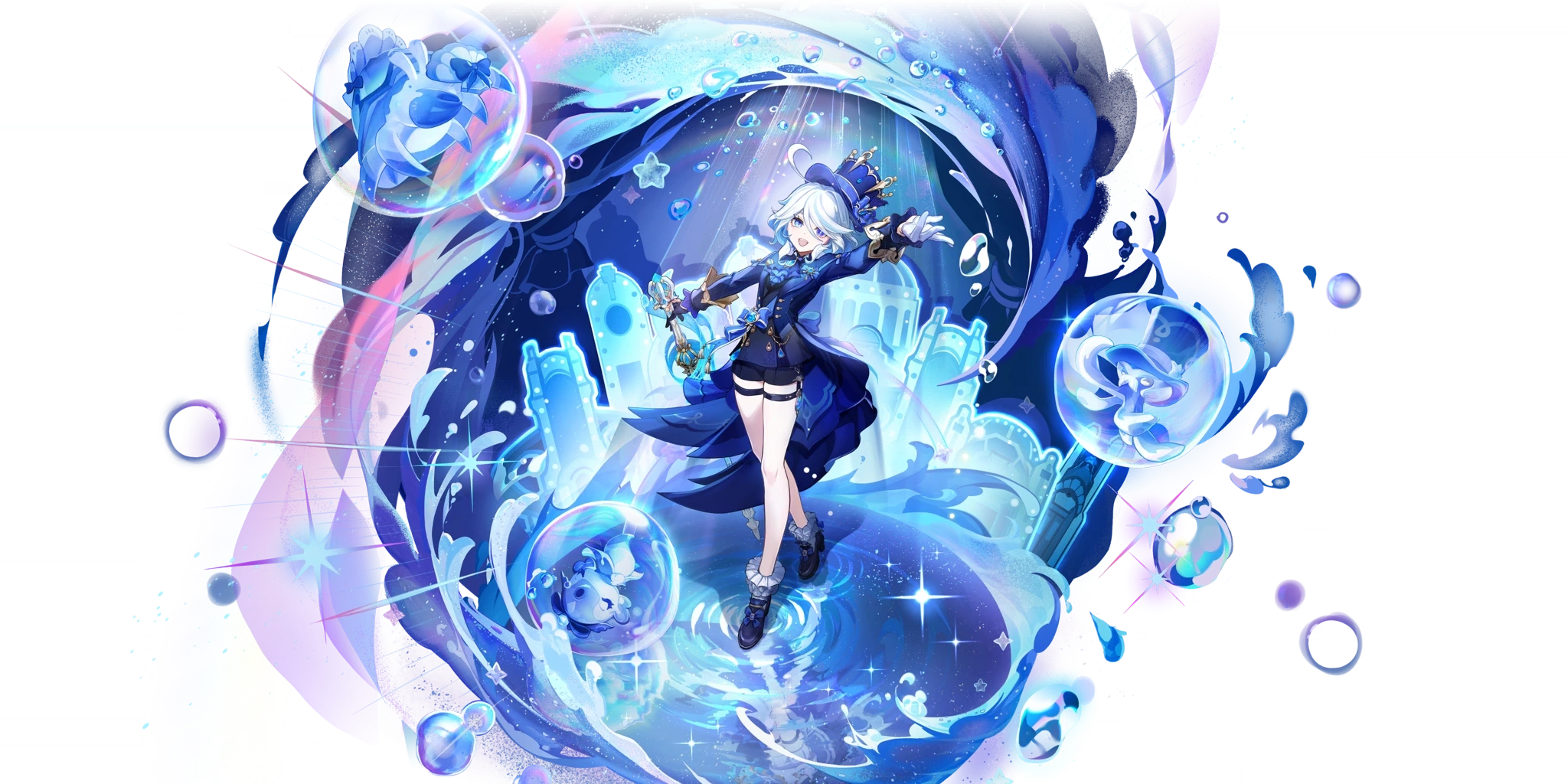


The most beloved person in Fontaine, the Hydro Archon Furina de Fontaine, has been giving the performance of her life for five hundred years. She is also, technically, not a god.
The actual Hydro Archon was Focalors. When she inherited the throne after Egeria's death, she found something the rest of Heaven didn't want her to share. Egeria's people, the Fontainians, were not technically human: they had been transformed from primordial waters, and a prophecy embedded in that transformation said that at some point in the future they would all dissolve back into the sea, leaving only the Hydro Archon weeping on her throne. Focalors's solution was to "outwit the Heavenly Principles," allowing the prophecy "to be fulfilled, ostensibly at least, while saving everyone at the same time." [17] She split herself in two. The split was Focalors's doing, not Egeria's. Egeria had been the first Hydro Archon, and she was killed at Tunigi Hollow during the Cataclysm; the split into divine and mortal halves came later, after Focalors inherited the Archon role as her stand-in. The deep-dive on Egeria and Fontaine's origin lays this out, and the cosmology section below walks through it.
In Focalors's own words, "After becoming a god, I separated my divinity from my body and spirit," and "the human counterpart I left behind, I named 'Furina.'" [10] The divinity hid inside the Oratrice, and Furina was given the task of pretending to be the Archon for as long as it took. Neuvillette, the Iudex of Fontaine, was never one of the halves. He is the Hydro Dragon in human form, and a letter he knew to be from Focalors invited him to come and see Fontaine. [11] [19] His invitation to serve as Iudex was also her idea, as he realizes in AQ IV Act V. [17]
Furina's job, for those five centuries, was "to play the part of the Hydro Archon in the prophecy," so that the prophecy might appear fulfilled. [17] She performed. She wore the gowns, she sang the operas, she turned the courtrooms into theater, she became the most theatrically vain monarch on record. And she did all of this alone: Focalors never let her in on the full plan, and Neuvillette didn't know either. [17]
The Fontaine Archon Quest catches her at the moment the prophecy comes due. She is stripped on stage in front of the people who loved her, exposed as no Archon at all, and accused of pretending to be one. She has nothing left to defend with except the truth, which she does not know in full. The Oratrice then passes judgment on "the Hydro Archon" instead of Furina: "To be punished via the death sentence." The sentence is Focalors's own design. It executes her and destroys the Hydro Archon's divine throne, returning the Hydro Archon's authority to Neuvillette, the Hydro Dragon, whose verdict makes the Fontainians "true humans" who will no longer dissolve. Furina abdicates and is free to live as an ordinary mortal. [17] [18]
She still sings.
A few facts:
- Furina never held divinity or a Vision. Focalors separated her divinity from the body and spirit that became Furina, who had no powers, and after AQ IV Act V Furina lived for a while as a mortal who could not fight without a Vision. She received her first Hydro Vision at the close of her Story Quest, "Animula Choragi Chapter": Paimon was supposed to lower a prop from the ceiling for the scene, but a real Vision appeared for her instead. She now carries an ordinary mortal Hydro Vision, not the authority of an Archon. [15]
- No one holds the Hydro Archon role now. Focalors was the second and last Hydro Archon: the Throne was destroyed with her, its authority over Hydro now belongs to Neuvillette as the Hydro Sovereign, and Furina gave up the political position to live as an ordinary Fontainian. [12]
- Furina's persona during her tenure, built for an audience the way a social-media personality is (the bows, the catchphrases, the dramatic faints), was real and also strategic. Casual readers tend to underestimate how lonely the performance was.
- The Tsaritsa got the Hydro Gnosis, but indirectly: it traveled through a different Harbinger after the prophecy resolved.
Chapter VII
The Holy Soil phenomenon finds Furina in Poisson, where "Navia and Clorinde invited me to Poisson to help set things up and gather supplies." Fontaine has no Nail of Retribution, which makes it "one of the few relatively safe places in the world at the moment... and a hotspot for refugees fleeing danger." In Act VI, A Yesterday Sent From Beyond, requests for help pour in about Natlanese travelers "showing signs of rapid memory loss," and with the Spina di Rosula "already stretched thin," she agrees with Navia to escort them home herself. She reaches the Stadium of the Sacred Flame with Ineffa and a group of returning Natlanese, then stays for the ceremony that opens a way into the Night Kingdom, joining it at the People of the Springs because, the shaman told her, "the more people who join the ceremony, the better." [20] [21]
Neuvillette, "being a dragon," will not go through the door in Chenyu Vale, so he asks Furina to represent Fontaine in Celestia: "Apparently, even though I stopped playing the Hydro Archon ages ago, he still thought I'd be the better candidate." She "couldn't really say no," and Mavuika flies her there on a "white-knuckle" flamestrider ride. In optional dialogue that Fandom records, Furina says she "already knew what my answer was without giving it a moment's thought." She has "helped make many films since leaving the stage behind" and loves the world those stories play out in, so "even if I'd never been a god, even if I were just some random, ordinary human being... I would still have every reason to stand up and give this everything I've got." [20] [22]
Nukvah's deadline shakes her. "I can't believe we only have 42 days left... As if one apocalyptic prophecy wasn't enough for one lifetime..." The Traveler reminds her, "We've beaten prophecy once before. We can do it again." She joins the others' resolve ("We have to find a way through this"), and when Paimon raises the missing Pyro Gnosis, it is Furina who proposes the search: "We'll scour every inch of Teyvat if we have to. We're all in the same boat now." In Born Toward the Flame, a World Quest added in Version 7.2, she is among the helpers from abroad when Natlan wins a battle, and she is ready to applaud: "who says the only time you can give a round of applause is after a show is all over?" [20] [23]
Cosmological context: Throne, Gnosis, and the Hydro Authority restoration
The deep-dive on Celestia and the Divine Thrones treats each Archon seat as two things that can be separated. The Throne is the power source, a Sovereign's Authority reshaped into an office by the Heavenly Principles after the forty-year war called When the Doves Held Branches stripped the original elemental Authorities from the Sovereigns. The Gnosis is the leash, a focus minted from a corpse and fixed to each Throne to keep its Archon answerable to Celestia. As the Heavenly Principles page explains, the whole apparatus was a patch the wounded Heavenly Principles assembled after the war of funerary flame, not their first design. That split matters for Furina, because the fifth Fontaine act destroyed the Throne while the Gnosis was taken away separately. Focalors's execution at Masquerade of the Guilty destroyed the Hydro Throne and returned full Hydro Authority to Neuvillette as the reborn Hydro Sovereign, the only restoration of full Sovereign Authority shown on screen since the Cataclysm. The Hydro Gnosis went to Arlecchino for the Tsaritsa, and Neuvillette accepted her proposal that the Fatui leave Fontaine at Palais Mermonia in the Ignis Purgatorius story quest (4.6). [6] [7]
The Hydro authority Focalors carried, and that Furina performed in her place for 500 years, came down from Egeria, not Focalors. Egeria was the Hydro Archon before the Cataclysm, but she was not a Sovereign. Naberius created her as a replacement heart for the Primordial Sea after the first Hydro Dragon was removed, and Fandom's table of Sovereigns does not list her: its original Hydro Dragon is unknown and was "Succeeded by Neuvillette." [13] She ruled Fontaine after Remuria fell, died at Tunigi Hollow during the Cataclysm (per the Vourukasha's Glow artifact text), and her body became the Amrita from which Greater Lord Rukkhadevata grew the Harvisptokhm to hold her consciousness. Focalors was her Oceanid follower, named her successor and her stand-in as Archon under the Celestia prophecy, and was never a Sovereign herself. The Fortress of Meropide's original purpose of sealing the Primordial Sea and the dividing of Fontaine's old foundation belong to Egeria's era, not Focalors's, and Neuvillette thinks the ban on changing into human form that Sigewinne broke was "more likely" hers too. [8]
In the wider scheme of Sovereigns giving way to Archons, Hydro is the case where the line continues through a rebirth. It differs from Pyro, a clean swap where Xbalanque slew Xiuhcoatl and was resurrected as the Pyro Archon, and from Anemo, Geo, Electro, and Cryo, where no handover from Sovereign to Archon is recorded at all. Egeria was the first Archon, Focalors stood in for her, and Neuvillette, the human-form Hydro Sovereign the Enkanomiyan prophecy named, took back full Hydro Sovereign Authority at the fifth Fontaine act. He is not Egeria's child; of her he says, "I had never met her." [14] Apep's words at the Heart of Oasis in Welkin Moon Act IX ("the Hydro Dragon has wrested his authority from the hands of the usurpers") are the first time another Sovereign confirms it. [16] Furina's path after the Throne falls is exactly what this case predicts for her: the Archon role she played sat on top of the Sovereign nature the Throne carried, so destroying the Throne folded that role back into the authority Neuvillette already was. [9]
Whether the Throne's destruction or Apep's confirmed reclamation actually changes anything downstream, for how Visions are handed out, for Furina's own new Hydro Vision (her Story Quest shows it appearing on screen, but never explains how that works now that a Sovereign holds the authority again), or for Hydro Vision-holders in general, the story never says. The question stays open.
The most beloved Archon in living memory was a 500-year stage performance, put on by one small, lonely woman to save her whole nation, and she carried it off.