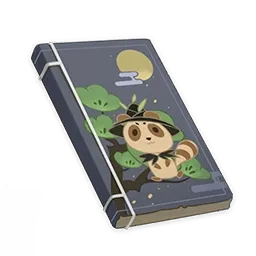
Toki Alley Tales is a six-volume Inazuma Book Collection assembled from Torn Pages scattered across Inazuma, not sold from any shop. Vols 1-3 (Prologue / I / II) released in Version 2.0 alongside Inazuma itself; Vols 4-6 (III / IV / V) followed in Version 2.1, in the same batch as Flowers for Princess Fischl, Princess Mina of the Fallen Nation, New Chronicles of the Six Kitsune Vol. 6, and Onibudou. Completing the set grants the Wonders of the World achievement Tales of Monstrous Madness, and a Hanamizaka Bulletin Board notice from Hiratsuka states that "this copy of Toki Alley Tales is the only extant copy of the book." Every volume is narrated in the first person by an unnamed tanuki (bake-danuki) reporter walking the Hanamizaka side street called Toki Alley and writing down the boasting of its youkai residents. [1] [2] [3]
Vols 1 and 6: the tanuki origin myth
Vol. 1 (Prologue: The Tanuki's Oral History of Inazuma) and Vol. 6 (Break Time) frame the collection with the same paragraph: "in the past, before the fragile and short-lived mortals had crossed over the sea… Inazuma was once a land that belonged to the tanuki." The kitsune "arrived by sea" and forced a war "first for 800 years and then for another 800 years," ending with the tanuki ceding "the giant Thunder Sakura." Disoriented shape-shifting in that war produced "the hapless mortals… the product of bewildered youkai." The closing "At least, that's what the tanuki elders say" marks the myth as tanuki clan folklore, not testimony about the founding. Vol. 6's reprise closes inconclusively: the tanuki narrator, unable to find an open restaurant, stretches in front of "Uncle Kitsune's soba stand" and notices "a familiar scent" behind him. [1]
Vol. 2: Yoichi's Tale
Yoichi is "a great youkai, set apart from the common folk" (her own words). She is a Great Tengu who rents an alcohol shop in Toki Alley. "The Great Gongen has never given her serious punishment, because she has never caused any major trouble." Her one sentimental possession is a golden paper fan, and the volume is her drunken boast about it. In another world she served as a male archer under a "haughty shogun," and in a moonlit naval engagement footnoted as "Reference to the feat of Nasu no Yoichi at Battle of Yashima" she shot down a golden fan held aloft on a small boat, then "flew over eight ships in a row" (footnoted as "Reference to the feat of Minamoto no Yoshitsune at Battle of Dan-no-Ura") to snatch the fan and the woman holding it. The fan-holder was a "neko" who "scratched [her] to pieces" (the volume's punchline). [1]
Vol. 3: Osen's Tale
Osen is the bake-neko Yoichi snatched; Notes Footnote 5 glosses bake-neko as "changed cat," a cat youkai. She "wasn't born in our world, but one where mortals were much more savage," was sold to the cross-world shogun, and transformed into a ninja for the naval battle. From her perspective Yoichi "slipped and fell, landing in the ocean with a great splash"; Osen took down the fan herself to spare her the humiliation, was leapt at, fell "into the sea looking like a hedgehog," dragged Yoichi from the water and flew her "in a headlock" over the fleets. She remains in Toki Alley "like… some kind of trophy", a position she protests but does not leave. [1] [4]
Vol. 4: The Tale of Granny Ame
Granny Ame, the Ameonna ("rain-woman") of Toki Alley, anchors the only volume that touches the history of present-day Inazuma's institutions. "Long ago, in the mountains and forests where youkai could lead carefree lives, the lady who could turn mist into rain was a good friend of the tanuki and kitsune." Then: "It was later, when everyone had submitted to the Great Gongen. Good times came for mortals, and youkai either lived in seclusion at various places, or were subjected to destruction and suppression... It was then that Granny Ame moved to Toki Alley. As a token of sympathy, the Kitsune of Grand Narukami Shrine, Lady Guuji, gave her this mansion." The Great Gongen (per Notes Footnote 1, "a manifestation of Buddha as an indigenous kami" in Shinto-Buddhist belief) refers to the Raiden Shogun. The "Lady Guuji" title belongs to the Grand Narukami Shrine's line of succession from the Kitsune Saiguu to Yae Miko. The volume does not name her further, and because the scene is set after the suppression, the referent stays unstated; this page does not try to settle it. Granny Ame says only "Thank you" and hands the narrator a wooden box. [1] [6] [5]
Vol. 5: The Tale of Gonbei
Gonbei is 76 years old and "the only mortal living in Toki Alley". He is a former "farmer, samurai, and craftsman" whose hand-made box of black lacquer and mother-of-pearl (the same one passed by Granny Ame in Vol. 4) reflects a craft "learned from the fishermen of Watatsumi Island." As a teenager during a drought he sought the Ameonna's help and deceived her to bring rain home. The village had its rare harvest year; Gonbei "deeply ashamed," moved to the city and "avoided the mountains." He bows deeply, says "I'm so sorry," but does not take the box back. [1]
Boasts, not testimony
It is not a Yae Publishing House light novel. Unlike its Version 2.1 companions Flowers for Princess Fischl and Princess Mina of the Fallen Nation, it is assembled from Torn Pages, and Hiratsuka's bulletin-board notice states this is the only extant copy. Yoichi is a YPH reader, though; she spends what money she has "on novels from Yae Publishing House, which she skims through halfway before promptly defenestrating them." [8] [9]
It is also not testimony about the founding of Inazuma. The tanuki origin myth in Vol. 1 and Vol. 6 presents itself as "what the tanuki elders say," clan folklore among the Inazuman youkai. The source for how youkai and humans actually co-founded Inazuma is Yae Miko's Character Story 4 ("the youkai lived alongside humans… Together, they founded a city on Narukami Island"), a cooperative founding rather than the tanuki myth's picture of a paradise before mortals. Neither version is settled here. [4]
And it is not a chronicle of the Genpei War. Footnotes 3 and 7 gloss Yoichi at Yashima and Yoshitsune at Dan-no-Ura as parodies of feats from real-world Japanese history, and Yoichi's name itself is a pun on Nasu no Yoichi. These are comic borrowings within the fiction, not testimony about a Teyvat battle. [1]