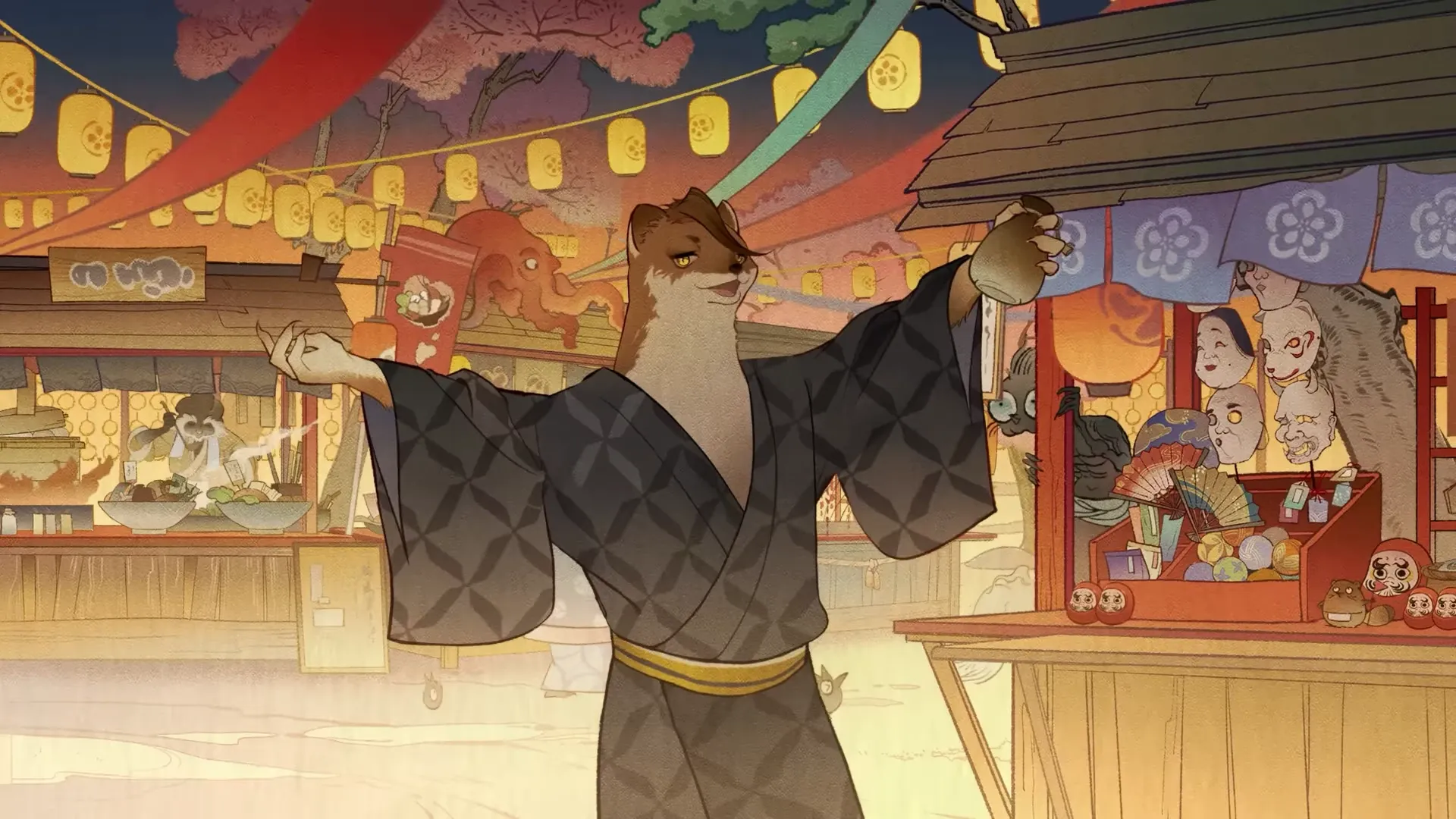
Inazuman Yokai (Japanese: 妖怪 youkai) are Inazuma's broad class of supernatural creatures, the regional analogue of Liyue's illuminated beasts. Per Yae Miko's Character Story 4, the yokai co-founded the Inazuman polity rather than integrating into a pre-existing human civilisation: "A long, long time ago, the youkai lived alongside humans and used their powers to help them through an era of strife and poverty. Together, they founded a city on Narukami Island, which would later become the nation of Inazuma." [1] [4]
The Oni page covers the oni, the horned ogre sub-category of yokai, in depth: the Crimson and Blue tribes, the Mikoshi Chiyo arc, the Blue-Crimson pact, and the present-day representatives Itto and Takuya. The broader class and the non-oni sub-categories follow: tengu, kitsune, bake-danuki, nekomata, yumekui-baku, and the Other Types residual. [21]
What an Inazuman yokai is
The yokai are "a class of supernatural creatures in Inazuma, akin to the illuminated beasts in Liyue." "Akin to" is the key phrase. Inazuman yokai fill the place in Inazuma that the illuminated-beast adepti fill in Liyue. [1] [30]
Fandom divides the present-day yokai into six sub-categories:
Sub-category | Cohort name | Attestation |
|---|---|---|
Bake-Danuki | Shapeshifting tanuki / raccoon-dog yokai | 10-character cohort; anchored on Ioroi (Protector of the Grove at Chinju Forest, tricked into Ei's service by the Saiguu) |
Kitsune | Fox-spirit yokai | 5-character cohort; anchored on the Hakushin Clan kitsune lineage with Yae Miko (full kitsune, contemporary Hakushin heir) and the pre-Cataclysm Kitsune Saiguu (Hakushin Kitsune; Grand Narukami Shrine High Priestess) |
Oni | Horned ogre yokai | 8-character cohort; handled in detail by the Oni page; contemporary playable representative Arataki Itto (the last full-blooded Crimson Oni) |
Tengu | Bird-yokai | 4-character cohort; anchored on the Yougou Tengu line with Kujou Sara as contemporary playable representative |
Yumekui-Baku | Dream-eating tapir yokai | 4-character cohort; anchored on the playable Yumemizuki Mizuki (Tapirus Somniator Chapter SQ arc) |
Other Types | Residual category | 7-character cohort; includes nekomata Kirara (Komaniya Express Gold Level Courier), youko (妖狐), daiyouko (大妖狐), and the broader cultural register |
Lifespan differs by sub-category and generally runs substantially longer than the human baseline. The present-day population is far smaller than it was before the Cataclysm: "By the present day, the number of youkai has dwindled substantially, and their bloodlines continue to thin." Over the 500 years since the Cataclysm, cross-species reproduction with humans has thinned the bloodlines of several sub-categories. The oni are the case in point, per the sister page's reading of the Mask of the One-Horned weapon text. [1] [21]
Tengu - bird-yokai
The tengu (Japanese: 天狗 Tengu, "Heavenly Dog" or "Heavenly Sentinel") are a kind of youkai of Inazuma. [2]
Their morphology is distinctive. Black wings are attested on both Teruyo and Kujou Sara. Crow masks are affixed on the head, and Akuou's claim of having taken the Great Tengu's mask as a trophy implies the masks carry great honour or are even essential to tengu survival. Tengu are slimmer than oni but far stronger than their appearance suggests. [2]
Their powers centre on martial-arts competence and speed:
- Archery and swordsmanship. The Great Tengu Sasayuri taught the human Takamine the Mistsplitter her archery techniques, which Takamine later taught Asase Hibiki (the pre-Cataclysm shrine maiden mentored by the Saiguu). [13] [2]
- The tengu art of transcension. Kamuna Harunosuke, the onmyouji member of the Yougou Three, learned this art while training under the Yougou Tengu and combined it with Liyue adepti arts to create onmyoudou, a mystic art that draws on both Inazuma and Liyue. [2]
- Speed, "nearly unrivaled." The Kitsune Saiguu won a race against the Chieftain of the Yougou Tengu (Reizenbou) but believed the tengu had gone easy on her. Iwakura Michihiro grazed Teruyo's wing during a duel, which won him the name "Tengu Victor." [2] [27]
- Naming power and feather fans. Per Teruyo, a name given by the Yougou possesses divine powers (whether this holds only for the Yougou or for all tengu is unclear). Tengu warriors carry feather fans, magical items with various effects in tengu hands but only "making one's body lighter" mid-air for ordinary people. [9] [2]
Before the Cataclysm, the tengu lived mostly secluded lives on Mt. Yougou. Two Great Tengu from different periods are attested:
- Sasayuri, a Great Tengu acquainted with Ei, slain in battle when Orobashi inexplicably invaded Shogunate-held islands (the pre-Cataclysm Watatsumi war). [2]
- Reizenbou, Great Tengu of the Yougou Tengu line and the Kitsune Saiguu's protector, gifted the Thundering Pulse by the Shogun at some point (whether Makoto or Ei is unclear). [12] [2] [27]
The Cataclysm hit the tengu hard. Reizenbou disappeared during this time; per the Shimenawa's Reminiscence narrative, the Great Tengu went into self-imposed exile over his failure to protect Saiguu, leaving Teruyo behind. In the same period Teruyo met Iwakura Michihiro, Chiyo's eldest son, who was born into the Mikoshi Clan (Doukei is an older English rendering of his given name). Ashamed of his mother's turn against the Shogun, he was living in seclusion in Konda Village. Teruyo gave him the name Iwakura, duelled him, and disappeared after he grazed her wing, asking him to forget her. [2] [10] [8] [11]
In the present day, "like the oni, most tengu continue to live in seclusion." At least two on-screen tengu appear before the Traveler's arrival in Inazuma: an unnamed tengu duelled by Arataki Itto at Byakko Plain, and Kujou Sara. Sara fell from a great height while battling monsters, was saved by her recently granted Electro Vision, and was unconscious when she was found; she was then integrated into human society. [2] [5] [22]
The local Heizou page describes Shikanoin Heizou, the Tenryou Commission detective, as having partial tengu blood, though the Tengu page does not list him by name in its "Other Characters" section (which hides per-character names behind a category-selection filter). The reading that Heizou is part tengu rests on the local sister page rather than on primary text naming him. [25]
Kitsune - fox-spirit yokai
Leaving the oni aside, the kitsune carry more weight in Inazuma's institutions than any other yokai sub-category. Per Yae Miko Character Story 1: "Amongst the youkai, the lineage of Hakushin Kitsune was the most revered, and it was this great line that left a great many tales amongst humans." [4]
At its centre is the Hakushin Clan kitsune lineage, organised around the Grand Narukami Shrine on Mt. Yougou. Before the Cataclysm, the clan's central figure was the Kitsune Saiguu (also called the Hakushin Kitsune), High Priestess of the Grand Narukami Shrine and founder of the Sacred Sakura Cleansing Ritual tradition. [27]
The Saiguu organised the Mt. Yougou circle, a regional group that spanned several yokai classes: kitsune (the Saiguu herself, Urakusai, Earth Kitsune, Sky Kitsune, and young Yae Miko), tengu (Reizenbou and Teruyo), bake-danuki (Ioroi), oni (Chiyo, friend of Ei), and human allies (Asase Hibiki, Kamuna Harunosuke, Takamine the Mistsplitter, and the Naganohara family). Before the Cataclysm it ran alongside Shogunate governance. [27] [9]
The Cataclysm broke the circle: "Many youkai lost their lives or disappeared, including Mikoshi Chiyo, the Kitsune Saiguu, and Reizenbou, all prominent members of revered clans." The Saiguu was consumed by a "dark will" that broke down her body and memories into filth. In her dying moments she asked the dark will to spare her memories, and some remained unsullied as filth. Those memories created Hanachirusato, the manifestation present-day Inazuma encounters at the Sacred Sakura Cleansing Ritual. [1] [9] [8]
Today Yae Miko holds the place in the Hakushin Clan that the Saiguu once held. Before she disappeared in the Cataclysm, the Saiguu delegated the role of Guuji of the Grand Narukami Shrine to the young Yae. Yae's voice-over recalls how the Saiguu talked her into it: "as Guuji you will be able to eat all the Fried Tofu you desire". Yae is the leading kitsune of the present day. She is Guuji of the Grand Narukami Shrine, proprietor of the Yae Publishing House, centuries-old confidante to Raiden Ei, and custodian of the Electro Gnosis that Ei entrusted to her before withdrawing into the Plane of Euthymia. At the Delusion Factory, Yae exchanged it with Scaramouche for the Traveler's safety; she did not deliver it to Pierro. [4] [17] [18] [23] [27]
The Sky Kitsune carries the kitsune's place in present-day folklore. Per Yae Miko's Elemental Burst description: "Legends of kitsunetsuki, or the manifestations of a kitsune's might, are common in Inazuma's folktales. One that particularly captures the imagination is that of the Sky Kitsune, said to cause lightning to fall down upon the foes of the Grand Narukami Shrine." The Sky Kitsune is central to the Grand Narukami Shrine's mystical defence, while Earth Kitsune Statues remain scattered across Inazuma awaiting the Saiguu's return. [4] [27]
Beyond the Hakushin line, the wider kitsune population includes literary figures (Urakusai, author of the original Chronicles of the Six Kitsune, banished by the Saiguu for an unspecified mistake) and the Black Fox Itaru, who defeated the Twin Oni of Tokaku and then became their ally (per New Chronicles of the Six Kitsune Vol. 3), an example of kitsune and oni cooperating. [7]
Bake-Danuki - shapeshifting tanuki yokai
The bake-danuki are the shapeshifter sub-category, with 10 characters. Their primary on-screen representative is Ioroi, a bake-danuki tricked into Ei's service by the Saiguu per the Hakushin Ring weapon text. The Saiguu trapped him with a challenge involving Naku Weed from the Tenshukaku garden, which led to his capture by Ei. She then convinced Ei to spare him and take him as "Protector of the Grove" at Chinju Forest, and secretly learned bake-danuki magic from him along the way. [9] [27]
A game of hide-and-seek with the Saiguu still shapes how Ioroi behaves. The Saiguu used it to trick him into staying out of the Cataclysm-era fighting, and he still believes the game continues today. The Four Oni of Ogata trespassed on Chinju Forest and were deceived by Ioroi (per the Eight Locales Over Mountains and Seas Event WQ), an example of bake-danuki and oni crossing paths. After the Saiguu's death Ioroi grew bored, went out causing havoc to lure her out, and was eventually sealed in stone by Kamuna Harunosuke alongside many other bake-danuki. [27] [21]
Nekomata - cat-yokai
Kirara's page intro classes her directly: "A youkai - a nekomata, specifically - Kirara is the Gold Level Courier of the Inazuma-based Komaniya Express. Her diligence in ensuring every package would be delivered to the right place has increased her company's renown and hers, making her the sole courier handling international deliveries." [3]
Kirara is a nekomata, a cat-yokai who can take two forms: a bipedal, mostly human form for public life, and a full cat form she uses for long-distance courier travel and in the Urgent Neko Parcel gameplay state. The nekomata belong to the "Other Types" residual sub-category, whose 7 characters include Kirara and several other on-screen NPCs. [1] [3]
Two corrections matter here:
- Kirara is a nekomata, not a komainu. The "Komainu - guardian-lion-dog. Kirara (komainu yokai)" framing is unsupported by primary text. The Kirara page intro classes her as a nekomata, and the Youkai page does not list Komainu as a Genshin yokai sub-category at all. Komainu (狛犬) are Japanese Shinto guardian lion-dog statues, a real-world cultural reference rather than a Genshin yokai sub-category. That framing appears to conflate Kirara's employer name (Komaniya Express) with the unrelated komainu folkloric category.
- Kirara's employer is the Komaniya Express, not the "Anonymous Aggregate Logistical Service." The local Kirara page calls her employer the "Anonymous Aggregate Logistical Service," which is not the institution's name per the Kirara page intro.
Yumekui-Baku - dream-eating tapir yokai
The Yumekui-Baku are the dream-eating tapir sub-category of yokai, with four characters. The playable representative is Yumemizuki Mizuki, an Anemo character who eats dreams; her Tapirus Somniator Chapter SQ is the primary-text arc for the Yumekui-Baku. Her Yumekui-Baku classification is grounded in Tapirus Somniator Chapter Act I Part 4 "Descendant of Nightmares." [6] [15]
Eating dreams places the Yumekui-Baku alongside Sumeru's Aranara, who also work with dreams. The aranara inhabit Mahavanaranapna, the dream version of the Sumeru rainforest, while the Yumekui-Baku eat dreams within the dreams of mortals. The two are not equivalent. The aranara are Sumeru dream spirits created by Rukkhadevata, while the Yumekui-Baku are members of the broader Inazuman Youkai class. They share only their connection to dreams.
Other yokai categories
Beyond the "Other Types" residual category and the Sacrificial Offering WQ primary text, Inazuman culture maps yokai onto a far wider set of folkloric categories than the formal six-category division captures.
Per the Sacrificial Offering primary text: "...they would turn into kasha, inugami, black jades, umibouzu, raging flames, and other such things. And not all of them would harm people, either. For example, there were the tofu boys..." [20]
Category names attested in primary text beyond the Big Six:
- Youko (Japanese: 妖狐, "demon fox") and Daiyouko (大妖狐, "great demon fox"), kitsune-adjacent fox-spirit categories attested in Yae Miko's Divina Vulpes Chapter and Akitsu Kimodameshi (Haunted Tales). [14] [16] [1]
- Kasha, corpse-stealing cat-yokai (real-world Japanese folklore).
- Inugami, dog-spirit yokai.
- Black Jades (黒玉), a yokai sub-type per the Japanese Wikipedia cross-reference in the Youkai page's footnote 4.
- Umibouzu, sea-monk yokai of the ocean.
- Tofu boys, small and mostly harmless yokai per the Sacrificial Offering primary text.
Inazuman culture reads many natural and supernatural phenomena as yokai, much as real-world Japanese yokai folklore does. The mapping is cultural rather than strictly biological, and not all of these categories correspond to biologically distinct groups.
Cataclysm-era cohort loss + post-Cataclysm dwindling
The post-Cataclysm trajectory is stated plainly: "During the Cataclysm, both humans and youkai fought against the Abyssal invasion. Many youkai lost their lives or disappeared, including Mikoshi Chiyo, the Kitsune Saiguu, and Reizenbou, all prominent members of revered clans. By the present day, the number of youkai has dwindled substantially, and their bloodlines continue to thin." [1]
The loss was not incidental attrition. Four central figures of the Mt. Yougou circle (Saiguu, Reizenbou, Chiyo, and Takamine the Mistsplitter) were lost at nearly the same time, and the part yokai had played in regional governance before the Cataclysm did not survive into the Tri-Commission system that followed it. [27] [21]
The line "their bloodlines continue to thin" holds for several sub-categories. The oni bloodline thins through dilution with human blood, as the Mask of the One-Horned describes; the tengu live in seclusion in reduced numbers ("Like the oni, most tengu continue to live in seclusion"); and the Hakushin line of kitsune has worn down to effectively a single central figure, Yae Miko. [21] [2]
The Hyakkiyakou era and the Mikawa Flower Festival show the celebratory side of yokai culture. Per Akitsu Kimodameshi and the Yae Miko Profile, cross-cited on the Kitsune Saiguu page, the Hyakkiyakou (Night Parade of a Hundred Demons) was the era before the Cataclysm when yokai culture flourished and the Kitsune Saiguu organised open gatherings of yokai. The Mt. Yougou circle and the wider Inazuman yokai competed with their powers, swapped stories under Urakusai's literary leadership, and staged festivals open to humans. The Mikawa Flower Festival was the highlight of the Hyakkiyakou era, attended by the Saiguu, Yae Miko (perched on the Saiguu's shoulder as a young kitsune), and the pre-Cataclysm Mt. Yougou circle. Its signature game was Akitsu Hazura (also called Haneasobi), a yokai game played with hagoita and a ball; the WQ reconstructs its modern descendant, Akitsu Yuugei, which uses flippers and elemental bricks. The Hyakkiyakou ended at the Cataclysm and has not been held since. The WQ also establishes the tsukumogami sub-category: yokai that emerge from objects and gain sentience, depend on the survival of their original body, and weaken as that body decays. Its example is the Hanyuuda Chizuru hagoita tsukumogami, which dates from the Cataclysm era (a pair of hagoita used by the yokai Kamai Kenji and the human samurai Yanagibashi Takuto in their decades-long Akitsu Hazura friendship). The Mikawa Flower Festival revival that closes the chapter, on the beach east of Chinju Forest, shows that the pre-Cataclysm celebration can be revived with the present-day Yashiro Commission's support for yokai cultural revival. [19]
How Inazuman yokai differ from adjacent race-categories
Inazuman yokai vs Oni (sister sub-category)
The Oni are one of the six yokai sub-categories, handled in detail by the Oni page. The two pages work together. This one covers the broader class and the non-oni sub-categories (tengu, kitsune, bake-danuki, nekomata, yumekui-baku, Other Types), and the Oni page covers the horned-ogre sub-category. Both deal with the same kind of creature, Inazuman youkai, but the groups are organised very differently. The oni live by the Blue-Crimson pact and by the dilution of their blood, which separates full-blooded oni from part-oni, while the rest spread across sub-categories with their own arrangements. [21]
Inazuman yokai vs adepti
The Inazuman yokai and the Liyue adepti are regional parallels: both are non-human supernatural classes coexisting with a regional human polity. The line "akin to the illuminated beasts in Liyue" makes the relationship explicit. [1] [30]
How the two are organised differs. The Liyue adepti hold contracts with Rex Lapis and operate under the Mighty and Illuminated Adepti charter, with Morax's blessings and Sub-Space Creation. The Inazuman yokai instead organised around the Mt. Yougou circle under the Saiguu. They were allied to the Shogunate through personal friendship and informal cooperation with Ei (the Saiguu was her close friend, Sasayuri an acquaintance, and Reizenbou a collaborator who received a gift from the Shogunate, per the Thundering Pulse) rather than through any formal contract. [27] [12] Kamuna Harunosuke combined the tengu art of transcension with Liyue adepti arts to create onmyoudou, which shows the two peoples' mystic arts are cosmologically compatible. The difference lies in how they are organised, not in their cosmology. [2]
Inazuman yokai vs humans
Per the Humans page, yokai share enough biology with humans to interbreed. Among the oni, the example is the dilution of Crimson and Blue blood after the Cataclysm (the Mask of the One-Horned weapon text on the sister page). Among the tengu, it is Shikanoin Heizou, who has partial tengu blood and works in the mainstream as part of the Tenryou Commission. Kujou Sara is a related case. She is a tengu working fully within mainstream Inazuman institutions, through adoption into the Kujou clan rather than cross-species reproduction. [31] [25] [24]
The "their bloodlines continue to thin" reading treats cross-species reproduction with humans as the main cause of the decline. The Inazuman yokai are the only Teyvat people whose page explicitly frames a thinning of bloodlines across the population; melusines, aranara, and saurians change as species through different mechanisms. [1]
Inazuman yokai vs Frostmoon Scions
Per the Frostmoon Scions page, the Frostmoon Scions are Nod-Krai indigenous humans organised around the Kuutar (Columbina) religious institution, a pre-Cataclysm faith based on Hiisi Island with the Statues of the New Moon as its infrastructure. They are a human community with a distinct cultural and religious organisation. [32]
The distinction here is biological. Frostmoon Scions are human (Finno-Baltic-coded, with a distinct language and religion); Inazuman yokai are a non-human supernatural class (Japanese-coded, across six sub-categories). Both hold a distinct regional place within their polities, and both organise around pre-Cataclysm religious institutions: Kuutar worship for the Scions, and for the yokai the Grand Narukami Shrine and the Sacred Sakura Cleansing Ritual of the Saiguu tradition.
Open questions
Yokai history from before the Mt. Yougou period that the Saiguu organised is vague. Yae Miko's Character Story 4 places the co-founding of Inazuma by yokai and humans in a mythic "long, long time ago" without pinning the period (before the Shogunate, before the Archon War, or after it). The claim that Heizou is part tengu has uncertain grounding, since the local sister page makes it but the Tengu page does not name him directly. The game does not show whether the near-simultaneous loss of Saiguu, Reizenbou, Chiyo, and Takamine came through four distinct Cataclysm-era mechanisms or through one strategy behind the Abyssal incursion. Beyond Yumemizuki Mizuki, the Yumekui-Baku are only given a count of four characters, and the other three go unnamed outside the Tapirus Somniator Chapter SQ. It is also unshown whether Inazuma after AQ II will rebalance its institutions for the yokai. Per the Itto SQ, the Tri-Commission regards the Arataki Gang as delinquents and does not address the Blue Oni's poverty, and nothing restores the part the wider yokai population played in governance before the Cataclysm.
The Inazuman yokai are Inazuma's broad class of supernatural creatures, the analogue of Liyue's illuminated beasts, but arranged differently. Per Yae Miko's Character Story 4, the yokai co-founded Inazuma alongside humans, building the city on Narukami Island that became the nation. There are six sub-categories: oni (covered on the sister-page), tengu (bird-yokai, Sara among them), kitsune (fox-spirits, Yae Miko and the pre-Cataclysm Saiguu line), bake-danuki (shapeshifting tanuki, Ioroi among them), Yumekui-Baku (dream-eating tapirs, Mizuki among them), and "Other Types" (the nekomata Kirara, who is not a komainu). Before the Cataclysm, the yokai gathered in the Mt. Yougou circle under the Kitsune Saiguu, a friendship across sub-categories centred on the High Priestess of the Grand Narukami Shrine. Then came the Cataclysm. The Saiguu was consumed by a "dark will" and reduced to filth (her memory surviving as Hanachirusato), the Yougou Tengu Chieftain Reizenbou disappeared, the oni Chiyo was corrupted and rebelled, and Takamine the Mistsplitter vanished. Four central figures were lost in close succession. Five hundred years on, the yokai keep dwindling as reproduction with humans thins their bloodlines, and the Mt. Yougou circle has never been restored. Today the yokai's central figure is effectively Yae Miko alone: Hakushin Clan heir, Grand Narukami Shrine Guuji, centuries-old confidante of Ei, and former keeper of the Electro Gnosis. One kitsune now carries the weight that the Saiguu's circle once spread across many.