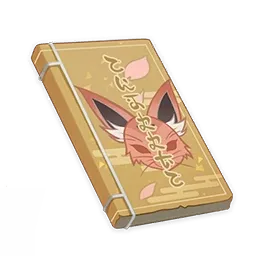
New Chronicles of the Six Kitsune (Japanese: 新六狐伝 Shinrokkoden; Chinese: 新六狐传 Xīn Liù Hú Zhuàn) is a six-volume Inazuma Book Collection sold at the Yae Publishing House in Inazuma City. Vols 1-5 (Prologue / I / II / III / IV) released in Version 2.0 alongside Inazuma itself; Vol. 6 (V) followed in Version 2.1, beside that wave's other Inazuma fiction, Toki Alley Tales (Vols 4-6), Princess Mina of the Fallen Nation, Flowers for Princess Fischl, and Onibudou. The volumes are a "slightly revised edition" of an in-universe original, Urakusai's Chronicles of the Six Kitsune, that "enjoyed a period of great popularity five hundred years ago," by the kitsune writer Urakusai himself: the same Urakusai banished by the Kitsune Saiguu before the Cataclysm. The Vol. 1 cover-text reads SHRKKTS in the Inazuman Language, "likely standing for Shin Roku Kitsune Den." [1] [2] [3]
Vol. 1 - Prologue: the Uyuu Restaurant commission
The new edition's unnamed kitsune narrator is drinking alone at the Uyuu Restaurant when "an old friend that I hadn't seen in forever" slides into the booth: "My, my, now, who could this be, sitting there in such a good mood, yet drinking all alone?" The friend is "the chief editor", Lady Yae, who has come back from a long absence and is offering "drinking money" in exchange for one more manuscript. "You're back," the narrator says, watching Sacred Sakura petals drift into her cup. "You're drunk," she retorts, then sighs: "I wasn't even born yet when she left. ... You must be the only one still able to recite the stories she once told." A note flags that Yae's feminine pronoun (她) here points to the Kitsune Saiguu, not to Urakusai, whose pronoun in the original edition (他) is gender-neutral. The new edition is framed, then, as one of the last living memories of the Saiguu's old tales, written reluctantly "to pay the chief editor back for the wine she so kindly bought me." [1] [6]
Vols 2-5 - Itaru the Black Fox
The story proper opens "on the towering Mt. Yougou" with the Vol. 2 frame: "in the time of the Great Kitsune Hakushin, she had six apprentices. All were greatly skilled in magic and in shape-shifting. Day-to-day, they were tasked with assisting their matriarch, Hakushin, in managing the shrine and defending Mt. Yougou." Whether this Great Kitsune Hakushin is the Kitsune Saiguu under her "Hakushin Kitsune" alias, or a separate matriarch of the same name within the broader Hakushin Clan, is left unstated. The volume names only the title and the Mt. Yougou setting. [5] [4]
The eldest of the Six Kitsune is Itaru the Black Fox, "unlike most other females, ... built as broad as a bear and as strong as a tiger," with "a wild and unruly personality." In a drunken rage she destroys "a shintai that represented the Shogun" in the main hall and is banished by Hakushin for "a period of much-needed self-reflection," a punishment Itaru immediately ignores in favour of "a bottle of good-quality liquor" and the nearest village. Vol. 3 is her clash with the Twin Oni of Tokaku, two bandit sisters armed to the teeth with "a seven-foot-long nodachi, a kodachi, and a wakizashi" each, who attack her on the road; Itaru disarms both, headlocks one, plants a foot on the other's chest, reveals she's "masterless ... now that I've been banished from the mountain by Hakushin," and recruits them into a chivalric trio. [7]
Vol. 4 is the editorial bridge. Resting in Konda Village, the trio meets Youzan and her daughter Yui, "musicians from the distant Seirai Island visiting Inazuma City to join in the festival," freshly scammed by a Lavender Melon merchant. The new edition flags an explicit gap against the original: "In the 500-year-old Urakusai's Chronicles of the Six Kitsune, Youzan and Yui went on to have their own tales. But at this time, the mother-daughter pair are still reliant on Itaru to rescue them." In other words, Youzan and Yui are two more of the Six Kitsune apprentices in Urakusai's original, and the new edition's adapter has simply folded their later arcs into Itaru's. [1]
Vol. 5 is the episode of Dozaemon the tanuki. The merchant, "once a samurai" turned village extortionist, meets Itaru when she demands four pounds of chopped Lavender Melon and accuses his scale of being wonky. After a bag of mora is thrown into his face and "a Liyue martial arts tournament was being hosted on his face," a single follow-up blow lands so hard "a pair of tanuki ears popped out." The merchant is "a youkai in disguise and a filthy tanuki at that"; Itaru confiscates his stolen wakizashi, redistributes the ill-gotten wealth, and continues on her way. [7]
Vol. 6 - Author's commentary on Saiguu, Urakusai, and Lady Yae
Vol. 6 is not narrative but author's commentary, the only volume whose material reaches beyond its own covers. The narrator pauses "the anecdotes of Black Fox Itaru" to record what "Lady Yae did offer to tell me ... after having between two and eight drinks." What he learns: "Urakusai was already famous when I was but a small child. By that time, the Saiguu had already taken great interest in Urakusai's literary abilities and expertise on tea, making Urakusai one of the most cultured and sophisticated of all the kitsune. Unfortunately, that is all in the past now. Urakusai made a grave mistake and had to leave. It has now been 500 years since then..." This is the same banishment the Kitsune Saiguu page records from the narration of the Hakushin Ring. [5]
The volume's central disclosure is the sequence of three departures that the narrator finally pieces together: "When the Kitsune Saiguu departed from the Hakushin Lands to take up her post at the Grand Narukami Shrine, Lady Yae still had yet to be born. ... after Urakusai had been driven out, the Kitsune Saiguu would no longer dwell at the Grand Narukami Shrine, but would instead set up permanent residence at Tenshukaku: 'A disaster that will engulf heaven and earth is coming. My duty is to defend the people and protect our lord, and so I must go to the Shogun's side.' When Lady Saiguu departed the second time, Lady Yae was but a young girl. ... This time, Lady Saiguu left a third time. This time, she departed forever." The same commentary ties Urakusai's expulsion to the Cataclysm directly: "his deeds may have had some connection to the later incursion of the Abyss." That line in Vol. 6's notes is the primary text behind the reading, recorded on the Kitsune Saiguu page, that Urakusai may have helped bring the Cataclysm about. [1]
Boundaries and distinctions
It is not Urakusai's original. The volumes are a "slightly revised edition" of Urakusai's Chronicles of the Six Kitsune, itself in-fiction, written before Urakusai's banishment, last popular "five hundred years ago," and not separately purchasable in-game. The unnamed adapter says as much: "I possess but limited writing skills, and can only hope that Urakusai and my other readers will peruse these pages with forgiving eyes."
It is also incomplete as a roster of the Six. Vol. 2 names only Itaru, the eldest; Vol. 4 confirms Youzan and Yui belong to the original six but folds them into Itaru's rescue; the remaining three go unnamed. The "Six" of the title is Urakusai's, not the adapter's. [1]
It is also not a Yae Publishing House light novel in the cross-region pulp vein of Princess Mina or Flowers for Princess Fischl. Vol. 6 is commentary about the real Kitsune Saiguu, the real Yae Miko, and the real Cataclysm-era group on Mt. Yougou. What the imprint brings out here is genuine pre-Cataclysm Inazuma history, not in-fiction lore relocated onto Teyvat. [9] [10]
Nor does it settle whether Hakushin is the Saiguu. Vol. 2's "Great Kitsune Hakushin" shares the "Hakushin" name with the Saiguu's "Hakushin Kitsune" alias and with the broader Hakushin Clan, but the volume never pins the matriarch-with-six-apprentices to the Saiguu specifically, and the wiki leaves it open. Leaving it uncertain is the safe course. [5]
And it is not really a companion to Toki Alley Tales, despite first appearances. Toki Alley Tales is a collection of folktales by a tanuki reporter, assembled from Torn Pages, whereas the New Chronicles is the Yae Publishing House's adaptation of an earlier work by an in-universe author, with a Vol. 6 commentary that genuinely touches the Saiguu's real history. They share the V2.0/V2.1 release wave and belong to the same family of Inazuma yokai folktales, but they do different things. [8]