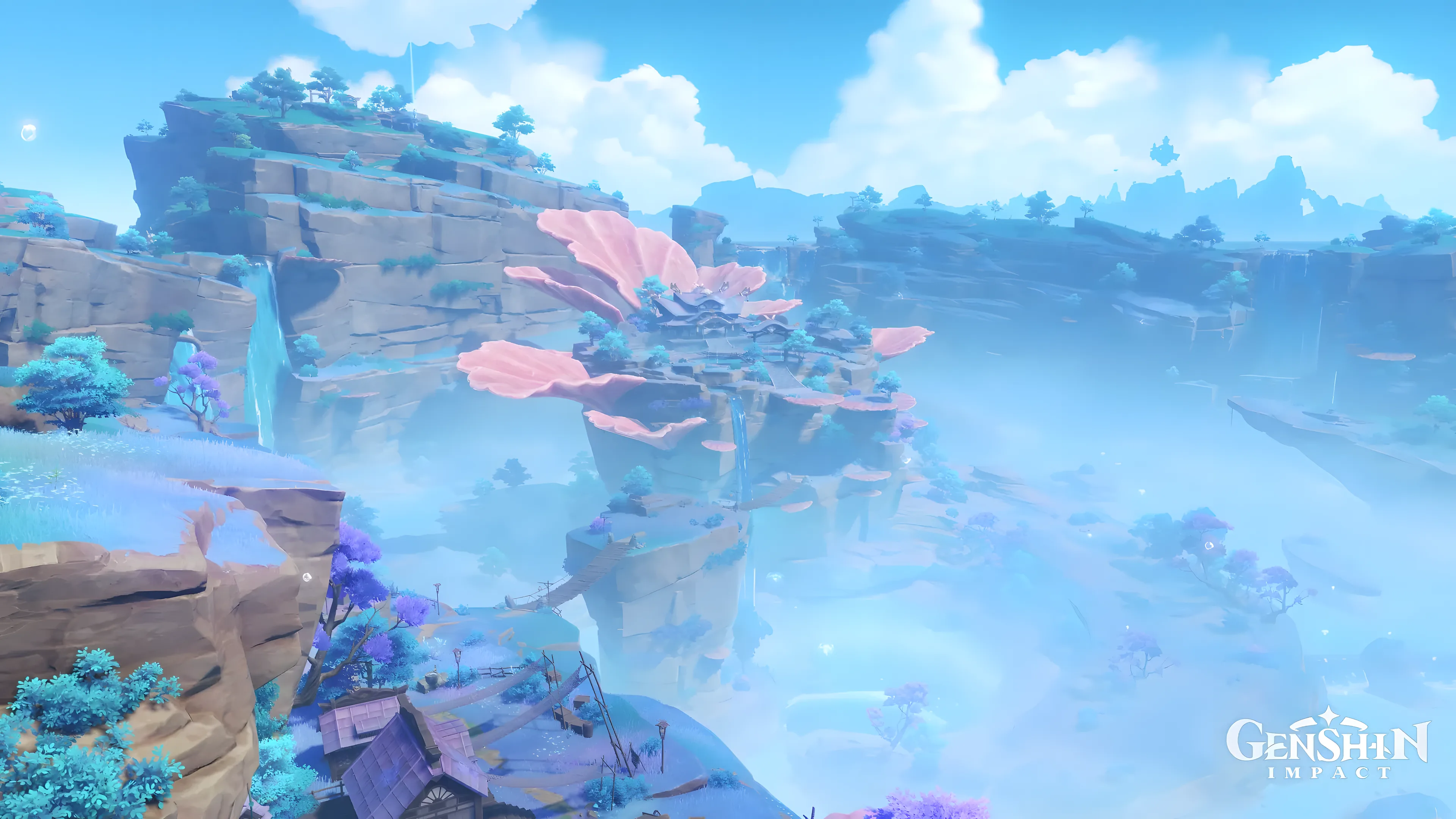
An outer-archipelago Inazuman island opposite Narukami Island, led by the Sangonomiya clan under Divine Priestess Sangonomiya Kokomi, with Gorou commanding the Watatsumi Army. Its people descend from the Enkanomiya exodus that Orobashi, the Watatsumi Omikami, led to the surface using his own coral branches as a ladder. Orobashi was slain during the Inazuma Archon War rather than the Cataclysm, and after his death the Sangonomiya's long friction with the Shogunate eventually boiled over into the rebellion against the Vision Hunt Decree.
Overview
Watatsumi Island (海祇島 Watatsumi-jima, "Sea God Island") is an outer-archipelago island of Inazuma, located the farthest from Narukami Island on the opposite end of the archipelago, known for "its dense foliage in breathtaking colors which are distinct from plants found elsewhere." The island was created by Orobashi, the giant corals visible across it being branches that broke off Orobashi's own body, corals the people of Enkanomiya later used as a ladder to rise to the surface and become the ancestors of the present-day Watatsumi population.[1] When this happened is uncertain. The Watatsumi Island page says the island was created "after the Archon War," but the Orobashi page places its creation about 2,000 years ago, with Orobashi living among his people for some time before he died "towards the end of the Archon War."[1] [5]
Watatsumi has been governed continuously, in religion and politics alike, by the Sangonomiya clan, currently led by Sangonomiya Kokomi as Divine Priestess, with Gorou as commanding general of the Watatsumi Army. The population worships the late sea-god Orobashi as the Watatsumi Omikami (海祇大御神) instead of the Raiden Shogun, a religious distinction that underlies every political tension between Watatsumi and the rest of Inazuma since Orobashi's death.[1] [8]
Geography
Watatsumi Island has four subareas:[1]
- Bourou Village, the camp where Watatsumi Army soldiers trained during the rebellion against the Shogunate.
- Mouun Shrine, the in-game opener for the WQ chain The Moon-Bathed Deep, the arc that unlocks Enkanomiya by breaking the seals of the Goshou Rocks.[3]
- Sangonomiya Shrine (珊瑚宮 Coral Palace), the central shrine and the "base for the resistance army led by Sangonomiya Kokomi, that opposes the Raiden Shogun's Vision Hunt Decree." The current shrine is not the island's original; it was built after Orobashi died from the Raiden Shogun's attack. Its design is inspired by Ryuuguu-jou, the undersea palace of Ryuujin in Japanese folklore.[2]
- Suigetsu Pool, the moon-bathed pool whose Pearlescent Palace viewpoint frames it as "the entrance to Enkanomiya," with water that shines year-round in moon-like light.[2]
Five Goshou Rocks (Eye, Fang, Fin, Tail, and Heart) sit around the island as the seal-apparatus separating Watatsumi from Enkanomiya beneath. During The Moon-Bathed Deep, the Traveler breaks all five seals to obtain the Key of the Moon-bathed Deep, the permission-token for entering Enkanomiya.[3]
History
Orobashi, the Watatsumi Omikami
Orobashi is the pre-Archon-War sea-god the modern Watatsumi people worship as the Watatsumi Omikami. In the Oathsworn Eye weapon text he says, "It was because I could best neither Deus Auri nor Narukami that I elected to flee into waters unknown" (Fandom links Deus Auri to Morax). He fled the continent of Teyvat and ended up in Enkanomiya, beyond the seal that separated it from Teyvat, where a child asked him to become their god.[6] [5] He then created Watatsumi Island, breaking branches from his own body to form the coral structures the Enkanomiyan exodus would later climb; as noted above, the sources disagree on whether this was during or after the Archon War.[1]
His motive for later invading the rest of the Inazuman archipelago is two-layered. The stated reason was the island's lack of natural resources. The actual reason, per the Watatsumi Island page, was that Orobashi had been "sentenced to death by the Heavenly Principles for learning forbidden knowledge," and the war he provoked was the mechanism by which that sentence was carried out.[1] Fandom's Orobashi page names the knowledge: the history in Before Sun and Moon, "a history of the world that Celestia wanted concealed," which Orobashi came upon in Enkanomiya and for which he and Watatsumi "were found guilty of four counts of profanity and eight counts of deceiving living souls."[5]
Death-locus and actor (canon-sharpening)
Two refinements place Orobashi's death correctly on Inazuma's timeline. First, the death came in the Inazuma Archon War, not the Cataclysm: per the Inazuma page and the Gods page, Orobashi was slain at Yashiori Island towards the close of the Inazuma Archon War, roughly 2,000 years ago, not during the Cataclysm 500 years ago. Second, the killing actor was Ei, not the Raiden Shogun puppet. External sources attribute the killing to "the Raiden Shogun" broadly, but the Gods page sharpens it: "the duty of slaying such foes during the Archon War fell upon Ei, rather than the Electro Archon." Makoto was the Electro Archon during the Archon War, and Ei performed the killing on Makoto's behalf. The Shogun-puppet the present-day public knows as the Raiden Shogun did not yet exist; it was constructed only after Makoto's death at the Cataclysm, ~1,500 years later.[11] [12]
Orobashi's body became Serpent's Head on Yashiori Island, and his lingering divine hatred surfaces as the Tatarigami there (per AQ Chapter II Act III Omnipresence Over Mortals and the Yashiori Island Rift Valley viewpoint). The Watatsumi Omikami was a god, listed among Inazuma's gods on the Gods page, and not one of the Seven Sovereigns. The Electro Sovereign seat remains formally unnamed in the game.[5] [14] [12]
Sangonomiya governance and the rebellion
After Orobashi's death the Sangonomiya clan assumed religious and political leadership and pursued peace with the Shogunate, but "tensions between the two islands remained relatively high." The present-day Coral Palace Sangonomiya Shrine was rebuilt at the centre of the island after Orobashi's death, and its Shrine Maidens worship Orobashi rather than the Sacred Sakura.[1] [2]
When the Vision Hunt Decree was enacted, it "drove hostility between the Sangonomiya Clan and the followers of the Raiden Shogun, particularly the Tenryou Commission, to an all-time high, and the Watatsumi Army has risen up in opposition to the decree." The resulting Sangonomiya rebellion is the political event on which the Watatsumi side of AQ Chapter II rests. Sangonomiya Kokomi held political and priestess authority and overall strategic direction, Gorou led the field forces of the Watatsumi Army, and the cause was rescinding the Sakoku and Vision Hunt Decrees. The rebellion was in part forced: Watatsumi's economy could not survive the Sakoku Decree's trade closure indefinitely. The Outlander sees this on screen in Stillness, the Sublimation of Shadow (joining the resistance under Kokomi and Gorou and fighting the Watatsumi Army's battles against Tenryou patrols) and Omnipresence Over Mortals (the Vision Hunt Decree revoked once Ei awakens inside the Plane of Euthymia, removing the rebellion's core grievance).[1] [18] [16] [17]
The arc after the rebellion opens, but does not complete, the process of reincorporating the island: "Following the abolishment of the Vision Hunt Decree, Kujou Sara met with Sangonomiya Kokomi to begin negotiations on returning the island to Shogunate rule. The negotiations made some progress, though following the discovery of instability in the Shogun's Army with the Fatui, talks were temporarily halted and the island retained its army to maintain peacekeeping efforts." That is the plot-spine of Kokomi's SQ Dracaena Somnolenta Chapter - Warriors' Dreams Like Spring Grass Renewing. Watatsumi therefore exits AQ Chapter II still autonomous in practice, with its own standing Watatsumi Army.[1] [8]
Enkanomiya, beneath the island
Watatsumi Island sits on top of the sealed undersea civilisation of Enkanomiya, a sunless underworld that predates the present-day Inazuma and operates under a different cosmological order (the false sun of the Dainichi Mikoshi, alternating the artificial daytime of Byakuya with the perpetual darkness of Tokoyo). Enkanomiya is the region that preceded Watatsumi. According to legend the Watatsumi people originated there, and Orobashi made the coral path they climbed to what is now Watatsumi Island, long before the Cataclysm. The five Goshou Rocks around Watatsumi seal the entrance to Enkanomiya.[9] [15] [3]
Per legend the depths of Enkanomiya try to absorb the spirit of Watatsumi Island, bleaching the soil and threatening to turn the island into a desert. To prevent this, the Watatsumi Goryou Matsuri (海祇御霊祭 Watatsumi Spirit Ritual) is performed regularly using a Jade Coral Branch from Enkanomiya to force the absorbing spirits back into the ocean. After the Three Realms Gateway Offering event, Kokomi decided to find a new way to counteract the Holy Soil phenomenon so as no longer to disturb the vishaps. The Byakuyakoku Collection (Vol. 4) separately preserves an old Enkanomiyan prophecy foretelling "the rebirth of the Dragon of Water in human form," the anchor on the Inazuma side for a thread the Fontaine arc later delivers, the Hydro Sovereign reborn as Neuvillette.[4] [10]
The Hallowing in Chapter VII
When the Holy Soil phenomenon spreads across Teyvat in Chapter VII, Watatsumi's long experience of it becomes part of the response. At the meeting of the nations' leaders in Snezhnaya in Act V, Sangonomiya Kokomi says that "We've dealt with the same phenomenon before on Watatsumi Island," and defines it in her island's terms: "Whenever Light Realm energy increases in intensity, causing the land to regress to its original state, this is a manifestation of the Holy Soil phenomenon." The Watatsumi Goryou Matsuri, she explains, "awakens the Sangacorexes using the Watatsumi Omikami's life force," and a Sangacorex "has the ability to convert Light Realm energy back into elemental energy, rendering the land fertile again." Ei doubts it can be scaled up: "The Serpent is dead, and few Sangacorexes remain. Even if we managed to awaken them all, I don't think it would be enough to save Teyvat." In the Version 2.5 event Tsumi had called the creatures the ritual awakens Sangacorallia; the act does not explain the different name.[19] [24]
In Act VI Kokomi keeps the island ready to help the rest of Inazuma. She has sent Gorou back to the Sangonomiya Shrine because "Watatsumi Island must be ready to support the other islands, too," while she joins the talks at Tenshukaku, which Yae Miko welcomes as "a rare opportunity for the shrine maidens from both sides to meet." No line says the Hallowing reached Watatsumi itself; the islands it is reported on are Tsurumi and Seirai. In the World Quest Thunder Purges All Spite, Kokomi blames it for destroying "many of the seals left behind by our predecessors" without saying which seals she means, and the quest does not mention Watatsumi's soil.[20] [23]
Related pages
The parent region Inazuma anchors the Tri-Commission, Tenshukaku, Sacred Sakura, and the full Inazuman race detail. The primary-text spine runs Stillness, the Sublimation of Shadow (the Outlander joins the rebellion) and Omnipresence Over Mortals (Decree revocation); the World Quests that open Enkanomiya, The Moon-Bathed Deep and The Still Water's Flow, are covered on the Enkanomiya page. Gorou is Sangonomiya Kokomi's senior tactical commander across the AQ II rebellion.
Several related figures have their own pages. Sangonomiya Kokomi is the Divine Priestess and commander-in-chief, and her SQ Dracaena Somnolenta Chapter closes the post-Decree negotiations track with Sara.[8] Orobashi, the Watatsumi Omikami, is at Orobashi, and the Gods page lists him among Inazuma's gods.[12] Enkanomiya, the region that preceded Watatsumi, is the sealed undersea civilisation Watatsumi sits on top of. According to legend the Watatsumi people originated there, and Orobashi made the coral path they took up to the surface.[9] On the Sovereign question, Orobashi is not listed among the Seven Sovereigns.[7]
Open questions
The Watatsumi Army's future is open: negotiations to return the island to Shogunate rule are stalled on Fatui-instability grounds rather than concluded, leaving the army's long-term form unresolved. Version 7.2 shows Kokomi working inside the Tenshukaku talks against the Hallowing, with Watatsumi "on guard" but not impeding "any collaborative action," and no line settles the island's status.[1] [19] And the prophecy of the Dragon of Water's rebirth arrives only in fragments; whether the Inazuma-side text preserves any mechanism or trigger for the rebirth beyond the prediction is unsurfaced.[10]