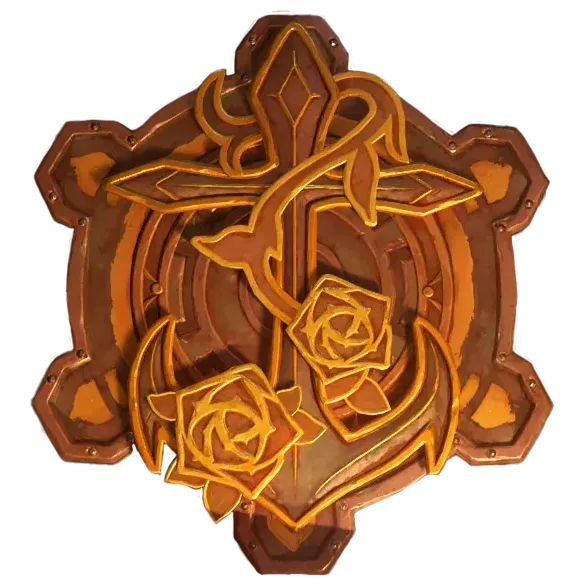
The Spina di Rosula ("the Rose's Thorn," in Fontaine's Latinate style) is the Caspar family's civilian organisation in Fontaine for investigating cases and helping people. Callas Caspar founded it; it is based in Poisson, funded by donations from supporters, and now led by its second president, Navia Caspar. Its mandate is to take on the matters the Gardes, the Court's local police force, cannot or will not handle, and to stand in for civic justice in the gaps Fontaine's three formal justice institutions leave under-served. [1]
Fontaine as a region is covered on the Fontaine page. Its formal counterpart in investigation is the Marechaussee Phantom. The Fatui institution led by Arlecchino, which coexisted with the Spina in Fontaine's civic balance before AQ IV, is the House of the Hearth.
Founding: Callas Caspar and the House of Caspar
The Spina di Rosula was founded by Callas Caspar, its first president. The House of Caspar, the broader family lineage, was a prominent Poisson family trusted across the region for fairness and reliability, and one of the key figures in building the Aquabuses that became Fontaine's public transit system. [2] [4]
That history of building Aquabuses shapes what the Spina di Rosula is. The Caspar family came to civic investigation from a background in civic engineering. The Spina continues the civic trust the family had already built through the Aquabuses; it is not a vigilante outfit that grew up to oppose the Court. When Callas founded it to take on cases the Gardes would not handle, he was extending a franchise the House of Caspar had earned, not claiming an authority parallel to the Court's that the family did not have. [1]
The name signals a deliberate stance. The rose is the figure of civic beauty (Poisson, civic order, the Fontaine the Spina serves), and the thorn is the protective edge the rose carries. The Spina is the thorn on the rose, not a different plant, so the civic-engagement reading is built into the name itself.
Operational structure
The Spina di Rosula operates from a Poisson headquarters and is funded by donations from its supporters. [1]
Its case-load is civilian civic justice: missing persons in marginalised communities, fraud against vulnerable populations, organised crime the Gardes will not pursue, and the investigations the Court's deputised institutions are not set up to carry out. As disclosed, the Marechaussee Phantom (Neuvillette's detective force; the Marechaussee Hunters no longer exist as an organized group), the Spina di Rosula (Navia's family), the House of the Hearth (Arlecchino's domain), and the Court itself coexisted in a stable balance before AQ IV. In practice that meant four institutions, each with its own civic register, in stable coordination throughout that period. [10] [9]
The Spina also has a documented reach outside Fontaine proper. Per the Summertide Scales and Tales event, Navia established a Spina di Rosula branch in Simulanka, the mirror-world domain the Hexenzirkel authored. The branch carries the Spina's civic-investigation doctrine into the secondary region that Alice and the Hexenzirkel maintain. It is the only confirmed branch outside Fontaine, and it shows that the Spina's reach is not bound to Fontaine's territory, even though its centre of gravity stays in Poisson.
The Callas-Clorinde event, three years before the present-day arc
The Spina di Rosula's history turned on the death of Callas Caspar. Callas was killed by Clorinde three years before the present-day Fontaine arc. The Rapperia Chapter SQ (Clorinde's Story Quest) develops that event as its emotional core, and the Roses and Muskets event also grounds it from the Special Patrol's side. [6] [7]
The story frames it as a Court-sanctioned duel under Fontainan duelling-justice doctrine. Clorinde, as Fontaine's Champion Duelist, works within the Court's formal framework of duels as a means of judicial resolution. Callas's prior actions licensed the duel under it; Clorinde won; Callas died. The Spina did not respond with retribution (Navia declared no vendetta against Clorinde). It responded as an organisation. The presidency passed to Navia, operations continued under her, and the tension between the Court and the Spina that the event exposed became the inheritance she has had to work through across the 4.x arcs.
Navia's presidency
Navia Caspar succeeded her father as the Spina di Rosula's second president. She took the leadership young, carrying both the weight of the Caspar lineage and the personal weight of her father's death. Per Fandom and the Rosa Multiflora Chapter Act I "Braving the Tides Together" Navia SQ, she is optimistic and devoted, with a sharp investigative mind and a knack for reading events from different angles. The optimism is deliberate. After losing both parents and trusted subordinates, she chose to lead forward rather than from grievance, and the Rosa Multiflora Chapter shows her instilling that ethic across the organisation. [3] [5]
Navia is a Geo Vision-holder, which one reading takes as a fit for a leader whose whole posture is standing firm on ground others have abandoned. Her style is more hands-on than her father's. She is regularly in the field with Spina operatives rather than directing from Poisson, and her arc from Marechaussee target to ally, through early AQ IV and the later 4.x events, grew out of repeated contact rather than diplomatic correspondence. [3]
Place in the Fontainan civic order
Fontaine's formal justice system has three institutions: the Marechaussee Phantom / Special Patrol (Court-deputised investigation; Chevreuse as Captain of the Special Security and Surveillance Patrol), the Fortress of Meropide (Wriothesley as Duke; post-conviction custody), and the Palais Mermonia Iudex (Neuvillette, Fontaine's Chief Justice; at a trial he and the Oratrice Mecanique d'Analyse Cardinale "hear statements from both sides," and then he makes "his final decision"). The three coordinate through channels between Chevreuse and Wriothesley (the Special Patrol captures and presents; the Iudex adjudicates; the Fortress detains and rehabilitates). [7] [8] [11]
The Spina di Rosula is a fourth tier alongside that system, handling the civilian civic justice the three formal institutions are not set up to carry out. It is not deputised by the Court (its authority is civilian, not Court); it is not funded by the Court (it runs on donations); it does not present cases to the Iudex for adjudication (its work ends in a civilian resolution, not a formal judicial one). It does the work the formal system cannot reach: cases below the Court's investigation threshold, cases in regions (especially Poisson) the deputised institutions cover less actively, and cases among marginalised populations the formal system systematically under-serves.
The balance among the four institutions was stable before AQ IV. The Court tolerated the Spina because it handled cases the Court could not, and the Court benefited when civic justice closed cases the Iudex would never be presented with. The Spina respected the Court because the three formal institutions handled what it was not equipped for (trials and verdicts, custodial detention, post-conviction rehabilitation). The reconciliation after AQ IV and V continues that coordination, now adapted to the Fontainan order that followed Focalors and the end of Furina's divinity, with Neuvillette having resumed his authority as Hydro Sovereign.
Post-AQ-IV-V state
After AQ IV (the Focalors / Furina arc) and AQ V (Capitano's death and the completed collection of the Hydro Gnosis, which closed the Fatui's trajectory in Fontaine), the Spina di Rosula has moved into a more reconciliatory stance. The balance among the four institutions (Marechaussee, Meropide, Iudex, Spina) survived both the collapse of Furina's divinity and the rebalancing after the Fatui withdrew. Navia's Spina kept operating through the transitions. The rapprochement between the Marechaussee and the Spina, which the Rosa Multiflora Chapter develops, has settled the remaining tensions between the Court and the Spina that Callas's death at Clorinde's hands had left in the relationship.
The Spina's future is open. Neuvillette has accepted the Fatui's withdrawal from Fontaine at Palais Mermonia, and the House of the Hearth's footprint is gradually withdrawing, so the balance has lost one of the four tiers it had before AQ IV. How the Spina adapts to an arrangement of three institutions plus the Spina is still in development. The rapprochement with the Marechaussee positions the Spina to expand its formal coordination with the Marechaussee Phantom on cases the two once divided; whether that happens in ordinary casework is still open as of 7.2.
In an emergency the Spina already works beside the Court. When the Holy Soil phenomenon spreads in Chapter VII Act VI, Fontaine, which has no Nail of Retribution, takes in people fleeing it, and Furina reports that "the Palais Mermonia issued a wide-reaching request for support. The Spina di Rosula were quick to get behind it, and Wriothesley mobilized the Wingalet." Navia and Clorinde invited Furina to Poisson "to help set things up and gather supplies." When Natlanese there began losing their memories and could not travel home alone, Furina knew "the Spina di Rosula were already stretched thin," so she "had a word with Navia" and took on the escort herself. [12] [13]
Open canon (as of 7.2)
- The Spina's response to the House of the Hearth's withdrawal from Fontaine is partly developed in 4.6 primary text but not settled. The Spina benefited from the House's presence in some ways (a fourth institution to share the load of keeping the civic balance) and clashed with it in others (the House's recruitment of orphans overlapped with civilian child-welfare cases the Spina considered its own). How the Spina and the Court will coordinate after the withdrawal is open.
- The Caspar family's history before Callas, and the timeline of its shift from engineering the Aquabuses to investigating as the Spina di Rosula, is largely undocumented in current primary text. One reading takes the shift as a choice made in Callas Caspar's time rather than something built up over several generations; the precise founding event is open canon.
- The Spina's relationship to the wider population of Fontainians with Crimson Moon blood, which the House of the Hearth page traces through the lineage connecting Arlecchino, Crucabena, and the Crimson Moon, is undeveloped. The Caspar family does not carry Crimson Moon blood; the Spina belongs to the register of ordinary Fontainian civilians, which the Crimson Moon lineage does not overlap. Whether that separation holds after the close of the Fontaine arc is open.