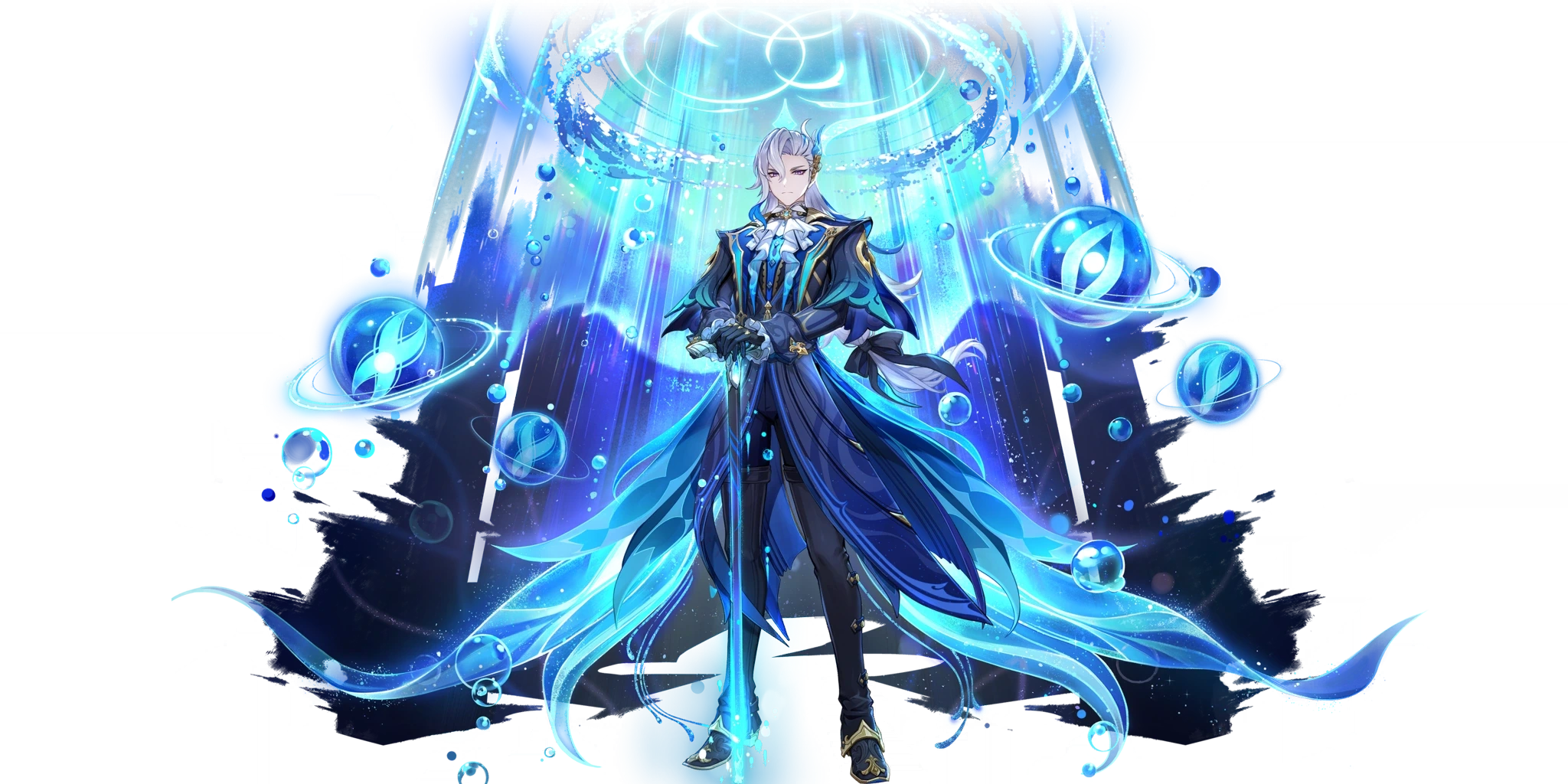


Neuvillette is Fontaine's Iudex and the Hydro Sovereign in human form. He is never the Hydro Archon. Focalors held that office until she destroyed the Hydro Divine Throne in AQ IV Act V, whereupon its Authority returned to Neuvillette.
What you should know:
- He fulfills the prophecy that the new Dragon of Water would appear in human form. His Sovereign identity is distinct from Fontaine's Archon office.
- He discovered and championed the melusines. After they had lived in Merusea Village for almost twenty years, he found them, answered their wish, and brought them to the Court of Fontaine. [1] His Character Story 3 has him call them both his dependents and his successors, "a new sort of Hydro Vishap species", a way of claiming them as heirs rather than a claim that he made them. Their actual origin is Elynas, from whose wounds they were born during the Marechaussee Hunter and Narzissenkreuz Ordo battle in Ancient Colors Act III. The law fixing she/her pronouns for melusines, and the harsh penalties for treating them as monsters, came out of his championing. See Melusines for the full picture.
- His courtroom role, Iudex, was Focalors's idea, as he realizes in AQ IV Act V. [19] He took it seriously. Much of Fontaine's legal system is Neuvillette's earnest attempt to do justice.
- AQ IV Act V restored his power. Furina's centuries-long performance ended with the prophecy resolved and the Primordial Sea threat dispelled, and Focalors executed herself to return the Hydro Archon's authority to him; with that he regained his full powers and his old memories. [4]
- He distributes Hydro Visions himself now. The Vision system's element-Authority component shifted with the restoration of his power: Fandom's Vision page says Visions are obtained from whoever holds the elemental Authority, and that Neuvillette now sets aside a portion of his power for humans to claim. Whether Celestia still has any part in Hydro Visions is not stated. [3] This is the clearest sign the Sovereigns can resume their old role if HP's grip slips.
- Welkin Moon Act IX confirms his reclaimed Authority in the main story. At the Heart of Oasis (A Divergence Leading to Oneself), the Dendro Sovereign Apep tells the Outlander, "I can already sense that far away from here, the Hydro Dragon has wrested his authority from the hands of the usurpers," and, "Though we have yet to meet, I know that we are both preparing for our revenge day and night." [18] It is the first time one Sovereign confirms another has taken back power, which opens what the Seven Sovereigns page calls the Sovereign-Authority-reclamation arc. From there, Fontaine's succession stops being a national matter and becomes a cosmological one.
- Chapter VII Act V, Hour of Ruin, brings him to the leaders' meeting at Zapolyarny Palace to speak for Fontaine. He does not hide how it feels: "I may not be a first-generation dragon, but even so... as I sit here, I feel a rancor stirring within me." Revenge can wait: "I do not come here seeking vengeance. The day of reckoning will come, but today is not that day." Fontaine has no Nail of Retribution, but he says he has "absolved the Fontainians of their sins... The Heavenly Principles has no right to cast down the death sentence upon them." And he will not pretend to friendship: "I have no intention of forming a feigned alliance with the present company. No matter how many eons go by, the Dragons will never forgive the gods for their usurpation. Yet I doubt that the Heavenly Principles ever envisaged the gods of this world rising up in rebellion against them. In this moment, at least, we share a common goal." [20]
- In Act VI, A Yesterday Sent From Beyond, Ei describes him as one "who openly declares the gods to be usurpers" yet "is offering them his help now that we have a common enemy." He spends a night helping with her project in Inazuma, which he calls "beneficial for dragonkind," and leaves promising to return "to pay my respects to the new Electro Dragon." When the nations' representatives gather in Chenyu Vale, he stays away and asks Furina to go in his place; "being a dragon," she explains, "he had his misgivings about showing up in person." [21]
What we don't know:
- Whether Neuvillette's example is repeatable. He's the only Sovereign currently functioning at full strength in human society; Apep intends to follow (per Welkin Moon Act IX); whether the Cryo Sovereign, or the missing four, could do the same is open. In Act VI Ei sets out to nurture primordial Electro power until it can "take shape as a conscious lifeform," which Neuvillette calls "the new Electro Dragon"; the act never calls it a Sovereign. [21]
- How long his cooperation lasts. At the Act V meeting he works with the Tsaritsa and the other gods against the Hallowing while refusing "a feigned alliance," and he ties the arrangement to the present: "In this moment, at least, we share a common goal." What he will do once the crisis has passed is not said. [20]
- Whether Apep is right that he is "preparing for our revenge." Her line is primary text, but it reflects Apep's reading of Neuvillette's intentions. In Act V he speaks for himself: "The day of reckoning will come, but today is not that day." He does not say what form that reckoning will take, or when. [20]
His place among Sovereigns and melusines
Set aside his job as Iudex for a moment. On the question of what he actually is, three race pages line up:
- He is the Hydro Sovereign. The Seven Sovereigns page sets them at the top of a dragon-kin line that runs from surface vishaps up through the Bathysmal Vishaps to the elementally-pure stock a new Sovereign can be born from. Neuvillette is the worked example of what happens when that pure draconic stock is gone: the Sovereign is reborn in human form instead. In Welkin Moon Act IX Apep, a Sovereign in dragon form, senses from afar that "the Hydro Dragon has wrested his authority from the hands of the usurpers," but she has never met him ("Though we have yet to meet"), and nothing she says shows she knows he now lives in human form. [18]
- The human-form rebirth was foretold. Per Bathysmal Vishaps, the Bathysmal Vishaps of Enkanomiya were the pure-Hydro stock a new Hydro Dragon could have come from, but they deliberately split into Rimebiter (Cryo) and Bolteater (Electro) strains through the trait-selection method in The Byakuyakoku Collection Vol. 4, which broke the species purity a new Sovereign needs. The Enkanomiyan prophecy had already named the fallback: "the new Dragon of Water will definitely descend in the form of a human." A later Bolteater Archive note calls him a "Dragon of Water that has returned to their complete form," one who still counts the impure strains as "one of their own" even as they grow "closer to another race."
- He is the melusines' father-figure, not their maker. Per Melusines, they were born from Elynas's wounds during a Marechaussee Hunter and Narzissenkreuz Ordo battle about 400 years ago, a chance event after the Cataclysm rather than a Sovereign's deliberate creation. Neuvillette found them after they had lived in Merusea Village for almost twenty years, won them citizenship in the Court of Fontaine, and helped pass the law fixing their she/her pronouns and the penalties for treating them as monsters. [1] His Character Story 3 has him claim them as both dependents and heirs through that "new sort of Hydro Vishap species" line. The melusine page reads him as their discoverer and adoptive patriarch, not their biological creator.
How the Hydro authority came back to him
Hydro is the only seat where the story shows a Divine Throne destroyed and its Authority restored. Focalors held the Hydro Archon office until her execution completed the plan and destroyed the Throne. The Authority then returned to Neuvillette as Hydro Sovereign; the separate Gnosis went to Arlecchino. Neuvillette did not succeed Focalors as Archon.
Canticles of Harmony recognizes Neuvillette as the new Dragon of Water. It treats his position as Sovereign succession, not national Archon succession.
The Sovereign-to-Archon transition sorts the seven seats into four patterns, and Hydro is the only one where the original Sovereign line carries through unbroken:
- Pyro, a clean swap. Xbalanque killed Xiuhcoatl 2,000 years ago, at the end of the Archon War era, Ronova resurrected him, and he became the first Pyro Archon, founding the Pilgrimage lineage that reaches Mavuika today. [2]
- Dendro, peaceful sharing. Apep is still alive (the Heart of Oasis scene in Welkin Moon Act IX). Sumeru's Archon role passed from the trio of King Deshret, Greater Lord Rukkhadevata, and Nabu Malikata, to Rukkhadevata alone, and then to Buer (Nahida) after the Irminsul edit. Sovereign and Archon stay separate there.
- Anemo, Geo, and Electro remain unidentified in this comparison. The original Cryo Sovereign is unnamed and dead, and the current successor unknown.
- Hydro, the exception. Focalors held the Archon office until destroying its Throne; Neuvillette remained Iudex and Hydro Sovereign in human form.
The melusines belong to the same story. They were born from Elynas's wounds about 400 years ago during the Marechaussee Hunter and Narzissenkreuz Ordo battle in Ancient Colors Act III, a chance product of that clash rather than a Sovereign's deliberate work, per Melusines. What ties them to Neuvillette's "new sort of Hydro Vishap species" line is the link between vishaps, Sovereigns, and melusines; Pahsiv, a Primordial Bathysmal Vishap who can take melusine form at will, is the clearest case of it on screen. By finding the melusines, championing them, and backing the Vautrin reforms, Neuvillette extends a Sovereign's protection over them in the present-day Court of Fontaine. He is their adoptive patriarch and patron, not the one who made them.
Put plainly: the composed judge in Fontaine's court is a dragon-god who spent five centuries pretending otherwise. He stopped pretending at the end of the Fontaine Archon Quest, and where that leads may matter more, on a cosmic scale, than any other Archon's personal story.