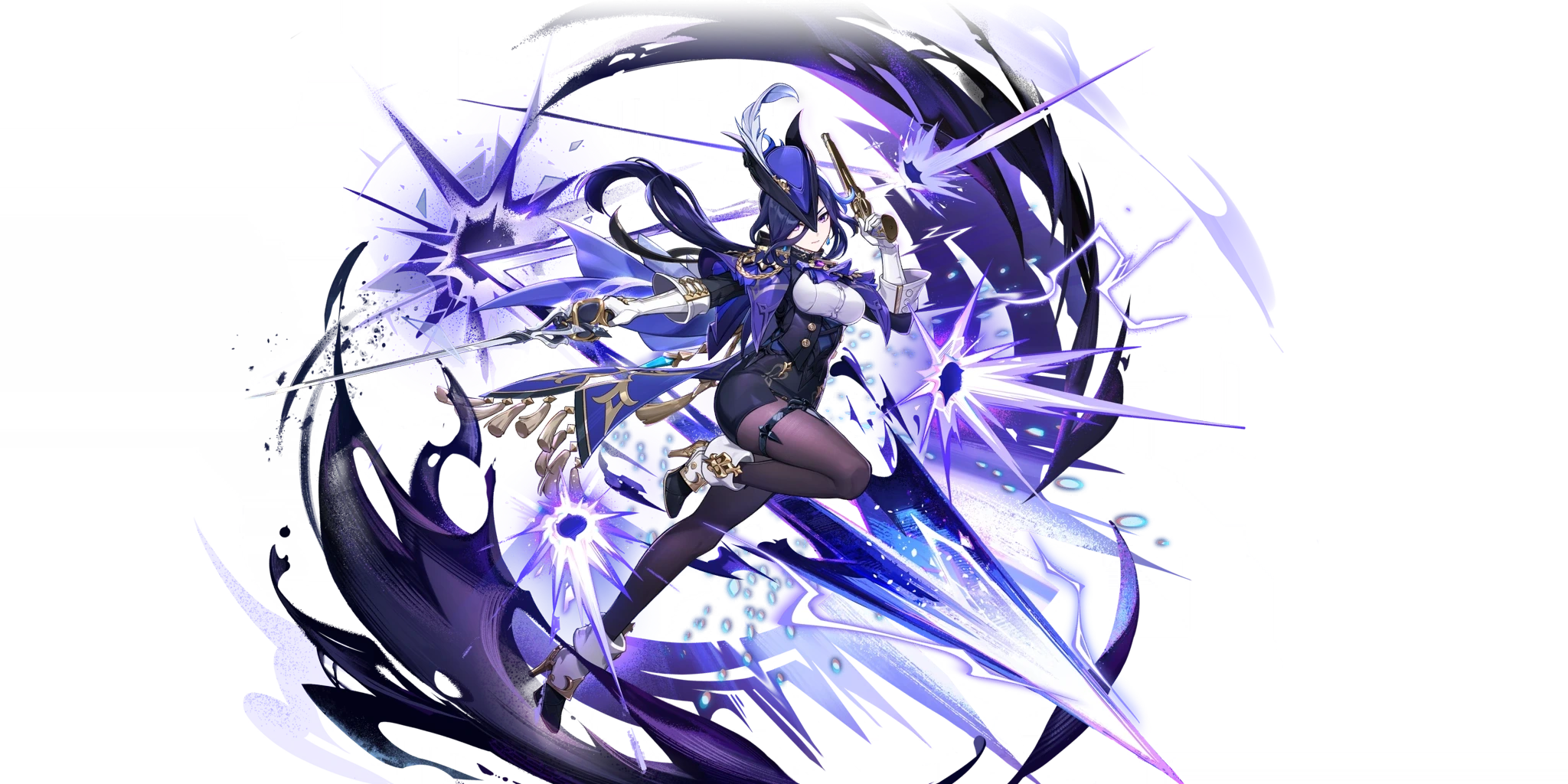


Clorinde is the strongest of the Court of Fontaine's Champion Duelists, the fighters a person on trial can challenge to a duel to defend their honour. [13] Her combat training descends from the Marechaussee Hunter lineage, a pistol-and-rapier style. Electro Vision. Her manner is cool and formal, with loyalty running underneath.
Who she is
As a Champion Duelist, Clorinde fights the duels that people on trial can request to defend their honour, and a defendant who wins is acquitted. The Champion Duelists are a group of Fontaine's best fighters, with Savinien and Guillaume Marais among the other current members, but the Court once announced that the duties of Champion Duelist "for all relevant trials" were entrusted to Clorinde. [13] [11] The post sits within the Court system, under the Iudex's office (Neuvillette). Trial-by-combat is one of Fontaine's documented judicial procedures, and she is its standing executor.
She holds an Electro Vision like any allogene and uses it for combat, and she fights in the pistol-and-rapier style of the Marechaussee Hunter lineage: hydraulic firearm work joined to close blade work. The style suits the post: it is built to close a duel decisively at any range.
History
Clorinde's combat training comes from the Marechaussee Hunters, the monster hunters Cassiodor founded a few decades after Remuria's fall. The Hunters no longer exist as an organized group, but individual Hunters still pass their training down through family lines or chosen successors. Clorinde learned their swordsmanship and marksmanship from her mentor, the Hunter Petronilla, who left without saying goodbye when Clorinde was ten. [6] [11] Her pistol-and-rapier kit is the Hunter standard, and her grounding in that tradition is well-established. She still counts herself a Hunter, but in her Story Quest she says, "My identity as a Marechaussee Hunter is not something I need people to remember. I wish only to be recognized as a Champion Duelist, nothing more." [12]
The post has a recognised rank within the Court, and Clorinde serves as the standing executor of trial-by-combat warrants. The whole officer corps recognises the commission, and her working relationships with the Iudex's office and the administrative Maison Gestion are professional and mutually trusting.
The commission survived the AQ IV Act V reset of Fontaine. The Court kept running through Focalors's dissolution and Furina's shift to mortal life, the Iudex's office held it together, and Neuvillette's restored authority as Hydro Sovereign came to frame the whole legal system. Clorinde's commission carries on after AQ IV.
In the story
Her central on-screen Archon Quest appearance is the trial-by-combat sequence in Chapter IV Act V, Masquerade of the Guilty, within the arc in which Furina is put on trial, where her role as the Court's executor comes out as the act reveals how its judicial process works. Her cooperation with the Outlander there is professional and clean.
Her one Story Quest, the Rapperia Chapter (Act I, Silent Night), walks through the Champion Duelist's work in practical detail, brings out her Marechaussee backstory, and runs a Court investigation that tests both her loyalty to the institution and her private side. Its emotional centre is the trust between Clorinde and the senior Court staff under a high-stakes engagement. She also recurs steadily across Fontaine's event material, through Court arcs, arcs about the Marechaussee and the Duelist, and the stories of Furina's civilian life after AQ IV, cool and formal throughout, her competence always in view. Her loyalty has two faces: to the Court as an institution, and to Furina personally, the second carrying across the AQ IV transition into Furina's mortal life.
In Version 7.2 she helps with Fontaine's response to the Hallowing. In Chapter VII Act VI, Furina says that Navia and Clorinde invited her to Poisson "to help set things up and gather supplies." [22] In the World Quest A Wall of Ships, Clorinde is aboard the Wingalet as the evacuees outnumber its cabins: "At this rate, the Wingalet won't just be transporting the injured. It'll have to serve as a makeshift floating shelter, too." [23]
Open questions
- Clorinde's history before the Marechaussee. The game touches on her early life and the years before her training and holds the specifics back.
- The Champion Duelist's mandate after AQ IV. The game has the commission continuing within the frame of the restored Hydro Sovereign; the long-term adjustments to Fontaine's trial-by-combat procedure are open.
- Her ties across the Marechaussee Hunter community. The game shows the cooperation consistently but holds back her specific relationships among the Hunters.
Where she fits in Fontaine's justice system
Clorinde's Marechaussee Hunter lineage and her Champion Duelist commission sit alongside, but not inside, two contemporary Fontainan bodies. One is the Marechaussee Phantom, the present-day investigative successor to the old Marechaussee Hunters, led by Neuvillette and mostly made up of Melusines. The other is the Hydro Sovereign Authority that Neuvillette resumed and that, after AQ IV Act V, frames Fontaine's whole legal system. Two distinctions matter here.
Marechaussee Hunter lineage, not Marechaussee Phantom membership
Per The Marechaussee Phantom, the contemporary Marechaussee Phantom is Fontaine's special-detective force, led by Neuvillette and mainly composed of melusines because their eyesight and perception exceed ordinary human limits. It descends from the old Marechaussee Hunters that Cassiodor, the Golden Hunter, founded a few decades after Remuria's fall. Those old Hunters eventually thinned the monster population and reintegrated into society. Hunters still exist today, but no longer as an organised group; they pass down their training through family lines or chosen successors. The present-day Phantom puts investigation first, is built around Melusine investigators and Suppression-Specialist Meks, and is distinct from its Hunter ancestor.
Clorinde inherits old Hunter marksmanship through that lineage. The Phantom record is explicit on the limit: she is the successor to old Marechaussee Hunter marksmanship traditions but is not stated to be a contemporary Phantom member. Her pistol-and-rapier kit is the Hunter paired-weapon style, and her Champion Duelist commission sits next to the Phantom (both under the Iudex's office, both coordinating with Chevreuse's Special Security and Surveillance Patrol) but works separately. The Phantom's present-day case is the Questioning Melusine and Answering Machine WQ, with Talochard and Curve; her commission is the standing post of trial-by-combat executor. The two share Fontaine's justice system without being the same institution.
For the Melusines, whose investigators in the Phantom share the Court floor with Clorinde's commission, their origin in Elynas's wound, the post-Vautrin law on she/her pronouns that frames their full citizenship, and the Phantom's mainly Melusine membership, see Melusines.
Why her post survived Fontaine's reset
Per The Sovereign-to-Archon transition, the Hydro line is the clearest case of continuity among the seven seats. Egeria held the first Hydro Archon role, Focalors succeeded her as a substitute Archon, and AQ IV Act V destroyed the Hydro Throne and returned full Authority to Neuvillette, the Hydro Sovereign. Egeria herself was never a Sovereign. [1] [2] That is the only restoration of full Sovereign Authority shown on screen since the Cataclysm, and Apep's disclosure about the Heart of Oasis in Welkin Moon Act IX records her acknowledgment of a fellow Sovereign.
Clorinde's commission survived the AQ IV Act V transition because the Court's jurisdiction ran broader than Focalors's tenure as Archon. Per Egeria and the true origin of Fontaine, Egeria, not Focalors, partitioned Fontaine. Focalors was Egeria's Oceanid follower, appointed as successor under the arrangement built on deceiving the prophecy, and the Court of Fontaine, the design of its legal system, and the Fortress of Meropide's original purpose all pre-date her tenure as Archon; they are Egerian institutions. The species-change law later enforced against Sigewinne may be one too: Neuvillette thinks it "more likely" was Egeria's. [21] Read across the two essays, the commission rests on a foundation Egeria laid as the first Hydro Archon, with the Hydro Sovereign Authority that Neuvillette resumed after AQ IV as its present frame; the substitution of Focalors is a chapter between the two, not the foundation itself. The continuity after AQ IV is exactly what a seat of continuity would be expected to show, not an exception.
The Marechaussee Hunter lineage she inherits
The The Marechaussee Phantom and Remuria pages, on the civilisation before Fontaine, sharpen three anchors of the Hunter lineage Clorinde inherits. None of them displaces the distinction above between Hunter lineage and Phantom membership; all three add depth behind it.
Cassiodor's end in the Canticles Finale
In the Finale of Canticles of Harmony, the Requiem movement (single quest Fortune Plango Vulnera), Cassiodor, the Golden Hunter, joins Boethius's ritual as a trap and takes hold of the new body from within. When Phobos reveals itself, he asks the Outlander, "Phobos and I... destroy us both!" He then fades: "This world shall no longer have Cassiodor, nor shall it have the Golden Hunter." His last request is the Requiem, "for me, and for my Imperator's wishes. Let our souls return to the present world, and return to the great sea..." [17] In the First Movement, Underwater Nocturne, he had sworn to "serve as the barrier between past and present" and called himself "the spirit-keeper of our ancient land." [18] Per Fandom, he "remained alive over the next two millennia, giving guidance to future generations," taking on many forms through possession. In Petrichor he speaks through the cat Osse, and only the cat is left when he is gone. [15] [17] The Hunters carry on through family lines and chosen successors. [6] The Hunter lineage Clorinde inherits therefore rests on a founder, the Golden Hunter, whose own story ended in the present day.
The Lochknights' descendants
The Lochknights were knights sworn to protect the Oceanids, and one of the rebel groups that Erinnyes led against Remus's rule; Erinnyes came from the same tribe as Cassiodor, who later went over to Remuria's side. [14] [15] By the time the Marechaussee Hunters first became active, a few decades after Remuria's fall, "the concept of the Lochknights had completely died out in Fontaine." The band of heroes the Golden Hunter gathered included "the descendants of the Lochknights." [16] [11] Per Fandom, he founded the Hunters to combat Boethius's Golden Troupe, and his skill against its enslaved Praetorian Golems earned him the name Golden Hunter. [15] The present-day Marechaussee Phantom was once made up mainly of Hunters. [6] Clorinde's pistol-and-rapier kit and old Hunter marksmanship descend from Cassiodor's Hunters, with Petronilla as the more recent link in the succession that the record notes. The distinction above still holds: Clorinde is the successor to Marechaussee Hunter marksmanship traditions, not a contemporary Phantom member, and her Champion Duelist commission works next to, but separately from, both the Phantom and Chevreuse's Special Patrol.
The Sybilla-Angel connection
Sybilla, the Golden Bee, was an Angel who served as Celestia's envoy in the ancient city of Meropis, guarding its Irminsul tree. Her form and mind were worn down until she remained a golden bee, and in that state Remus found her in the city's ruins. [19] Angels were creations of the Heavenly Principles who served as Celestia's envoys during the era of the unified civilization, and many cursed Angels survive today in their devolved form as Seelies; Fandom reads Yohualtecuhtin as another such envoy. [20] Sybilla's Angel lineage is distinct from the Marechaussee Hunter lineage Clorinde inherits, but the two threads meet in the Canticles of Harmony Chapter: Sybilla's wisdom and life were what Remus built Phobos from, and Cassiodor's self-sacrifice in the Canticles Finale closes the arc of Phobos's corruption that Sybilla's worn-down Angel nature opened. The two come from different layers of Fontainan history, recorded together in the Canticles of Harmony Chapter rather than on any single lineage page. Sybilla is older than Remuria: Underwater Nocturne calls her "the prophet who survived the previous cycle," and Phobos says she "was originally a survivor of the last deluge that swallowed the earth." The Hunters came a few decades after Remuria's fall, once Cassiodor had joined Egeria's people. [18] [17] [15] [6]
For the authority that grounds her commission, see Neuvillette's office as Iudex and Hydro Sovereign at Neuvillette; for the mortal life after AQ IV that the Court supports, see Furina; and for the neighbouring commission of the Duke of Meropide, see Wriothesley, all within Fontaine. The distinction between Hunter lineage and Phantom membership anchors to The Marechaussee Phantom and Melusines, while the Egerian foundation and the Hydro continuity case run through Egeria and the true origin of Fontaine and The Sovereign-to-Archon transition.