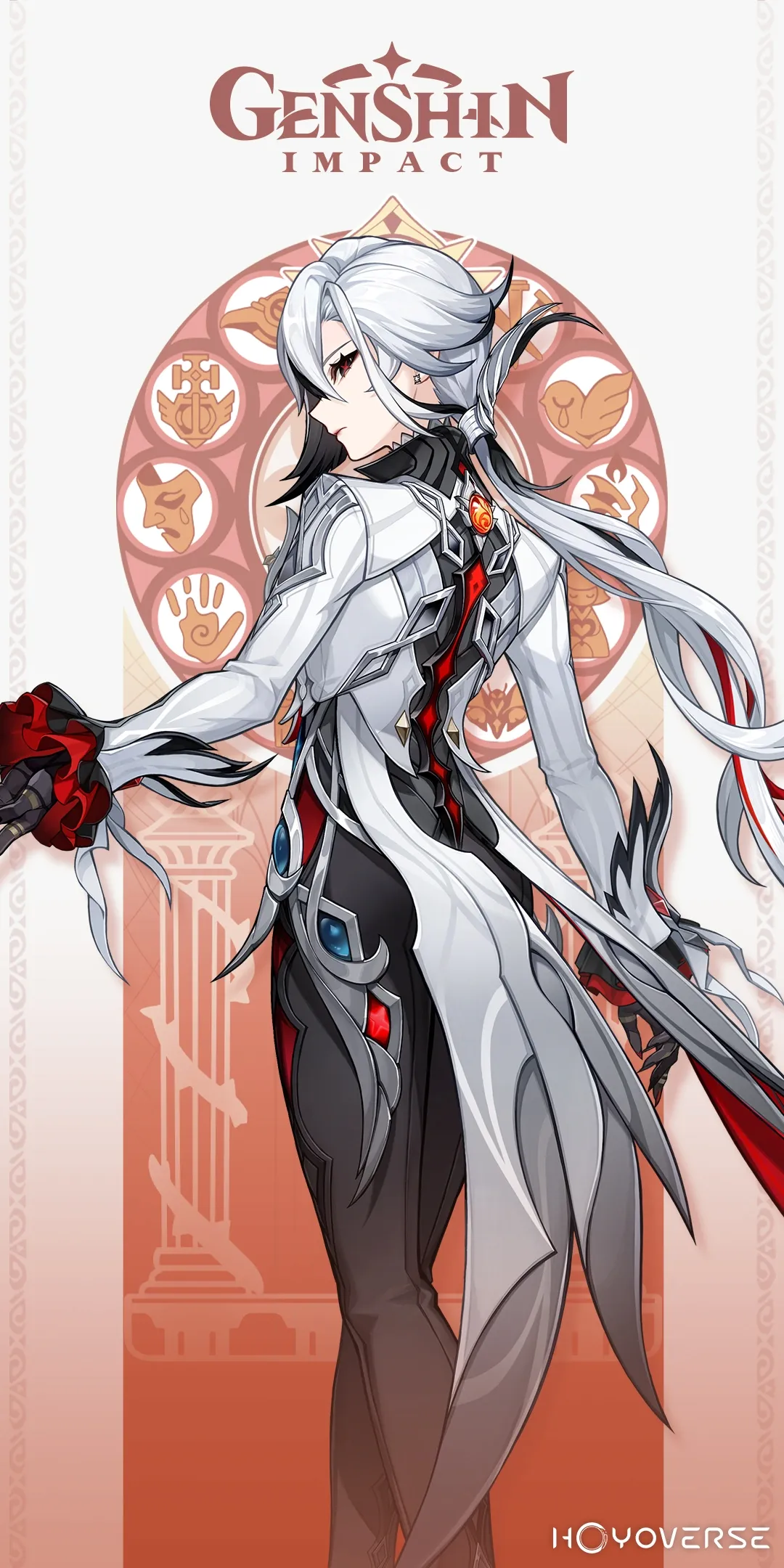
The House of the Hearth is the Fatui institution that recruits orphans and trains sleeper agents, currently directed by the Fourth Harbinger Arlecchino, "The Knave," born Peruere. She is a descendant of Khaenri'ah's Crimson Moon Dynasty, not a Fontainian native despite the Fontaine headquarters; that Crimson Moon blood is the source of the Balemoon Bloodfire curse that defines her combat and her self-discipline. [9] The House gathers orphaned children from across Teyvat and raises them as family; the most capable are trained as Fatui agents or as deep-cover sleeper operatives placed in target nations. House members describe their bonds as "tighter than blood" and call Arlecchino "Father." [1]
Arlecchino as a Harbinger is covered at Arlecchino, the wider Fatui context at the Eleven Fatui Harbingers, and Fontaine as a region at Fontaine.
Pre-Crucabena lineage: the Crimson Moon Dynasty original iteration
The House of the Hearth's lineage pre-dates Crucabena's directorship in Fontaine by millennia. Per Perinheri Vol. 1, a sage in the Crimson Moon Dynasty era of Khaenri'ah suggested to the then-ruler that an organization be established to house children who came from beyond this world, hoping that one such child would have the power to transcend the gods. That dynasty, the earlier of the kingdom's two known ruling dynasties, was named for the "crimson moon" (the Iridescent Moon) that shone over Khaenri'ah during its tenure. The ruler gave their implicit permission. The organization came to house Khaenri'ahn orphans from all walks of life; the outlander Perinheri and the alleged Liyue-born Angelica are among its named pre-Cataclysm members. Pierro implies, per Arlecchino's Character Story 5, that this organization is the original iteration of the House of the Hearth, and that he is feasibly responsible for its later affiliation with the Fatui. [9]
The Crimson Moon Dynasty era is also the peak of alchemy and the Beastmaster-Knight tradition in Khaenri'ah, per Narzissenkreuz Ordo archaeological records. The "crimson moon set, and the dark sun descended into a yet darker dusk" sometime before the events of Perinheri (II) (set during the Archon War), at which point the Eclipse Dynasty succeeded, ruling Khaenri'ah until King Irmin's reign and the Cataclysm. [9]
Arlecchino is a Crimson Moon Dynasty descendant. Her Balemoon Bloodfire, the curse that burns black from her hands and underwrites her combat, is inherited from that lineage. The Bloodfire draws on Abyssal energy, which slowly corrupts its user; Arlecchino learned that if the corruption ever reached the user's heart, they would become a completely different person, so she exercises extreme caution when using it. She was not aware of her own Crimson Moon Dynasty heritage until she met Pierro, who disclosed it to her. That disclosure is the personal and historical root of her loyalty to him. Pierro was a Khaenri'ahn royal mage, not the First Sage. [9] [11]
Other named Crimson Moon Dynasty descendants disclosed in the material after Welkin Moon include Tholindis (a sub-branch lineage, distantly related to the main line). Her fiancé Rerir, one of the Five Sinners of Khaenri'ah, was originally an Eclipse Dynasty secret agent whose primary mission was to hunt down and assassinate remaining Crimson Moon Dynasty descendants. The rivalry between the Crimson Moon and Eclipse dynasties sits underneath the present-day House's lineage politics and the Sinners of the Wild Hunt era. [9]
The history of the House below (Crucabena's era and Arlecchino's takeover) runs forward from the original iteration in the Crimson Moon Dynasty, through its re-grounding in the Fatui under Pierro. The Khaenri'ahn Dynasties disclosure resolves an earlier framing of an "uncatalogued pre-Crucabena House". The House's lineage before Crucabena traces back to Khaenri'ah's Crimson Moon Dynasty era, and Pierro is the architect of its modern Fatui form.
Origin under Crucabena: the purgatory doctrine
Before Arlecchino came the Crucabena era. As the previous Knave, Crucabena ran the House as an orphanage aligned with the Fatui, under a doctrine of coercion that the Ignis Purgatorius Chapter SQ (4.6) names the House's purgatory in the strict sense. [5] Children were taken in, broken, conditioned, and discarded as sleeper-agent material; injured or disobedient children were given to Dottore for experimentation or sent on deadly missions. The institution ran as a production line for disposable Fatui operatives rather than a family. [1]
Canon does not detail a specific bargain by which Crucabena became director. The House's affiliation with the Fatui traces to Pierro (see the Crimson Moon section above), and Crucabena held the Knave title and ran the House before Arlecchino. The account sometimes attached here, that Crucabena was the mother of the cursed child Caribert and traded his care for the directorship, is a conflation. Caribert is the son of Chlothar Alberich and belongs to the Abyss Order's separate origin in Caribert, Chapter III's sixth act, not to Crucabena or the House. [1]
Crucabena's own daughter was Clervie, raised inside the House from the age of six. Clervie saw through the cruelty, tried to spare the other children, and was tortured as an example. Her death in a forced duel against the young Peruere, and Peruere's killing of Crucabena a year later, are the events that crystallised Arlecchino's character and founded the modern House. The Ignis Purgatorius Chapter develops this in detail. [5]
Peruere's takeover: the coup that founded the modern House
Arlecchino was born Peruere, an orphan of Khaenri'ahn descent recruited as a child into the House under Crucabena. The Old Story SQ tells her life before she became a Harbinger as a story of survival through repeated violence and discipline. She did the assignments she was given, trained at the rate the House demanded, and lived through the attrition that Crucabena's House treated as expected. The turning point was Clervie's death. Crucabena's biological daughter Clervie died in a duel against Peruere. How the duel was framed, and whether Peruere had a choice in the matter, is the emotional core of the Old Story SQ. [4] [1] Crucabena, whom the children called "Mother," had favoured Peruere far more than Clervie, so few understood why Peruere later repaid that kindness with an assassination. [7]
A year after Clervie's death, Peruere fought Crucabena at the same spot and killed her. Crucabena was significantly stronger, and Peruere believed she won only through a conviction Crucabena lacked. [2] Crucabena's experiments had taken place "far from prying eyes," so Peruere was tarred with "matricide," and she never explained herself; she let the rumours spread. She took the title of the Knave and the name "Arlecchino," met the Tsaritsa, received a Delusion, and was granted an audience with Pierro. A small tombstone, its eulogy written in her hand, marks the place where she killed "Mother": "Here the last light of the setting sun lies buried. Here the coming dawn finds a welcome." [7]
Clervie's shadow was absorbed. Per the When the Hearth-Flame Goes Out event, Peruere's "unique constitution," that is, her Crimson Moon Dynasty descent, meant that she absorbed Clervie's shadow at Clervie's death, where it merged with other shadows her Balemoon Bloodfire flames had consumed over the years (something the page frames as exceedingly rare). The absorbed Clervie is not a true entity but a childhood version of her that can only appear in shadows and cannot eat actual food. She is unaware of everything that has happened since her own death, including Crucabena's assassination and Peruere's rise as the new Knave. The shadow Clervie resurfaces during the When the Hearth-Flame Goes Out event and stirs up dissent among House members (influencing Nanteuil, Filliol, Chapleau, and Freminet) in an attempt to "save" them from a Crucabena who is no longer in command. She is finally reunited with the adult Peruere at the spot where she died. There Arlecchino reveals to her that she is a shadow, the Traveler and Paimon describe the world she never got to see, and Arlecchino dismisses her from the House so she may disperse. [10] This absorption of shadows is the sharpest disclosure in the material after Welkin Moon of how the Balemoon Bloodfire interacts with the Crimson Moon Dynasty lineage's relationship to the Abyss. The flames consume shadows, and a descendant's constitution preserves them.
Arlecchino's doctrine: orphans-as-trained-family
The current House under Arlecchino runs on an explicitly reformed doctrine. Where Crucabena maintained absolute control and had children fight each other (with injured or disobedient ones given to Dottore for experimentation or sent on deadly missions), Arlecchino "enforces one vital rule: loyalty, with betrayal punishable by death," is less strict overall, and can spare those who show strength by giving them potions containing her flame that erase their House memories. [1]
The doctrine has several distinct parts.
- Loyalty as the binding rule, betrayal as the only capital offense. Crucabena's doctrine had multiple categories of capital offense (disobedience, injury, insufficient utility, falling behind in training). Arlecchino's reduces the list to betrayal alone. Members have substantially more autonomy than they did under Crucabena; the boundary they cannot cross is loyalty to Arlecchino and to the House.
- Memory-erasing flame potions as the way out. This rests on Arlecchino's Pyro affinity and her Crimson Moon blood. She can prepare potions containing her own flame that erase memories of the House. The potion is the House's exit, a way out for those who show strength but are not suited to (or do not wish to remain in) the Fatui's deeper operations. It is rare, and only Arlecchino can administer it.
- "Father" as a formal title, not personal pretense. House members call Arlecchino "Father" within the House; the title is the institution's formal language, not affectionate roleplay. It reflects the doctrine of the House as a trained family, in which its senior figure is the parental authority and not just the commander of its operations.
- About fifty active children. The current House keeps roughly fifty at any given time, considerably fewer than under Crucabena. The smaller size fits the change in doctrine, since a House run as a trained family cannot sustain the volume of disposable operations the prior House supported.
Named members: the Fontaine group
The most visible named House members are the Fontaine group trained for the Lyney/Lynette case that anchored AQ IV Acts 1-3:
- Lyney: Pyro Vision; stage-magician public profile; Arlecchino's eldest. Per Lyney's SQ, his mix of stage performance and work as a Fatui sleeper agent is Arlecchino's doctrine in miniature, a House operative whose public role is its own protective cover. [8]
- Lynette: Anemo Vision; Lyney's adoptive sister; the quieter counterpart to Lyney's public performance.
- Freminet: Cryo Vision; the group's underwater-operations specialist, and the calmest temperament among them.
These three are Arlecchino's "children" in the House's formal sense and operate as a trio through AQ IV Act 1-3. They give the clearest look at how the House under Arlecchino works in the field. The larger roster of ~50 children holds many more unnamed House children, plus operatives presumably placed across other regions the player has not yet met. [8]
Project Stuzha: the Fatui-internal challenge
The Ignis Purgatorius Chapter SQ (4.6) discloses more about the Fatui's internal affairs than any other single piece of content in the window after AQ IV Act V. It is where the House first meets Project Stuzha. After Fontaine's events, Pantalone and Pulcinella assigned Arlecchino and House members to take the spotlight in the project, which Arlecchino suspects is a ploy to control their influence. [3] Chapter VII later explains that Project Stuzha is a set of energy reforms, approved by the Veche, that limit public consumption and channel the saved resources to the Armory Palace for Project Mistilteinn. It is a national programme, not an operation aimed at the House. [3] [12]
The chapter develops the confrontation across several beats. Arlecchino recognizes how Project Stuzha is being framed, refuses to let House children be deployed at the intensity Pulcinella and Pantalone requested, and produces the response that closes the chapter, a proposal for the Fatui to withdraw from Fontaine. [5]
The proposal is delivered to Neuvillette as Iudex at Palais Mermonia. The Fatui will gradually withdraw their formal presence from Fontaine, and the House's operations there with it. In exchange they get the outcome already in hand (the completed collection of the Hydro Gnosis) and stability on Fontaine's side under Neuvillette's resumed Sovereign authority. Neuvillette accepts. The Fatui presence in Fontaine is in gradual withdrawal as of 4.6. The acceptance is one of the densest pieces of primary text on Fatui diplomacy in the broader 4.x-5.x narrative. It is also the most explicit confirmation that the House under Arlecchino operates with substantial autonomy from the chain of command that runs through the Tsaritsa and Pierro. [5]
The Ignis Purgatorius Chapter also names 5 of the 11 Harbingers on-screen together: Arlecchino, Pulcinella, Pantalone, Pierro, and one more whose scene the chapter develops in detail. It is one of the densest Harbinger scenes in any single piece of primary text; the wider roster is revealed across many scattered moments rather than all at once.
Chapter VII: independence on terms
In Snezhnaya the House works for the state. In Act III it gives the Tsaritsa its own list of corrupt officials, which she hands to Pulcinella with orders to "review it carefully and add in any missing entries." During a sting, the disguised Alyosha says that dressing well "would only make me a target for the House of the Hearth," and the swindler Avaz agrees that "They've been acting like wild dogs lately, preying on people everywhere." Lyney, Lynette, and Freminet are in Snezhnograd on a mission with "Father," which Lyney describes as "gathering and organizing all kinds of intel, preparing some little surprises for officials looking to defect, and so on." [13] [14]
Act IV changes the House's status, at least by agreement. Arlecchino volunteers for Pierro's high-risk Delusion experiments, and he sets out her price: "The House of the Hearth will become an independent organization, no longer serving as a Fatui intelligence agency, and no more children will be trained as spies. Instead, they will follow your leadership in the name of the Crimson Moon." He calls it a deal that "strikes at the fundamental contradiction of the House of the Hearth: the inseparable mix of love and exploitation. Many are aware of this, but you are the only one willing to make this deal with me." Arlecchino's reason is the children: "The children once asked me what a real family looks like. Before I can even discuss that with them, I should first free them from the least familial elements of their home environment." [15] [16]
The independence comes with a condition. "Provided you remain loyal to the Tsaritsa and act in the interests of Snezhnaya," Pierro says, "it makes little difference whether your subordinates are independent or not." The act does not show the change taking effect, or say what the House will do once it stops gathering intelligence. [15]
In Act V the House is still asked for intelligence. When the Holy Soil phenomenon begins, Pantalone turns to Arlecchino at the council: "Has the House of the Hearth come across any intelligence regarding the Hallowing?" "Some, but nothing confirmed. Only rumors," she answers. "Supposedly, there exist certain lifeforms capable of consuming light realm energy and converting it back into elemental energy, thus reversing the Hallowing process." Sandrone dismisses it as "just a folk tale," and Mitya, who finds a man-made conversion "theoretically feasible," doubts any such technology could fully reverse the process at that scale. Nobody says whether the rumored lifeforms are the Sangacorexes that Kokomi later describes to the nations' leaders. [17] [18] [19]
What the House is for
The House of the Hearth is the Fatui's pipeline for recruitment and loyalty. Where the Northland Bank (Pantalone's institution) is the Fatui's financial monopoly, the House is its monopoly on people, the pipeline of orphans raised as a trained family through which the next generation of Fatui field operatives is shaped. Crucabena's doctrine optimized that pipeline for volume (many disposable operatives); Arlecchino's optimizes it for durability (fewer operatives, raised as family, who can work independently over the long term in target nations).
That shift toward durability fits the Tsaritsa's late-game plan in a way Crucabena's doctrine did not. The endgame of Gnosis collection demands assets that can carry out independent diplomacy over a long horizon (Arlecchino's diplomacy at Palais Mermonia is the model case), not just disposable enforcement labor. The Project Stuzha challenge from Pulcinella and Pantalone tests whether the Tsaritsa will keep backing Arlecchino's House against the Harbingers who prefer the old doctrine's heavier use of House assets; per the Ignis Purgatorius Chapter's resolution, she does. The House under Arlecchino is the form the institution takes in the Fatui's late game. [5] Chapter VII Act IV complicates that reading: under the terms Arlecchino agreed with Pierro, the House is to stop being a Fatui intelligence agency altogether. [15]
Open canon
- What the House becomes after Chapter VII. By the end of Act III, Lyney, Lynette, and Freminet are working in Snezhnograd with Arlecchino, and Act IV sets terms for the House to become independent and stop training children as spies. When that takes effect, what the House does instead, and where the rest of the roughly fifty children are based are not shown as of Version 7.2, and in Act V Pantalone still asks the House for intelligence on the Hallowing.
- The House's history before Crucabena is settled as far as its lineage goes, but it is still open whether the organization itself continued unbroken. Per the Khaenri'ahn Dynasties / Perinheri Vol. 2 disclosure, the House's original iteration was founded in the Crimson Moon Dynasty era of Khaenri'ah and survived into the Eclipse Dynasty, through the Cataclysm, and into post-Cataclysm Fontaine, with the Fatui affiliation implied to be Pierro's design. What remains open is the link between the organisation of the Crimson Moon era and the House Crucabena ran in Fontaine. The same institution may have operated continuously across the change of dynasty and the Cataclysm, or Pierro may have rebuilt it from scratch after the Cataclysm and presented it as a continuous tradition, or the truth may be some combination of the two. The reference to Crucabena's predecessor (the figure Arlecchino killed before Crucabena) sits in this open stretch of continuity.
- The Khaenri'ahn Dynasties disclosure sharpens, but does not fully settle, how the House's Crimson Moon Dynasty lineage relates to the broader cosmology of the Crimson Moon (the Iridescent Moon). That cosmology is the vampire-coded ruling line of Khaenri'ah before the Eclipse Dynasty, which Arlecchino's bloodline and Crucabena's both trace into. The chain from the Balemoon Bloodfire to Abyssal energy to the corruption of the heart is confirmed. What is not yet disclosed is whether House children selected for compatibility with the Balemoon Bloodfire are chosen on purpose for their lineage (per what Pierro knew of Arlecchino's heritage before the Tsaritsa) or whether the compatibility surfaces by accident. A dedicated Crimson Moon Dynasty page is a natural place for more detail.
- Crucabena's Crimson Moon Dynasty status is ambiguous. She was Arlecchino's predecessor as Knave and Clervie's biological mother. Whether she was a Crimson Moon Dynasty descendant in her own right, or simply a House operative on the Fontaine side who inherited the framing of Crimson Moon blood through the House rather than through lineage, has not been settled in canon as of 7.2. [2]