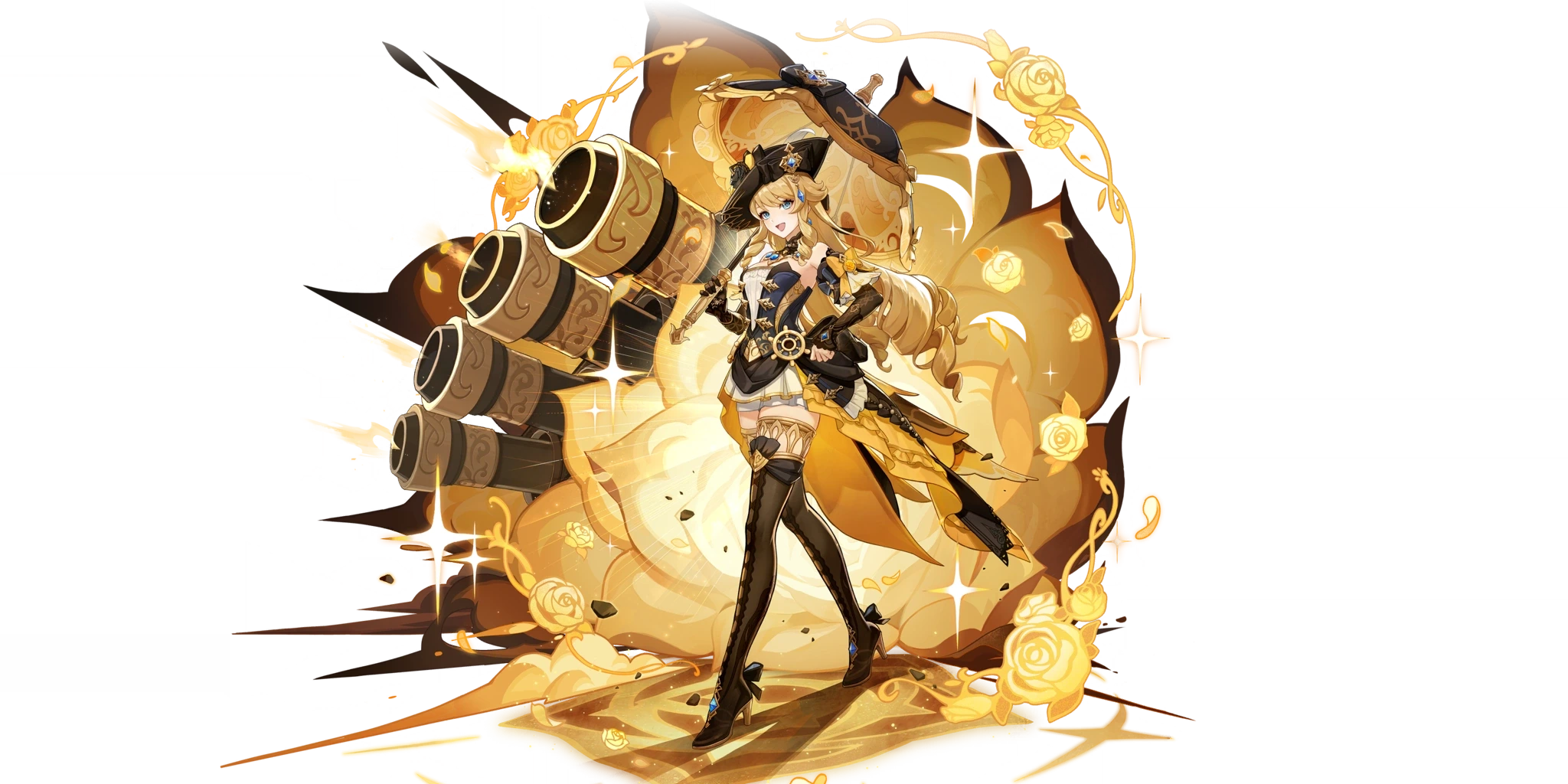


Navia is President of the Spina di Rosula, the daughter of its founder Callas Caspar, and a Geo Vision-holder who fights with an Ousia-aligned Gunbrella. Within Fontaine's justice system she runs the civilian side, the investigative organisation that takes on the cases the formal three institutions will not. She carried the Spina forward after her father's duel-death three years ago, and the optimism she leads with sits on top of real loss.
Who she is
Navia is the second President of the Spina di Rosula, the Caspar-family civilian-investigation organisation headquartered in Poisson, funded by donations from supporters across Fontaine and set apart from the Court of Fontaine's three formal-justice institutions (Marechaussee Phantom, the Fortress of Meropide, and the Palais Mermonia Iudex). Its mandate is to handle what the Gardes (the Court's local police) will not or cannot: civilian cases below the Court's threshold, regions its deputised institutions cover less actively, and the marginalised populations the formal system under-serves. Navia inherited the presidency after Callas died three years before the present-day Fontaine arc.
Her Geo Vision is Ousia-aligned, and her weapon is the Gunbrella, a combined gun and umbrella whose origin (per Character Story 3) is purely practical: she disliked carrying both an umbrella and a sidearm, so she merged them. She works hands-on, more often in the field with her operatives than directing from Poisson; she is optimistic, dutiful, sharp, and able to read a situation from angles others miss.
The surname Caspar is one of the Three Magi from the Bible, from an Aramaic root meaning "treasurer." Inside the Spina she is addressed as Demoiselle (by senior operatives Melus and Silver) or Boss. Her aliases also include King of Constellation Metropole, from her stint as monarch of the Simulanka mirror-world during Summertide Scales and Tales, and the Soaring Yellow Rose, the title of Charlotte's Steambird photograph of her.
History
Navia's family, the House of Caspar, is a prominent Poisson-region lineage that pre-dated the Spina di Rosula's founding. The House's pre-Spina civic standing came in part from its sponsorship of the Aquabus construction project, and the Aquabus Callas line is named after her father in recognition of that work. Callas earned wide civic trust across the construction: the Palais Mermonia tried to grant him the honorary title of Baron after the aquabus lines completed, which he refused, on the grounds that the title was hollow and that accepting it would distance the House, and the Spina, from the ordinary Fontainians the family worked with. The Caspars came to civic-investigation work from a background in civic engineering, so the Spina continues the House's existing standing rather than being a separate vigilante operation.
Navia's mother Clementine died from complications following Navia's birth. Per Character Story 4 and the supplementary "The Right Time" story, Clementine had visited the Fountain of Lucine with Callas before deciding to have a child, and had kept a notebook of hopes and small observations about the child she was about to bear. Callas gave Navia that notebook only after she had grown into an adult by her own path, reading that her mother had not wished those hopes to become a burden on a growing child. The Clementine-and-Callas story is the emotional core of Navia's understanding of her father's later silences.
Navia met Clorinde when she was a (self-proclaimed) "big girl of something over ten years," via an introduction by Petronilla, the late-stage Marechaussee Hunter lineage figure the Marechaussee Phantom page records. The two girls were close in Navia's pre-teen years and remained so through Clorinde's tenth birthday and Petronilla's later disappearance. Navia is older than Clorinde, the gap set back when they first met as children.
How her father died: the Opera Epiclese duel
Three years before the present-day Fontaine arc, Callas Caspar was killed by Clorinde in a duel. The truth of it, and the frame for any account of Navia's history, is not a covert Geo-related operation or a Spina-internal coup. It is the Fontainian trial-by-combat institution playing out under its standard rules, with Clorinde acting in her standing capacity as the Court's Champion Duelist and Callas opting into the duel as an explicit alternative to a courtroom trial at the Opera Epiclese. The operative sequence, per AQ IV Act II As Light Rain Falls Without Reason:
- Marcel's Sinthe operation. Three years before the present-day arc, Callas entered a partnership with Marcel that he believed was legitimate. Marcel was secretly running Sinthe, a beverage popular in Poisson that was Primordial Sea water diluted with ordinary water, causing severe long-term physiological side effects. When Callas discovered the operation, he banned Sinthe and began investigating its vendors, and he persuaded a vendor named Jacques to turn cooperator.
- The banquet killing. Marcel ordered Jacques killed for the betrayal. Jacques could not bring himself to assassinate Callas as instructed, so Marcel hired a third assassin. At a countryside banquet Callas hosted, the assassin shot Jacques; Callas shot the assassin in turn. The remaining guests found Callas standing with the gun and Jacques dead. Marcel then dissolved the assassin's body using Primordial Water, a method the Fontainian public did not yet know would dissolve Fontainians, and which therefore erased the exonerating evidence completely.
- The duel. Charged with murder, Callas opted not to stand trial at the Opera Epiclese. Defending himself in court would have required testifying against the Sinthe network, and Marcel's faction would then have retaliated against Navia. Callas instead invoked Fontaine's age-old duel-settlement tradition and faced Clorinde, the Champion Duelist, to maintain his innocence under trial-by-combat. Before the duel he asked Clorinde to look after Navia, and she accepted. Callas fought to the death, and Clorinde killed him.
- The years of silence. Callas had kept his motives a secret from Navia. For years she could not understand why her father had refused to defend himself, and her relationship with Clorinde was strained accordingly. Marcel did not move against Navia during this period, because Callas's surviving Spina associates would have published intelligence on the Sinthe business if she were ever harmed; the dead-man-switch standoff was, in retrospect, the entire point of Callas's choice.
- The resolution, in AQ IV Act II As Light Rain Falls Without Reason. With the Traveler's assistance, evidence retrieved from Marcel's secret headquarters, and Clorinde's testimony, Navia exposed Marcel in court and posthumously exonerated her father. The act is the only primary-text source for the whole arc of Callas's framing; the Vacher serial-killer case running in parallel through the same act is connected to Sinthe (Vacher exploited the dissolution-as-cover trick the network had pioneered), but Vacher and Marcel are distinct individuals in different positions.
(Note: any reading of Callas's fall as a covert "Operation Solar Flare," a Spina-internal coup, or a Geo-cosmology event has no primary-text grounding. The actual event is the sequence above, the duel and the Sinthe frame-up, sourced to a single AQ act and the chain linking Marcel, Sinthe, and Jacques. Geo only enters her history in the coming-of-age Vision story with the Tabletop Troupe, a separate later event.)
In-game arc
In AQ Chapter IV Act I Prelude of Blancheur and Noirceur, Navia makes her first NPC appearance (sub-quest Lies Cast Shadows Under Gathered Lights). The act opens the Fontaine chapter at the Court of Fontaine with the Lyney-and-Lynette stage-magic case; Navia enters as an NPC aligned with the witnesses and investigators, whose civic network in the Spina di Rosula has a parallel interest in the pattern of dissolutions the case is part of. Her cooperation with Lyney and the House of the Hearth Fontaine cell (Lynette and Freminet) runs across the act's broader investigative arc.
AQ Chapter IV Act II As Light Rain Falls Without Reason is the act that investigates the framing of Callas. Navia is its mainstay on the civilian side of the investigation; the Traveler, Clorinde, and Charlotte cooperate across her recovery of Marcel's evidence trail; the act resolves with Marcel's exposure, Callas's posthumous exoneration, and the onset of Navia's reconciliation with Clorinde. This single act is the primary-text source for the whole frame-up.
In AQ Chapter IV Act V Masquerade of the Guilty (Finale, Opera of Noirceur and Blancheur, Apocalypse, Hunters, Prophets, Meeting Is Also Parting, Deluge of Wrathful Waters), Navia's role is supportive rather than central. The chapter's centre-stage trial is Furina's, not Navia's, but the Spina di Rosula's presence in the Court's broader response to the Prophecy resolution is primary text.
Navia's Story Quest, the Rosa Multiflora Chapter, opens with Act I Braving the Tides Together, released in Version 4.3 (Phase 1) alongside her playable debut banner (prereqs: Adventure Rank 40 and AQ IV Act V completion). It covers Navia's presidency of the Spina after Callas was exonerated. A faction of former Spina members who left during the dispute between Romeuf and Callas over whether resources went to the Aquabus or to Poisson, among them Romeuf, Colter, and Martinat, return with a plot to destroy Poisson with explosives. Navia confronts Colter directly; Florent and the Spina operations team coordinate with the Maison Gardiennage and Esmond for prosecution; the act resolves with Navia choosing to prosecute the conspirators to the full extent of the law rather than handle them privately as ex-Spina members, and announcing the extension of the Aquabus system to Poisson, her official answer to the grievance behind Romeuf's faction.
Navia also appears briefly in AQ Chapter V Act I, Flowers Resplendent on the Sun-Scorched Sojourn ("Natlan! A New Adventure"), a Natlan-arrival cameo rather than a Natlan-arc role.
In Version 7.2 she is part of Fontaine's response to the Hallowing, though she appears only in Furina's account in Chapter VII Act VI. As refugees head for Fontaine, Furina says, "Navia and Clorinde invited me to Poisson to help set things up and gather supplies." The Natlanese in Poisson, who were losing their memories, could not safely be sent home on their own, and Furina took that on: "I knew the Spina di Rosula were already stretched thin, so I had a word with Navia. We agreed that I'd help to escort them back home." [11]
She is a steady recurring presence across Fontaine cumulative-event material: the Summertide Scales and Tales Simulanka arc (King of Constellation Metropole role; Spina di Rosula Simulanka branch establishment), Whirling Waltz (Spina business-acumen vignette), the Vibrant Harriers and Macaron Melange web events, and multiple Tabletop Troupe ensemble arcs with Clorinde. The tone is consistently optimistic and civic-minded, and her competence in the field is consistently on show.
What stands out
- The presidency itself. Navia is the second-generation head of Fontaine's civilian-side investigative institution, donation-funded and Poisson-based, sitting as a fourth arm alongside the formal system of the Marechaussee, the Fortress of Meropide, and the Iudex. The ethic she has settled the organisation into since Callas's death is the real substance of her tenure.
- Optimism over a foundation of loss. She has lost both parents and the trusted subordinates Melus and Silver, all of it primary text rather than backstory colour, and she chose to lead the Spina from optimism rather than grievance.
- The Gunbrella and the Vision story. Navia's Geo Vision came during a Tabletop Troupe session on her coming-of-age birthday (Character Story "Vision"), recognising the moment she sacrificed her in-game character, Demoiselle, to save the party. The Gunbrella is the same practical instinct to compress two things into one, in combat form.
- The Soaring Yellow Rose. She is one of Charlotte's favourite Steambird subjects, and the Soaring Yellow Rose is the title of her photograph in the exhibition hall; the Spina and the Steambird work together by consent rather than as press and quarry.
What canon leaves open
The immediate reconciliation with Clorinde and the cooperation with the Court's three arms are settled, but the long-term shape is not, especially with the House of the Hearth Fontaine cell withdrawing after AQ V. Canon glosses the multi-generational history of the House of Caspar without filling in specifics. And Navia's exact age is never stated: Rapperia Chapter dialogue places her in her mid-to-late twenties, but the framing stays deliberately imprecise.
The organisation she runs has its own page at The Spina di Rosula, and the duel that shaped her belongs to Clorinde. The Hearth cell she worked with across AQ IV runs through Lyney, Lynette, and Freminet, while Wriothesley keeps the narrow arrangement between Meropide and the Spina that Callas set up. Her father's frame-up plays out across Act I and Act II, with Act III carrying the cosmology of the Primordial Sea that the Sinthe operation sat downstream of. That dissolution mechanic traces to Egeria, not Focalors, who partitioned Fontaine and built the Fortress of Meropide to seal the Primordial Sea path; and the Marechaussee Phantom stays a separate body from the Spina, its Court-deputised detective work standing beside the Spina's civilian justice, the two sharing Fontaine without overlapping jurisdiction.