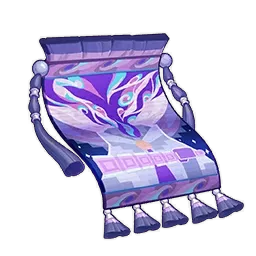
The Headless Coquitao is a two-volume Natlan Book Collection released in Version 5.5, framed in its standing description for both volumes as "a woven scroll from the Masters of the Night-Wind. It is said that the stories within are older than the tribe itself, a claim that remains difficult to verify." That standing description is the in-text disclaimer that marks the book as deep folklore: older than the tribe that preserves it, passed down through the tribe's blind weaver-tradition, and hedged on its own framing line. The two-volume count comes from the Book Collection master index, where the title sits in the V5.5 batch of Natlan tribal folktales alongside Kompore the Cunning (3 vols), Sundjatta's First Foray (3 vols), and Rangi Nui's End (1 vol). [1] [2]
Vol. 1: the pact and the obsidian blade
The volume opens with a frame on the Masters of the Night-Wind's blind-weaver tradition: "the weavers of the Masters of the Night-Wind know every river of the night's domain - they know how stories and poems emerge from the black river of Mictlan." The predatory night-birds serve "She-With-The-Broken-Visage," who carries "moonlight condensed into three silver strands" from her master's hand to commission blind weavers to render the strands into tapestries that "become history." The wandering sage Ropal the "Child of the Sea," banished by all tribes, is quoted: "I embrace chaos, yet I know not if chaos embraces me." The Lord of the Night "blinded all who weave tales, compelling them to focus on stories while being unable to see the present", "never to witness the three moons' death with their own eyes." The body of the volume narrates Coquitao, "one of the Masters of the Night-Wind's precursors, whose soul's homeland lay beneath a distant midnight, under a frigid sun", a warrior bearing the stone club Makana, "following a contract forged with gods dead and cold." On a night of wind and rain he makes "a wordless pact with the deity of the dog days," mortgaging his fate to the Kame Twins "from a plague-ridden land." The deity bids Coquitao "punish the deluded ones who had forgotten death" and use Makana "to bring forth death irreversible, guiding the masterless souls back to the deep black river of Mictlan, returning them to the Night-Lord's slumber." His companion Nagual is named, "a cunning shapeshifter from a distant scorched land that burns endlessly even now." When the pacifying slaughter is complete and "the river of blood at last pleased the jade-skirted master who dwelled above the thundering clouds," the deity "refused to return the hero's soul, instead commanding the treacherous Kame Twins to direct the despicable Nagual in secret", and Nagual "hewed Coquitao's head with an obsidian blade." The volume closes: "headless Coquitao failed to complete his covenant with the deity of the dog days, and could only blindly follow the Tzitzimimeh in their wandering." [1]
Vol. 2: the vengeance and the residual flame
The grieved "mistress of heavenly stars" commands her Tzitzimimeh to descend and guide the headless Coquitao to his vengeance. The headless body strides through moonlit nights gripping Makana; "some say he transformed into a black spirit leopard, silently passing through forests and plains, bringing nightmares and inspiration to priests deep in meditation." He wanders "transforming into unnumbered forms, traversing lands awash with blood," until at last he finds Nagual at an oasis "in the land of scorched and burning soil… sipping a poisonous serpent's blood and hallucinogenic Mexicali juices." The first Makana-blow shatters "the traitor's skull like the illusory Mexicali oracle"; the further blows "blasted Nagual back to his burning hometown." But Coquitao's spirit "was already one with the life of the earth, never to return"; what remains in the headless body is "eternal, burning, icy rage… akin to the cold sun in the night skies over the land he called home." The volume closes with the Makana-inheritance line: "long, long after, even after the deity who reigned over the dog days, the cunning twins, and the master with the jade skirt had all passed away, after the starlight-born Tzitzimimeh had begun to flicker, their light decaying, Coquitao's wrathful flame, the weavers claim, has not yet gone out… many heroes have inherited Makana in times of tumult and trouble, the legendary tyrant Och-Kan being one of them - he, too, ultimately met his end in raging fire... but that is another story." [1]
Mictlan, the Night-Lord, and the Makana line
The book is the primary-text source for the Masters of the Night-Wind's deepest folklore, the "older than the tribe itself" layer at which the tribe's blind-weaver tradition operates. Mictlan works both ways here: as the "black river" that stories flow from, and as the destination "the deep black river of Mictlan" to which masterless souls return at "the Night-Lord's slumber." The in-book "Lord of the Night" and "Night-Lord" titles line up with Yohualtecuhtin, Lord of the Night, the surviving Angel who designed the Night Kingdom. So the book is where the Masters of the Night-Wind frame the material on Yohualtecuhtin, Mictlan, and the Night Kingdom at a depth older than the tribe, separate from the more cosmological account the dedicated Yohualtecuhtin page gives. [4] [5]
The book is also the primary-text source for the Makana inheritance line its ending names. In Vol. 2's long-after framing, Makana passes to "many heroes… in times of tumult and trouble," with Och-Kan named as one such inheritor whose end "in raging fire" is held back as "another story." Och-Kan is the Natlan tyrant from before Mavuika. The damage he left was later repaired through the work of reconciling the tribes' bonds with their Saurians, centred on the Stadium of the Sacred Flame. The book sets Och-Kan inside a much older line of Makana's inheritors that begins with Coquitao's headless body. [3]
What the figures are not equated with
The figures introduced here are not equated with any named Sovereign, Archon, or entity of the Heavenly Principles outside the book's own folklore. The "deity of the dog days" is authorial framing: the "dog days" alludes either to the Eastern-Hemisphere summer-heat period, or to the Aztec Tonalpohualli calendar's Itzcuintli (Dog) day-sign (ruled in real-world myth by Mictlantecuhtli), or to the trecena beginning with 1-Itzcuintli (ruled by Xipe Totec). It is not identified in primary text with any specific in-Teyvat Natlan deity, Sovereign, or Archon. The "jade-skirted master who dwelled above the thundering clouds" is a flagged real-world allusion to the Aztec deity Chalchiuhtlicue ("She of the Jade Skirt"), not equated with any named Natlan figure in-game. The "Kame Twins from a plague-ridden land" and the "despicable Nagual… a cunning shapeshifter from a distant scorched land" (the word nagual / nahual derives from Nahuatl nāhualli, a Mesoamerican shapeshifter archetype) are in-book entities with no wider identification. She-With-The-Broken-Visage, the "mistress of heavenly stars," the Tzitzimimeh under her command, and the wandering sage Ropal the "Child of the Sea" appear only within this book and are not equated with named Wayob, Angels, Sovereign Lords, or figures of Archon rank elsewhere. [1] [4]
The book is also not a historical record. The standing description's "older than the tribe itself, a claim that remains difficult to verify" is an in-text disclaimer that the volume is folklore passed through the blind-weaver tradition, not cosmological testimony, reinforced by Vol. 1's "the great master of riddles and allegories remains forever an indiscernible, indescribable mist upon a tapestry." The "three moons' death" the blinded weavers "never witness with their own eyes" stays here as in-book imagery and is not equated with any specific cosmological event involving the Three Moons; the "obsidian blade" Nagual uses is not attested as a named ritual artefact outside the book. [1]
A note on the names and the cold-sun imagery
Coquitao is "the Zapotec title for a king" (authorial framing for the precursor-warrior whom the weavers of the Masters of the Night-Wind preserve in oral tradition), and Makana derives from the Hawaiian word for "gift," fitting a stone club granted at a pact rather than forged by mortal hand. The closing-line image, "eternal, burning, icy rage… akin to the cold sun in the night skies over the land he called home," returns the volume to its opening: Coquitao's "soul's homeland lay beneath a distant midnight, under a frigid sun," and the leftover fire in the headless body after vengeance is the same "frigid sun" imagery the Masters of the Night-Wind's oldest tradition inhabits. The "that is another story" deferral, the closing formula of Natlan tribal folktales seen in its V5.0–V5.5 stablemates The Tale of Qoyllor and Ukuku, The Tale of Kuntur, Kompore the Cunning, and Sundjatta's First Foray, leaves Och-Kan's inheritance of Makana open as a hook for future books. [1]