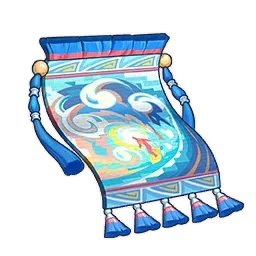
Rangi Nui's End is a single-volume Natlan Book Collection released in Version 5.5 and sold from Idukan's Trove, the bookshop in the "Masters of the Night-Wind" tribal area of the Tezcatepetonco Range, though the song's tribal attribution in-text is the People of the Springs (Meztli). The standing description is its framing line: "An ancient folk song from the People of the Springs. It describes the tale of the legendary hero, Rangi Nui." The song shares its Meztli oral tradition with the Version 5.0 sibling Maawe and Monetoo, which tells the first-hot-spring origin. [1] [2] [3]
The song
The volume is a single first-person song from a descendant of the People of the Springs, addressing Rangi Nui's End as "my hometown" and "the ancestral lands" of the singer's grandparents. The opening stanza names three places over which the morning sun rises: "Waiata, the spring of flowing song," "Te Pahau, the wind-whiskered valley," and "Poheka, the land of abundance", and the singer vows to journey home from "Ohauiti... where the wind is gentle on the plains" on "the twenty-fifth night, when the eels begin their dance."
The journey-stanza walks a wending path past "the waterfall where sharks do leap" and "the shallow shoals," to "Titiwha, those dazzling radiant depths," up "the mountain bathed in sunlight" to visit "the long-slumbering master of mountain and stream," through "the ancient dwelling place of the long-forgotten pygmies," and then down, "down to Te Tahutama, where luminescent fish congregate," through "Aka-aka, where plants grow small and strange," and "Mahinini, where the dark currents flow soft yet sharp," to at last "dark Uropi, the depths of the forest." [1]
The elegiac middle pivots: "These distant, far-off lands... were thrown down, destroyed by disaster and violence, like collapsing mountains and raging wildfires... my ancestors once lived in prosperity and peace, yet were plunged into famine and exile." Drifting through "fields of mottled green - that my ancestors called Kahotea" and soaring "like the ancient dragons... to the mountains where chants abound," the singer reaches the song's central cosmological vignette: "The lost envoys of the heavens built there a city of gold and stone, but it was destroyed when raging flame fell from the heavens, the fury of the ancient sovereign."
The third movement names the title-place: "there Rangi Nui once stood upright between heaven and earth, so the ancestors say, for he was both a sage who spoke to the heavens, and a hero of the land, whose soul returned to the rising sun, whereupon the sky itself became Rangi Nui." The closing stanza traces a final crossing "to the distant shore... overgrown with tendrils," past "the lonely, desolate volcano" and "countless hot springs," across "the dark currents," to "the ferryman, who rows a dugout canoe and wears a gold-feathered crown," by whose "circlet, glimmering in gold" the singer expects to reunite "with my kin in the garden of Hairinei, the birthplace of the forgotten sovereign of humans," and at last "gather my tribespeople and friends, and we shall go there together." [1]
What the book anchors
The book is the primary-text source for the People of the Springs' Rangi Nui as a sage-hero. It is the only attestation of Rangi Nui as an in-Teyvat deified Meztli ancestor, both "a sage who spoke to the heavens" and "a hero of the land," whose post-mortem apotheosis made the sky itself bear his name. It pairs with Maawe and Monetoo (Version 5.0, also Meztli) to give the People of the Springs' oral tradition in two modes. Maawe and Monetoo holds the layer of tribal origins (the first hot spring, the first Koholasaur, and the first poets); Rangi Nui's End holds the founder-hero pilgrimage. Its closing-stanza "countless hot springs" image extends the same Toyac Springs the Meztli oral tradition is grounded in. [4] [5]
The volume is also the source for the People of the Springs' Māori place-names. Six of them derive from Māori: Waiata = "song"; Te Pahau from te ("the") + pāhau ("beard, moustache"); Ohauiti = "place of little wind"; Titiwha = "gleam, shine"; Aka-aka from akaaka ("vines"); Kahotea = "a dark green variety of greenstone." The Māori cluster fits Natlan's wider Polynesian-and-South-American naming pattern, sitting alongside Nahuatl (Xiuhcoatl, Mavuika), K'iche' Maya (Xbalanque), Quechua (Kuntur, Qoyllor, Hanan Pacha), Manding-Mali (Sundjatta), Hawaiian (Makana, Maawe), and Zapotec (Coquitao) tribal naming. [1]
The figures the song leaves unnamed
The song's in-text cosmological figures are not pinned to named Natlan entities. The "ancient sovereign" whose "fury" of "raging flame fell from the heavens" destroyed the "city of gold and stone" built by "the lost envoys of the heavens" is not equated in this volume with Xiuhcoatl, the Pyro Sovereign of Tollan, with any specific member of the Thirteen Sovereign Lords Xiuhcoatl created, or with the "scion of the great lord of the volcano, Xiuhcoatl" whom Records of Hanan Pacha Vol. 1 names as the winged dragon hoarding Pyrophosphorite. The song keeps only the generic "ancient sovereign" appellation. Likewise, the "lost envoys of the heavens" and their "city of gold and stone" are not equated with the gold-and-feather city of Hanan Pacha, the city of "magnificent palaces and temples" that Records of Hanan Pacha Vol. 2 narrates, nor with any other named pre-Cataclysm Natlan site. [8] [6]
The "ferryman, who rows a dugout canoe and wears a gold-feathered crown" whom the singer seeks across "the dark currents" is a folkloric figure within this song only. The "Lord of the Night" title is borne by Yohualtecuhtin, the surviving Angel who built the Night Kingdom and mediates Natlanese souls in and out of the realm. Neither the dugout canoe nor the gold-feathered crown is attested as Yohualtecuhtin's iconography anywhere outside this song, so the equation is interpretive rather than stated in primary text. The theme of a death-mediating ferry across dark currents, carrying the singer to reunite with kin, sits close to the Night Kingdom's soul-mediation, but the song's ferryman stays the song's ferryman. [9]
The "forgotten sovereign of humans" born at the "garden of Hairinei" is un-glossed elsewhere. The phrase is not equated with Xbalanque (the first Pyro Archon, born mortal), with Och-Kan (the "Holy Sovereign" / "Sacred Lord" tyrant of Ochkanatlan in Fires of Autumn Twilight), with Kukulkan / Waxaklahun Ubah Kan (the Sage of the Stolen Flame, Dragon Prince and Regent of Natlantea in Records of Hanan Pacha), or with any other named pre-Cataclysm Natlan figure. Rangi Nui himself, named in-song as the deified Meztli sage-hero whose soul became the sky, is only the People of the Springs' founder-hero. He is not equated in this book with the real-world Māori sky-father deity Ranginui whose name the title echoes; that Māori parallel is authorial framing, not in-universe quotation. [7]
The song is also not a historical record. The standing description's "ancient folk song" is an in-text disclaimer that the volume is the oral tradition of the People of the Springs, carried by tribal singers, not chronicled history. The named places (Waiata, Te Pahau, Poheka, Ohauiti, Titiwha, Te Tahutama, Aka-aka, Mahinini, Uropi, Kahotea, Hairinei) are not assigned to present-day Natlan locations within this song, and this page does not assign them to the modern Toyac Springs settlement or any other site. The journey is folkloric pilgrimage-poetry, not a map. [1]