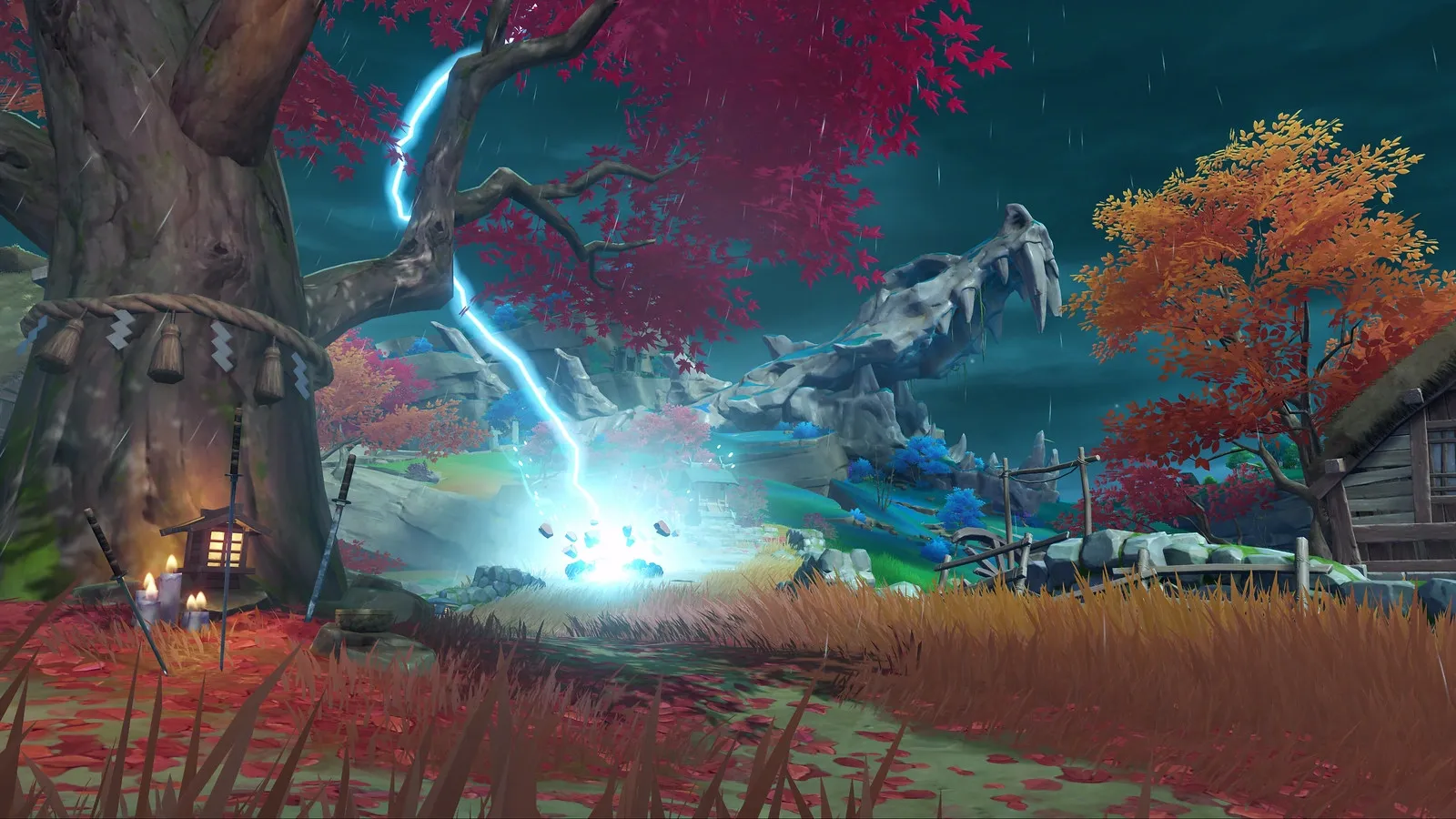
The Tatarigami (祟り神, "Curse God") is the curse that plagued Yashiori Island in Inazuma, "formed from the will and power of the serpent god Orobashi who was slain over the island." It is what a dead god leaves behind: when the wards suppressing it are disturbed, it brings "sickness and calamities." The Golden Branch of a Distant Sea puts it plainly: "Orobashi's divine form was sundered along with the mountains, its ichor turned into plasma, and its will and power became a curse that could never be extinguished: Tatarigami." [1] [2]
A slain god's residue
The Tatarigami "spawned from Orobashi's will and power after Ei slew it on Yashiori Island towards the end of the Archon War." Ei's Musou no Hitotachi, the blow that carved the Musoujin Gorge, shattered the god into a lingering, hateful residue scattered across the island. [1] [3] [9]
The Tatarigami belongs in its own category: the residue of one specific slain god, not a manifestation of Forbidden Knowledge or a direct outflow of the Abyss. It is grouped thematically with Abyssal Corruption and Karma, and its sickness profile rhymes with abyssal blights elsewhere, but its mechanism is the resentment of a murdered deity, bound to the land where he fell. [1]
What it does
Areas under the Tatarigami suffer perpetual thunderstorms, and plants grown in contaminated soil wither away. On humans, exposure causes a "mysterious, untreatable" affliction, "random unstoppable bleeding from orifices, fevers, constant migraines, rashes, as well as dizziness and weakness," and, worse, psychological collapse: "auditory hallucinations and insanity," the hallucinations "primarily revolving around an unknown god addressed as 'Him.'" The Higi Village chief Washizu, raving, described this god as having "eighteen pairs of blood-red eyes! Thousands of sharp, venomous fangs! Countless mouths and numberless tongues, ever thirsting after blood!" [1]
Vision-bearers and the elementally-sensitive are largely spared the worst effects, the usual pattern in which elemental authority buffers cosmological corruption. A few people show unexplained resistance even without a Vision: Chouji's mother stayed lucid (the curse's energy "flowing freely inside of her" rather than corrupting her), and the boy Chouji and the pharmacist Yasumoto never developed symptoms at all. [1]
The curse can infect objects, too. Akame Kanenaga infused his own consciousness into the blade Kagotsurube Isshin using Tatarigami power, but "the intrinsic hatred in the Tatarigami corrupted the sword," warping its purpose into rivaling the gods at any cost and driving it to possess one human host after another. That blade's arc plays out in Kazuha's Story Quest, Ere the End, a Glance Back. [1] [8]
Suppression - the Narukami Pillars
After the curse arose, the Raiden Shogun placed wards called Narukami Pillars to "suppress Orobashi's soul," and so subdue the Tatarigami; the Yashiori Guardians (the Kitain Clan, led by Kitain Bunsou) took up the same duty. With the threat minimised, people from Narukami Island began mining Crystal Marrow from Orobashi's remains, which deeply "incensed" the Watatsumi faithful, who still worship the slain god. [1] [4] [5]
Exploitation - the Mikage Furnace
The Shogunate went further than suppression: it turned the curse into industry. At Tatarasuna, the Tenryou Commission built the Mikage Furnace, "using technology from Fontaine capable of harnessing the Tatarigami's energy to smelt Jade Steel." The priestesses of the Grand Narukami Shrine "hotly contested" this, holding the Tatarigami "too dangerous to be trifled with," and they were right. The smelting process, covertly engineered by Il Dottore (operating as the Fontaine mechanic "Escher"), was releasing the Tatarigami bound in Crystal Marrow into the environment, sickening and killing Tatarasuna's workers. [1] [7]
The present-day resurgence
The Tatarigami's modern flare-up was engineered by the Fatui. Acting on orders from the First Harbinger to stall the Inazuman civil war, the Fatui mole Nathan spurred Orobashi fanatics within the Watatsumi Army into damaging the Narukami Pillar wards while Sangonomiya Kokomi was away negotiating with mercenaries. The wards' failure unleashed a Tatarigami resurgence: "mysterious ailments and poor weather" that ground the Shogun-versus-Watatsumi conflict into a "bitter stalemate." The Traveler later restores the wards across the WQ series Orobashi's Legacy and repairs the failing Mikage Furnace core across Tatara Tales, though Higi Village is left all but abandoned. [1] [6]
Open questions
- Who is "Him"? The unknown god in the hallucinations, eighteen pairs of blood-red eyes and countless mouths, is never identified. Whether it is Orobashi's true aspect, a projection of the curse, or something else is left open. [1]
- Why some are immune. The unexplained resistance shown by Chouji, Yasumoto, and Chouji's mother (energy "flowing freely" rather than corrupting) is noted but not explained. [1]
The god whose death produced the curse is Orobashi, and the Archon who slew him and then warded and weaponised the residue is the Raiden Shogun. The Harbinger behind the furnace sabotage is Dottore, the corrupted-blade thread runs through Kazuha, and the faith that survived the god lives on at Watatsumi Island and with Sangonomiya Kokomi.