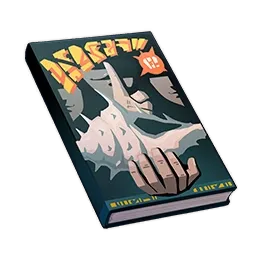
Conch Echoes, CN 海螺的回响 Hǎiluó de Huíxiǎng ("Echo of the Conch"), is a two-volume Nod-Krai Book Collection released in Version "Luna I". Both volumes are purchasable for 3,000 Mora each from the open-world shop NPC Dhabit, at his Mimisbrunnr Books point of interest in Nasha Town on Lempo Isle. They share the shelf with the Luna-I pulp anthology The Legends of Reed Miller, Thief Extraordinaire and the Luna-IV titles A Brief History of the Pale Starborn and Night Murmurs From the Far Border: Varcolac, a mix of books rooted in Nod-Krai and books rooted in Snezhnaya but found in Nod-Krai. Each volume opens with the same one-line description: "A tale passed down in this land since the earliest times, telling of children who spoke bearing conch shells in the empty frontier wastelands. The original author has long since been forgotten…" [1] [2] [3] [4]
The frame: the Outlands and the pact
Vol. 1 opens at a bonfire on the "thirtieth night in the desolate land of exile, which the boys and girls secretly called the Outlands." The backstory is sketched in three lines: the children had been brought to "this desolate land" by adults who "sought to control them by force" and have since "died before ever drawing their own blades from their sheaths"; one blade survives, "once felled trees, cut grass, pried open fruits, and silenced a great many not of their group … no longer as sharp as it used to be"; and the conch, a real seashell "secreted from the beach during the day's labor right under the adults' noses," was made the children's "proof that they were not infallible." From those three things the pact is built: "whoever is holding the conch has the right to speak," and a leader will be chosen "from their midst, a child like them, clever and capable of guiding them through hardship. One who would stand with them, yet not fear strength." The leader is the diminutive boy nicknamed Shorty, "the most diminutive of them all, and hence, they called him 'Shorty'." [1]
Vol. 1: the seizure by blade
The Vol. 1 confrontation is the parable's hinge. The unnamed "handsome young man" arrives at the bonfire with his followers, "idly fiddling with the blade in his hand," and demands the conch from Shorty. He concedes the pact in form while inverting it in substance: "I was the one who put in the most effort, and I also got the most in return. What's more, I'm the one holding the blade now." The exchange is the volume's central dialogue:
"Then you will become the one who commands us all." >"Yes, of course I will become the one who commands you all." >"Just like those adults at the beginning…?" >"Well, that might not sound so bad after all."
The narrator's own gloss is blunt: "the bestial cruelty in the hearts of these children, yet unquenched, was becoming more rampant without anyone to suppress it. For if violence was capable of overthrowing everything, why should those who could wield it not seize everything through it?" Shorty rises with his back to the flames, "his face hidden in shadow," and the handsome young man catches "a smirk on the other boy's face, and a strange unease about the future washed over him." Shorty hands him the conch and walks into the forest. The volume closes on his disappearance: "After that night, the boy who once held the conch seemed to have vanished into thin air." [1]
Vol. 2: the return and the new pact
Vol. 2 opens with the girl wearing glasses finding Shorty: "You knew that things would end up like this…" / "Things always end up like this. I just didn't think it'd happen so soon." The handsome young man is dead in his chair "piled on with heavy objects, his features sharpened by the pallid green tone of his skin. His deep crimson-purple lips were stark against the bonfire's eerie flames, which flickered like a strange veil in the wind. The young man bore no visible wounds, and yet his hands hung dully, long stiffened as if cast in plaster." The cause is left ambiguous, and the volume's read on it is less forensic than human: "the young man didn't know how to tend to this power, but as it was his only lifeline, he kept the blade's need for tending a secret. Naturally, he grew to distrust all and sundry. His sleep became short and restless, and he was quick to anger. The fear of revealing flaws like the adults did caused him to reveal still more flaws… Things could thus only end in one way." The narrator's wry coda, "In truth … the only thing the protagonists in most stories need is more patience," is the parable's clearest moral. [1]
The closing scene is the founding act the book is named for. "A pair of hands, holding a conch, emerged from between the boy and the girl. The owner of the hands stepped forward and placed the conch in the boy's hands. The boy looked down and saw red marks on the palms beneath the shell, left there by the coarse rope." The conch is a new one, fresh from the beach, carried in by an unnamed third child whose rope-marked hands show the labour of retrieving it. Shorty raises it to his lips "just like he'd seen in the picture books," manages only "a soft, comical puff of air," and then "brought it to his ear and listened, and from the conch came the sound of waves." The vow is the book's clearest statement of shared rule: "We shall build a town here and make it an Elysium for boys and girls. No one person shall monopolize the conch from now on, for it belongs to all of us. Anyone can hold it and speak their mind." The girl with glasses presses the obvious objection, "But all of us will grow up one day. And we'll become the adults we don't want to be," and Shorty answers with the book's line about passing things on: "Don't worry, it's okay. There's always a tomorrow, and there will always be other children. If they don't like who we become, they can shatter our world with their own hands." The narrator's final image closes the book: "He hurled the dented blade into the waves, / And placed the conch amidst the children." [1]
The Elysium connection
That Vol. 2 vow to build an "Elysium for boys and girls" is what ties the book to Nod-Krai's wider lore, rather than leaving it as a generic "frontier wastelands" folktale. Elysium is the Frostmoon Scions' word for their promised paradise. The post-Aila Moonchanter office prays for Kuutar's intercession on behalf of "those forever barred from Elysium" in Hymns of the Far North Vol. 3, Prayer Song XXII (Kuutar the Moon Maiden), and the post-Cataclysm Lightkeeper co-founder Silvestr Petrovich Solovei vows "a brief beam to bid Elysium unfold" in Tales Carried by the Northwind Vol. VI. The same word turns up across the same Nod-Krai release arc in three very different voices: a children's parable, a book of clergy prayers, and a Lightkeeper officer's poetry. Conch Echoes holds the children's-tale version, a shared pact rather than a clergy prayer or an officer's lighthouse oath. It is the clearest sign that Elysium is not only a clerical word: its oldest form here is a pact made by children around a bonfire, "passed down in this land since the earliest times." [6] [7] [8]
What the book is and is not
The book is not a Frostmoon Scions sacred text. It has no prayer-song structure annotated by Ehrnrooth, no revisions from Aila's era, and the Vol. 2 vow is not a liturgical formula. Neither is it a Snezhnayan imperial chronicle in the manner of A Brief History of the Pale Starborn, which carries Cycle dates, a political cast (the Belyi Tsar, the Tsaritsa, the Volkodlak, the Vila), and a layer of institutions (the Fatui, Glupov, the Snezhnograd Veche) that this book lacks. It is not a catalogue of fae folklore like Night Murmurs From the Far Border either: no Varcolac, no Snowland Fae, no two-heart anatomy, no feeding tells taught by priestesses, and its villain is a human child rather than a fae shapeshifter. And it is not a Lightkeeper poetry anthology in the mould of Tales Carried by the Northwind, with no Starshyna succession, no inheritance of the Nightingale title, no lore of lighthouses and beacons. It keeps its own voice: a folk parable "passed down in this land since the earliest times," with no named author, no datable event, and no faction it points to. The "adults" who enslaved the children go unnamed, the "Outlands" is the children's own word for an unspecified desolate land, and the children answer to plain nicknames, Shorty, the handsome young man, the girl wearing glasses, rather than personal names.
Out of universe, the parable echoes William Golding's Lord of the Flies: the conch as right-to-speak, the bespectacled-girl confidant, the violent usurper, the small protagonist, and the tension between a shared pact and a strongman. Nothing in the book states that source outright, so the resemblance is left as a likeness rather than a claim. The book is also not a historical record of any Nod-Krai founding. It does not narrate the Bunker No. 0 child evacuation that Solovei, Aila, and Brahe rescued after the Cataclysm in the world quest East of the Moon, West of the Sun, and its exile-and-pact frame is distinct from the orphan group the Lightkeepers were founded around. The two can be read side by side, both about children surviving a desolate northern land and re-founding themselves by a shared pact, but the book does not equate them. [9] [10] [11]