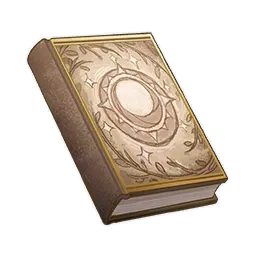
Hymns of the Far North (CN 终北祷歌集 Zhōng Běi Dǎo Gē Jí, "Collection of Hymns of the Utmost North") is a three-volume Nod-Krai Book Collection released in Version Luna I. Each volume opens with the same one-line standing description: "A book of hymns passed down for generations among the Frostmoon Scions, compiled by the priestess Ehrnrooth. Most of its contents, and the rites they serve, have long since fallen into disuse." The book is the surviving liturgy of the Frostmoon Scion clergy, the Runo hymn-tradition the Hyperborean refugees carried south to Hiisi Island after Huurrekuutar guided them out of the Celestial Nail catastrophe. It records twenty-two numbered Prayer Songs, of which fewer than ten survive in the playable text and one (Prayer Song V) is missing. [1] [2]
The compiler and the doubled text
Ehrnrooth, the priestess named in every volume's standing description, is the compiler whose footnotes accompany every recovered Prayer Song. Her annotations are a record more than a commentary. They note which rite Aila, the first Moonchanter, abolished five centuries ago and which she revised and simplified. The corpus is therefore a doubled text: the Hyperborean form from before Aila preserved "for the sake of textual fidelity" (Ehrnrooth's phrase on Prayer Song IV), with the standard as Aila reformed it recorded alongside. Vol. 1 opens with a long invocation that names the figures the rites address: "the bronze-bound ship of Seutervoinen ... the golden arrows of Ianikuinen unbroken ... the poisonous plot of Pakkaisukko ... Pohjola's calamity ... O heirs of Hyperborea." Each figure named there returns in the Prayer Songs that follow. [4]
Vol. 1 - the cosmological pantheon
Songs I-IV address the gods of cosmic scale. Prayer Song I, Pitkamoonen, Lord of the Seven Calamities, is the summer-solstice rite Aila abolished outright; Ehrnrooth notes that the obscured portions of the prayer "were not deliberately redacted ... the Archpriestess was to chant in an indistinct manner to avoid provoking the god of the Seven Calamities." Prayer Song II, Maadteraahka, Mother of Life, carries the corpus's clearest cross-region line, "From Hyperborea to Sal Vindagnyr, your compassion is revered by all," naming the goddess as revered across both lost civilisations the wiki ties to Hyperborea and Sal Vindagnyr. Prayer Song III, Tuonetar, Mother of the Underworld, governed funerary animal-sacrifice rites; Aila abolished it in favour of "May the new moon lead you to the shore of peace." Prayer Song IV, Laimelea, Mother of Time, references the Verdant Crest, and Ehrnrooth flags the appearance as a chronological anomaly ("the Verdant Crest, a Divine Tree that appeared at the birth of the Moon Maiden five centuries ago, should not feature in any account of rituals predating that event"), preserving the text as a "presumed scribal error" out of fidelity to the text. Prayer Song V is marked [Missing]. It is likely about Asmoday, the Ruler of Space, who is herself currently missing, though that is a reading rather than an assertion. [1]
Vol. 2 - the Saarelainen disclosure
Vol. 2 preserves Prayer Song XVI, Saarelainen, The Stranger of Winter's Day, which Ehrnrooth notes was an old prayer for healing wounds and curing disease, later simplified by Aila. It addresses a "cheerful, fair, kind-hearted lad, noble-born and nobly raised," who rode across "the forsaken isle of Hiisi and the dark, mist-shrouded lands of Pohjola" to court "the daughter of Pakkaisukko." Old Pakkaisukko, "servant of our forebears," would grant the marriage "if you should open for him the gates of Pohjola." The lad "knew well that wicked scheme, yet you went forth freely," because otherwise "old Pakkaisukko would have his gullible daughter suffer the punishment instead." The hymn ends his story there: "In dark and foggy Pohjola, the Lord of the Seven Calamities carved you into seven pieces. And that young and pure girl, the daughter of Pakkaisukko, shall never again be wed." Vol. 1's opening invocation already curses "the poisonous plot of Pakkaisukko" and decries "Pohjola's calamity." [1]
The book does not call Saarelainen a Descender or the seven pieces Gnoses. Skirk separately says the Gnoses are the Third Descender's remains. [5] [6]
Beside Chapter VII Act IV
Version 7.1's Chapter VII Act IV tells a story with the same outline. Rhinedottir tells the Tsaritsa that "the Belyi Tsar incited you — a mere herald of the court at the time — to open the gate to the Abyss alongside the Third Descender." After the Heavenly Principles erased her existence, the Third Descender went to Celestia, "willing to trade his own life to bring yours back," and "consented to have his remains be split into seven pieces to consolidate the system of rule established by the Heavenly Principles." [12] [13]
Read side by side, both accounts have a schemer who wants a gate opened, a young woman who would bear the punishment, and a man who goes knowingly and ends in seven pieces. They also differ. The hymn makes the woman Pakkaisukko's daughter and has the Lord of the Seven Calamities carve the man apart; Act IV makes her a herald of the court who opened the gate herself, and has the Third Descender offer his own remains in a bargain. Neither text says whether Pakkaisukko is the Belyi Tsar. Act IV never names the Third Descender, and the hymn never calls Saarelainen one, so the name is still not joined to that title anywhere in-game. Reading Saarelainen as the Third remains a strong inference drawn from several sources. [12] [1] [5]
Vol. 3 - Huurrekuutar to Kuutar
Vol. 3 preserves Prayer Songs XXI and XXII. Prayer Song XXI, Huurrekuutar, Goddess of the Frost Moon, addresses the founding Scion deity "mother of holy light"; Ehrnrooth's note records that "the chief god who protected our ancestors, and the origin, past, and future of the moons" was too sacred for long elaboration, and preserves Aila's reformed "O pale white Frost Moon, in the name of the descendants of the far north..." formula, a slightly different version of the prayer Lauma recites in the Moonlit Ballad of the Night trailer. Prayer Song XXII, Kuutar, the Moon Maiden, is the only Song in the corpus that originated after Aila. It is addressed not to Huurrekuutar but to Kuutar herself, the "pure and flawless new moon" (identified, on cautious cross-reference, with Columbina the Third Fatui Harbinger, per the Welkin Moon Archon Quest), and it is offered "in the name of the messenger of the Frost Moon," a figure the prayer leaves unnamed. It asks her to "wipe away the endless pains and tears of those forever barred from Elysium." [1] Fandom's Frostmoon Scions page describes Kuutar as the current goddess of the Frost Moon, who succeeded the late Canon, known to the Scions as Huurrekuutar. [14] The prayer to Kuutar is the corpus's hinge from the founding deities to the present day. [7] [8]
Liturgy, not folktale
The book is the Frostmoon Scions' liturgy, not a forensic chronology. Being included in the corpus does not give Saarelainen an exact date or divine office. Identifying him as the Third Descender remains a strong inference drawn from several sources combined.