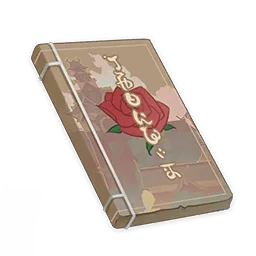
The Saga of Hamavaran (Japanese: ハマヴァラーン戦記 Hamavaraan Senki, "War Records of Hamavaran"; Chinese: 哈玛瓦兰战记 Hāmǎwǎlán Zhàn Jì) is a 3-volume light novel Book Collection released in Version 2.0 and sold by the Yae Publishing House at Hanamizaka in Inazuma City (Kuroda's catalogue, 1,500 mora per volume). The in-universe author is Pursina, a present-day member of the House of Pursina, an esteemed Sumeru research lineage (presumably descended from someone named Sina). Another present-day member, Khedive, is an Amurta ecologist who travelled to the Chasm to do field work. The book reads as a Sumeru historical novel on the strength of its author and protagonist even though it is published in Inazuma; cultural exchange between the regions is the frame it sits in. [1] [2] [3]
Vol. 1 - Preface and foreword
The first volume is preface-only. Per the in-text aside: "The prefaces of the new light novel 'The Saga of Hamavaran,' now combined into their own separate volume due to a business model adjustment!" That is YPH humour about the publishing industry. The foreword itself, written by an unnamed Yae Publishing House editor speaking for the house Yae Miko runs, opens with thanks: "Thanks to a fruitful new writer recruitment drive and the phenomenal success of the contest 'This Novel is Amazing!' we have received many highly original works from up-and-coming writers all over the world. We would like to take this opportunity to thank our international writers for supporting Inazuma's light novel industry, and we'd also like to thank Kanjou Commissioner Hiiragi Shinsuke for his grace and generosity." [1]
The foreword then establishes the in-fiction historical premise: "prior to the promulgation of the Sakoku Decree, a number of accomplished samurai from various lands were active in Inazuma. One of them, whose name is Hamavaran, hails from the distant rainforest nation of Sumeru, but came all the way to the land of the lightning's glow to be an agent of chivalry. Though tales of Hamavaran's deeds were once buried during the peak of unchanging eternity under Her Excellency the Shogun, they have now been given life anew thanks to the narrative prowess of a good friend of mine, the budding author, Pursina." [8]
Two notes about institutions follow. The Kanjou Commission, headed by the Hiiragi Clan, is the Tri-Commission's arm for Inazuman finance, civilian administration, and border supervision. Commissioner Hiiragi Shinsuke also appears in the game itself. In the Inazuma Archon Quest he introduces himself as "Kanjou Commissioner and head of the Hiiragi Clan," and he is Hiiragi Chisato's father. [10] After the Fatui plot came to light he was imprisoned for stockpiling Crystal Marrow for the Fatui, and Chisato became the clan's acting head. [11] [12] The foreword thanks him as the sitting Commissioner and gives no date. It treats the Kanjou Commission's patronage of YPH as ordinary publishing sponsorship rather than a channel for state propaganda; the relaxation of the Sakoku Decree after AQ II may be what makes a story about "samurai from various lands" publishable at all. [9]
Vol. 2 - voyage to the land of thunder and lightning
Vol. 2 opens Hamavaran's adventure proper. The Honey-Hunter description glosses it: "'How could this happen...' An ordinary scholar from Sumeru is unexpectedly assigned an unpopular specialization and ordered to go forth to the land of thunder and lightning... The curtains slowly rise on an adventure in the nation of many shores!" Hamavaran's specialisation is marine biology (explicitly "the much-neglected discipline of marine biology instead of mysticism"), and the comedy is that he is a graduate student worried about "deferred graduation" more than about the storm on the sea voyage. As the tempest "shakes the seas and heavens alike," an unidentified voice begins arguing with him through the cabin window: "You're worrying about not getting your thesis finished in time and having to delay your graduation, aren't you?" - "Shush... Who are you, anyway!?" - "Who, me? Is that important?" - "Good point. No, you're not that important..." When the ship reaches shore, the voice's owner is nowhere to be seen, and Hamavaran rationalises: "Maybe it was the ghost of a shipwreck victim... Ghosts are just the Ley Lines' memories of the deceased, Hamavaran reasoned. It's a completely natural phenomenon that occurs due to resonance between past and present." [1]
Vol. 3 - shikigami, ghost-calling, and spirit-warding
Vol. 3 reveals the voice ("'Who are you calling a ghost? You're the ghost!'"). Once on land, the voice manifests as a "talkative young girl, who claimed to be a shikigami," who gulps glutinous-rice dango fast enough that Hamavaran worries she'll choke. Asked whether she's a ghost, she insists "No! I'm not even dead yet!", and when pressed ("But you've never been alive either?") replies "Um... Yeah, I guess you could say that..." The conversation turns ethnographic when she clarifies her relationship to her summoner: "If I had to explain it, I'd say my situation is more like that of a 'ghost-calling.'" [1]
This is where the book's only real piece of canon sits. Hamavaran connects the Inazuman category to his own Sumeru training: "One argument later, Hamavaran finally understood that what she called 'ghost-calling' was something roughly equivalent to what in Sumeru is known as 'spirit-warding.' Both involve signing a pact using one's real name. The notion that you can command someone when you know their real name is common to many of the world's mystic traditions, and it highlights a core fear held by humans: the fear of being under someone else's control." The cross-cultural reading, that Inazuman ghost-calling / shikigami-binding and Sumeru spirit-warding / jinni-binding are regional variants of a single Teyvat-wide tradition of pacts made with a real name, is the book's one piece of genuine ethnographic content. It stays uncertain, as the in-text framing ("common to many of the world's mystic traditions") leaves it. The volume closes on Hamavaran's regret about choosing marine biology: "First I have to sail all the way to Inazuma, then I have to go through the living hell that is a thesis defense... But maybe running into this noisy little thing is a stroke of good luck for me..." [6]
Etymology and cultural references
The book's etymology is unusually layered. The Japanese title ハマヴァラーン戦記 (Hamavaraan Senki) is "War Records of Hamavaran," and the 戦記 suffix is "may be derived from the Japanese light novel and anime The Heroic Legend of Arslan", itself an amalgam of the Arabian Nights and Persia, set in *"a legendary vision of an indistinct amalgam of over a thousand years of ancient Persia and nearby other countries." The name Hamavaran itself "seems to be derived from the Persian word Hāmāvarān (Persian: هاماوَران), which is considered to be the name for the Himyarite kingdom of Yemen in old Persian mythology. The name mainly appears in Shahnameh, a long epic poem written by a Persian poet." The cover text reads LGDHMVR in the Inazuman Language, "likely standing for Legend of Hamavaran." The book is thus coded across cultures twice over. A Sumeru author's Persian-named protagonist is retold as an Inazuman senki light novel, with the format of The Heroic Legend of Arslan mapped onto the premise of an Akademiya-trained scholar abroad. [1]
Two names were adjusted after release: the book was "updated from 'The Saga of Hamawaran' to 'The Saga of Hamavaran'" and the author was "renamed from Priscina to Pursina," fixing the romanisation of both to match the Persian Hāmāvarān and the House of Pursina lineage. A separate note also distinguishes this Pursina from the otherwise unrelated namesake of the weapon Pursina's Spikes: "The creator of Pursina's Spikes and the author of The Saga of Hamavaran are unlikely to be the same person, but neither have been given personal names to distinguish them." [1] [2]
Where the framing stops
The book is a cross-cultural comic light novel. It is comic in tone and ethnographic in one telling detail, and otherwise the adventure of a graduate student and his spirit companion in the senki genre, in the style of The Heroic Legend of Arslan. It carries none of the weight that the foreword's Sumeru author and ancient-historical framing might invite.
It is not lore about the ancient Akademiya or King Deshret. The only historical anchor is "prior to the promulgation of the Sakoku Decree," a few centuries at most. The book does not touch the Akademiya's Six Darshans, the pre-Akademiya cosmology, King Deshret, Setaria, the pre-Apep era, the period of Greater Lord Rukkhadevata, or any ancient Sumeru cosmology. Its Sumeru content is exclusively modern: the House of Pursina as a present-day research lineage close to the Akademiya, and the Sumeru mystic tradition of spirit-warding / jinni as cross-cultural backdrop.
Nor does it make a claim about Sovereigns, Archons, or Descenders. The foreword's "the peak of unchanging eternity under Her Excellency the Shogun" references the Eternity doctrine of the AQ II era, not any cosmological pole from before the Heavenly Principles. King Deshret is not one of the Seven Sovereigns: the Dendro Sovereign seat is held by Apep per the AQ III Sumeru post-game arc, and Apep is not the Dendro Archon (Greater Lord Rukkhadevata was; the present-day Dendro Archon is Nahida). The book carries no claims about Sovereigns or Descenders. The Pyro Sovereign's disposition is unknown, and the Sustainer is Asmoday rather than a separate tier.
And it is not a primary historical record. The premise is that "tales of Hamavaran's deeds were once buried" and Pursina has given them "life anew through narrative prowess", which makes it a novelistic reconstruction rather than a chronicle of an actual historical Hamavaran. Whether a pre-Sakoku samurai named Hamavaran ever existed in Inazuma's history is left undetermined; the book treats him as real, but its framing is novel, not record.
What the book contributes
Its most-cited contribution to the corpus concerns institutions, not cosmology. The book is evidence that the Yae Publishing House actively recruits cross-region authors, that "international writers" are a deliberate YPH category (per the foreword's thanks), and that the Kanjou Commission under the Hiiragi Clan patronises Inazuman publishing as part of its civilian-administration portfolio. Its one wider contribution to canon is the ethnographic detail: an in-fiction scholar trained in Sumeru recognises Inazuman ghost-calling / shikigami-binding and Sumeru spirit-warding / jinni-binding as regional variants of the same tradition of pacts made with a real name. That remains uncertain, since it is the scholar's own inference rather than a doctrinal claim in primary text. The rest is comedy: a marine-biology graduate student worried about his thesis defense, a shikigami who eats too much dango, and a tempest at sea between Sumeru and Inazuma that closes with the scholar concluding "running into this noisy little thing is a stroke of good luck for me."