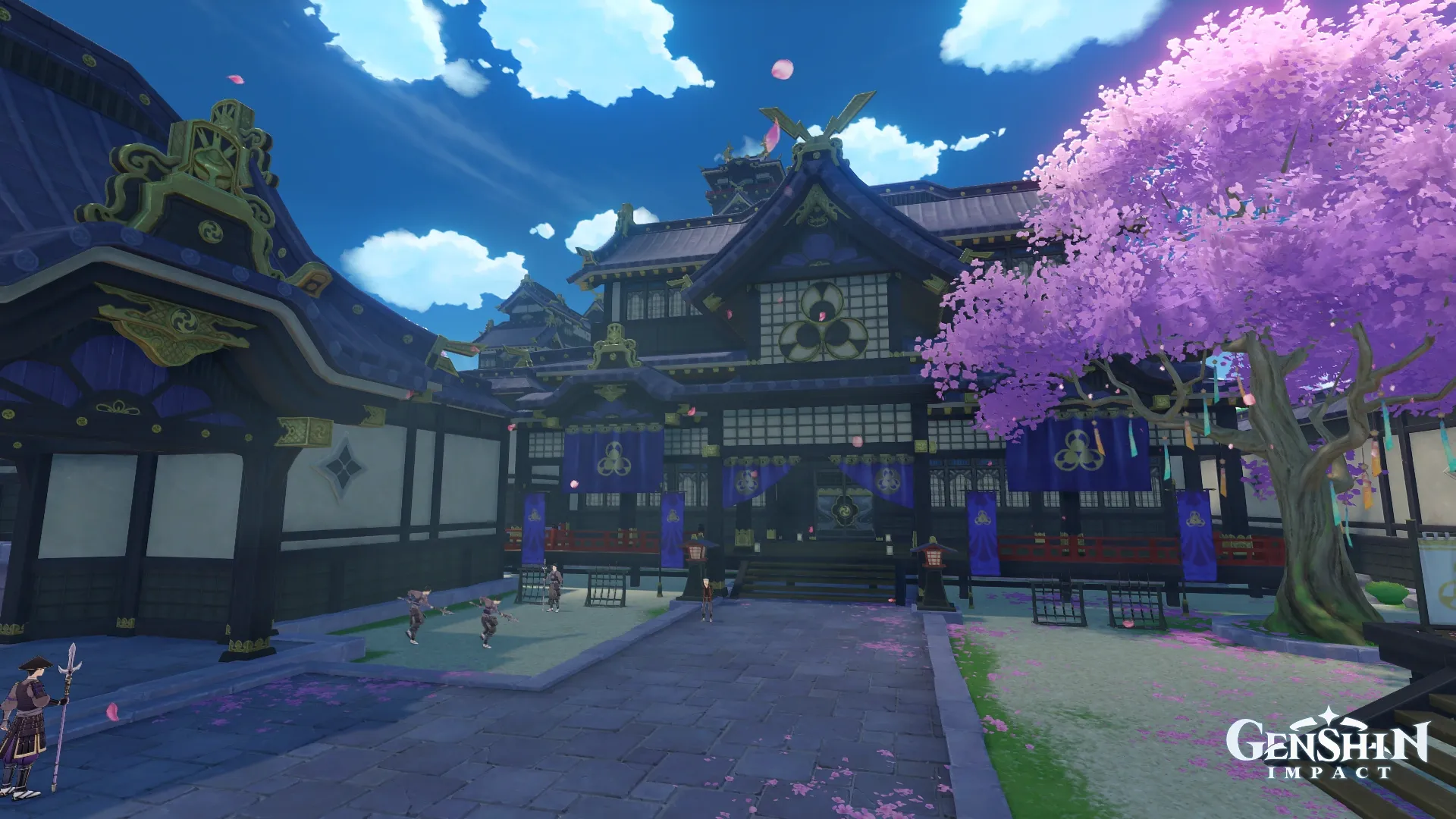
The Tri-Commission (Sanbugyou in the Inazuman idiom) is the three-arm civilian government of Inazuma, operating under the formal authority of the Raiden Shogun, the puppet ruler created and animated by the Electro Archon Raiden Ei (Beelzebul). Three Clans, three portfolios, three meeting seats at Tenshukaku, and one mandate to keep each other in check. [1]
This page gathers all three Commissions in one place; until now they were detailed mostly on member pages. Inazuma as a region is covered on Inazuma, the Raiden Shogun on Raiden Shogun, and the Watatsumi-side political opposition on Vassals of Watatsumi.
Structure: three Commissions
The Tri-Commission is the Inazuman equivalent of the Liyue Qixing and the Knights of Favonius: the working government under a state headed by an Archon. The Qixing run Liyue as a seven-seat ministerial council under Morax's nominal authority, and the Knights of Favonius run Mondstadt under the authority of Barbatos, who is effectively absent. The Tri-Commission runs Inazuma under the authority of the Raiden Shogun, who is actively present, and that difference shapes the whole culture of its government. The Shogun is not a constitutional monarch in the Mondstadt sense; she is the source of state legitimacy, and the Commissioners answer to her formally even when they disagree with each other. [1]
The three Commissions are:
Commission | Clan | Portfolio | Commissioner (as of 7.2) |
|---|---|---|---|
Yashiro Commission | Kamisato | Cultural affairs, ceremonial events, public festivals, shrine and temple management | |
Tenryou Commission | Kujou | Public security, military and police affairs, enforcement of major Decrees | Kujou Kamaji (Sara acting as general on his behalf) |
Kanjou Commission | Hiiragi | Financial management, border supervision, mercantile and bureaucratic affairs | Hiiragi Chisato (acting on the Hiiragi line's behalf) |
The three Commissioners meet at Tenshukaku, the Shogun's palace and the formal seat of state, to decide on government affairs. Fandom does not say the three hold equal authority, and it calls the Yashiro Commission the one "closest to the Raiden Shogun." What the game gives instead is Ayato's view of a balance of power. In his Cypressus Custos Chapter, Matsuura accuses him of opposing a Kanjou-Tenryou alliance because "the new balance of power in the Tri-Commission would be a threat to you personally," and Ayato replies that Matsuura is "far more talented than I at monitoring the power balance within the Tri-Commission." He later sums up his aim: "All I have tried to do is make sure the three parties to the Tri-Commission serve to restrain each other. Stasis is not the only form of stability. A balance of power leaving no room for maneuver achieves the same end." [7] [15] [1]
The Yashiro Commission: Kamisato Clan
The Yashiro Commission is the "closest to the Raiden Shogun" of the three, the Commission that holds the rites and ceremonies through which the Shogun's authority is publicly performed. Its portfolio covers cultural affairs (festivals, theatre, the Inazuman ceremonial calendar), public-event coordination (including the Irodori Festival arts week the Yashiro Commission hosts), and shrine and temple management (distinct from the Grand Narukami Shrine's line of successors to the Kitsune Saiguu, but in close working cooperation with it). [2]
The Kamisato Clan runs the Yashiro Commission. The current Commissioner is Kamisato Ayato, who took the Clan headship after his parents' deaths and runs both Clan and Commission with a political operator's deliberate instinct. The Cypressus Custos Chapter develops this as the fixed mask of the obliging public servant over a perfectly calculating private interior. His sister Kamisato Ayaka is the heir-presumptive and the public face of the Clan's ceremonial leadership. Her own Grus Nivis Chapter SQ develops the Clan's internal discipline, which lets Ayaka present the public persona of the Frostflake Heron while privately remaining one of the Clan's most steady-tempered members. [8] The Clan's housekeeper Thoma, the "Fixer," is half Mondstadter and half Inazuman and holds a Pyro Vision. He handles the day-to-day Yashiro Commission work that needs a public-facing operative who is not a Kamisato.
Its cultural portfolio gives the Yashiro Commission a softer, more diplomatic stance than the Tenryou Commission's focus on combat and enforcement or the Kanjou Commission's focus on finance and administration. That softness is strategic. In politics between the Commissions, the Yashiro Commission's leverage comes from its closeness to the Shogun and from the way its cultural work binds the Clans together, not from coercive instruments.
The Akitsu Kimodameshi 3.3 Flagship Event is the clearest primary-text example of a cultural festival the Yashiro Commission organised in cooperation with another Commission. Per the Akitsu Kimodameshi event, Ayato hosts the opening of the Test of Courage at the Kamisato Estate. It runs in three rounds with three sponsors: merchants fund it, the Kamisato Clan provides the grounds, and the Grand Narukami Shrine provides the grand prize. The chain runs on cooperation between the Yashiro and Tenryou Commissions. Shikanoin Heizou's investigation of the unsanctioned Akitsu Yuugei beach stall, commissioned by the Tenryou, proceeds under cover of the Test of Courage the Yashiro staged. Per what Ayato discloses after the chapter, the Test of Courage was staged as cover and publicity for the Mikawa Flower Festival the three little yokai had wanted to revive. The Yashiro Commission was supporting a yokai cultural revival, organised together with Yae Miko's Grand Narukami Shrine. [11]
The Tenryou Commission: Kujou Clan
The Tenryou Commission is the Inazuman state's Head of Public Security: military, police, internal enforcement, border defense. Its formal Commissioner is Kujou Kamaji, head of the Kujou Clan, but across AQ II and the rebalancing after Sakoku, the Commission's working face has been his granddaughter Kujou Sara. She is a tengu-coded general adopted into the Kujou Clan, and the most fanatically loyal to Raiden among the named Tenryou officers. [3]
The Raiden Shogun's two most controversial Decrees were enforced through the Tenryou Commission: the Sakoku Decree (Inazuma's borders closed, foreigners barred from entry) and the Vision Hunt Decree (the Shogun's puppet confiscating Visions from bearers not affiliated with the Tri-Commission, as incompatible with the post-Makoto Eternity doctrine). [6] The Decrees did not originate as Tenryou Commission policy. They were the Shogun's policy, enforced through the Tenryou apparatus. But the line between "Tenryou enforcement of the Shogun's policy" and "Tenryou political ownership of the Decrees" became uncomfortably thin during AQ II, particularly while Kujou Takayuki ran the Commission day to day. The Outlander exposed his conspiracy with Fatui assets over Sakoku and the Vision Hunt at the end of Act 2.
After Raiden Ei revoked both Decrees in Act 3, the Tenryou Commission survived as an institution. Kujou Takayuki was disciplined, the Kujou Clan kept the Commissioner seat, and the three-Commission structure held even through the exposure of the Kujou conspiracy. The Tenryou Commission also includes Shikanoin Heizou, a half-tengu detective who combines martial arts with rationalism. His investigative work is the case study for the Commission's softest working edge (intelligence and detective work rather than military enforcement). After Sakoku, the Tenryou Commission turned toward intelligence and investigation and away from coercive enforcement, a change in its culture that AQ II's resolution made possible.
The Kanjou Commission: Hiiragi Clan
The Kanjou Commission is the Tri-Commission's financial and bureaucratic backbone. It runs Inazuman state finance, border supervision (the customs and trade side of the Sakoku Decree, distinct from the Tenryou Commission's military enforcement of it), and the mercantile licensing under which Inazuma trades with the outside world. The formal Commissioner is Hiiragi Chisato of the Hiiragi Clan, currently acting on the broader Hiiragi line's behalf. [4]
The Kanjou Commission's profile in the AQ II narrative was lower than the Tenryou Commission's. Enforcing the Sakoku Decree fell mainly to the Tenryou side, while the Kanjou side handled the bureaucracy and customs of the closure as a downstream consequence, not as a policy it had authored. That lower profile has continued since AQ II. The Kanjou Commission has the deepest reach of the three (every trade transaction, every border crossing, every state-financed initiative goes through Kanjou paperwork) but the quietest voice. Per Fandom and the politics between the Commissions that surface in the Cypressus Custos Chapter, the arrangement is built in. The Kanjou Commission's authority depends on not being publicly disruptive, and the Hiiragi Clan runs it accordingly. [4]
How the three balance each other
The balance works through a shared council. The three Commissioners meet at Tenshukaku to decide on government affairs, and in the Archon Quest A Flower Blooms in a Prison Kamisato Ayaka says that whenever the Yashiro Commission proposed repealing the Vision Hunt Decree, the Tenryou and Kanjou Commissions promptly vetoed it. Fandom reads that as a council that proposals must pass through, with no way for the Yashiro Commission to take a proposal straight to the Raiden Shogun. [1]
The Ayato SQ (Cypressus Custos Chapter) is the densest primary-text source for how this works in practice. The chapter treats the rivalry between the Yashiro and Tenryou Commissions as a rivalry between institutions rather than a personal one between Ayato and whoever then ran the Tenryou. It shows the balance of power working even when one Commission would prefer to dominate on its own. This page reads the chapter as treating slight inefficiency as the price of protection against the tyranny of a single Clan; Ayato's own words are that "Stasis is not the only form of stability." [15]
The Sangonomiya Rebellion at the centre of AQ II Act 2 was the test case for what happens when an initiative mandated by the Shogun (enforcing the Vision Hunt Decree through Tenryou channels) overruns that balance of power. The rebellion halted the Decree's enforcement on Watatsumi Island specifically, but the Tri-Commission's internal balance could not resolve the underlying conflict over the Eternity doctrine. The resolution came only when the Outlander reached Raiden Ei directly and Ei revoked both Decrees in Act 3. The reading that follows is that the balance of power is real and works for ordinary state policy, but it cannot contain an Archon's policy directives without an Archon's intervention.
Pre-Cataclysm structural predecessor
The modern Tri-Commission's design of three arms that restrain each other has a pre-Cataclysm analogue in the three-pendant system of accountability in Watatsumi and Enkanomiya. There, the Watatsumi Omikami gave "The three pendants" to "the Dainichi Mikoshi, the Sangonomiya line, and the Vassals of Watatsumi," with the intention "that the common folk, the officials, and the divine vassals would all hold each other accountable," per Sangonomiya Kokomi in the event quest Three Realms Gateway Offering: Aftermath. She does not say which pendant stood for which group. [14]
The post-Cataclysm Tri-Commission divides the oversight of Inazuma among Tenryou (military and police affairs), Yashiro (ceremonial affairs, festivals, and shrines and temples), and Kanjou (state finance, the borders, and mercantile and bureaucratic affairs). [1] The Sangonomiya line itself bridges the two systems. It is the one pre-Cataclysm pendant line that survived into modern Inazuma as an organised political institution, and it survives in tension with the system of the Shogunate and the Tri-Commission rather than as a fourth Commission inside it. The echo is hard to read as coincidence, but no on-screen text frames the modern Tri-Commission as descended from the Enkanomiya three-pendant system, so the relationship is preserved as a parallel in design rather than a claim of direct descent. [10]
Post-AQ-II state
After Raiden Ei revoked the Sakoku and Vision Hunt Decrees in AQ II Act 3, the Tri-Commission entered a rebalancing phase. Separately, the Electro Gnosis Ei had entrusted to Yae before her withdrawal passed to Scaramouche when Yae exchanged it at the Delusion Factory for the Traveler's safety; Signora never carried it, and there was no Pierro or Tenshukaku handoff. [12] [13] The Sangonomiya Rebellion stood down, and the Visions confiscated in the Vision Hunt were returned through Tenryou channels. The Kanjou Commission re-opened Inazuman borders and licensed foreign trade. The Yashiro Commission's cultural portfolio expanded to include the reconciliation work between the islands that became possible once the Decrees were gone.
The Eternity doctrine the Raiden Shogun rebuilt after AQ II, developed across Ei's own Imperatrix Umbrosa Chapter and in the wider Inazuman political context, does not dispense with the Tri-Commission. It gives it new ground. Instead of the Shogun pursuing a static Eternity through Decrees enforced via a single Commission, Ei's revised doctrine lets the Tri-Commission's deliberation produce the changing but enduring state policy that the revised Eternity now allows. The Tri-Commission survives AQ II as the backbone of the new Inazuman political order, not as a vestigial body. [9]
One caveat: Inazuma after AQ II continues to host active Fatui cells, remnant Fatui operatives aligned with Signora (grounded in Kokomi's Dracaena Somnolenta Chapter). The Tri-Commission's health after the Decrees were revoked does not mean Fatui pressure on Inazuma has lifted. The Commissions' day-to-day enforcement work still has to deal with Fatui interference into the 6.x period.
The Tri-Commission and the Hallowing
When the Holy Soil phenomenon reaches Inazuma in Chapter VII Act VI, the Tri-Commission meets it as a working government. "The Tri-Commission responded quickly, so things are relatively stable for now," Kamisato Ayaka reports, and evacuation points are in place. At Tenshukaku, Kamisato Ayato explains that "all the Commissions are responsible for fighting off monsters and coordinating evacuations," and that "The Kanjou Commission is also gathering supplies and readying as many ships as possible." Hiiragi Chisato adds that storage sites in Ritou are being cleared "so they can be repurposed as refugee shelters or rudimentary ship-building sites," while Kujou Sara leads a team to Seirai Island against the monsters. Kujou Kamaji, meeting with Ayato, Chisato, Sangonomiya Kokomi and Yae Miko, warns that "If we don't act in solidarity now, it will only serve to deepen any existing divisions." The Commissioners also weigh in on Inazuma's trial. After the Raiden Shogun's first meeting on it, Ayato and Yae hold the talks, and Ayato reports that she "has shared her plan with us, and we all approve." [16] [17]
Why this page covers all three
This page brings together all three Commissions, Yashiro (Kamisato), Tenryou (Kujou), and Kanjou (Hiiragi), with their Clan pairings, Commissioners, and portfolios set out above. Earlier the full set was only assembled on member pages, most explicitly in Ayato's Cypressus Custos Chapter and on the Alhaitham page (through the Akademiya-Yashiro comparison). Gathering them on a dedicated page keeps the whole picture in one place rather than scattered across side notes.