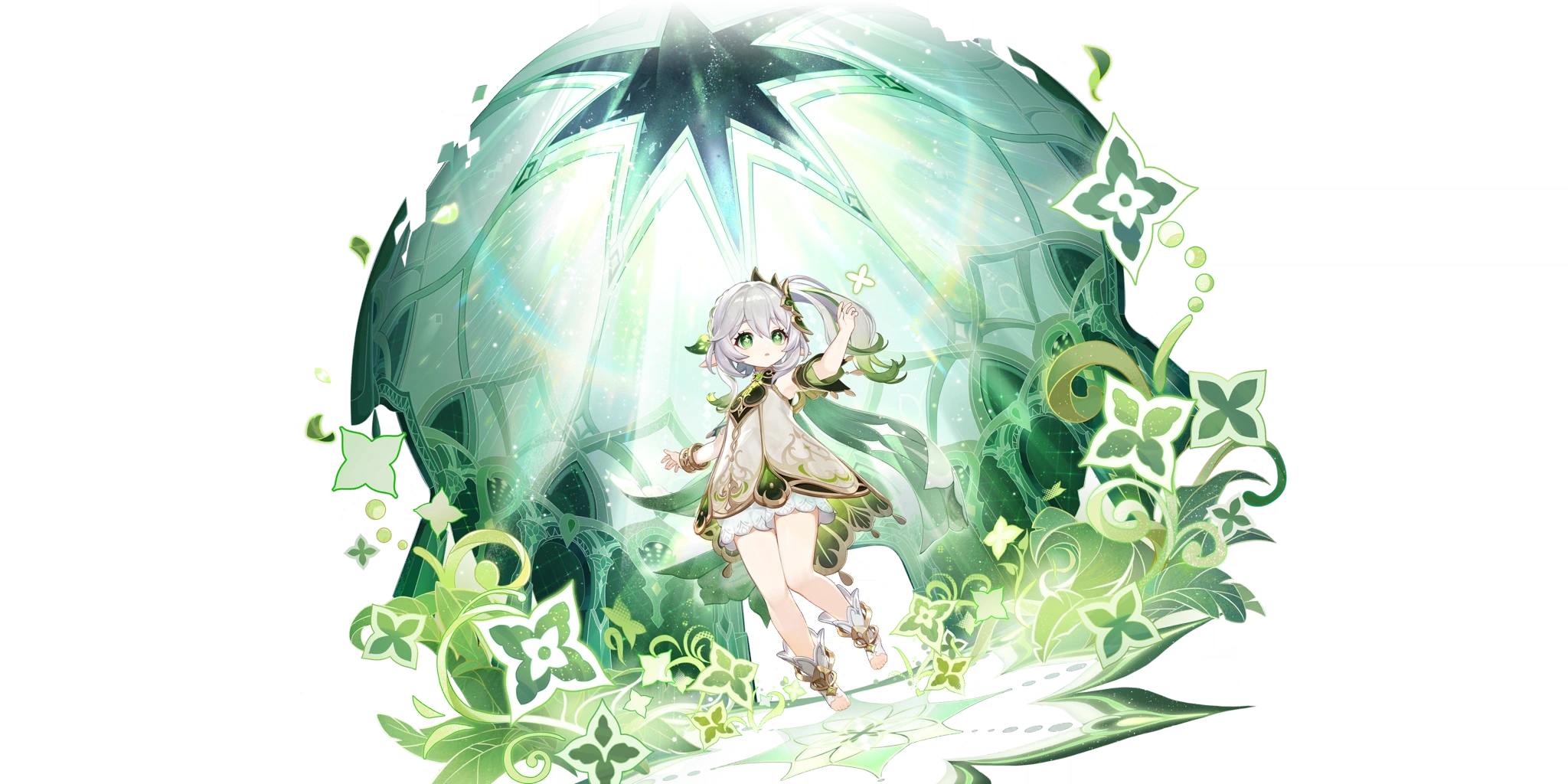


The Dendro Archon is a 500-year-old child who has spent most of her life imprisoned in a glass cage by the people who were supposed to serve her. She is, characteristically, neither bitter about it nor naïve.
To understand Nahida, you have to understand who she replaced. Greater Lord Rukkhadevata, the original Dendro Archon, was one of Teyvat's most powerful gods, and during the Cataclysm 500 years ago she sacrificed herself to seal a force that would otherwise have destroyed Sumeru. Knowing she would die, she split off a fragment of her consciousness into a smaller, simpler form: a tiny green-haired girl. That fragment is Nahida.
The Akademiya's Sages, ostensibly serving the new Archon, decided to lock her in the Sanctuary of Surasthana and keep her as a power source while they ran their own scientific experiments. They built her a machine god (the Akasha plus the Balladeer, later Wanderer) to act in her stead. Nahida sat in her glass tank for years, watching, learning, planning.
She got out by recruiting the Traveler. She didn't fight her way out; she invited herself in, projecting dreams, leaving puzzles, putting the Aranara on standby. After the Traveler and Nahida defeated Scaramouche's Gnosis-powered Shouki no Kami, Nahida recovered the Electro Gnosis. In the later negotiation she transferred that Gnosis to Dottore in exchange for the destruction of his other segments, then transferred her Dendro Gnosis for information about Teyvat's false sky. [3] [4]
A few facts that matter:
- Nahida's mind-reading isn't psychic gossip. She connects to Irminsul, the world's memory-tree, and reads what's recorded there. She does it judiciously, and never brags about it.
- She rewrote Sumeru's recent history by editing Irminsul to remove the Eternal Oasis (Apep's domain), which incidentally erased Scaramouche from history and gave Wanderer a clean slate. It is one of the most powerful acts any Archon has been shown performing.
- Her relationship with the Aranara (forest spirits raising her since infancy) is genuinely tender. They call her "Buer", her old name; she calls them "the Aranara" out of respect.
- She transferred both the recovered Electro Gnosis and her own Dendro Gnosis to Dottore under separate negotiated terms.
Welkin Moon Act IX - Irminsul-investigation collapse and Heart-of-Oasis restoration (Luna VII / 6.6)
Song of the Welkin Moon Act IX, "As All Falls to Emptiness" (Luna VII, patch 6.6), moves the Luna arc back to Sumeru after eight acts in Nod-Krai, a first for the Archon Quest. It runs on the wiki as As All Falls to Emptiness, and it takes up Nahida's own arc within the chapter: the thread the Welkin Moon Prelude planted with its Sumeru hint pays off before the act ends. Her arc continues in Act X, Truth Amongst the Pages of Purana (first titled "Of Myriad Paths, Flux, and Dissolution"), where she names Dottore as the intruder in Irminsul and burns the corrupted tree with the Pyro Gnosis. [6]
It opens on a dream. Collei receives a prophetic vision in which the Sumeru cast have swapped roles (Sethos as her Master, Tighnari as General Mahamatra, Cyno as Temple-of-Silence leader, Kaveh as a wealthy merchant, Layla as the architect of the Palace of Alcazarzaray, and so on), followed by an unseen voice, traced later to Nicole Reeyn, warning, "Time is short... A storm is coming from beyond the bounds of fate." After Collei reports the dream, Nahida consults her Sages, agrees it is a warning of things to come, and orders an immediate evacuation of the rainforest to Caravan Ribat, given out publicly as "a large-scale renovation of the rainforest's ecosystem" so as not to "cause widespread panic." She sends word through Collei that she will "hold out until the very end," and stays at the Sanctuary of Surasthana. [16]
Nahida then does something only she can do: she connects to Irminsul to investigate, and as information backs up inside it she takes over its recording and processing herself. The story is blunt about the risk. Cyrus calls it "an almost impossible task": "All that information flooding in at once would instantly fry any human mind." Her ability to reach Irminsul directly is what the act turns on. Naphis of Amurta, now confirmed as one of the old-guard Sages kept on after the Sumeru arc, identifies the underlying problem: "Information is bottlenecking inside Irminsul, hampering the Ley Lines' flow." Alhaitham spells out the cost: "the souls of the dead will be stranded, while the living have their sense of reality warped." Twelve hours pass with no new information from her. Wanderer reports, "Looks like our working theory was wrong. There's no signs of Irminsul having been attacked from the outside"; as he finishes, the energy surrounding Nahida breaks and she collapses. Naphis finds that "Her breathing is weak! And her elemental energy levels are dangerously low..." Alhaitham moves to the backup plan, getting her out of the city, since her connection to Irminsul "should grow weaker with distance," as Cyrus explains, and everyone evacuates to Caravan Ribat. [16]
The Outlander then remembers the Heart of Oasis and Apep: "If I use Apep's 'Heart of Oasis,' I might be able to help Nahida replenish her lost Dendro power without any need to rely on Irminsul!" They carry the comatose Nahida to the centre of the Desert of Hadramaveth, where Apep is already expecting them: "Hah. I had a feeling your kind might come calling." The Outlander wins her help with a reminder of the debt ("Because you owe a debt of gratitude, and this way you can repay it."), and Apep recalls that "it was Buer who saved me from agony." She agrees, since "to receive aid without repaying it would likewise tarnish a dragon's dignity," and brings them to the Heart of Oasis, which "is supplying her with life force." She warns them, "Unless the issues plaguing it are resolved, she will never completely recover her former strength." Nahida briefly regains consciousness and hands the Outlander a key; touching it puts a piece of information in their mind, with the instruction, "Remember, tell no one." [16]
That scene also carries the act's heaviest revelation. Apep tells the Outlander, adding to what we knew rather than contradicting it, that "Irminsul existed before they ever arrived in Teyvat," meaning the Heavenly Principles; that "The Ley Lines flowed with an abundance of a familiar, primitive form of elemental energy... You may know it as the power of the Light Realm"; that "The Heavenly Principles usurped and refashioned Irminsul, made it serve humanity, and used it to anchor the fate of the world"; that "there will come a day when we reclaim this world for ourselves"; and that "the Hydro Dragon has wrested his authority from the hands of the usurpers," adding, "Though we have yet to meet, I know that we are both preparing for our revenge day and night." [16] Nahida is not the one talking, but it is for her sake that the Outlander asked Apep's help, and it is while repaying that favour that Apep goes on record about the Sovereign-Authority reclamation the later story is built around. The Heavenly Principles page follows that disclosure further; the Seven Sovereigns page covers the reclamation arc.
In Ancient Shadows Re-Emerge, all seven Pillars of King Deshret come together at his Mausoleum. Heryshaf, the Goat King, calls Shesepankh and Bennu, joined by Thoth (the "Ibis King") and Sobek, the Crocodile King; Thoth calls the other two prisoners Goatie and Croco. When Shesepankh doubts that Apep will ever take part, Sobek answers that "Apep is, in fact, healing the Dendro Archon as we speak," and Heryshaf counts in the two absent Pillars: "Hermanubis's representative and the Dendro Dragon Apep made their choice ahead of time." With all seven in agreement, the path to Aaru opens; Apep's help for Nahida is what completes the old Sumeru lineup. [16] Sumeru carries the full Seven Pillars story.
The Akademiya's six schools, back in order
The act also wraps up the Akademiya's leadership, which Nahida has guided since the Sumeru Archon Quest. The Akademiya is Sumeru's great school, organised into six Darshans, or academic houses, each led by a Sage. At Caravan Ribat, Naphis names the full set of Sages at last. Naphis of Amurta and Baladhuri of Vahumana are the old guard kept on; Baladhuri's name had been left open since A Toast to Victory in the original arc, where four new Sages were still to be chosen, and is filled in here. They are joined by Azar's replacements: Alkindi of Spantamad, Firnas of Kshahrewar, Shakir of Rtawahist, and Rushd of Harvatat. The four open seats from the Sumeru arc, which Kusanali promised to oversee herself, finally get filled on screen. Sumeru Akademiya lists all six houses.
The same briefing returns to the Akasha System. Kaveh notes that "the technological infrastructure is all still there," and Tighnari that "The Akasha relies on the Gnosis as a power source, and in its absence, we'll need to find an alternative." The scholars go looking for one at the Temple of Silence and settle on Aaru. Apep's power comes up for a different purpose, helping Nahida recover: "as long as Apep is willing, she should be able to convert her own power into a form that the Archon can use," Tighnari says, and Alhaitham adds, "The only problem is convincing her to help." [16] The Akasha needs a substitute because Nahida no longer holds a Gnosis: she transferred the recovered Electro Gnosis and her own Dendro Gnosis to Dottore during their negotiation. [3]
Nahida, Collei, and the old gods of Sumeru
The act also reaches back to the Sumeru that existed before the Cataclysm, the one the present-day Akademiya inherits. In a quiet scene in Ancient Shadows Re-Emerge, Nicole Reeyn, the Memory-Witch of the Hexenzirkel, the secret circle of witches, an Angel-race survivor and its first playable member, tells Collei that the god remains the Fatui injected into her as a child were "the remains of Nabu Malikata... the Goddess of Flowers." Cyno reassures Collei that "you are simply you." [16] In Act X Nahida says she had known all along: "Long ago, I sensed that the god remains inside Collei had come from the Goddess of Flowers, but I kept it a secret." The remains were not hurting Collei, and Nahida sensed her yearning "for an ordinary life": "With someone like her, I have a responsibility to keep her secret." Liloupar later takes the remains from Collei in Mondstadt. [17]
The reveal sits beside Nahida's own origin. She is a fragment of Greater Lord Rukkhadevata, the old Dendro Archon, and Collei carried a fragment of Nabu Malikata, the old Goddess of Flowers. The fragment does not make Collei the goddess: in Act X Liloupar tells her, "You're nothing like Nabu Malikata, and you're certainly not her." [17] Nahida comes from Rukkhadevata, not Nabu Malikata. See Nicole Reeyn for the full reveal and The Seven Archons for the older gods.
Old Sumeru rested on three figures: Nabu Malikata, the Goddess of Flowers, long dead, with one fragment of her remains in Collei until Act X; King Deshret, the desert god, dead but kept alive in legacy through the Seven Pillars; and Apep, the Dendro Sovereign, sealed but active, confirmed as the seventh Pillar in Welkin Moon Act IX. Nahida is part of none of that. She inherited Rukkhadevata's Dendro Archon role after the Cataclysm, and the Akademiya she reformed inherits Rukkhadevata's legacy through her. She comes after the world she draws from. Apep, a survivor of that older world, stands at Rukkhadevata's level rather than Nahida's. She helps the comatose Nahida at the Heart of Oasis only to settle a debt, since "it was Buer who saved me from agony," and she counts Nahida's kind among the "intruders who followed in the wake of the Heavenly Principles." [16]
Deep dives
Two deep-dive essays carry the threads this act ties off. The Seven Pillars of King Deshret walks all seven Pillars and King Deshret as a god in his own right. Who runs the Akademiya: the six Darshans and their Sages walks the six houses and the replacements for Azar that Nahida promised to oversee back in A Toast to Victory. Both arrive at the same Welkin Moon Act IX moment that Nahida's Heart-of-Oasis arc anchors.
Those essays split old Sumeru into three. Greater Lord Rukkhadevata was the Dendro Archon whose place Nahida inherits as a fragment of her mind. King Deshret was a separate god rather than a Sovereign, with the Dendro Sovereign seat belonging instead to Apep. And Nabu Malikata was the Goddess of Flowers, whose scattered remains left one fragment in Collei. Nahida comes 500 years after all three, an heir rather than one of them, and the Akademiya she reformed inherits Rukkhadevata's legacy as the six houses are filled. See Sumeru and Apep for the regional and Sovereign-side detail.
This all turns on a distinction Act IX makes plain. Nahida can reach into Irminsul directly ("The Dendro Archon has the power to connect to Irminsul," Cyno says), and when she takes over its processing, Cyrus warns that "All that information flooding in at once would instantly fry any human mind." The Outlander is simply outside its records: "Nahida once said that Irminsul doesn't contain any information about me... So theoretically, I shouldn't be affected by such anomalies." Her access works from the inside; the Outlander's immunity works from the outside. [16]
Chapter VII: the Hallowing and the trial of wisdom
In Chapter VII Act V, Hour of Ruin (Version 7.2), the Nails of Retribution set off the Holy Soil phenomenon, or Hallowing, and Nahida goes to Zapolyarny Palace to speak for Sumeru. Tighnari and Cyno come with her because Naphis "had too much going on." At the leaders' meeting Pierro explains the Heavenly Principles' preference for nations kept apart, and she answers with a caution: "we must speculate with care, or we risk crossing the line into the conspiratorial." She will not put all the blame on Snezhnaya either, since Ronova "could easily have activated only the Nail of Retribution located here." "Her actions are a declaration of war against us all, and we ought to respond as a united front." Meeting Neuvillette for the first time, she grants that from the dragons' perspective "both we and the Heavenly Principles belong to the same despicable breed of 'usurpers.'" He thanks her as "Buer, God of Verdure." When Pierro admits the Fatui have not found the Pyro Gnosis, she asks, "Why should we believe that you haven't acquired the Pyro Gnosis already?" She also offers Sumeru as the first nation to attempt a Trial of Usurpation: "There was once a god of the desert who researched the Nail of Retribution, and we still have the records of what he had learned." Liyue's trial is completed during the meeting, so no test nation is needed. [18] [20]
Back in Sumeru, in Act VI, A Yesterday Sent From Beyond, she alone can hear a sound that appeared "at almost the same time as the beam of light in the distance" over the desert Nail. To her "it really does sound like it could be some sort of language, just one I haven't been able to identify." Close to the Nail the Traveler hears it too, and Nahida maps its vibrations onto paper. Thoth thinks the drawing looks like "that thing our king used to tinker with." Aaru has "enough processing power" to decode it, and the answer is "A single word: 'dreams.'" Paimon asks whether that isn't her authority, and it is. Because "The Akasha Terminals have been turned off," she keeps the dreamscape running from outside while the Traveler and Paimon walk through it. [19]
In the dream the Nail "asks us to examine our past actions." Its first test is a painting of Shouki no Kami with the middle missing, and the question "whether defeating Shouki no Kami was truly the only solution to that particular crisis back then." Nahida voices the alternatives as questions the dream poses: "could we not have attempted to destroy the Electro Gnosis entirely?" Or, "in an even more extreme approach, could we not have accepted the existence of Shouki no Kami, and infused him with the power of the Dendro Gnosis?" In her view "these alternate solutions each fail to account for the whole picture in their own ways," and each one the Traveler tries turns out badly. Her conclusion is that "we could not have defeated him without the combined wisdom of everyone in Sumeru." A second puzzle reopens Apep's Heart of Oasis, where the road not taken was "using the Fire Seed to absorb Apep's power." Fandom's transcription records a third that the Yatta record lacks, set at the moment "when Dottore tried to contaminate Irminsul": "The coded message hinted that appropriate use of the Pyro Gnosis could have allowed us to avoid burning Irminsul." When the Traveler tries it, the corruption spreads, and Nahida takes over. "This was nothing more than a dream." "I'll make the final call instead." [19] [22]
Inside the Nail she is alone ("Perhaps one of the stipulations of the trial is that one must face the Heavenly Principles alone..."). Esoptron gives the subject, "Wisdom," and she starts from her guiding principle: "Life has always been the end, while it is wisdom that shall be the means." Then her answer: "There is no single answer to the question of wisdom, because the very foundation of wisdom is disagreement and divergence. Our views on Teyvat differ, our very selves differ, and without those differences there can be no wisdom." Paimon counts "one less sigil," and Nahida admits that "The Heavenly Principles didn't make things too difficult for me." The Traveler and Paimon had reached what seems to be the same chamber without seeing her, where Esoptron registered an "Unexpected target" and managed only "Welcome... to the... world..." Her guess is that the Nail's space "operates differently from the outside world," perhaps "to prevent the person participating in the trial from cheating." [19]
At home, Sumeru's own operations are delegated. In the World Quest From Trees to a Forest, Kaveh tells Cyno, "The Dendro Archon put you in charge," and Cyno coordinates from the House of Daena "While the Dendro Archon and Grand Sage Naphis are occupied." [23]
Once every trial is passed, Nahida represents Sumeru at the door in Chenyu Vale. Of the Heavenly Principles she says, "Let's hope they're willing to reverse the damage that has already been done by the Hallowing..." Inside, Nukvah greets the representatives ("Welcome to the 'Divine Throne,' Celestia's integrated computational array"), announces that "The default program requires Teyvat to be reset," and offers to preserve one allogene chosen by each of them. Nahida questions the design itself: "If you find the arrogation of living beings to be so distasteful, why not delineate Fate as you see fit? Why give the allogenes any control over the variables at all?" Nukvah calls it "the optimal result arrived at through immensely complex and extremely lengthy calculations." Outside again, she weighs Celestia's frankness: "In the past, Celestia never would've wanted the civilizations of the world below to find out what happens up there. But this time, it told us the truth..." "As much as I hate to say this... I suppose that, from its perspective, it is allowing us to die with some sort of dignity..." When the Tsaritsa says the only option left is to fight "until our last breath," Nahida agrees: "There's no other way." [19] [21]
The Pyro Gnosis and its open fate
One clarification about the Gnoses. In Akasha Pulses, the Kalpa Flame Rises, Nahida recovered the Electro Gnosis from the defeated Shouki no Kami and later transferred it to Dottore; she separately transferred her Dendro Gnosis to him for information about Teyvat's false sky. The Pyro Gnosis is a later, separate custody event. Mavuika made it available to Nahida via the Traveler, and Nahida used it for the Irminsul-burning operation in Sumeru. It disappeared without a trace afterward despite Nahida's attempt to find it. Its current location is unknown: neither Mavuika nor the Fatui/Tsaritsa is confirmed to hold it, and disappearance after the burning is not proof that the burning consumed it. [3] [4] In Chapter VII Act III (Version 7.1), the Traveler tells the Tsaritsa that the Pyro Gnosis was reduced to ashes with Irminsul and, according to Mavuika, has returned to the Ley Lines; the Tsaritsa still calls its whereabouts unknown. [5] Version 7.2 leaves it missing. At the Act V meeting Pierro says the Fatui "have yet to locate the Pyro Gnosis," Nahida asks why anyone should believe him, and Mavuika, who "looked after it for a very long time," says "I can no longer sense it." Act VI ends on Paimon's "But we still don't know where the Pyro Gnosis is..." The Pyro Gnosis line in Sumeru's dream, which only Fandom's transcription records, looks back at the burning of Irminsul and says nothing about where the Gnosis is now. [18] [19] [22]
The Pyro Sovereign is a different question again. Xiuhcoatl, the Pyro Sovereign, was slain by Xbalanque (per the Natlan world quest A Finale Emberforged), which is a matter of the Sovereigns, not the Gnoses. Nahida's later use and loss of the Pyro Gnosis is about the Gnosis; the Pyro Sovereign's death is about Natlan's dragons. The two should not be conflated.
In short: Nahida is the youngest god in Teyvat and easily the cleverest, and she reads minds with a light touch. In the Welkin Moon arc she pushed her connection to Irminsul against a problem big enough to drain her, collapsed in front of her Sages, and had to be carried out to the desert by the Outlander. An old serpent who owed her a favour restored her at the Heart of Oasis, and while repaying it let slip how Teyvat's cosmology really works beneath the Heavenly Principles' surface. Nahida is herself again. What she now knows is still being worked through.