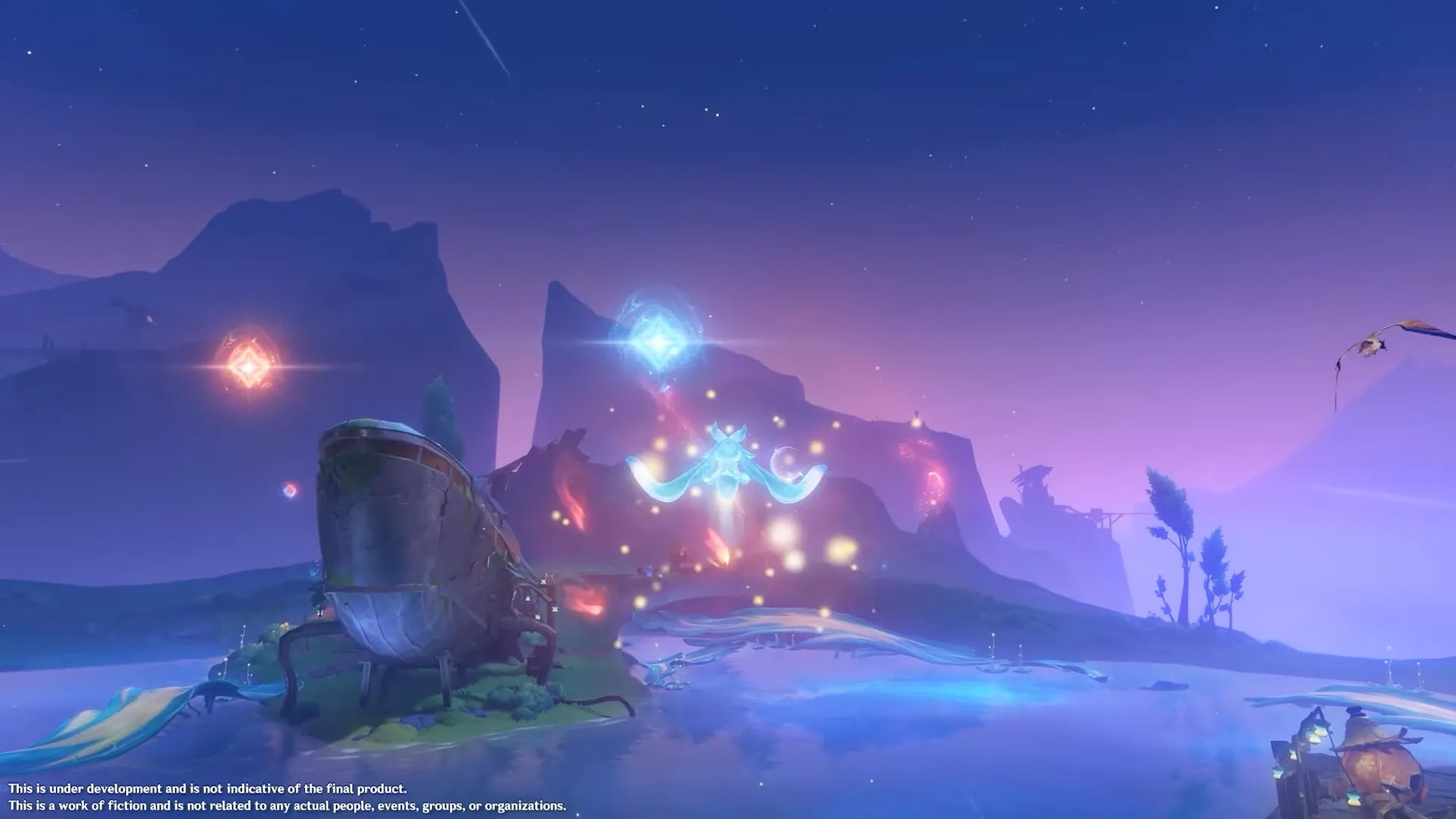
Kuuvahki is Nod-Krai's exclusive pre-elemental energy, "moon power" in Finnish (kuu + väki). Every Luna-arc Nod-Krai mechanic, ritual, and combat interaction is built on top of it. [1] In gameplay it looks like a polarity puzzle that empowers characters, but underneath it is the discarded body of the Fatui Harbinger Columbina, scattered across Nod-Krai after she split her being into three to escape the Three Moons' timeless confinement in the Lunar Palace. [2] The mechanisms that run Nod-Krai today, from Frostmoon Scion rituals to Lightkeeper devices, all draw on that inheritance.
Etymology and naming
The term "kuuvahki" is a Finnish compound: kuu ("moon") plus väki ("power" or "force"). [1] Väki has several meanings in mythology. It can refer to an impersonal supernatural force, a troop of beings, or the invisible power held by supernatural entities (Finnish folklore comparable to forest-elf power), and it can also transfer to objects or places. The compound translates as "moon power," "moon force," or "moon-troop's power," and in-game the term holds all three resonances at once: the power the Frost Moon transmits to Nod-Krai, the substance that fills the region's ecosystem, and the gift the Frostmoon Scions revere as their inheritance from the Moon Goddess.
The term itself is not native to Nod-Krai. The Frostmoon Scions traditionally call the substance "the blessing of the Moon Goddess," the liturgical name the Verna character uses throughout Polkka Beneath the Moon's Oracle, where the ruby text glosses kuuvahki as the "Moon Goddess's blessing." [6] A Nod-Krai loading screen gives both names: "The Frostmoon Scions call this the blessing of the Moon Goddess. 'Kuuvahki' is the name given to it by the researchers in Snezhnograd." [1] The word "kuuvahki" was coined by those Snezhnograd researchers, the Snezhnayan academics who study it from a scientific angle rather than a devotional one. [3] The word is not only an academic one, though: in Welkin Moon Act I, Ineffa says, "The locals refer to it as 'kuuvahki.'" [3] Both names appear in primary text, and both are canon.
Origin
The origin event is told in Archon Quest Song of the Welkin Moon Act VIII "True Moon," Part 1: The First Sliver of Moonlight (Version 6.3, Luna IV): [2]
- Columbina, the former Third Fatui Harbinger known to the Frostmoon Scions as Kuutar, entered the moon's reflection to escape Dottore and, travelling backwards in time, found the three Moon Sisters (Aria, Canon and Sonnet) imprisoned there. Canon calls the place "this lunar palace." The prison could hold divinity and authority but not a physical body. [1]
- The Three Moons sisters together transferred their Trilune authority to Columbina.
- To escape, Columbina split her being into three: her soul, her body, and the Trilune authority itself. The three components separated. Her soul stayed in the moon's reflection, anchored to her Luonnotar, and the Trilune authority was hidden within the Frost Moon. She willed herself to be born about 500 years before the present day without that authority, and the three parts came together again in the fight against Dottore in Descending Moon. [9] [1]
- Her body, the third component, became kuuvahki energy and was poured over Nod-Krai in the past, during the war of funerary flame. [1]
This is why Nod-Krai is the only region in Teyvat with abundant pure kuuvahki. The substrate is literally Columbina's body, spread across the region backwards in time. [1]
In the broader framing, kuuvahki is one of two ancient and primordial forms of elemental energy belonging to the Light realm, alongside Phlogiston (Natlan's pre-elemental substrate). The analogy runs: "just like a beam of light that can be split into seven colors, Kuuvahki is a state of light before dispersion takes place." [1] On this framing, the seven elements that organise present-day Teyvat are the dispersed state of the Light-realm energies kuuvahki and Phlogiston belong to.
Polarity, empowered state, and gameplay manifestation
Mechanically, kuuvahki manifests in two opposite polarities, red and blue, interacting on a "same colors repel, opposite colors attract" rule. [8] That polarity system drives most of Nod-Krai's puzzles:
- Unipolar objects carry a single polarity, red or blue. A character infused with the matching polarity is repelled by them; one infused with the opposite polarity is attracted to them or can destroy them.
- Bipolar objects have a mixed red-and-blue appearance and respond to either infused polarity, so they can be attracted regardless of which polarity the character carries.
- Empowered state is the name for the infused condition. When a character is sufficiently saturated by red or blue kuuvahki, typically by standing near a kuuvahki-influenced plant or entering a Strong Kuuvahki Environment, they can carry, throw, attract, repel, or smash kuuvahki-influenced objects in line with their polarity.
The empowered state is limited to one object. A character can carry only one kuuvahki-affected object at a time, and picking up another (or exiting the empowered state) drops the carried object. The mechanic gates specific in-quest items: Kuuvahki Dewdrops, Kuuvahki Relay Mechanisms, ID Cards (used to get past the perimeters of Fatui barrier generators), Assembly Modules, Portable Bearings, and the kuuvahki-influenced Rainbowdrop Crystal harvestable resources. [1]
Strong Kuuvahki Environments are region-wide saturation zones; walking into one automatically enters empowered state. The free-roaming red and blue kuuvahki orbs of Colors of Emptiness leave permanent Strong Kuuvahki Environments in their wake as they move (red orb to a red stain, blue orb to a blue one), which is how that chain presents the Nothing Passage gorge on Lempo Isle as a ruin now saturated with kuuvahki.
The mechanic also supports Kuuhenki Transformation. A character who accumulates enough kuuvahki energy by lingering near kuuvahki-influenced plants can briefly transform into a kuuhenki, a small kuuvahki-native elemental lifeform, to enhance mobility. [7] Passing a Moonshine Violet during a kuuhenki flight gives an additional vertical boost. The kuuvahki-current and Moonlane transportation networks run on the same substrate; in Co-Op Mode a guest player in another player's world cannot enter empowered state or use kuuvahki currents, but can still use Moonlanes.
The Frost Moon correlation
The substrate's intensity is modulated by the Frost Moon, the only one of the Three Moons that remains intact. [3] Per AQ Song of the Welkin Moon Act I Part 1 "Where the Moon Rises," kuuvahki is strongest when the Frost Moon is closest to Teyvat in its present-day orbit. The correlation has practical regional consequences:
- The local Nod-Krai ecosystem has adapted to kuuvahki saturation at several ecological levels. Many regional creatures, Longplume Ibises, Blunthorn Rhinos, and Rock Crabs among them, carry kuuvahki-influenced body parts that respond to the polarity a character is infused with in the empowered state; these can be startled but not killed by kuuvahki interaction. [1]
- Specific Nod-Krai plant species store kuuvahki, which is the source of the saturation a character draws on when entering empowered state.
- Because the Frost Moon's proximity sets kuuvahki's intensity, Moon Wheel wielders and Radiant Beasts can use kuuvahki in combat directly; its usefulness in combat scales with the moon's proximity in real time.
The same proximity correlation explains why kuuvahki is exclusive to Nod-Krai. The distribution of Columbina's body in the past was confined to Nod-Krai, and today's gradient of intensity is tied to the Frost Moon's particular orbital geometry over the region.
Sensitivity and biological effects
Like other elemental energies, kuuvahki is physiologically active, and individual sensitivity to it varies. [1]
Overexposure produces frequent nosebleeds, dizziness, headaches, nausea, and full-body allergic itching, documented across several NPC dialogues. The Czcibor dialogue records nosebleeds; the Nasha Town Bulletin Board "The Cannon Must Go!" notice records dizziness; the Veroslava dialogue records nausea; and AQ Welkin Moon Act V Part 2 "Ripples That Will Never Reach" records allergic itching.
Chronic conditions exist too. The NPC Kaarina is diagnosed with "Congenital Kuuvahki Sensitivity," a condition that flares up with debilitating effects on sustained exposure. It is treatable with a Snezhnayan-developed medicine from the Curatorium of Secrets, the institution linked to Nefer and Jahoda that appears through Jahoda.
The silver blood of Frostmoon Scions with strong Hyperborean lineage, explicitly Lauma per AQ Welkin Moon Act I Part 2 "Reunion Beneath the Moonlight," [4] can counteract kuuvahki's adverse effects in ordinary people. This is the same Hyperborean purity that Polkka Beneath the Moon's Oracle reveals in Aila and Lovia's pre-Cataclysm rite, in which Lovia raised Aila and her twin Alia by having them consume Frostmoon Scion silver blood, to increase the purity of their bloodline. The ability to counteract kuuvahki is the post-Cataclysm inheritance of that rite's chemistry.
There is a technological counter as well. Verna (Vernadska), the Frostmoon Scion acolyte priestess from Polkka Beneath the Moon's Oracle Chapter I, has developed a wearable anti-kuuvahki suit. [6] The suit works both ways. It wards off external kuuvahki and prevents symptoms of overexposure in the wearer, but it also neutralises the wearer's own use of kuuvahki, so Verna cannot perform Frostmoon Scion blessings while wearing it even though she has the capacity to. It is also why she can operate in Strong Kuuvahki Environments like Thunderclap Reef without nosebleeds despite her own sensitivity ("if I take it off I might get a little nosebleed").
Recovery can also be spontaneous. Per the Czcibor dialogue, a person with kuuvahki hypersensitivity sometimes recovers after extended exposure to saturated zones. Czcibor disappeared in the Barrowmoss Barrens for a long stretch, returned with no memory of the event, and found his sensitivity reduced to manageable levels. The mechanism is unstated.
Institutional registers
Three present-day institutions operate on kuuvahki, each with a distinct register.
The Frostmoon Scions treat kuuvahki as "the blessing of the Moon Goddess," a sacred gift inherited from Kuutar, whose identity as Columbina the AQ Welkin Moon arc and Polkka Beneath the Moon's Oracle establish. Their kuuhenki-summoning blessings, Statues of the New Moon, and the Court of the First Edict's system for authorising kuuvahki engravings all grow out of that devotion. One Moon Mirror did serve them as a seal: in Blessings of the Frost Moon, Lauma needs help "undoing the seal created with the Moon Mirror by a previous Moonchanter." Moon Mirrors in general are an exploration mechanic, in which the empowered state of kuuvahki and a kuuhenki are used to move polar and bipolar objects. [10] [11] The Scions' Moonchanter office draws on kuuvahki. The Moonchanter's always-on ability to communicate with animals, shown in Blessings of the Frost Moon, runs on continuous kuuvahki saturation.
The Lightkeepers treat kuuvahki as working material for their defences against the Wild Hunt. The Tideseal Stones placed across Nod-Krai, introduced in Lightkeepers' Oath, are kuuvahki-powered devices that disperse the Wild Hunt's permeation, and the Oath Lanterns every Ratnik carries are kuuvahki-operated devices for tracking and insignia. Their language is practical rather than devotional, but it inherits Frostmoon Scion engineering directly. Solovei and Aila co-founded the order after the Cataclysm, as the capstone of Polkka Beneath the Moon's Oracle reveals, and the Lightkeepers' toolkit against the Wild Hunt descends from Aila's kuuvahki engineering at the Court of the First Edict.
The Snezhnayan academic establishment treats kuuvahki as a research subject, and the term "kuuvahki" is itself their coinage, replacing the Scions' devotional name with a scientific one. The Armory Palace research shown in Colors of Emptiness is the highest-profile Snezhnayan effort. In it, Professors Karnatsky and Preobrazhensky work on moon shards at Lempo Isle, aiming to "tear open the veil of the world, igniting the first spark for Her Majesty's wishes," though the chain treats the work as catastrophically mishandled. The Curatorium of Secrets's medicine for Congenital Kuuvahki Sensitivity is the medical-research arm, and the Kuuvahki Experimental Design Bureau on Paha Isle is the industrial one. The effort runs tense with the Frostmoon Scions: "recent efforts to explore practical uses of kuuvahki, particularly by the Fatui, has significantly increased tensions between them and the Frostmoon Scions." [1]
What kuuvahki is not
- It is not one of the seven elements. Kuuvahki predates the seven-element organisation; the analogy calls it "a state of light before dispersion takes place" while the seven elements are the post-dispersion organisation. The Vision system issues no Visions for kuuvahki, and Moon Wheel wielders are not Vision-bearers using kuuvahki. They wield it outside the Vision system entirely.
- It is not Phlogiston. Phlogiston is Natlan's pre-elemental substrate, also from the Light realm, also pre-dispersion. The two are sibling primordial energies, not the same energy under different names. Kuuvahki responds to Frost Moon proximity; Phlogiston responds to the Sacred Flame and the Children of Echoes cycle. Primary text shows no crossover behaviour between them.
- It is not the Abyss-substrate. The Abyss-substrate is a separate cosmological thing, distinct at the pre-elemental level from both kuuvahki and Phlogiston. Colors of Emptiness draws the line in its own text, distinguishing the "color" that devoured the 6th Company from kuuvahki: "They were inside those damned rocks at first... Those detestable rocks that fell from the moon." The color and kuuvahki both arrived via sky-rocks, but they are categorically distinct.
- It is not Columbina's ongoing power. The discarded body that became kuuvahki is separated from Columbina's present-day soul and Trilune authority. As a present-day Harbinger she does not "control" kuuvahki through that inheritance; she and Lauma have special interactions with kuuvahki-influenced wildlife that can aid them in exploration, but she does not treat the energy as a personal resource. The body she discarded is let go. Its role in present-day Nod-Krai is as the region's energy, not as Harbinger power.
Where this connects
Kuuvahki belongs to the broader cosmology of The Three Moons, and the body that became it belongs to Columbina, whose present-day role is covered at Eleven Fatui Harbingers. The pre-elemental Light-realm framing has its analytical opposite in the Heavenly Principles' organisation of the elements, while the saturated landscape itself (Hiisi Island, Lempo Isle, Paha Isle, Wavechaser Plain) is mapped at Nod-Krai.
Each of the three registers has its own chains. The devotional register of the Frostmoon Scions runs through Blessings of the Frost Moon (Lauma, Moon Mirror, Lunar Semblance) and Polkka Beneath the Moon's Oracle (Verna, the Court of the First Edict, the first-Moonchanter engraving); the Snezhnayan research register through Colors of Emptiness (Karnatsky, Preobrazhensky, the Armory Palace moon-shard work); and the Lightkeepers' practical register through Lightkeepers' Oath (Oath Lanterns, Tideseal Stones) and Nightingale's Song (the Verdant Crest sealing array). The whole engineering toolkit of the Scions and Lightkeepers is built for the operation against the Wild Hunt in The Last Night, the First Light. Kuuvahki sits beside but apart from the pre-elemental Abyss-substrate of The Abyss, and its counter-agent in ordinary people is the Hyperborean silver blood of Lauma.