Before the Heavenly Principles arrived, Teyvat had a ruler of its own. Canon remembers him as "Teyvat's original ruler, the Dragon King Nibelung." Aksinya, in the Version 7.0 World Quests, calls him "a will born alongside Teyvat, the master of the Light Realm's power at the very beginning, and the King of all Dragon Lords." [3] [5]
A voyager from beyond the stars warned him that his world would end. In the artifact text Deep Gallery's Distant Pact, she has seen "the lightless end, tearing through star clusters like a spindle among silken threads," and she urges the dragon: "Forsake this world, fated for ruin, and journey with me beyond the stars." He thanks her for "imparting these truths from beyond the skies" and refuses. "If the tide of oblivion must come, then let my bones be the bulwark that shields this realm," he answers. "Bear witness to the path I have chosen, for I shall lead my people onward to the stars." [6]
The artifact never names her. Fandom identifies the voyager as Anacharsis, the Saint of Hyperborea's records, and treats Seutervoinen as the Frostmoon Scions' name for the same figure. [7] [8]
Fandom also reads the warning as the reason he left, with the moons raised to govern in his place; the artifact itself records only his promise to lead his people to the stars. The weapon Fractured Halo puts it in one line: "The king who sought the world beyond set the moons aloft, to govern the cycles in their stead." Nicole's account is plainer. "In the beginning, no moons adorned the sky. It was the Dragon King Nibelung who raised the three moons into the heavens, and thus were the Moon Goddesses born." They "were shadows of the planet, born to wield Nibelung's authority and oversee the world on his behalf." [11] [9] [3]
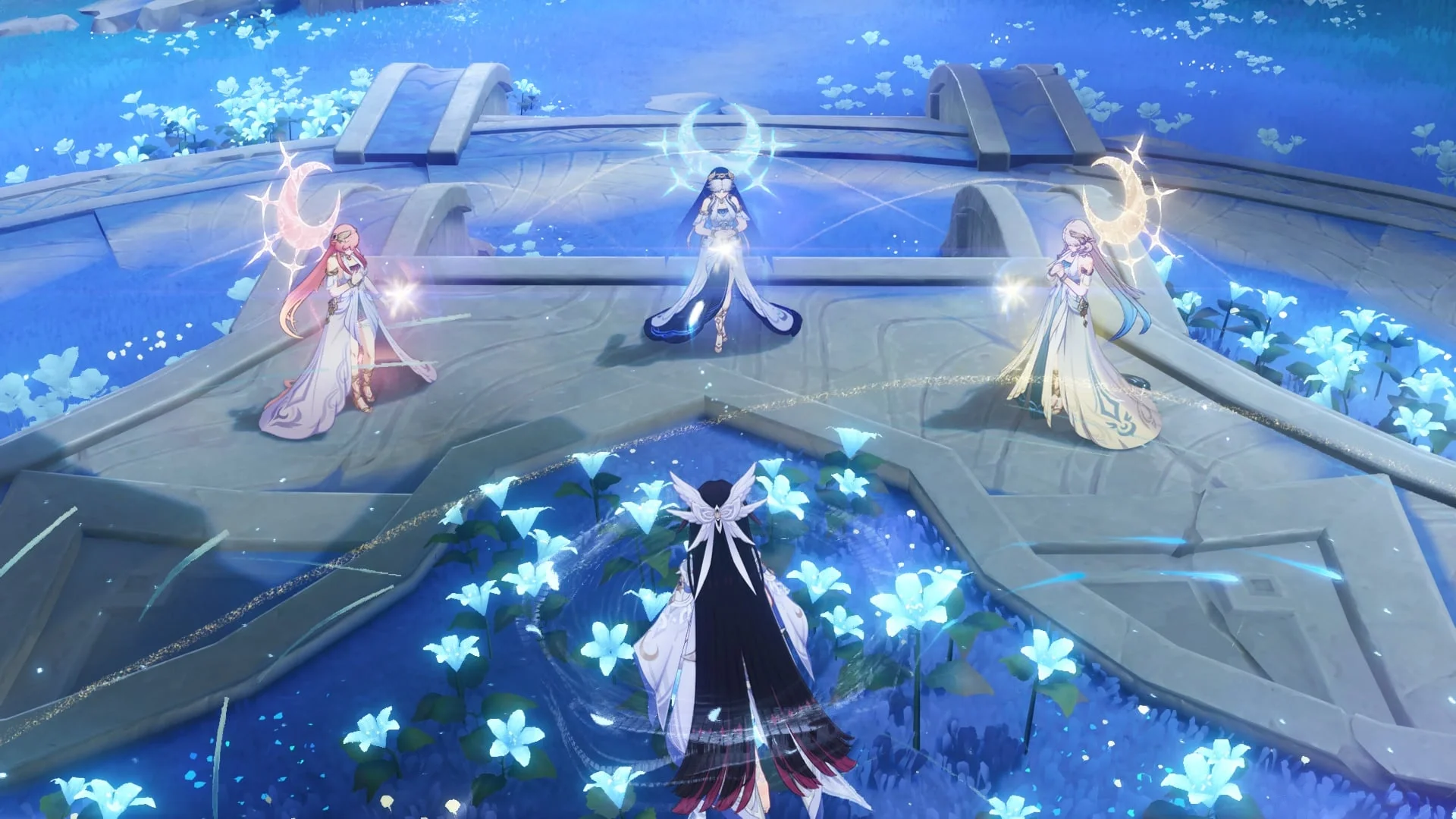
The goddesses are Aria of the Eternal Moon, Canon of the Frost Moon, and Sonnet of the Iridescent Moon, all named on screen in Act VIII of Song of the Welkin Moon. "Nibelung, our original master, created us in the distant past to maintain Teyvat," Canon says. Fandom gives Huurrekuutar, the Frost Moon goddess of the Frostmoon Scions' hymns, as another name for Canon herself. Kuutar is a different case: it is the Frostmoon Scions' name for Columbina, the present-day Moon Goddess, not a fourth sister. [3] [10] [2]
Aria tells the rest briefly: "But he left this world and traveled into the dark universe beyond, to explore worlds vaster still." [3]
He came back changed. In Nicole's telling the moons' creator "had returned bearing the perilous power of the Abyss," and Fractured Halo says that "when the king returned — now corrupted by the darkness — his fury knew no bounds." The war that followed, the war of funerary flame, is a later entry. Fandom counts him as the Second Descender, though released text does not say how or when he became one. [4] [9] [11]
The moons did not survive that war intact. Nibelung had the three goddesses imprisoned and turned their moons into weapons, and "the Heavenly Principles shattered two moons, and flung the other beyond the skies." The Frost Moon was the one flung away, and it returned inside Teyvat's sky in Act VIII. [4] [2]
Nod-Krai, formerly called Nephilheim, is sometimes read as the remnant of a failed fourth moon attempted after the three fell. That is a community reading, not a line from the game. The sources that use the name Nephilheim say nothing of a fourth moon, and Fandom's account has Nibelung raising the three moons from the planetary crust at modern-day Nod-Krai, which would make the region their origin rather than the crater of a fourth. The deep dive on the three moons weighs both readings. [12] [2] [13]