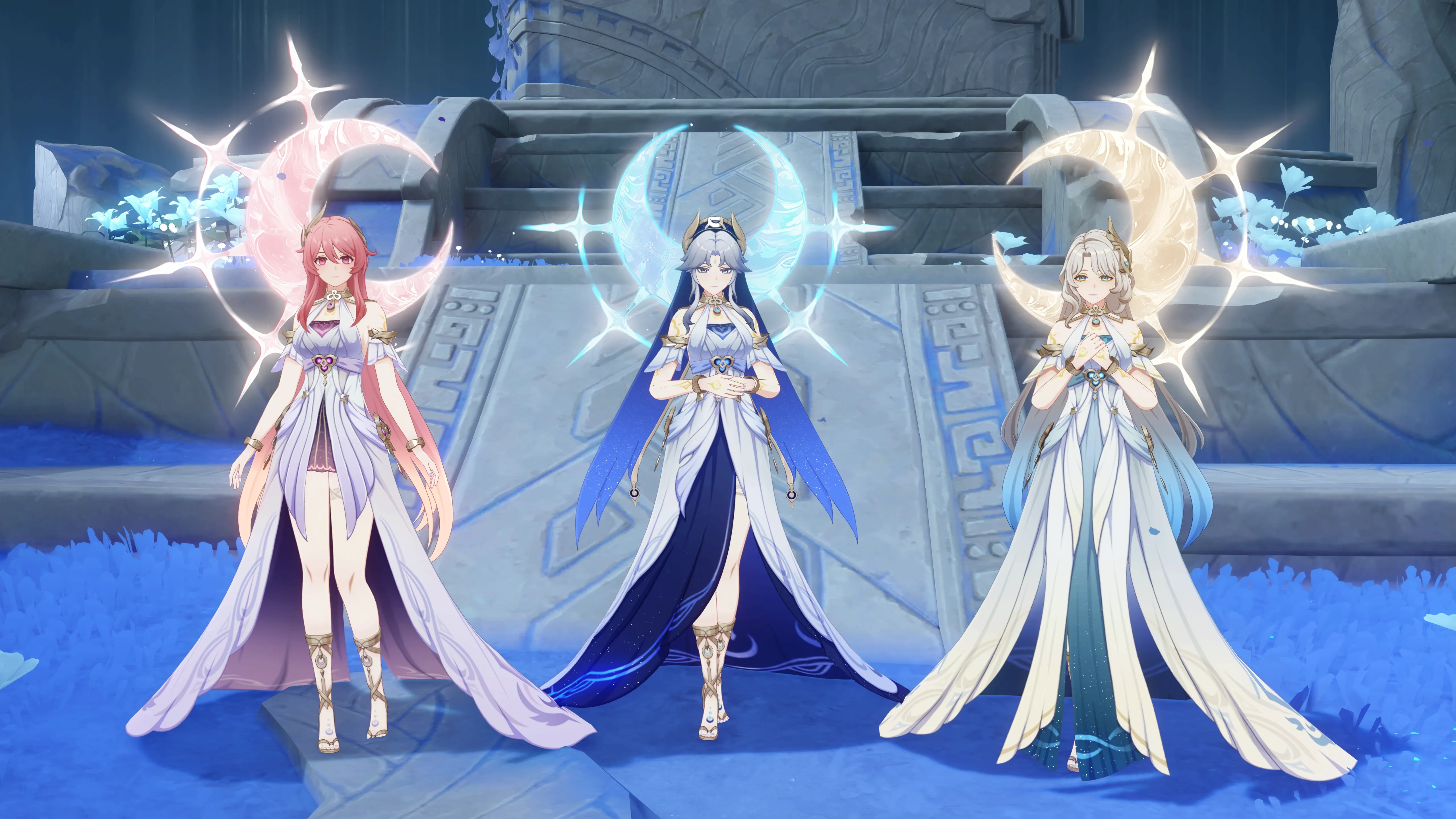
For five patches the Three Moon Goddesses were the wiki's biggest unsolved cosmological puzzle: three authorities from before the Heavenly Principles that Nibelung had raised over Teyvat and then lost, named on-screen at first only through Kuutar, the Frostmoon Scions' name for Columbina, the present goddess of the Frost Moon. [17] The Welkin Moon Archon Quest closed the gap across three acts in three patches. Act VI ("Melting Moonlight in the Morning Mist") showed the Outlander the murals in the Hyperborean ruins, which narrate the moons' creation, their weaponisation by Nibelung in his war with the Heavenly Principles, and their shattering. [4] Act VIII ("True Moon") brought the Three Moon Sisters themselves before Columbina in the moon's reflection (Sonnet, Iridescent; Canon, Frost; Aria, Eternal) and closed the framework at 3/3. [2] Act IX ("As All Falls to Emptiness") added the Apep disclosure: Irminsul existed before the Heavenly Principles arrived on Teyvat, the Ley Lines of that age flowed with what she calls "the power of the Light Realm," and the Heavenly Principles later refashioned Irminsul and "used it to anchor the fate of the world." [5] [21]
One interpretive layer runs throughout: the wiki's reading of Nephilheim as a failed fourth moon, carried by the Nephilheim page since before the framework was named. The framework itself is complete in canon; the failed-fourth reading is the wiki's own interpretive synthesis, and is flagged as such below.
Where the Three Moons came from
The creation event is stated plainly: "Nibelung created the Three Moons using ancient dragon technology and raised them into the space outside Teyvat." [1] The technology is Secret Source technology, the same draconic engineering that produced the Field Tillers and the broader family of ruin machines, and the moons were raised from Teyvat's planetary crust at modern-day Nod-Krai. Their geological origin is therefore Nod-Krai itself, the site they were lifted from long before any of the cosmology that later settled on top of it.
Each moon had its own character. Aria's Eternal Moon was the largest, and its immense moonlight formed Teyvat's ocean tides. The Frost Moon, Canon's, was the brightest and lit the night sky, while Sonnet's Iridescent Moon was the smallest, its faint light throwing fleeting halos. [1] One sister held sovereignty over the night sky at a time, riding the heavens on a silver chariot and switching places three times a month. Per Zibai's voice-overs, a sister who did not feel like being on duty could coax a sibling to cover for her in exchange for gifts, which occasionally put all three moons in the sky at once, the image that became the iconography of pre-Cataclysm Teyvat. Their footing was protective rather than ruling: they agreed to divide their power equally so that no one sister grew too strong, and their concern was Teyvat's welfare rather than authority over it. [1]
Their authorities are exactly the four the Four Shades now carry: Life, Death, Time, and Space. [1] This is the framework's central claim, that the Trilune Authority is the same power the Four Shades work with, only divided up differently. The same primary text gives those authorities one major caveat: they do not affect Descenders. The caveat matters doctrinally. It is why Dottore's ambush with the three moons' power in Act VI failed to freeze the Outlander, and why the Trilune Goddess's later descent against Dottore in Act VIII met a being who had manufactured a Moon Marrow substitute rather than received the authority natively.
Chapter VII Act IV restates the link through Arlecchino and supplies the first allocation of the four. "Long ago, the authorities of Life, Death, Time, and Space all belonged to the moons. Of the three, the Iridescent Moon received the greatest share of the authority of Death." After the moons' demise, she says, "these highest of authorities were reclaimed by the Heavenly Principles, who redistributed them between the Four Shades under a new system of rules." Which sister held the larger share of Life, Time, or Space is still not said. [15] [16]
The Heavenly Principles' arrival, and the sisters' split
The Heavenly Principles arrived several millennia after Nibelung departed. [1] The sisters sensed no ill intent from the Primordial One and received their presence as a guest. For a while the arrangement was genuine: the Heavenly Principles modified Teyvat's rules using the sisters' own authorities, and the sisters did not at first oppose the change.
Their first internal split is the most consequential judgment call in the framework's history. Sonnet opposed the changes; Aria and Canon chose to wait and see whether the order the new rules introduced, unlike anything Nibelung had taught them, would bode well or ill for Teyvat. [1] Then the Heavenly Principles waged war on the Seven Sovereigns and dragonkind, and after a forty-year struggle overthrew the dragons and created the false sky. Because the Moon Sisters did not intercede for their fellow Nibelung-creations, the dragons came to see them as traitors. That reading carries into the present-day Natlan, where Sovereign-aligned groups still call the Three Moons "the traitors" and the Heavenly Principles "the usurper," per the Source Servant report in Ineffa's Moon Wheel character story, the Nephilheim page's primary citation. [8]
What the Heavenly Principles did not do in this period was destroy the moons. They accepted them because the moons kept Teyvat running, and the two settled into a long co-creation. Per the Moon Wheel record, Moon Wheels were originally created by the Heavenly Principles and the Three Moon Sisters together, given to the Moon Goddesses' human followers so the Goddesses could speak with them in rituals. [3] The partnership is grounded in primary text through the Moon Wheels themselves: the system the Visions later borrowed from is a joint inheritance from the Heavenly Principles and the Three Moons, not an inheritance from the Three Moons alone. That matters for the wiki's failed-fourth-moon reading, which assumes a more hostile standoff between the Heavenly Principles and the Moons during their years of joint work than the primary text actually supports.
The sisters could also read humanity's succession to the surface as continuity with Nibelung rather than a rejection of him. When humans called to Canon, she judged that answering them could fulfil the mission their King had bestowed; Aria connected that judgment to Nibelung's maxim that life across the sea of stars were allies against the darkness. [6]
The Moon Goddesses maintained friendly relations with the angels. The Heavenly Principles sent servants to share the sisters' duties, including Zibai as a Lunar Envoy, and the sisters accepted her help. [2] [7] The sisters also witnessed the union of Koitar, the first angel, and Seutervoinen, the voyager from beyond Teyvat, at least ten years before Nibelung's return. [1] That places the Moon Sisters in the same era as Koitar herself, as witnesses, and anchors the pre-war social world the Aubade of Morningstar and Moon artifact set narrates. Many civilisations chose to worship the Three Moons over the Heavenly Principles in this period, since the moons offered solace to those scorched by the Heavenly Principles' unyielding rules.
The war of funerary flame, and three deaths
Their collapse is anchored to the war of funerary flame, the catastrophe that began when Nibelung returned to Teyvat corrupted by Abyssal power and furious over the world's transformation. The Moon Sisters again fell into dispute over how to respond, and Nibelung read their hesitation as disloyalty. He imprisoned them within the moon's reflection, a lunar prison of warped space-time that kept them out of the war, [1] then weaponised the moons against Celestia. The Heavenly Principles retaliated, perhaps unaware the goddesses were imprisoned, by shattering both the Eternal and Iridescent Moons and flinging the Frost Moon beyond the false sky. The goddesses lost their rationale for existence; the world would now reject their presence until they vanished entirely.
The three deaths are distinct, and each shapes a present-day cohort downstream.
Aria, the Eternal Moon. Its fall "threw heaven and earth into chaos," and some of its remains rained down onto Teyvat like stardust. [1] They coalesced into the Moon Marrow, kept as a sacred relic by the Frostmoon Scions. In Welkin Moon Act VIII's Marrow distribution, the Eternal Moon Marrow went to Lauma, the present-day Moonchanter. [2]
Sonnet, the Iridescent Moon. When it shattered, her agony drove her to fuse her soul with Abyssal power in a last attempt to prolong her life. The mix of Light Realm and Abyssal power turned her into the baleful Crimson Moon, the namesake and origin of Khaenri'ah's Crimson Moon Dynasty. [1] In Act VIII the Iridescent Moon Marrow went to Arlecchino, the present-day Crimson Moon Dynasty descendant, receiving that power back. In Chapter VII Act IV Arlecchino traces Death down the same line: the broken Crimson Moon "merged with the Abyss, which simulated its former authority," so the authority of Death "resides within the Crimson Moon and its people's bloodline," and the Fatui draw on it for a new Delusion. [15]
Canon, the Frost Moon. Unlike her sisters she was not destroyed outright. The Frost Moon was flung beyond the false sky, intact but lifeless, and Canon survived for a time, guiding the survivors of Hyperborea to Hiisi Island before she died of Teyvat's constant rejection. The bloodline traits of the Frostmoon Scions (kuuvahki sensitivity, animal communication, silver blood, and white antlers) are said to be her hereditary gift to those survivors, who honoured her by taking the name "Frostmoon Scions." [1] The pre-Kuutar Frost Moon Goddess Huurrekuutar (per the Frostmoon Scions page) is the Scions' own name for Canon, and Kuutar, Columbina, is Huurrekuutar's successor, born from what was left of the Frost Moon roughly 500 years ago on Hiisi Island. [12]
The post-war cover-up was the shadowmoon, an illusory moon the Heavenly Principles projected onto the false sky to hide the three sisters' fates. [1] It is the moon every character before the Welkin Moon arc has actually been looking at. When Mavuika struck the false sky in the Rainbow Destined to Burn arc (Act V IV), brief glimpses of the real sky and the Eternal Moon's shattered remnants surfaced, and once Act VIII pulled the Frost Moon into Teyvat the shadowmoon's role was obsolete and it dissolved.
How Columbina inherits all three
The framework's resolution is the Welkin Moon Act VIII Lunar Palace audience. Six thousand years after the war of funerary flame, Columbina enters the moon's reflection to escape Dottore and walks backwards through time until she reaches the era of the sisters' imprisonment. [1] Sonnet, the youngest of the three, introduces herself first, then Canon and Aria. Once they learn what came of the war, the sisters resolve to make amends for their indecision by transferring their Trilunar Authority to Columbina, making her the present-day Trilune Goddess.
Her escape mechanism is the three-way split that underlies the whole Luna arc. To leave the timeless confinement, Columbina splits her being into three: body, soul, and the Trilunar Authority itself. Her body becomes kuuvahki and is poured over Nod-Krai in the past, the regional essence the Frostmoon Scions have channelled in worship for millennia and Snezhnayan researchers have catalogued scientifically. Her soul stays in the moon's reflection, anchored to her Luonnotar as its present-day tether. Her Trilunar Authority is hidden within the Frost Moon. [10] [13] Before "dying," she sings the lullaby her newborn self would remember 5500 years later, the recursion that closes the framing in Character Story 1 of her birth on Hiisi Island. [1]
The reconstitution lands in Act VIII's Descending Moon subquest. Arlecchino, Varka, and Nicole pull the Frost Moon into Teyvat through Sandrone's deceptive formula (the real formula hidden in Pulonia and a false one in Sandrone herself). The false sky shatters, Columbina's corpus, spirit, and hidden Trilunar Authority merge, and the Trilune Goddess unfurls her wings, opens her eyes for the first time, and descends. [2] Present-day Columbina is the consolidated embodiment of the authorities of all three Moon Sisters, and after the Tsaritsa revoked the Palestar Edict she resides at Silvermoon Hall on Hiisi Island. [13]
One clarification on the framework's name. Act VI's earlier Everlasting As the Moon subquest staged a moment where Sonnet's lingering consciousness recognised the Outlander as a Descender and addressed Columbina fondly with her dying words before realising who she was, not knowing her future self would meet Columbina in the moon's reflection. [1] Columbina is not, strictly, Canon's direct reincarnation. She is a recursion of the Frost Moon Goddess line that carries a fragment of Aria: the Moon Marrow she returns to Lauma is Aria's remains, while her role as successor to the Frost Moon Goddess, carried through Scion worship, traces back to Canon, the goddess the Scions call Huurrekuutar. [18] The three-part split (body, soul, authority) is what lets the threads of the Aria fragment, the Canon succession, and Sonnet's recognition braid into one being without contradiction.
The Frost Moon, the spaceship, and the biggest reveal
The Frost Moon's present-day status after Act VIII has several layers. It remains in Teyvat's sky: the false sky shattered, the shadowmoon dissolved, the Frost Moon's connection restored, and part of the Frost Moon given back to Nod-Krai as kuuvahki, which Columbina arranged. [2]
The act's biggest cosmological reveal is that the Outlander's spaceship was placed on the Frost Moon by the Heavenly Principles. Columbina does not know why: "Perhaps your ship contains something that is incompatible with Teyvat. Or something that cannot be known." [2] [22] Per the flight logs the Outlander reads aboard the ship on the Frost Moon, the vessel "flew over the skies of Teyvat once before. A long, long time ago," barely stopped, and flew on, the Outlander suspects "for thousands of years," before it "made a forced landing in Nod-Krai..." [2] [22] The placement shows the Heavenly Principles acting on the Outlander's pre-Teyvat origin: the First Descender handling the vessel tied to the Outlander's nature as the Fourth Descender. The Frost Moon, the only one of the three not destroyed in the war, was what made it a suitable place to quarantine the ship.
The missing fourth - what canon does and does not say
The wiki's most distinctive interpretive layer is the reading of Nephilheim as a failed fourth moon, carried since before the Welkin Moon arc resolved the framework. Per the Nephilheim page, the reading runs: a fourth moon was attempted and failed; its crater persists in northern Teyvat as the region called Nephilheim, now Nod-Krai; and that failed-fourth remnant is what makes Nod-Krai so strange cosmologically. [8]
The reading is respectable, but it has to be marked carefully. The primary sources the Nephilheim page cites (Ineffa's "Moon Wheel" character story, which is the Natlan Source Servant report, and the dialogue of the NPC Kofitse, a Mictlan Sovereign supplicant) establish that "Nephilheim" is the pre-Snezhnayan name of the region and that Natlan Sovereign-aligned groups treat the Three Moons as "the traitors" and the Heavenly Principles as "the usurper." [8] They do not state that a fourth moon was attempted, or that Nod-Krai is its crater. The failed-fourth framing is a community synthesis that maps the primary text's three moons, rather than four, onto the question of why Nod-Krai feels so cosmologically saturated.
The Three Moons record offers a cleaner account that needs no fourth moon at all. [1] Nibelung raised the Three Moons from Teyvat's planetary crust at modern-day Nod-Krai, which makes the region the geological origin point of all three, not the remnant of a failed fourth. Add the pouring of Columbina's body over Nod-Krai as kuuvahki in the past, and Nod-Krai's anomaly has two anchors without a fourth moon: it is both the site the moons were lifted from and the site the Trilune Goddess's body was poured back into.
The reading stays useful as a frame for why the moon gates (the Wild Hunt was created during Rerir's attempt to enter one) [20] are true cosmological portals rather than mere geological features, and why Nephilheim's double etymology, Norse Niflheim plus Biblical Nephilim, carries the fallen-and-anomalous feel the Nephilheim page reads into it. [8] But the framework holds at three of three, and the moons that were raised are the moons that fell. The wiki keeps the failed-fourth reading as a synthesis by the community and the wiki, not as primary-text fact.
What canon has resolved, and what remains open
The closure list is the largest single-act cosmological resolution the Luna arc has shipped. The Three Moon Goddesses are Aria, Sonnet, and Canon; their moons the Eternal, Iridescent, and Frost; their authorities Life, Death, Time, and Space. Nibelung created them from Nod-Krai's planetary crust and later imprisoned them in the moon's reflection during the war of funerary flame, where they died at three different points. Their power ran downstream into Aria's Moon Marrow (Lauma), the Crimson Moon Dynasty (Sonnet's Abyssal fusion into Arlecchino's bloodline), and the Frostmoon Scions (Canon guiding the Hyperborean survivors before her death). In the present day the Trilunar Authority is gathered in Columbina as the Trilune Goddess. [1] [2] Chapter VII Act IV adds that the Iridescent Moon received the greatest share of Death, and that the Heavenly Principles reclaimed the four authorities after the moons' demise and redistributed them among the Four Shades. [15]
What stays open: how the rest of the four authorities were divided among the sisters; how Act IV's reclamation fits the Act VIII transfer of the sisters' Trilunar Authority to Columbina, which Act IV does not address; where the Trilune Goddess ranks relative to Archon, Sovereign, Shade, and Descender (Act IX's Apep disclosure that the Sovereigns will reclaim Teyvat opens a reorganisation arc her rank sits within but is not yet pinned down); what becomes of the shadowmoon after it dissolves following the Frost Moon's return (per the resurrection event involving Zhongli and Zibai after the Welkin Moon arc, in A Lanternlit Ode to the Silver Moon); and whether any later patch resolves the failed-fourth-moon reading directly (Act X, Truth Amongst the Pages of Purana, which opens under the title Of Myriad Paths, Flux, and Dissolution, is not covered here). [19] The interpretive layer the wiki carries is respectable but not closed.
Put simply, Nibelung raised three moons from Nod-Krai and named them Aria, Sonnet, and Canon. The Heavenly Principles arrived later and were welcomed at first. Then war broke out, Nibelung imprisoned the sisters and weaponised the moons, the Principles broke the moons, and the sisters died. Aria's remains became the Moon Marrow, Sonnet became the Crimson Moon after fusing with Abyssal power, and Canon guided the Hyperborean survivors south before dying. Six thousand years later their successor Kuutar, Columbina, went back in time, was given their authority, and returned as the Trilune Goddess. The fourth moon you might have heard about probably never existed; the region people took for its crater is actually where Nibelung lifted the original three from.