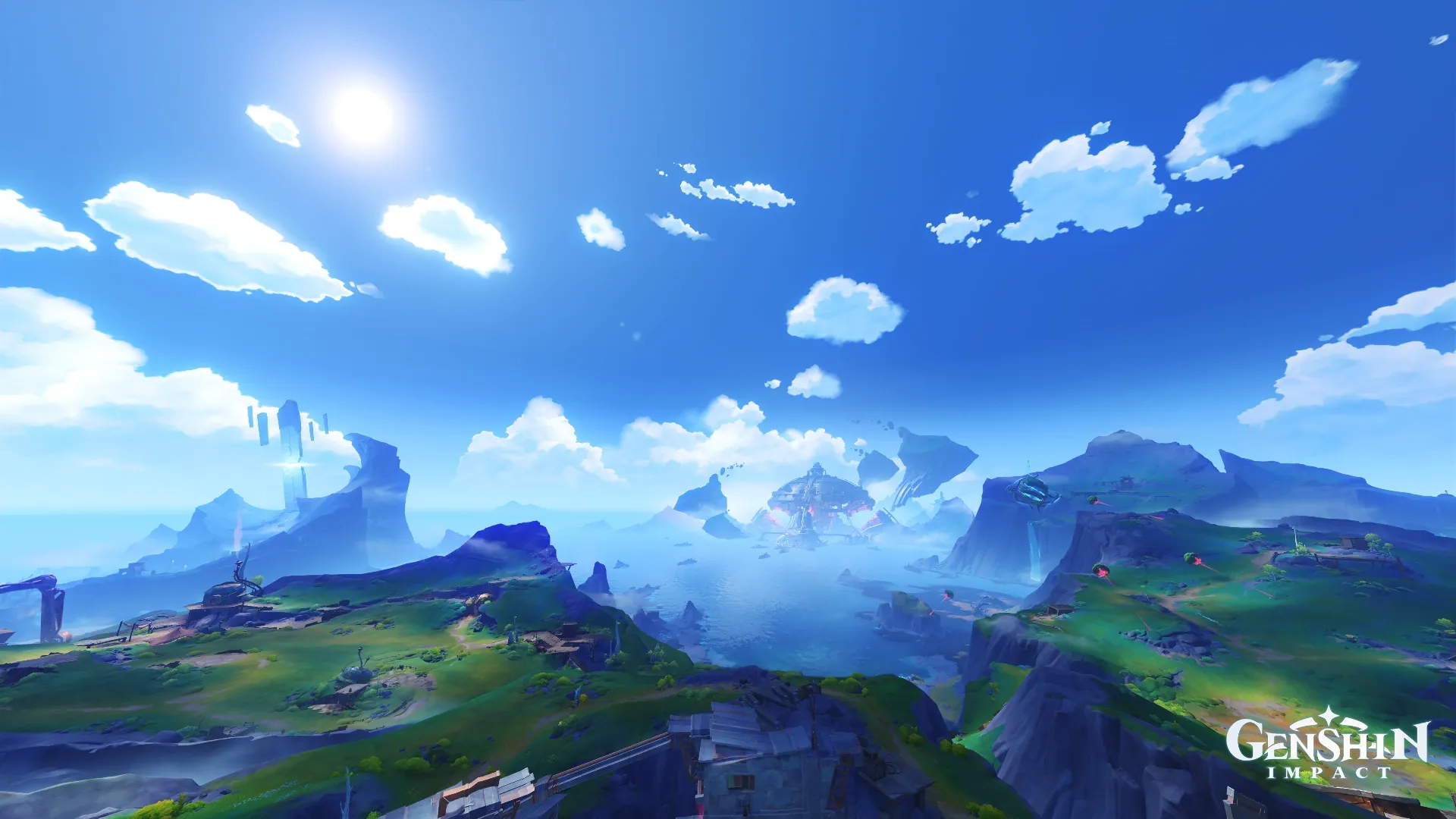
Nephilheim is the pre-Snezhnayan name of the region now known as Nod-Krai; Fandom dates it to the time of Natlantea. [1] The name still turns up in two present-day voices: the intelligence reports of the faction aligned with Natlan's Sovereign (the leaked Source Servant report that forms Ineffa's "Moon Wheel" character story), and the Mictlan supplicant Kofitse's in-game dialogue (where he calls them "the outlander warriors of Nephilheim/Nod-Krai"). Neither the Frostmoon Scions' hymnbook nor the Welkin Moon Archon Quest uses the name, and no in-game text says a fourth moon was attempted; the "failed-fourth-moon" reading is the community's. [2] [3] In everyday Snezhnayan use the region is "Nod-Krai," "the borderlands," or "an Elysium," but the older name, the one those two sources use, is Nephilheim.
Cosmological origin
The framing in the rest of this section (Nephilheim as the remnant of a failed fourth moon attempted after the original Three Moons fell, with the crater of that failure persisting as the Nod-Krai region) is an interpretive layer: community interpretation, not in-game primary text. This page flags it as such against the cleaner framing from the Hyperborean ruins murals in Welkin Moon Act VI, which the Three Moons, the failed fourth essay's "The missing fourth - what canon does and does not say" section and the Welkin Moon arc synthesis essay's "What we don't know - Act X and the open threads" section settled on. [9] [10] Per the Welkin Moon Act VI mural exposition (per Welkin Moon Act VI, Where Does Her Name Rest?) and the cross-referenced Three Moons page the deep-dives synthesise, Nibelung raised the original Three Moons themselves from Teyvat's planetary crust at modern-day Nod-Krai using Secret Source technology, before his journey into the Sea of Stars. He weaponised them in his war with the Heavenly Principles, and the goddesses eventually died. One moon (the Frost Moon) survived the shattering, which is the reason Columbina could be born at all. [7] Under that primary-text framing, Nod-Krai's anomalous status has two anchors, and neither needs a fourth moon. The region is the geological origin point the original Three Moons were lifted from before they were placed into the night sky. It is also (per the Lunar Palace disclosure in Welkin Moon Act VIII Part 1, The First Sliver of Moonlight) the site Columbina's discarded body was poured back into as kuuvahki when she split her body, soul, and Trilunar Authority three ways to escape Nibelung's lunar prison. [8] The failed-fourth-moon reading is still useful as the interpretive frame this page carries. It explains why the moon gates work as cosmological portals rather than geological features, why the dual etymology of Nephilheim (Norse Niflheim and Biblical Nephilim) carries the fallen / anomalous sense the Etymology section reads on, and why some readers hear in the Frostmoon Scions' oral history an echo of a fourth moon being attempted. It is kept here in that interpretive spirit, flagged as community interpretation rather than in-game text.
Within that interpretive frame, Nephilheim is the crater of a failed fourth moon. Per the cosmology laid out on the Three Moons page, Teyvat's pre-Cataclysm sky once held three moons, created by the Dragon King Nibelung before his journey into the Sea of Stars, governing Teyvat in his absence and running on the pre-elemental energy the present day calls kuuvahki. [6] On that reading, when the three moons fell, whether destroyed, sealed, or removed in a cosmological transition that released material has not directly shown, someone attempted to bring a fourth moon into being to keep the moons-era order running. The attempt failed, and the crater of that failure, its energy, its cosmology, and what it passed on, persists in northern Teyvat as the region called Nephilheim. [4] No in-game text says a fourth moon was attempted.
Two things make Nephilheim anomalous in present-day Teyvat, ordered as it is by the Heavenly Principles:
- Kuuvahki saturation. The pre-elemental energy persists in Nephilheim in concentrations not seen anywhere else in Teyvat. The cause is twofold: (i) in the era of Nibelung's three moons, kuuvahki was strongest where the Frost Moon's gravity concentrated it (per Kuuvahki); (ii) Columbina's discarded body was poured across the region in the past, so the kuuvahki saturation is literally her body spread across the land. Both effects compound at Nephilheim, the strongest concentration of pre-elemental energy on the whole continent.
- The Wild Hunt. It began at a moon gate: Rerir tried to enter one to find his lost lover Tholindis and was torn into pieces scattered all over Nod-Krai, and "these pieces are what brought the monsters of the Wild Hunt into existence." Kipumaki Cliff in the north is a separate hotspot, where the Scourge of Endless Decay was sealed 500 years ago and where the Hunt "was caused by Rotwang and his disciples" (The Last Night, the First Light ends him). Sending Rerir through a moon gate in Echoes of Fate (Act IV) did not dissolve the Hunt; the Abyss made an imitation of Roland to lead it. [20] [21] [22] [23] On the community reading, the Hunt is also tied to Nephilheim's status as the remnant of a failed cosmological body.
The Moon Wheels: Nephilheim's ritual infrastructure
Much of what we know about Nephilheim's cosmology comes through an unlikely source: an intelligence report by a Source Servant aligned with Natlan's Sovereign, which appears in Ineffa's character story at Friendship Level 6 (unlocked after The Journey Home). [2] The report's author, CL-08 Ix Ajkotz'i'j Iq'ismal Waxak Ch'ule-L, is investigating a "suspicious sample" recovered from "the detritus of the humans who instigated unrest at Ek' Pulinik." The sample is a Vision; the report compares it to the ritual items at Nephilheim:
"...The Source Servant sent has retrieved the suspicious sample from the detritus of the humans who instigated unrest at Ek' Pulinik. According to the local subjects, the sample is referred to as a 'Vision' by merchants from beyond Natlantea... >...I briefly discussed its operating principles with the Third Lord. She put forth an intriguing hypothesis - that this sample may be in some way related to the ritual items at Nephilheim... >...Through certain means, I managed to acquire a working 'Moon Wheel' (one of Nephilheim's ritual items - or, to be more accurate, a plaything given by the traitors to their human followers, allowing them to communicate)... Much like the wisdom conferred by our Sovereign, the Moon Wheel relies on a purer form of power, and not elemental energy, tainted as it is by the usurper..."
Three viewpoints stack in this single passage:
- "The traitors" are the Three Moons: Natlan's Sovereign side regards them as having betrayed the order that came before the Three Moons (per the Natlanteca Sovereign Ruler's inheritance from Xiuhcoatl's era, per the broader Natlan arc).
- "The usurper" is the Heavenly Principles: Natlan's Sovereign side regards the present-day order as illegitimate.
- "Our Sovereign" is the Natlanteca Sovereign Ruler (Xiuhcoatl / Ix Uxul Tz'ib Bolon Ch'ule-L, the pre-Archon Sovereign authority recognised in the kuuvahki engraving at the Court of the First Edict, per the Polkka Beneath the Moon's Oracle capstone).
The Moon Wheels, the Vision-like ritual items carried by present-day Nod-Krai inhabitants (Flins, Lauma, and Ineffa among the playable cast), are:
- created by the Heavenly Principles and the moon goddesses (per the Moon Wheel page's framing: "originally items created by the Heavenly Principles and the moon goddesses Aria, Sonnet and Canon"); [5]
- given by the Three Moons ("the traitors") to their human followers as a way to communicate during moons-era rituals;
- powered by a "purer form of power," kuuvahki, rather than the seven-element energy Visions run on (per the same source); [2]
- formed from "the stuff of the soul" in the same family as Visions (per CL-08's working theory).
Nephilheim's ritual items are therefore a moons-era layer that survived the fall of its parent moons. The Moon Wheels are gifts the moons sent into their followers' hands before the fall, and the Frostmoon Scions' faith, the Lightkeepers' Tideseal Stone engineering, the Moon Mirrors (an exploration mechanic across Nod-Krai, worked with kuuvahki; in Blessings of the Frost Moon Lauma speaks of "the seal created with the Moon Mirror by a previous Moonchanter") [15] [16], and the Court of the First Edict itself (per Polkka Beneath the Moon's Oracle) all continue that tradition after the moons fell. Nephilheim is a regional remnant, and also a living inheritance from the era before the Heavenly Principles.
Present-day inhabitants and institutional continuity
In present-day Snezhnayan terms, Nephilheim's inheritors split into three groups (per Nod-Krai, "Factions"):
- The Frostmoon Scions: the indigenous pre-Snezhnayan population, descended from the original human followers of the Three Moons era, preserving the moons-era oral history in their lyrist tradition and their hymnbook, Hymns of the Far North. [17] The office of Moonchanter (held in the present day by Lauma, in the pre-Cataclysm period by Aila, per Polkka Beneath the Moon's Oracle) descends directly from the ritual leadership of the Three Moons era.
- The Lightkeepers: the defensive order Solovei, the first Torchforger, founded shortly after the Cataclysm, with Aila's help, to defend Nod-Krai against the Wild Hunt. [18] [19] The order is far newer than the Frostmoon Scions (500 years versus millennia) but runs on the same pre-elemental kuuvahki; Tideseal Stones, Oath Lanterns, and Verdant Crest sealing arrays (per Nightingale's Song Chapter II) are all kuuvahki-powered devices.
- The Snezhnayan administration: the most recent inheritor. Snezhnaya formally annexed Nod-Krai as an autonomous region after the Cataclysm. The Armory Palace research effort (per Colors of Emptiness, the Karnatsky / Preobrazhensky team) is Snezhnaya's attempt to harness Nephilheim's kuuvahki through moon-shard research, and the term "kuuvahki" itself was coined by Snezhnograd academics and replaced the Frostmoon Scions' devotional word.
The recent infiltration by the faction aligned with Natlan's Sovereign, revealed through Kofitse's dialogue and the CL-08 Source Servant report, is the fourth voice now active in Nephilheim. [3] Kofitse openly identifies himself as "Kofitse of Mictlan/Masters of the Night-Wind, supplicant of the Wayob" and as having been sent by the Wayob "to show the outlander warriors of Nephilheim/Nod-Krai the way." The Mictlan faction treats Nephilheim as a site from an earlier cosmological era worth their attention; the Wayob's interest in the remains of the Three Moons era is itself an open thread of the Luna arc.
Etymology
The name "Nephilheim" may carry a dual etymology: [1]
- Niflheim, the Norse primordial realm of ice and cold. The phonetic similarity is close, and the cosmological resonance is direct (Nod-Krai's northern snowfields, the Frost Moon as the only intact moon, the idea of kuuvahki as moon power).
- Nephilim, the Biblical group of mysterious powerful beings (variously interpreted as giants, descendants of Seth and Cain, the offspring of angels and humans, etc.). The resonance is to the fallen / anomalous sense: the Nephilim are the fallen or anomalous group in their tradition, as Nephilheim is, on the community reading, the remnant of a failed fourth moon.
The dual etymology is unusually legible: Niflheim points to "frozen primordial realm," Nephilim to "fallen / anomalous group." Both readings fit the in-game material, and both may be present in the name.
The present-day Nod-Krai name may likewise be a Snezhnayan coinage: Nod (per the Biblical Land of Nod, the place to which Cain was exiled after killing his brother Abel) plus Krai (Russian край, "edge," "border," "country," "region"; the standard Russian-administrative suffix). The renaming lays an echo of exile and borderland over the community's reading of Nephilheim as the remnant of a failed fourth moon.
The Three Moon Goddesses, named at last
The Three Moon Goddesses (Pre-Archon Cosmology), the framework Nephilheim anchors at the regional level, was completed when all three were named at the Lunar Palace audience in Welkin Moon Act VIII Part 1, The First Sliver of Moonlight, cross-referenced through Columbina, the Three Moons, the failed fourth deep-dive, and the Welkin Moon arc synthesis deep-dive. [8] [11] The three sisters Nibelung raised over Teyvat, per the mural exposition in the Hyperborean ruins (Act VI) and the disclosure at the Lunar Palace audience, are: [7]
- Sonnet, the Iridescent Moon Goddess; the youngest of the three. She opposed the arrival of the Heavenly Principles, and when the Iridescent Moon shattered she fused her soul with Abyssal power and became the Crimson Moon behind the Crimson Moon Dynasty. The Iridescent Moon Marrow was returned to Arlecchino (a distant Crimson Moon Dynasty descendant) at the close of Welkin Moon Act VIII.
- Canon, the Frost Moon Goddess; the only sister whose moon survived the war of funerary flame intact (flung beyond the false sky by the Heavenly Principles, devoid of life). She guided the survivors of Hyperborea to Hiisi Island before dying from Teyvat's constant rejection. The "You have the same power as Canon" line is what grounds Columbina's succession, as Kuutar, in the Frost Moon Goddess line. In Act II Columbina says that while the Frost Moon's goddess died, "her moon was never broken" and "would birth a new deity sooner or later." Huurrekuutar is the Frostmoon Scions' name for Canon herself, so the line runs from Canon (Huurrekuutar) to Kuutar = Columbina, per the Frostmoon Scions page. [12] [13] [14]
- Aria, the Eternal Moon Goddess; the largest of the three (the Eternal Moon's moonlight formed Teyvat's ocean tides). The Moon Marrow the Moon Wheels section references is Aria's remains, per Welkin Moon Act II and Act VIII, and the Eternal Moon Marrow was returned to Lauma (the present-day Moonchanter of the Frostmoon Scions) at the close of Welkin Moon Act VIII.
The closing events supply the deeper mechanism behind Nephilheim's kuuvahki saturation, which is Columbina's discarded body spread across Nod-Krai's past. At Columbina's Lunar Palace audience, the sisters transferred the Trilunar Authority at the cost of becoming mortal, and Columbina split into body, soul, and Trilunar Authority to escape the prison in the moon's reflection. [8] The earlier framing behind the Cosmological origin section's kuuvahki saturation point, "Columbina's discarded body was distributed across the region in the past," is resolved by the Lunar Palace audience in Welkin Moon Act VIII. Columbina poured her body into Nod-Krai of the past as kuuvahki, anchored her soul to her Luonnotar in the moon's reflection, and hid her Trilunar Authority within the Frost Moon. She was reconstituted in the Descending Moon event after Welkin Moon Act VIII, when Arlecchino, Varka, and Nicole pulled the Frost Moon into Teyvat. The Three Moons the Natlan Source Servant report names as "the traitors" are Sonnet, Canon, and Aria; naming all three resolves the identity of the first of the report's three groups. [11] [9]
For the deep-dive that walks through the sisters' creation, the war of funerary flame, the three deaths, the Trilune Goddess's restoration, and the analysis of the reading of Nephilheim as the remnant of a failed fourth moon, which this page flags as interpretive, see Three Moons, the failed fourth. [9] For the deep-dive that reads the Prelude and Acts I–IX of Song of the Welkin Moon as a single ten-beat story, weaving the framework's resolution together with the strands about the Wild Hunt's mastermind and about the Outlander and Sibling before Teyvat, see Welkin Moon arc synthesis. [10] For an overview of the Trilune Goddess and her residence at Silvermoon Hall after the Welkin Moon arc, see Columbina. [11]
Related pages
The broader cosmology runs through The Three Moons, with Kuuvahki for the lunar energy that anchors Nephilheim's anomalous status and Heavenly Principles for the order the Natlan Source Servant report names "the usurper." The cleaner Welkin Moon Act VI mural framing, where Nibelung raises the Three Moons from Teyvat's planetary crust at modern-day Nod-Krai, is at Melting Moonlight in the Morning Mist. The present-day Snezhnayan name for the region is at Nod-Krai, and Rotwang's northern Wild Hunt at The Last Night, the First Light. The Frostmoon Scions' devotional tradition survives through Polkka Beneath the Moon's Oracle, Blessings of the Frost Moon, and Lauma; the Snezhnayan moon-shard research at Colors of Emptiness; the Lightkeeper counter-operations at Lightkeepers' Oath and Nightingale's Song; and the Cataclysm the annexation followed at The Cataclysm.