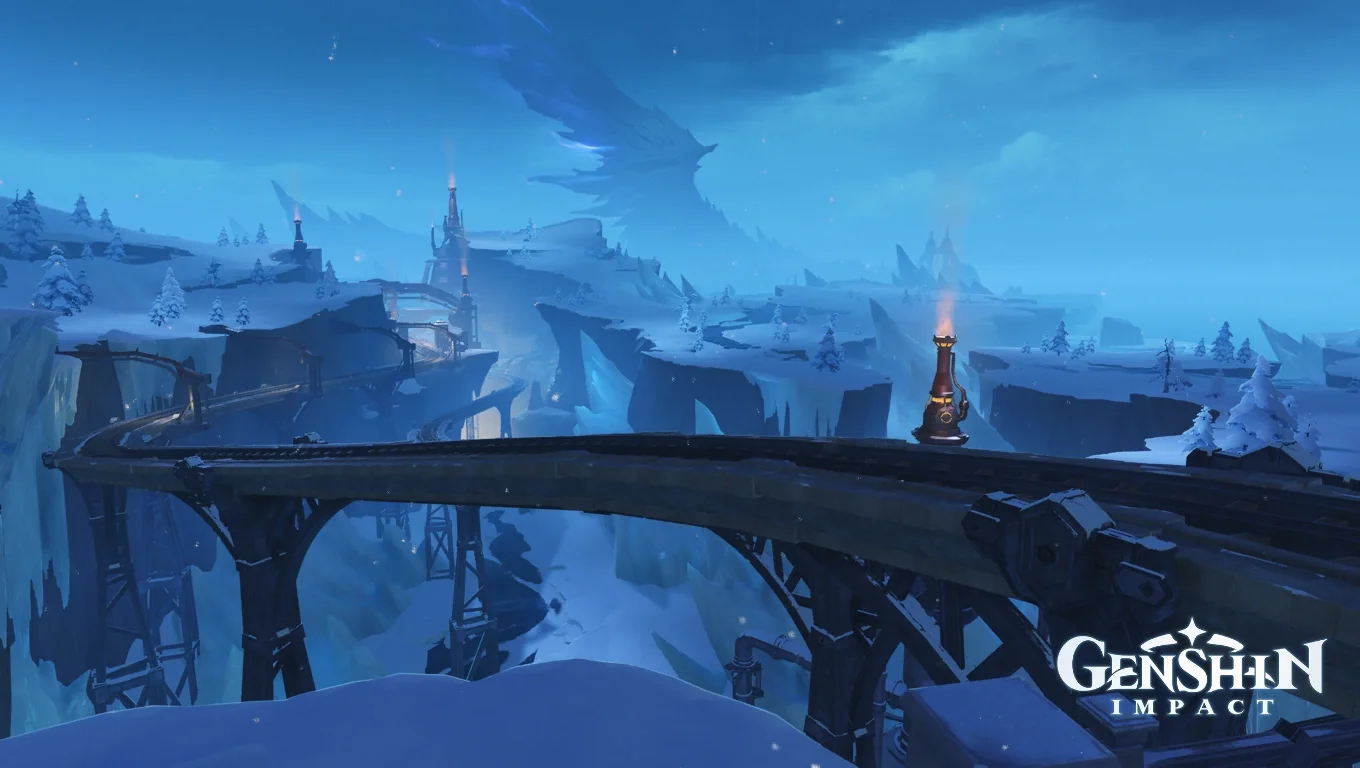
Snezhnaya's largest mining city, built in a gorge and joined to the national railway by a vertical rail hub, where the nation's Kresnik Kristall is mined and refined. The Domovoy Grand Duke Alvis built it after Old Kitezhgrad fell to the Abyss five hundred years ago, and it hosts the headquarters of the Snezhnaya Royal Railway Transport Bureau. In Version 7.2, after Alvis's death, the city loses his daughter Thrud, passes to the Tsaritsa's commissioner Glinin, and sees its Transport Bureau director exposed and arrested.
A city below the railway
The city lies at the bottom of a gorge, below the level of the national railway. Its downtown description says the Domovoy Grand Duke Alvis "built this city beneath the rift," and a notebook given to the Traveler calls it "a cozy underground mining city where many fae reside." Trains come down to it through the Central Hub: "A massive hub for vertical rail transport. Countless Domovoy craftsmen devoted their ingenuity to its final design, allowing Novokitezhgrad's railways to connect with the wider rail network spanning Snezhnaya." The hub's viewpoint adds, "To bridge the sheer vertical divide between Snezhnaya's railways and Novokitezhgrad, a wondrous steel behemoth was forged from molten iron amid plumes of soot." On the Traveler's first visit, in Fandom's transcript of To the Kristall City, the train rolls onto a turntable at the hub, which carries it down to the lower level. [2] [11] [3] [4] [5] [6]
The line from the capital runs through Byaroza Station, "A transition station between Snezhnograd and Novokitezhgrad." Its navigation text says it was built "to prevent maintenance difficulties caused by an excessively long stretch of track" and has mattered less since the railways proved sturdier than expected. [7]
Newcomers have to register. "If you wish to enter the urban zone, you must first register at the headquarters of the Snezhnaya Royal Railway Transport Bureau," the Eye of Graeae tells the Traveler, and Paimon finds it odd that nowhere else in Snezhnaya has asked. The Eye adds that the late Grand Duke, the city's ruler until recently, "was responsible for the implementation of stricter public security laws in the region." Glinin, a surveyor from Zapolyarny Palace, is visiting for the first time himself, and when the Traveler asks how a Snezhnayan can never have been, he says, "It's actually the norm. Some people even live their entire lives on a single street, you know." [36]
Places the dialogue names include the Grand Duke's residence, where the miners stage a protest; a market street; a restaurant called The Cellar Forge; and "the lower region of Novokitezhgrad," where Danica corners a suspect. On Fandom's map the name covers a wider area. Besides Downtown Novokitezhgrad it takes in the Central Hub, Byaroza Station, the Transport Bureau's headquarters, the Crystal-Tree Grotto and Port Belovodye, the ice-free port where Act V finds Snezhnaya's Nail of Retribution and where a con man runs a rigged game in Better a Finch in the Hand. [36] [43] [41] [44] [9] [2] [4] [7] [18] [31] [10] [3] [50] [68] [42]
The ground is never quite still. When a tremor startles the newcomers, Koshkin, once a foreman in the mines, calls it "Kristall growth": the mines have never run dry because "the underground veins are still expanding to this day," and the tremors have gone on "for centuries." Under the streets an underground river feeds a waterfall whose water, to Paimon, "looked like it was glowing faintly." Its source is at Teplo Oasis. When a quake dams it, Glinin warns that the trapped water could burst out as a flash flood, and "half of Novokitezhgrad could be swept away..." [36]
Kristall and the people who dig it
The Eye of Graeae calls Novokitezhgrad "the main production site of Kresnik Kristall, which is a very important resource throughout Snezhnaya," and to Paimon it is "Snezhnaya's biggest source of Kresnik Kristall!" The loading screen describes the trade: "Vast quantities of Kresnik Kristall, vital to keeping Snezhnaya running, are mined and refined here before being shipped by rail across the nation." The downtown viewpoint has the refined crystal flowing "from this heartland across the whole of Snezhnaya, pumped throughout the realm like its very lifeblood," and at the far end of the line Yelagina, who keeps the log at the central Kresnik's Torch in Snezhnograd, says, "The ore is brought in by rail from Novokitezhgrad." Where the crystal comes from is less clear. "To this day, we don't know how it forms," Glinin admits, though its veins "begin at Old Kitezhgrad and run west through nearly two-thirds of Snezhnaya," through Teplo Oasis and Novokitezhgrad to Snezhnograd. [36] [3] [12] [13] [37]
Only Domovoy work the mines. "There are only Domovoy down there. No humans," says Pyatkin, the mine's supervisor, though he concedes that "when it comes to operating machinery or any fine finger work needed, humans are far more reliable than Domovoy." The rule is a custom. In his words, "everyone reckons Kresnik Kristall mining ought to stay in Domovoy hands." The viewpoint at the mines shows the same scene: "Here, countless industrious Domovoy toil without pause, their Prime Ice picks striking unceasingly through day and night." Fandom's map files the Kresnik Kristall Mines under Wingspan Peak rather than under the city. In Curious Lights a Domovoy named Gudi hears "that someone in Novokitezhgrad was taking advantage of the chaos to steal crystals from mine carts and resell them for a profit." He reads a flashing lamp as a coded message about "that special minecart train running between Novokitezhgrad and the Small Oasis," the stolen crystals turn up, and the Traveler reports them to "investigators from the Snezhnaya Royal Railway Transport Bureau." [37] [14] [15] [40]
A larger share of the city is fae than of the capital. "In contrast to Snezhnograd, which hosts a majority population of humans, Novokitezhgrad is home to a greater fraction of fae," its navigation text says, and Pulcinella, whom Danica calls "the leader of the Domovoy," tells the Tsaritsa in Life on the Platform that "Most Domovoy reside in Novokitezhgrad." Netochka noticed their absence in Nod-Krai: "I thought there would be plenty of fae living in other places too, like back home. Even Snezhnograd has its fair share of them." Few Snowland Fae are left in Nod-Krai, the Lightkeeper Flins among them, and most of his kind live in Novokitezhgrad, Snezhnograd and elsewhere in Snezhnaya. In the series finale Paimon says the city belongs to "every human, Volkodlak, Domovoy, Vila, and all the countless other fae who call the city home." [1] [45] [48] [16] [71] [72] [39] [73]
Fae manners are still argued over. In Winner Takes All an old fae, Asmud, refuses to give way to a young one, Fastvica, on a bridge, asking, "If we forsake the virtues of old, what separates us from the short-lived humans?" Fastvica disagrees: "Whoever steps onto the bridge first, crosses first. And whoever makes the most sense, their words carry weight. That's how things work in Novokitezhgrad now." They settle it with rock-paper-scissors, which Asmud insists is nothing new: "We were using it to settle arguments in Novokitezhgrad back when I was just a boy!" The title "King of Rock-Paper-Scissors" of Novokitezhgrad, offered to a Jack Frost, ends up with the Traveler. [41]
The city is also known for its drink. "We're known for our liquor industry as much as our mining industry," Netochka says. A merchant in Mondstadt's Dornman Port sells Fire-Water "all crafted by the fae in Novokitezhgrad," and Glinin, trying "Novokitezhgrad Fire-Water" for himself, finds that "even the smell of it stings the nose." The Urkin winery at Teplo Oasis "also supplies taverns in Novokitezhgrad." In Dark Clouds in a Wine Bottle Mitya and Valeriy follow counterfeits of its Snowy Nocturne through the city's distributors to a hidden distillery outside town, from which the gang sent its crates "through the mine tunnels to a hidden exit in Novokitezhgrad." [16] [17] [36] [43] [45]
The Grand Duke's city
Until recently Alvis was "the de facto ruler here," in the Eye of Graeae's words, and he held the city by imperial grant. An edict of the Tsaritsa, one of the papers left in the Palace of Glacial Reflections, records that when "the princes of old plunged the realm into bloody rebellion," Alvis "unhesitatingly pledged his undivided allegiance" to her. He gave up "the authority over the mines he had wielded for so many years" and handed over "the locomotive technology hitherto kept in deepest secrecy." In return she made him and his heirs hereditary Grand Dukes, confirmed "his seigniorial rights over the cities of Novokitezhgrad and Old Kitezhgrad," and granted him "a permanent seat upon the Snezhnograd Veche." The edict is dated "in the third year of the Old Calendar's eight-hundredth cycle, and the tenth of Her Imperial Majesty's reign." [36] [51] [27]
His court kept its own guard. "Here in Novokitezhgrad, the guard is to the Grand Duke's court what the Druzhna is to Her Majesty," as Koshkin puts it. After Alvis dies, the miners object to the decrees coming "out of the Grand Duke's Estate." The guard's captain, the Vila Sadunova, has placed "the entire city under lockdown," in Koshkin's words, and raised the Kresnik Kristall quotas, so the miners march on the Grand Duke's residence, where she threatens to "throw you all behind bars!" Pyatkin insists they were "protesting so we could work under better conditions." Alvis's daughter Thrud steps in with a promise: "From now on, I will bear the weight that is mine to carry." [36] [67]
The rest of An Ancient Song of Flowing Crystal and Stone Chests turns the protest into a disaster. Two earthquakes bury the mines and dam the river, Sadunova is caught growing Blightkristall inside the Shadow Realm and carries Thrud off, and the trail leads to Old Kitezhgrad and into the mountain behind it. There Paimon finds the Grand Duke's body: "Grand Duke Alvis... There's a deep wound in his chest." Thrud turns out to be the gentler self of The Shimmering One, which says that Alvis "created me from his own flesh" and that "She and I killed Alvis together," meaning Aksinya. Thrud dies when it is defeated. [67] [36] [37] [38] [39]
The man left in charge is Glinin, the Volkodlak who arrived as "a minor official" on a hydrological survey and turns out to be "an Imperial Commissioner specially appointed by Her Majesty the Tsaritsa," with authority "to assume control of Novokitezhgrad's affairs in an emergency." At the end he will be "overseeing all affairs here" until the Tsaritsa "appoints a permanent governor," and Koshkin observes that he is "practically holding the real power here now." What the city learns about Thrud is the player's choice. Glinin either breaks the truth "as gently as possible" once rebuilding is under way, or reports the full facts to Zapolyarny Palace and leaves another explanation on record, so that "To the people here, Thrud will forever remain... the daughter of the Domovoy Grand Duke." [36] [37] [39]
The city has its own court. Case files kept at the Transport Bureau's headquarters close "pursuant to the judgment handed down by the Court of Novokitezhgrad," and one concerns a former prima donna of "the Novokitezhgrad Theater," who fell from the platform at the city's station under an incoming train. In Dark Clouds in a Wine Bottle "the local wealthy merchant" Denngiyev holds a charity gala, to which Vodyanitsa and Odette are invited "in our capacity as onstage partners," and Pulcinella attends "to discuss a few administrative matters," among them "Mining collaborations and public affairs management." [59] [60] [19] [43]
The Royal Railway Transport Bureau
The Snezhnaya Royal Railway Transport Bureau, whose staff run the nation's trains, has its headquarters here rather than in the capital. Its navigation text gives the reason: "Why was the Snezhnaya Royal Railway Transport Bureau not built in Snezhnograd, but rather in Novokitezhgrad? This is because the Bureau's original purpose was to ensure the safety of Kresnik Kristall shipments to Snezhnograd." The same text calls the building "The headquarters of the Chicota," a name Fandom also records for the Bureau. In Act V, Pantalone reminds the Traveler that "the railroad design is such that trains often stop at the Transport Bureau headquarters to restock," and Fandom's steps for Like Melting Snow route the journey to Port Belovodye through Novokitezhgrad and the headquarters. [59] [18] [20] [50] [21] [68]
The Bureau was set up once the railway was finished. Foundryman's Magnanimity, an artifact text from Version 7.0, says that "After the railway across the frozen plains was completed, preparations began for the organization that would oversee its operation." Alvis "believed only a fae of noble birth could bear such responsibility," but his fellow Domovoy and rival Izmaylov, President of the Royal Energy Commission, "had already learned the Tsaritsa's wishes. Every name on his list of nominees belonged to a human." Alvis "relinquished his right to recommend the Director of the Transport Bureau," expecting Izmaylov to fail against the rebels called the Burner of Cities, who "used the railway to roam the frozen plains like a shadow," so that he could step in himself. Instead Izmaylov "forged weapons for the heroes of Luchkins," and together they crushed the rising. A case file kept at the headquarters seems to record the same rising from the Bureau's side. Fae rebels hijack "a train carrying crystal ore from Novokitezhgrad to various towns across Snezhnaya" to blow up the Kresnik's Torch in Snezhnograd, and Eprokin, "then Director of the Transport Bureau," stops it. Their leader, Natalia von Ostenwined-Cirnareka, the Burner of Cities, goes missing; witnesses believe she and a volunteer leapt into the Torch together, and a longsword found nearby was "crafted by President Izmaylov of the Royal Energy Commission." [65] [62] [19]
Its reach has grown since. "For various reasons, the scope of the Transport Bureau's authority has been expanded several times throughout its history," Danica explains. "Amongst other things, they are now responsible for maintaining public order in the city." And: "...But excessive power often breeds greater ambition." Two of its officers claim the right to close roads "In special situations," and its detectives once worked with the ducal guard on a case against Koshkin's human friend, built, as Pyatkin tells it, on evidence of "the type that the young human himself knew nothing about." [44] [43] [37]
One former Director is Netochka's father. In Nod-Krai a Fatui officer calls her "Police Chief Stalanov's daughter"; in Version 7.2 a retired Director named Staranov says his daughter is "Netochka Staranov," and Paimon replies that she is "one of our companions in Nod-Krai!" No line explains the different spelling. Since the Bureau keeps order in the city, the two titles may name one post, but nothing says so. Two of the case files at the headquarters are signed "N. A. Staranov," and neither says whether that is him. [69] [16] [45] [43] [59] [61]
"Back when I was in charge, Novokitezhgrad's problems were manageable," Staranov says. "But ever since he took over... little things have been piling up." The current Director, Drogin, is "held in very high regard in Novokitezhgrad," yet, Danica says, "Zapolyarny Palace suspects Drogin of colluding with local gangs and using his position to cover up their crimes." In Beneath Dust and Snow she goes through the Bureau's archives with the Traveler's help and exposes him as the killer of Sokov, a middleman whose death had been staged as a drunken fall. Cornered in "the lower region of Novokitezhgrad," Drogin escapes into the Shadow Realm through a hidden Shadow Realm Generator. Dark Clouds in a Wine Bottle, with Mitya, Valeriy and Staranov, uncovers the bootleggers he shielded, and Beasts in a Cage ends with "Transport Bureau Director Drogin under arrest." The gangs behind the trade, Danica says, "were originally formed by both Domovoy and humans," and Pulcinella tells Pantalone that "Supporting the gangs was necessary once, given the circumstances of that era. But that time has passed." Danica stays on at the Bureau: "If I am to manage this palace on Her Majesty's behalf and understand where the dust comes from... I must naturally begin with the smallest room." [43] [44] [45] [46]
How the new city began
Novokitezhgrad was built after Old Kitezhgrad fell. "They say that after Old Kitezhgrad was struck by the calamity unleashed by Chernabog five hundred years ago, it only took Grand Duke Alvis a little over a decade to establish this new city...," Glinin says, passing on what people say. Chernabog, in Thrud's words, "is another name for the Abyss." The downtown description agrees: "Five hundred years ago, after the Old Kitezhgrad was destroyed by the dark tide, Alvis, Grand Duke of the Domovoy, built this city beneath the rift." Koshkin will not give the duke the credit. "Sure, he drew up the plans, but the fae and the humans here built this city." [36] [2]
Texts from Version 7.0 give Alvis's reasons. His notes in the ruins of Hvergelmir, written after "His Majesty's passing," treat "The destruction of Kitezhgrad" as "a perfect opportunity to avoid the cleansing directed at [...]" (the text breaks off there) and set out a plan: "Snezhnaya shall need a new Kitezhgrad, and that shall be my great work. Once accomplished, even the one on the new throne shall have no choice but to acknowledge me." They also look ahead to a day when "once Novokitezhgrad has been established, we can move Hvergelmir to that new city in secret," and no source says whether he did. The artifact text Foundryman's Calculus tells the same years from Izmaylov's side. While Alvis was taken up with the new city, Izmaylov won an audience with the Tsaritsa, so that "when Grand Duke Alvis returned from Novokitezhgrad, he discovered that the Energy Commission already had a new master." Izmaylov tells his rival that "Her Majesty the Tsaritsa has been merciless toward the faes who once held true power in the old court," and "That is why you needed the construction of Novokitezhgrad to serve as the cornerstone of your standing in the new regime." [53] [22] [65] [1]
Koshkin gives another figure: a road near the station "has barely changed in the 400 years since the central hub of Novokitezhgrad was built." That fits the decade-long building story only if the hub came later, and no line says when it did. The edict from the tenth year of the Tsaritsa's reign already speaks of "the cities of Novokitezhgrad and Old Kitezhgrad." Alvis had plans beyond the city, too. "After the Oasis development project," Pyatkin says, he "had meant to keep extending the railway toward Old Kitezhgrad and then to the north of the tundra," but the conditions were too harsh and the track was abandoned. [36] [51] [37]
Old Kitezhgrad
Old Kitezhgrad is "the dead city at Snezhnaya's easternmost edge." Glinin calls it the place where "His Majesty the Belyi Tsar raised his army for his westward march," and what let the Tsar "amass the resources to dominate all the frozen lands," Koshkin adds, was "Old Kitezhgrad's mining industry." Its loading screen reads, "An ancient fairy city once ravaged by the Abyss and the black crystal calamity. Today, it stands completely abandoned." On Fandom's map it is a subarea of Wingspan Peak. [37] [3] [23]
The city died in the war with the Abyss. "Old Kitezhgrad was the main battlefield against the Abyssal corruption at the time," Glinin reads in the records, "and it was almost entirely overrun by the speed of the Blightkristall eruption." When the Abyss "invaded the Ley Lines, the entire city was swallowed by Blightkristall," the corrupted form of Kresnik Kristall. The crystal later withdrew; the viewpoint over the ruins says that "The Kristall-Blight that once swallowed this land has since ebbed away, leaving behind an empty city to endure centuries of solitude." Nobody went back to live there. As Pyatkin says of Alvis's abandoned railway, "hardly anyone would need to travel to a dead city with nobody left in it..." [36] [37] [24]
In Version 7.2 the ruins are swallowed again. "It's not just Old Kitezhgrad...," Paimon realizes at the start of Chapter III, when she sees that the whole mountain lies inside the Shadow Realm, where Kresnik Kristall has been turning into Blightkristall "for quite a while." Koshkin later hears that "Old Kitezhgrad and the entire mountain were covered with them." The Shimmering One, the series' crystal being, scolds Sadunova there: "You allowed humans to trespass upon Kitezhgrad." The update notes add that finishing the series makes the Shadow Realm area east of Wingspan Peak recede. [38] [39] [35]
Older texts usually call the city just Kitezhgrad. Ovations That Ceased Upon Festivity, from the Disenchantment in Deep Shadow artifact set, remembers Alvis as "the great lord of Kitezhgrad who had monopolized the city's mining industry since its founding." Foundryman's Conjecture, in the Version 7.0 set Heart of the Furnace, follows the young Izmaylov, "born in Kitezhgrad," as he leaves "the snowbound old capital" and looks "back toward his hometown beneath the winged peaks," and Foundryman's Calculus recalls "Kitezhgrad's destruction by the dark tide." Snezhnaya's histories credit Monomakh with founding it. General History of Snezhnaya (I) has him wander "the blizzard-swept lands for hundreds of years" before "the founding of Kitezhgrad," and General History of Snezhnaya (II) dates one legend to the time "before Tsar Monomakh founded Kitezhgrad." The Version 7.2 Supplement (II) notes that by the time "the young Emperor Monomakh raised the city of Kitezhgrad beneath the Pale Star," the Volkodlak alliance against him was united only in appearance. Supplement (III) calls him "Monomakh Snezhnyi of Kitezh," and in Supplement (I) a Volkodlak chieftain who went over to his court "labored alongside Grand Duke Alvis to sustain commerce, mining, and the apportionment of tribute made to Kitezh." [66] [65] [54] [55] [57] [58] [56]
A Brief History of the Pale Starborn says that "Kitezh was the first city in all of Snezhnaya," an imperial capital that remained "the center of power over the frozen lands" until the Emperor moved "his seat to Snezhnograd." It also tells how, after defeating King Miscislav at Kitezh, "he named himself the Belyi Tsar." The Tsaritsa still styles herself "Grand Suzerain of the Princes of Snezhnograd, Glupov, Kitezh, and Belovodye." Read together, these texts point to Old Kitezhgrad being the Kitezh of the histories, Monomakh's first capital, and a Snezhnograd bookseller, Moes, even calls the ruined city "Old Kitezh." Fandom states the identification outright, citing the Version 7.2 Special Program, but no in-game line says in so many words that Old Kitezhgrad is the Kitezh of the histories. [63] [74] [51] [8] [23] [75]
The ruins have a reputation. Moes says hydrological texts show "massive geographical shifts" centered on the site of "Old Kitezh's founding," and he wonders whether they made the rift valley at Novokitezhgrad and "the giant glaciers that lie between Snezhnaya and Nod-Krai, or separating Novokitezh from Snezhnograd." He adds, "Rumors have persisted for ages that some great secret lies hidden beneath Old Kitezhgrad." In a ghost story printed in the Snezhnaya Vestnik, a Snegovik warns some miners that if their find "came from the ruins of Kitezhgrad, you would do well to return it without delay. Otherwise, misfortune will follow." [8] [64]
Wingspan Peak
Wingspan Peak is the other area that Version 7.2 opened. Fandom's map lists Old Kitezhgrad, Teplo Oasis, the Kresnik Kristall Mines, the Palace of Glacial Reflections, the Hollow of the Ancient Scaled One, Star-Piercing Canyon and the Hallowed Plain among its subareas, and the series crosses its snowfields and rift valleys on the way to Old Kitezhgrad. It is named for its mountain. Approaching Byaroza Station in Fandom's transcript of To the Kristall City, Paimon cries, "look at that mountain! It looks just like a pair of wings!" Its viewpoint reads, "So did one wing once point toward the heavens; so did another plunge into the lake of fire." Inside, Paimon finds "Kresnik Kristall all over the place in here, too..." [35] [25] [28] [67] [6] [26] [38]
The mountain is a grave. The Shimmering One calls it "this mountain of bones," and the notes found at Old Kitezhgrad speak of "the mountain where that great beast lies buried." What The Shimmering One wants is "all the power within the Cryo Dragon's remains," which lie in the Palace of Glacial Reflections inside it. The palace's map marker, as Fandom records it, says that "Mirroring the deathly aspect of a colossal beast, this palace of ice was also the birthplace of a once-great life in an age lost to time," and the dying Thrud repeats a story she has heard: "They say the Domain within this mountain was the birthplace of His Majesty the Belyi Tsar..." A painting among the palace papers, Among the Winged Peaks, shows "Duke Alvis leading his forces to garrison the Wingspan Peak under imperial decree from His Majesty the Belyi Tsar." [38] [39] [27] [52] [76] [75]
Teplo Oasis
Teplo Oasis is, in its loading screen's words, "An artificial warm zone created amid the ice and snow at immense cost in labor and resources." Thrud takes the Traveler there on "a very particular special train." Her father made it, "carving out a warm haven amid the permafrost," she says, and in Fandom's transcript she adds that it was "the artificial oasis that the Belyi Tsar bade my father build while he yet reigned," with a heat source underground whose cost, Glinin has heard, "was astronomical." Its rye "was imported from Nod-Krai after Teplo was transformed into an oasis," and with it, Thrud says, "we can distill the best fire-water in all Snezhnaya." The oasis is also the source of Novokitezhgrad's underground river, and a new fissure there leads down into the Crystal-Tree Grotto, where, by Glinin's reading of its inscriptions, Hyperborean survivors and fae once sheltered. The viewpoint remembers a larger hope: "There were those who once hoped this warmth might spread outward, until all the frostlands were as warm as the days told in legend. Yet mortal strength has its limits, and once met with reality, even the grandest dream could only ever become this solitary corner." [3] [36] [30] [67] [31] [29]
Mitya grew up here. "His good fortune began in Teplo Oasis," his profile says, among "sweeping fields, pastoral scenery, and simple, honest folk rarely found in this frozen realm." In A Lovely Oasis Holiday he helps the Domovoy couple Urkin and Sezhna, who run "the most famous winery in this region," because their soil "has been getting worse." Kresnik Kristall grows on their fruit trees, the two forming "a peculiar symbiotic relationship" that Mitya says is found only around the oasis. The oasis has seen fighting as well. Valeriy's first assignment was to wipe out "the rebels entrenched outside Teplo Oasis, who sought to restore the rule of the lords of old," and his regiment earned the name "Hammer of Teplo" when it "shattered the Volkodlak forces here" in the early days of the Fatui. [32] [47] [33]
Still unclear
- How old the city is. Glinin's "a little over a decade" after Old Kitezhgrad's fall is hearsay, and Koshkin's four-hundred-year-old central hub is not dated against it. [36]
- Whether Alvis ever moved Hvergelmir to Novokitezhgrad, as his notes planned. [53]
- Whether Old Kitezhgrad is the Kitezh of the histories. The texts point that way, and no line says it. [23]
- Who will govern the city. Glinin holds it only until the Tsaritsa "appoints a permanent governor." [39]
- Why Netochka's father is Police Chief Stalanov in Nod-Krai and the retired Director Staranov in Snezhnaya. [16] [45]
- What the city is told about Thrud, which the series leaves to the player. [39]