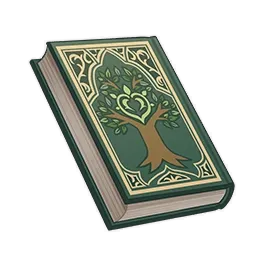
The Folio of Foliage is a three-volume Book Collection (4-Star) introduced in Sumeru in Version 3.0. Each volume's in-game description identifies the work in identical terms: "A biography written by researchers from ancient Sumeru. It records the trail of the Dendro Archon during the times of calamity." [1] The named in-universe author is Sunitha Cosamvi, who opens Vol. 1 by setting the work's posture explicitly: "I dare not presume to mention her true name, let alone overstep my bounds as an earthly being to judge the divinity she displayed then. I, Sunitha Cosamvi, a servant of shallow intellect, have merely recorded the stories heard from the sages who followed her in the past and nowhere else." The unnamed Dendro Archon is Greater Lord Rukkhadevata: Sumeru's pre-Cataclysm God of Wisdom, the avatar of Irminsul, and the predecessor of Lesser Lord Kusanali / Nahida. [2]
Three volumes, each a single sustained prose passage, carry more than their length suggests. The book is the documentary witness for the Cataclysm-era Black Tide and for Rukkhadevata's final sacrificial arc, and, uniquely among Genshin's Book Collections, for the mechanism of the Irminsul edit itself. Its text was rewritten in-game after the AQ III Act V quest Where the Boat of Consciousness Lies, and the parallel Version 1 and Version 2 texts survive as the cleanest record of that edit operating on a single document. [1]
Vol. 1 - The Black Tide opens
Vol. 1 sets the cosmological scene. The author records "the stories heard from the sages who followed her in the past", and the imagery is unambiguous: "When the moon's shadow shattered, hordes of beasts emerged from the deepest depths of the abyss and devoured living creatures by the thousands. Of those she created, none could escape their destined annihilation. The goodness, peace, and wisdom she had bestowed - all perished before this pure malice without exception." Under "that sneering waning moon, the black tide of decay surged over the deserts and through the valleys, turning clear springs once interlaced with roses into puddles of filth, defiling the earth as mortals trembled with despair." The sages, per the text, "called it The Black Tide, for it was a dark flood that swallowed up fields, villages, and cities." [1]
This is the primary-text grounding for the term "The Black Tide". The Cataclysm 500 years ago operated in Sumeru as "Khaenri'ah's increasing use of forbidden knowledge culminated in an overflow of Abyssal powers and monsters into Teyvat. These Abyssal monsters wreaked havoc on the land under Celestia's control and the Withering spread uncontrollably throughout both the forest and the desert, causing decay and destruction so terrible that it was called 'The Black Tide.'" The Black Tide name traces directly to The Folio of Foliage Vol. 1. [2] The volume gives one of the names for the Cataclysm's wounds in Sumeru its primary-text source, and it is the in-universe origin of the Cataclysm's Sumeru chapter. [5]
The volume's second movement is the goddess's response: "She witnessed this all with her own eyes and wept bitterly for the sorrow and suffering of the living. Her tears fell to the ground, dispelling the foul flames and giving birth to blossoms abounding with sweet dew from the once barren and scorched earth." The root cause, however, "still lay beneath the earth, and the shadow of death continued to obscure the once luminous moonlight." Vol. 1 closes with the vow that frames the rest of the book: "thus, she vowed to save the creatures of the earth, embarking on a radiant journey together with her servants." [1] This "final journey with some of her followers" is the journey from which she "never returned." [2]
Vol. 2 - The journey and the becoming-Gaokerena
Vol. 2 walks the journey itself. She enters "a long-since ruined forest"; "with each step she took, a thousand Nilotpala Lotuses bloomed in her wake. Every calamity - raging fires, death, and destruction - all receded before the wonder of her wisdom." Fragrant flowers proliferate; hurricanes abate before her singing. She plays "a flawless tune with a Karrenay" (a real-world Iranian / Central Asian metal trumpet) and "in an instant, thousands of demonic troops were reduced to dust and scattered to the four winds." [1]
The volume then locates the source: "this land remained broken, its heart devoured by evil spirits and monsters who made it their dwelling - a cavern of the damned where neither sun, moon, nor fire shine." She makes "a great wish, vowing that she would go into those cankered, rotted courts, setting forth on her sojourn to cleanse the withered land." The image of the "withered land" rhymes the book with the broader Withering the Cataclysm-era Sumeru chapter inherits. [5]
The volume's culmination is the book's most-cited sentence: "All the spirits, their envoys, humans, and the inhuman all watched as she entered the hollowed heart of the mortal world and touched its timeless face. Thus did all the goodness, peace, and wisdom that she had granted unto the world become the immortal Gaokerena, indeed, become the very earth itself." [1] That reference comes hedged in a wiki note: "the term 'Gaokerena' is also mentioned in The Folio of Foliage Vol. 2 as the name of either Rukkhadevata's remains or the culmination of the Dendro Archon's wisdom, but it is unlikely to have any intended overlap with the Harvisptokhm's Gaokerena" (the giant lotus inside the Harvisptokhm tree at Sumeru's Cataclysm seal in Tunigi Hollow, a separate primary-text referent). [2] The book's Gaokerena is the goddess becoming the earth, not the lotus at the seal.
Vol. 3 - The promise to the dreamers
Vol. 3 is the after-image. "Many have never heard her voice, and even those who heard knew not that it was her - and still she heard their wishes. And many have never seen her face, and even those who saw her knew not that it was her - and still she watched over their dreams." Her will "permeates all", and "she dwells in the Sanctuary of Surasthana watching over the dreams of all who live in this land - just as she did when she returned and commanded the queen of the realm of dreams to break the pure white branches and rebuild the viridescent hunting ground from amidst the withered leaves." [1] The Sanctuary of Surasthana is the seat in Sumeru City that the post-Cataclysm Dendro Archon inhabits, the seat Nahida holds, and the seat the book frames as continuous through the transition of reincarnation in samsara. [4]
The volume closes on the promise: "For memories are like pearls - tossed about by wind and sand though they may be, their true, pure color shall never be changed. All beautiful dreams are like the newborn grass - though they may be consumed by sudden flame, the warm spring breeze shall bring them swaying to life again." [1]
The Irminsul-edit witness - Version 1 vs Version 2
The Folio of Foliage is one of the documents whose text was rewritten in-game after the AQ III Act V quest Where the Boat of Consciousness Lies, in which Nahida removes Greater Lord Rukkhadevata from Irminsul to purge the forbidden-knowledge contamination her existence had carried. The affected materials are listed explicitly, and The Folio of Foliage is singled out by name under the "Books in both the player's inventory and in the Archive change to no longer refer to her" heading. [2]
Both versions survive in the record. The diffs are small but pointed. Vol. 1's closing vow shifts from "embarking on a final journey together with her followers" (V1) to "embarking on a radiant journey together with her servants" (V2). The V1 wording's "final" gives away the outcome, her death, which the post-edit text obscures. Vol. 2's "she stepped alone to that emptied earthly heart and softly touched its timeless face, becoming the immortal Gaokerena and the earth itself" (V1) is replaced by an extended hymn-bearing passage in V2 ("All the spirits, their envoys, humans, and the inhuman all watched as she entered the hollowed heart of the mortal world..."), and V2 adds a wholly new four-stanza hymn ("The path was made straight long ago by the path of a great vow...") the V1 text does not contain. Vol. 3's V1 narrator-frame uses "the princess of the kingdom of dreams gently snapped off the white branches"; V2 reframes the same scene as "she...commanded the queen of the realm of dreams to break the pure white branches". [1]
These changes show Nahida's Irminsul edit at work on a single primary-text document. The same edit rewrites the Aranara's "Queen Aranyani" dialogue to "Dendro Archon" / "Lord of Verdure", the archive description of the Rukkhashava Mushroom, the archive entries for the Kalpalata Lotus and the Harra Fruit, and "The Boon of the Elder Tree". [2] The book is the only Book Collection on the affected-document list. The survival of both V1 and V2 is the cleanest trace the Irminsul edit's primary-text consequences leave anywhere in the canon.
What the book anchors
Three claims rest on The Folio of Foliage. It is the primary-text source, at Vol. 1, for the Black Tide as the name of the Cataclysm's wound in Sumeru. [2] It narrates Rukkhadevata's sacrificial arc in the Cataclysm era (the vow, the journey, and her becoming the earth), which places her in the Sumeru row of the Sovereign-to-Archon transition (the "peaceful sharing" exception that resolves into Rukkhadevata's sole stewardship as Dendro Archon and then into Nahida's inheritance through reincarnation in samsara after the Cataclysm). [7] [6] And its own parallel texts, Version 1 and Version 2, show the mark the Irminsul edit leaves on primary text. [1]
The author's own stance matters too. Sunitha Cosamvi writes from the ancient Sumeru tradition the Sumeru Akademiya inherits, the "researchers" whose predecessors, followers of Rukkhadevata, founded the Amurta Darshan. The book speaks for the Akademiya as an institution, in the form of a devotional biography, and the author's "I dare not presume to mention her true name" keeps the Sumeru scholars' habit of treating the Dendro Archon's identity as a divine name not casually invoked. That habit survives both the goddess's death and the rewrite from the Irminsul edit. [2]
The Cataclysm the book sits inside is covered on the Cataclysm page, and the continuation of the Dendro Archon after the Cataclysm that it anticipates on Nahida. The Akademiya tradition the author writes from sits at Sumeru Akademiya, the region at Sumeru, and the cross-region Sovereign-to-Archon transition this book's Sumeru chapter occupies in the Sovereign-to-Archon transition deep dive.