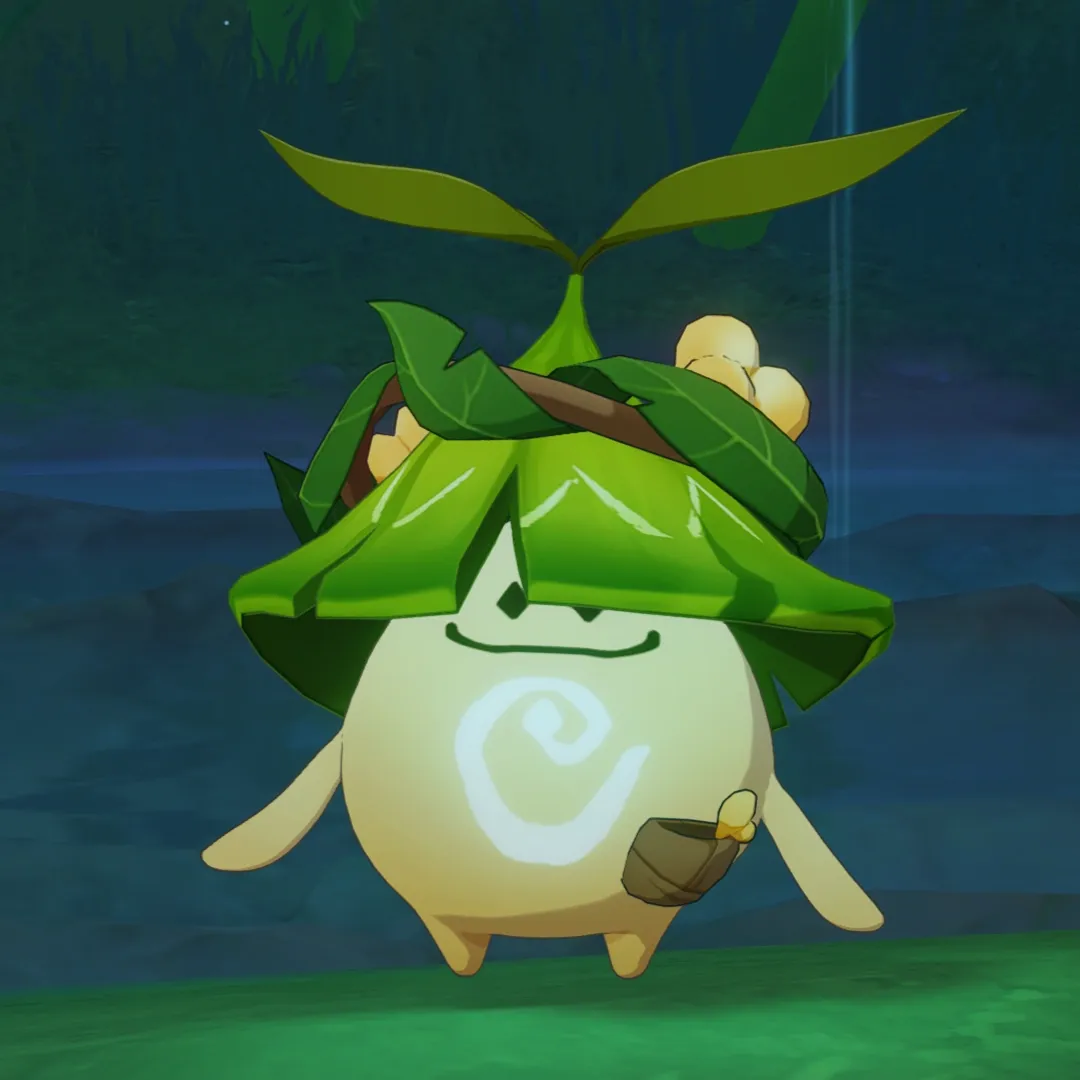
Aranara are the small, plant-like forest spirits of Sumeru's rainforest. They live in Vanarana, the village in the Dharma Forest sub-region, though most adults never see Vanarana at all, because the aranara have hidden the "true" Vanarana inside a dream anchored to the real world by the Tree of Dreams. [1] [2] In play they are at the centre of the Aranyaka world-quest chain, Sumeru's longest, and the player's main introduction, before Apep, to the rainforest's pre-Cataclysm history. Beneath that, they are a deliberately created race whose whole purpose has been to fight Marana (the Withering) alongside Rukkhadevata's other rainforest defences.
The chain that introduces them lives at Aranyaka, the follow-up about their engineering work with humans at Varuna Gatha, and the disclosure about Apep and Marana after AQ III that completes the story at Sapientia Oromasdis. The present-day Dendro Archon they now consider their parent-figure is Nahida, and the Dendro Sovereign whose corrupted elemental life-forms became Marana is Apep. [4] [5] [6] [8] [9]
Origin: Rukkhadevata sang a song
The aranara were created rather than emerging on their own. Per the Aranyaka world-quest chain Part III ("Nursery of Lost Dreams"), Greater Lord Rukkhadevata, the original Dendro Archon whom the aranara called Queen Aranyani, created the aranara shortly after she left the Sumeru desert to create Dharma Forest. She sang a song, the song caused the Ashvattha Tree to "grow from Sarva," the tree bore a pomegranate, and each of its seeds became an aranara. Aramuhukunda was the first to be born. [1]
Unlike Apep, the Bathysmal Vishaps, or the original elemental Vishaps, the aranara are not a pre-Archon species from the Sovereign era. They are a post-Archon species, which the Dendro Archon set up as guardians of the rainforest she had just founded. Other rainforest residents (humans included) were already present in that Sumeru: "they used to live alongside humans in the past." [1]
Primary text does not settle how their creation by song, pomegranate, and seed relates to other acts of creation by Archons (Rukkhadevata's own creation of Nahida, Egeria's pre-Cataclysm Fontainan engineering, Morax's Liyue contract work). Canon does not generalise the mechanism; it presents it as a one-off event of Rukkhadevata's era, for the aranara specifically. The Humans page lists the aranara among the "pre-human peoples" that predate humans on Teyvat; the framing holds only if "pre-human" is read narrowly as predates the post-Cataclysm humans of present-day Sumeru, since Rukkhadevata's reign extends well back into pre-Cataclysm history and the aranara have been around for most of it. Read more broadly, the framing overstates what canon supports. [14]
Vanarana and its hidden dream
The aranara live in two places at once.
Vanarana is a real subarea in the Dharma Forest of Sumeru, accessible to anyone with the map open, but most visitors cannot see the aranara there. The "true" Vanarana the aranara actually inhabit is Mahavanaranapna ("Vanarana of Great Dreams," per Arama's etymology in The World of Aranara), the dream-version of the same area, anchored to the real world by the Tree of Dreams at the village centre. The Traveler enters and leaves Mahavanaranapna by playing the Rhythm of the Great Dream on the Vintage Lyre at a Silapna leaf. [2] [1]
The dream is why the aranara are invisible to most humans. All aranara can hide themselves from human view, though they are visible to children, "most likely due to the fact that they dream, whereas adults do not." Specific adults can also see them: those the aranara trust, or those with "a fiercely pure and warm heart." The primary-text examples are Rana (the Forest Watcher disciple who survived Marana exposure) and Yoimiya (during the Carassius Auratus Chapter Act II All Things Flawless and Pure, though she never knowingly encounters them on-screen). [1]
Much of aranara life also takes place in the dream. Vanarana's dream-version contains the area's Statue of The Seven; Aranara songs played on the Vintage Lyre open Gloomy Paths, activate other Silapna, and summon Healthy Dendrograna; non-aranara visitors (the Traveler in particular) can use the songs to work the dream's mechanics. The dream-spirit framing is not metaphor. It is where the aranara do most of their work. [2] [4]
Memories, Ararakalari, and the Sourcesong
The aranara are a memory-driven race. They love memories both because memories are their source of power and because they are long-lived and sentimental. Some forget easily, so they give flowers to friends as memory-aids. They can use accumulated memories as fuel to channel power from the plants of the forest, a mystic art the Aranyaka chain names Ararakalari. Every aranara has their own Ararakalari, which can fight enemies, restrain or suppress an enemy's strength, teleport across long distances, and block off areas. Aranara can also selectively create and remove dreams and memories. [1]
Music shows most clearly how memory and Ararakalari are linked. Every aranara has a unique tune used to identify one another; songs can carry information only other aranara understand; and an aranara's song is linked to their power, since the closer the tune is to the Sourcesong, the stronger their Ararakalari. Per the Aranyaka chain Part III, Queen Aranyani's song was closest to the Sourcesong, so her Ararakalari was the strongest. [1]
A specialist few, the song gatherers, dedicate their lives to collecting other aranara's songs, a craft learned from humans, undertaken for love of music, for memory-preservation, and as a way to search for the Sourcesong itself. Known song gatherers include Aramuhukunda, Arakavi, Aradasa, Arasudraka, and Arayasa. Some song gatherers, unusually, also collect human songs. [1]
Physiologically the aranara share many qualities with plants. Under great danger they turn into a seed and enter "hibernation"; when the danger passes, the seed sprouts back into an aranara, a costly process. The final stage of an aranara's life is growing into a Vasara Tree, whose size and growth rate depend on the volume of memories the aranara collected. They do not need to sleep or eat, are extremely fearful of fire and salt, and can be revitalised using Dendro energy. They communicate with plants and with non-monster fungi (such as Rukkhashava Mushrooms), and they easily befriend wild animals, with Rishboland Tigers the primary-text example. [1]
The Sumeru Akademiya ran a research investigation into whether the aranara exist at all, despite the common adult dismissal of them as "imaginary friends." Their sensors could not detect what children can, so the Amurta darshan classified the aranara as "unidentified lifeforms." [1] [12]
Marana, the Cataclysm, and a dwindling people
The aranara's purpose is to fight Marana, what the rest of Teyvat calls the Withering. The word derives from Sanskrit maraṇa ("death" / "killing"); per the NPC Arakarman, "Marana has the power to turn Vana (forest) into Valuka (desert)." [3]
Marana was introduced when King Deshret brought Forbidden Knowledge to his people. Greater Lord Rukkhadevata temporarily halted it, but at the cost of most of her power and her reduction to a child-sized form. Marana re-emerged during the Cataclysm, and Rukkhadevata sacrificed herself to keep it from spreading rapidly across Sumeru. The reduction did not hold cleanly. Her taint in Irminsul kept the Withering spreading faster than the Forest Rangers' Vision-bearers could clear new zones. After Lesser Lord Kusanali removed Rukkhadevata from Irminsul at the close of AQ Chapter III Act V (Akasha Pulses, the Kalpa Flame Rises), the Withering stopped expanding, though zones already established before the removal remained. [3] [7] [13]
Per Nahida's Story Quest Sapientia Oromasdis Chapter Act II Homecoming, the Withering is the death of elemental life-forms that originated inside Apep's body, Apep's pre-Cataclysm fauna in effect, who escaped when it was corrupted by Forbidden Knowledge. The elemental life-forms themselves turned into Tumors of the Withering. After a Withering Zone is cleared, if the destroyed Tumor still contains life-essence from its elemental life-form, another living elemental life-form can retrieve it. [3] [6] [9]
That disclosure changes how the aranara's role reads. Marana is not a generic Abyssal corruption. It is the death-form of a specific group of elemental life-forms whose home (Apep's body) was poisoned by Forbidden Knowledge, and the aranara have been the front-line workers fighting it on Sumeru's surface for as long as Rukkhadevata required. Their purpose is tied to a Sovereign's cosmological wound (Apep's corruption by Forbidden Knowledge) and to an Archon's self-sacrifice in the Cataclysm (Rukkhadevata's taint in Irminsul), not to ordinary rainforest housekeeping.
The Cataclysm itself displaced them physically. Per the Aranyaka chain Part III, many aranara fought fiercely against the invaders from the Abyss, but they were forced to abandon their original home, Old Vanarana (now a Withering zone with naturally accumulating Decay), and establish the new Vanarana to the north, hidden in Mahavanaranapna. [1] [3]
Shortly after the Cataclysm, the Traveler's Sibling travelled through Sumeru and befriended the aranara. They helped repair the Varuna Contraption, the device that regulates the rainforest's water, which the aranara and humans had originally built together, and were dubbed Nara Varuna for it. Before leaving, they told the aranara to expect another golden-haired human who would give them even better memories. The aranara have preserved the memory of Nara Varuna in murals and stone monuments throughout Vanarana. [1] [5] [10]
Relationship to Rukkhadevata and Nahida: the Irminsul rewrite
The aranara's understanding of who their parent-figure is has been rewritten.
For most of their history, the aranara understood themselves as the children of Queen Aranyani, Rukkhadevata, the singer who grew the Ashvattha Tree that bore the pomegranate that bore them. Her song was closest to the Sourcesong, her Ararakalari was the strongest, and she was the centre of their whole world. [1]
When Lesser Lord Kusanali (Nahida) removed Rukkhadevata's name and trace from Irminsul at the close of AQ III Act V, the same removal that halted Marana's expansion, the rewrite reached the aranara. Per Arakarman's NPC dialogue: "like any Teyvatian creatures, the Aranara also forgot her as Queen Aranyani. With this revised history, they believe that they are the children of the current Dendro Archon, whom they refer to as The Lord of Verdure." [1] [7]
This is the cleanest on-screen demonstration of Irminsul rewriting a Teyvat population's self-understanding, not merely its factual recall but its sense of where it came from. The Outlander retains both memories, pre- and post-erasure, per the five-property distinction set out on The Traveler; whether any aranara similarly retain residue is unaddressed. [18]
Nahida, created from a fragment of Rukkhadevata's consciousness and the one who removed Rukkhadevata from Irminsul, is now the parent-figure the aranara's revised history names. She also organises the cooperation between species that the Homecoming arc requires, mobilising children as helpers in tending Apep on the aranara's behalf. [8] [6]
Language and naming
The Aranara Language (so-named by community convention; canon does not name it) is the language the aranara speak, and the basis of every aranara name. The lexicon is built on Sanskrit, the classical language of India.
The most important word is Nara, derived from Sanskrit nara, "human" or "person." It is the aranara's term for the Traveler (and for the Sibling: Nara Varuna). The same Sanskrit base underlies their own name (áraṇya "forest" or "wilderness" plus nára "person") and the Aranyaka world-quest series (Sanskrit Aranyaka, a class of Vedic texts treating ritual sacrifice and meaning "produced, born, relating to a forest"). Individual aranara names follow the Ara- prefix convention (Aramuhukunda, Arakavi, Aradasa, Arasudraka, Arayasa, Arama, Arana, Aranakin, Araja). [1]
Some aranara words double as cosmological terms. Vana is forest, Valuka is desert, Marana is death/killing, Mahavanaranapna is Vanarana of Great Dreams, and Apshvaana (Sanskrit "water dog") is the aranara word for Spinocrocodile. The pattern is consistent: the aranara name things by their function in their world, with Sanskrit as the etymological base. [1] [2]
There is also an aranara script. Inscriptions appear on Silapna leaves and on walls throughout Vanarana, but canon does not yet decode the script's grammar or full lexicon. [1]
How aranara differ from adjacent race-categories
Three distinctions matter for the race-category question.
Aranara are not adepti
Per HoYoverse Developer Insight #4 and the adepti race page, the adeptus category is restricted to non-humans, and the path to becoming one runs through Morax's blessings and the contract of Liyue's Mighty and Illuminated Adepti, with Sub-Space Creation power "granted by Rex Lapis as part of the illumination." [15]
The aranara are distinct. They were created by the Dendro Archon, draw their Ararakalari from dreams, and live in Vanarana. They hold no contracts with Morax or any other Archon, and they do not use Sub-Space Creation. The difference lies in how each was made and what kind of being each is. Aranara are dream-spirits of Sumeru made by the Dendro Archon; adepti are illuminated beings of Liyue blessed by Morax.
Aranara are not humans
Per the humans race page, humans live under the distribution of Visions, the Archon hierarchy, and Irminsul's memory, which that page reads together as the Heavenly Principles' way of managing the world (its own reading, not a stated rule), and carry a "higher purpose" per HoYoverse Developer Insight #4. [14]
The aranara are distinct here too. They hold no Visions, and they are not administered by the hierarchy of Archons; they were in Rukkhadevata's particular care, which Nahida has inherited through the Irminsul rewrite. They are recorded by Irminsul. Primary text is unambiguous that the rewrite reached them, which makes them a population Teyvat records rather than an exception like the Outlander. They also have a distinct language, the Sanskrit-based Aranara Language, where humans speak the common tongue plus regional variants. Across the five-property distinction on The Traveler, the aranara differ from humans on four of the five (Visions, Archon hierarchy, engagement with the Statues of The Seven, and language) and agree only on being recorded by Irminsul. [18]
The aranara are an ally race, not a rival. They cooperated with humans on the Varuna Contraption in the pre-Akademiya rainforest era, they continue to befriend children and a few trustworthy adults, and their reclusiveness from adults is a response to humans giving up dreaming after the Cataclysm, not hostility. [1] [5]
Aranara are not melusines (and not hilichurls)
Melusines are a post-Cataclysm species born from a Sovereign-related accident, emerging from Elynas's wounds during the Marechaussee Hunter / Narzissenkreuz Ordo battle, and the present-day Hydro Sovereign Neuvillette recognises them as a successor people. They belong to the Sovereign side of things. Aranara, by contrast, were deliberately created by an Archon (Rukkhadevata) to defend against a Sovereign-related cosmological wound (Apep's corrupted elemental life-forms, manifest as Marana). The two races sit at opposite ends of that relationship. Melusines are the Sovereign's offspring, and aranara were made to oppose it. [17]
Hilichurls are post-Cataclysm humans degraded by the curse of the wilderness, a punitive species-level change. Aranara were created from scratch by a Dendro Archon. Both populations have shrunk in the post-Cataclysm period, but for opposite reasons: hilichurls were generated by the Cataclysm and remain stuck under the curse, while aranara were displaced by it, lost Old Vanarana to Marana, and remain a finite people that, per the in-game Trivia, does not reproduce. [16] [1]
What we know
- Aranara are plant-like forest spirits native to Sumeru's Dharma Forest, primarily resident in Vanarana (and in its dream-version Mahavanaranapna). [1] [2]
- Greater Lord Rukkhadevata created the aranara by singing a song that grew the Ashvattha Tree from Sarva, which bore a pomegranate whose seeds became the aranara; Aramuhukunda was the first. [1]
- The aranara called Rukkhadevata "Queen Aranyani." Her song was closest to the Sourcesong, and her Ararakalari was the strongest. [1]
- After the Cataclysm, many aranara fought against Abyss invaders and lost Old Vanarana to Marana. They abandoned the old home and established a new Vanarana to the north, hidden in a dream anchored by the Tree of Dreams. [1] [3]
- Shortly after the Cataclysm the Traveler's Sibling befriended them, helped repair the Varuna Contraption, was dubbed Nara Varuna, and prophesied another golden-haired human would give them better memories. [10] [5]
- Marana is the aranara name for the Withering (Sanskrit maraṇa, "death"); per Nahida's Story Quest Sapientia Oromasdis Chapter Act II Homecoming, it is the death-state of elemental life-forms that originated in Apep's body and escaped when Apep was corrupted by Forbidden Knowledge. [3] [6]
- Rukkhadevata sacrificed herself during the Cataclysm to keep Marana from spreading rapidly, but her taint in Irminsul kept the Withering spreading until Nahida removed her from Irminsul at the end of AQ III Act V, halting its expansion. [3] [7]
- The Irminsul removal rewrote aranara memory of Queen Aranyani: they now believe themselves children of the current Dendro Archon, whom they call "the Lord of Verdure" (Nahida). [1]
- Aranara are visible only to children, with a few trusted-adult or pure-hearted exceptions (Rana, Yoimiya). [1]
- Aranara use memories to fuel Ararakalari, an aranara-specific mystic art that channels power from rainforest plants. [1]
- Every aranara has a unique tune; songs convey aranara-only information and gate access to the dream's mechanics (Silapna activation, Gloomy Paths, Healthy Dendrograna). [1]
- Aranara turn into seeds under great danger and end their lives as Vasara Trees whose size depends on the volume of memories they collected. They do not need to sleep or eat, they fear fire and salt, and they are revitalised by Dendro energy. [1]
- Aranara do not reproduce; the whole population stems from the original creation from the pomegranate's seeds. [1]
- The Aranara Language is Sanskrit-based, with Nara meaning "person." [1]
- The Akademiya's Amurta darshan classified the aranara as "unidentified lifeforms" because Akademiya sensors could not detect what children can. [1] [12]
What we don't know
- How many aranara survived the Cataclysm, and how many remain now. Canon establishes a finite, shrinking people but gives no population figure. Old Vanarana is now a Withering zone with naturally accumulating Decay, and the new Vanarana population is whatever fits in Mahavanaranapna.
- Whether creation by song and pomegranate applies to other acts of creation by Archons (Rukkhadevata's creation of Nahida, Egeria's Fontainan engineering, Morax's Liyue contract work). Canon presents it as a one-off event of Rukkhadevata's era, for the aranara specifically.
- Whether individual aranara who personally interacted with Rukkhadevata retain any residue of her presence beyond the swap from Queen Aranyani to the Lord of Verdure that the Irminsul rewrite imposed. The Traveler retains both memories per the Outlander exemption; whether any aranara do is unaddressed.
- The exact relationship between Apep's elemental life-forms and the aranara. Both are Sumeru Dendro-aligned populations, and both are tied through Marana to Apep's corruption by Forbidden Knowledge. Whether the aranara are biologically related to the elemental life-forms or simply share an Archon's making is not addressed in primary text.
- Whether the "Lord of Verdure" parent-figure rewrite holds across all aranara. Canon establishes the rewrite as the new common belief; whether outlier individuals (Aramuhukunda as the first-born, the song-gatherers closest to the Sourcesong) experience it differently is unaddressed.
- Whether the Humans page's framing of aranara as a "pre-human predecessor people" is an error or a defensible narrow reading. Per canon they were created by a post-Sovereign-era Archon (Rukkhadevata) and lived alongside humans in the rainforest era. The "pre-human" framing reads narrowly as predates the post-Cataclysm humans of present-day Sumeru and broadly as predates humans as a species across Teyvat; the narrow reading is defensible, the broad reading overstates. Flagged for sister-page refresh.
The aranara are a race an Archon sang into being so the rainforest would have someone to take care of it. Most adults can't see them at all. Their oldest enemy, Marana, turns out to be the death of another race entirely, the elemental life-forms that lived inside a Dragon Sovereign who got poisoned, escaping their dying home and becoming the corruption the aranara have fought ever since. The mother who made them is gone, edited out of the world to stop her poison from spreading further, and the daughter who replaced her and edited her out is the one the aranara now think made them in the first place. They remember Nara Varuna, build monuments to him, and wait for the second golden-haired human he told them would come.