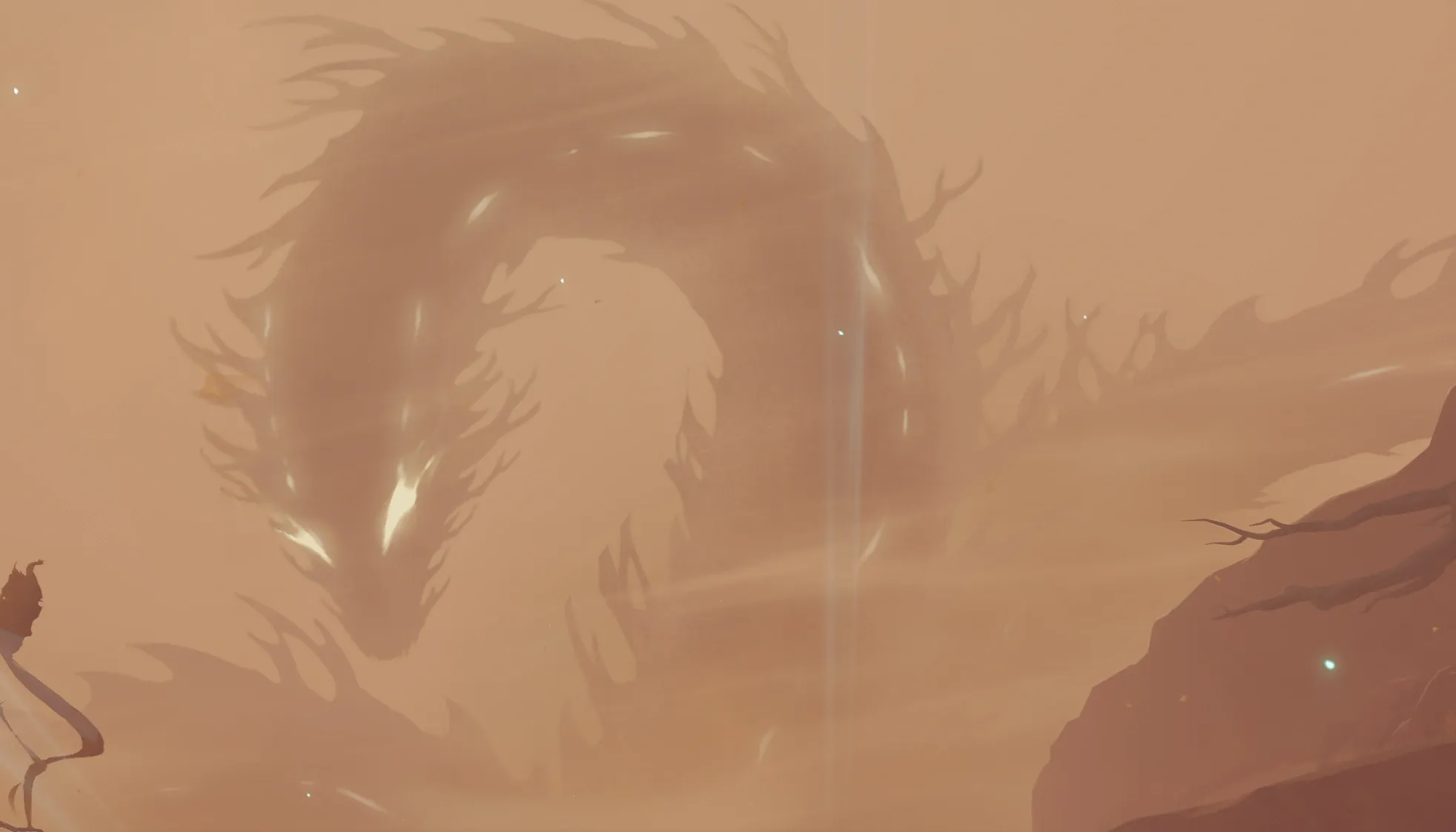
The common shorthand for Teyvat's cosmology runs from "the dragons ruled the old world" to "the Heavenly Principles defeated them and put the Seven Archons in their place." Each step is true. Put together that way, though, the whole thing flattens into one tidy swap.
The shorthand hides the real structure. The transition is two huge events separated by thousands of years: a forty-year war the Primordial One waged against the Seven Sovereigns when they arrived from the sea of stars, and an Archon War the wounded Heavenly Principles set in motion much later, after Nibelung's return and the war of funerary flame had stripped them of the strength to rule Teyvat directly. The Sovereigns were defeated in the first event but not destroyed. The elemental Thrones the Seven Archons now hold were assembled in the second.
The old world: rule by the dragons
The world the Primordial One arrived in already had a working order. Per Apep's exposition to the Outlander in the Nahida SQ Homecoming, from the dawn of time the world belonged to the dragons, led by the Dragon King Nibelung and the Seven Sovereigns. Each Sovereign held one of the Seven Authorities, Pyro, Hydro, Anemo, Geo, Electro, Dendro, Cryo, and each Sovereign's land matched their element. [10] [3]
Underneath it all was the Light Realm, the pre-human layer where elements existed in raw, primordial form. The Sovereigns were creatures of the Light Realm, not inhabitants of it. They were dragon-kind at its peak, born from elementally pure vishaps along a single line that ran from surface vishaps through their more advanced relatives up to the Sovereigns themselves. [5] [4] [19]
Two things on Teyvat are older than the Heavenly Principles themselves. Per Apep's disclosure at the Heart of Oasis in Welkin Moon Act IX, Irminsul existed before the Heavenly Principles even arrived on Teyvat, and in that age "The Ley Lines flowed with an abundance of a familiar, primitive form of elemental energy... You may know it as the power of the Light Realm." [9] [34] The tree and the network Teyvat now runs on both came before the order built on top of them. The Heavenly Principles inherited both and refashioned Irminsul; they did not create either.
The forty-year war and the war of funerary flame
The era of the war between the HP and the Sovereigns is named "When the Doves Held Branches." The great ruler of the firmament hailed from the sea of stars, journeyed across the universe in search of a suitable home for humankind, found Teyvat suitable, and engaged the dragons and their Seven Sovereigns in battle. [2] The Primordial One created four Shades to assist (Naberius, Ronova, Istaroth, and Asmoday), and after forty years emerged victorious and seized the Sovereigns' Authorities.
What that victory was matters. Most surviving Sovereigns were not killed; those who survived were knocked unconscious or entered deep slumber, and those who refused to yield fled into the ocean depths. [3] The Authorities themselves were taken, separable in principle from the dragon-kin bodies that had held them. The dragons survived as a scattered, disabled, or hidden population, while the elemental Authorities passed to the Primordial One.
The Primordial One then reshaped the planet. Per The Byakuyakoku Collection Vol. 2 Before Sun and Moon, the Human Realm was established by repurposing the dragons' Light Realm, the primordial energies of the Light Realm were turned into the modern seven Elements, and a false sky was raised to seal the planet off. [5] [2] Only the elements are a retrofit in that sense. Fandom lists the Vision system among the new laws the Heavenly Principles created, "to allow mankind to wield elemental energy," and says they "fashioned the seven Gnoses from his corpse," the Third Descender's, so neither is a refitted piece of the dragons' world. [2]
The swap from Sovereigns to Archons did not happen right away. The Primordial One ruled Teyvat directly for thousands of years before two events forced it to delegate: Seutervoinen's arrival from the sea of stars, and Nibelung's return (Fandom counts him as the Second Descender), which brought the Abyss into Teyvat for the first time. The war of funerary flame that followed gravely wounded the Heavenly Principles. They won it around six thousand years ago, killing Nibelung and shattering the Three Moons, but the wounds left them unable to keep ruling the world directly. [2]
After the War of Funerary Flame and before the Archon War, the Heavenly Principles and "one who came after" fashioned the seven Gnoses from the Third Descender's remains. Hymns of the Far North separately says Saarelainen was carved into seven pieces, making him the strongly implied candidate rather than an explicitly named identity. [2] [1]
Chapter VII Act IV gives the bargain behind those remains in Rhinedottir's words. The Belyi Tsar had incited the Tsaritsa, then "a mere herald of the court," to open the gate to the Abyss alongside the Third Descender, and the Heavenly Principles erased her existence. He then "ascended to Celestia to negotiate with the Heavenly Principles, willing to trade his own life to bring yours back." His bargaining chip was his body, with "an unparalleled affinity for the power of Teyvat's Human Realm" and the ability to "amplify the power of the various elements." If they resurrected her and never harmed his descendants, the Khaenri'ahns, he "consented to have his remains be split into seven pieces to consolidate the system of rule established by the Heavenly Principles." He held them to it with "a curse, profound and complex, one that would only take effect if the promise was ever broken," and their own condition was that "everything about him would be forgotten." The Tsaritsa concludes that the Cataclysm in Khaenri'ah triggered that curse: "That's why the Heavenly Principles are asleep." Rhinedottir answers that it "was just a story." Act IV never names him and gives no date for the bargain. [32] [33]
The war itself is described most cleanly in Neuvillette's Character Story Vision, recalled from his predecessor's memory: "all fragments of the primordial were driven to devour each other." In other words, the Heavenly Principles set the gods to eliminate each other. [11] [1] The gods of Teyvat were pushed into the war to claim a Gnosis and a Divine Throne, and the winners, across an era that ended around 2,000 years ago, became the Seven Archons. They hold the elemental Authorities the Heavenly Principles had first seized from the Sovereigns and re-issued to the Gnosis-bearing Archons. The Sovereigns keep the deeper claim; the Archons hold the formal authority.
How it played out region by region
The swap from Sovereigns to Archons worked differently in each of Teyvat's seven nations. The variation matters. It is the clearest sign that this was not one uniform mechanism, and that the Sovereign and Archon roles do not always belong to the same line.
Element | Sovereign | Sovereign fate | Successor Archon (first holder; current holder) |
|---|---|---|---|
Pyro | Killed by Xbalanque 2,000 years ago, when the Archon War era ended. Fandom's Archon War page says Natlan had no native gods but still saw conflicts from which a nation under an Archon emerged. [8] [1] [14] | Xbalanque (reborn after the fight; founder of the Pilgrimage line of mortal Pyro Archons); current: Mavuika | |
Hydro | Original Hydro Dragon (removed before the Archon War), succeeded by Neuvillette. Egeria, whom Naberius made as the Primordial Sea's new heart, was not a Sovereign. | The Hydro Dragon was removed before Egeria was made; Fandom lists it as unknown and deceased, "Succeeded by Neuvillette." Egeria, the first Hydro Archon, died at Tunigi Hollow during the Cataclysm. [26] [3] | Egeria → Focalors (Egeria's Oceanid follower, appointed successor); after AQ IV Act V → throne destroyed, Authority returned to Neuvillette (the Hydro Sovereign reborn in human form, not Egeria's child) |
Anemo | Original Anemo Dragon, unnamed and dead; Fandom's table lists Dvalin as the current Anemo Sovereign, basing it on a note | No on-screen Sovereign-to-Archon event. Fandom says Dvalin, "the new Anemo Sovereign," was born "from a convergence of elemental energy in the high heavens" in the age when the gods walked the land. Mondstadt's pre-Archon-War gods (Decarabian, Boreas) are separate from the dragon line. [3] | Barbatos (rose from a wisp; defeated Decarabian; claimed a crumbling ancient seat of divinity); the only Anemo Archon |
Geo | Azhdaha, the original Geo Dragon; Fandom's table lists him as the Geo Sovereign, citing Zibai's Chapter VII Act V line about "the great Geo Dragon," which does not use the title (an earlier revision rested on a note about his Chinese title) [38] | Azhdaha woke from long slumber beneath Nantianmen, befriended Morax, and fought in the Archon War on Morax's behalf; after erosion and Chasm-mining drove him mad, Morax and three adepti sealed him under the Dragon-Queller at Nantianmen. Fandom lists him as incapacitated. [7] [3] [13] | Morax, already God of Geo before the war; the only original Archon besides Barbatos still in place |
Electro | Unnamed in the game. Fandom's table now lists Kapatcir, the Thunderbird Ei slew on Seirai Island, as the original Electro Dragon; Chapter VII Act VI calls it the Electro Dragon, never a Sovereign. The Bathysmal Vishaps (Orobashi's line) include an Electro strain, but tying it to the seat is speculation. [3] | In Act VI Ei says she "once slew a great Thunderbird on the island of Seirai" and "sealed the primordial Electro element away." The Hallowing undoes the seal, and she stores the Thunderbird's power in the Shogun's body until it can "take shape as a conscious lifeform"; Neuvillette plans to pay his respects "to the new Electro Dragon." No Sovereign-to-Archon handover is shown. [39] | Makoto (Baal); succeeded by her twin Ei (Beelzebul) after Makoto's death during the Cataclysm |
Dendro | Apep | The first Celestial Nail, used against the forbidden knowledge she had gathered, turned Sumeru's rainforest into desert; Fandom does not say it wounded or sealed her. The Traveler and Nahida seek her out again at Welkin Moon Act IX. [25] [15] [16] [18] | Sumeru is the peaceful sharing exception: King Deshret, Greater Lord Rukkhadevata, and Nabu Malikata held the formal positions together. After Nabu Malikata and King Deshret died thousands of years ago, Rukkhadevata "presumably ascended as the Dendro Archon," in Fandom's words. [1] [37] Current: Nahida (Buer), after the Irminsul edit |
Cryo | Original Cryo Dragon Sovereign unnamed and dead. [30] | Hyperborea used the corpse's flesh and blood in an unfinished Primordial Human experiment. Its authority froze Snezhnaya and crystallized its Ley Lines; a heavenly nail was sent; the Belyi Tsar awoke from the remains one thousand years later. No current Sovereign successor is named. | Current Cryo Archon: Tsaritsa. The World Quest does not identify its Belyi Tsar as the Sovereign, Nibelung, Monomakh, or a Cryo Archon, so no direct handover from the Cryo Sovereign to the Belyi Tsar to the Tsaritsa can be asserted from it. [30] |
Three patterns stand out. Pyro is the cleanest direct swap; Hydro is the continuity case; and Anemo, Geo, Electro, and Cryo lack a shown Sovereign-to-Archon handover. Cryo is no longer missing at the original-body level, because the original Sovereign is confirmed dead, but its current successor and any connection to the Archon line remain unknown. Dendro sits in between: Apep exists, while the Archon was installed through the peaceful sharing arrangement.
The Neuvillette exception: a Sovereign reborn in human form
The Hydro case is the only on-screen return of full Sovereign Authority since the Cataclysm, and it works through a mechanism the other seats have not shown. Per Fandom's Seven Sovereigns page: "It is also possible for Sovereigns to be reborn in human form, as the current Hydro Sovereign takes on the form of Neuvillette, due to the aforementioned impurity of the Bathysmal Vishap." Rebirth in human form is the fallback when elementally pure draconic stock is unavailable. [3] [19]
The condition that forced the fallback is set out in The Byakuyakoku Collection Vol. 4. The Bathysmal Vishaps of Enkanomiya were the pure-Hydro stock from which a new Hydro Sovereign could have been born. The dragons deliberately broke that line through trait-selection, branching into Rimebiter (Cryo) and Bolteater (Electro) strains alongside the pure-Hydro Primordial. [5] [23] The Enkanomiyan prophecy expected exactly this: "the new Dragon of Water will definitely descend in the form of a human." Neuvillette is that prophecy coming true. He is not Egeria's child; of her he says, "I had never met her." [17] Like any living Sovereign, he could not use his full power while the Hydro Archon's throne stood, since a Sovereign regains it only when the Archon's seat is destroyed and the Authority returned. [24] [3]
AQ IV Act V is the moment his power returns. The Hydro Throne is destroyed by Focalors's dissolution in the Masquerade trial, the mechanic by which Fontainians dissolve into water is abolished, and the Hydro Archon's authority, which Egeria held first, returns to the Hydro Dragon. [6] Neuvillette's Ascension voice-over says it plainly: "now that I have reclaimed one of the Seven Authorities from the hands of the usurpers, I have regained my true form." [11] The swap can be reversed, seat by seat, when the conditions hold.
Welkin Moon Act IX: the dragons will reclaim Teyvat
The Welkin Moon Act IX disclosure sets the reclamation arc against the deep history of the transition itself. Apep's exposition at the Heart of Oasis lands four claims in a single exchange: [9] [34]
- Irminsul existed before the Heavenly Principles even arrived on Teyvat: "That tree was not planted by the Heavenly Principles." Its "appearance and function then differed greatly from today," so the tree is older than the Sovereign-to-Archon transition even though the role it plays now is not.
- In that age, "The Ley Lines flowed with an abundance of a familiar, primitive form of elemental energy... You may know it as the power of the Light Realm."
- The Heavenly Principles "usurped and refashioned Irminsul, made it serve humanity, and used it to anchor the fate of the world." That role of anchoring fate was added later by the Heavenly Principles; Irminsul did not have it from the start. Fandom's example of it is the Prophecy of Fontaine, which Nahida says "was carved into Irminsul long ago." [35] [36] That the curse of Khaenri'ah and the system of Vision distribution also sit on it is this essay's own reading and is unconfirmed.
- One day, the dragons will reclaim control of Teyvat. Apep states this as fact, not as a hope. The transition can be recovered, not just mourned.
This is the plainest statement of why the transition matters now. The Heavenly Principles inherited the world the Sovereigns had been operating; the Archon War moved the Authorities into a stand-in within the Human Realm, but what those Authorities are for still traces back to the Light Realm and the Sovereigns. The reclamation arc opens with one surviving Sovereign sensing another's: Apep has never met the Hydro Dragon ("Though we have yet to meet") but counts him as preparing for revenge alongside her. [9] [34] [19] The Tsaritsa's project of collecting Gnoses is the most prominent active plotline that could be the vehicle for restoring Sovereign Authority across more seats, though the game has not confirmed her motive on screen.
What we know
- The transition is two huge events: the Primordial One's forty-year defeat of the Seven Sovereigns, and the Archon War the wounded Heavenly Principles set in motion much later, after the war of funerary flame. [2]
- Most surviving Sovereigns were knocked unconscious or entered deep slumber after the victory; those who refused to yield fled into the ocean depths. They were defeated rather than destroyed. [3]
- The Human Realm was built by repurposing the dragons' Light Realm; the modern framework of seven elements is the Heavenly Principles' retrofit of the older primordial elements. [5]
- The Divine Thrones were crafted out of pieces of the Dragon Sovereigns' powers; the Gnoses were crafted out of the Third Descender's remains. [1] In Rhinedottir's Act IV account he consented to the split "to consolidate the system of rule established by the Heavenly Principles," and she calls the account "just a story." [32]
- The Pyro Sovereign Xiuhcoatl was killed by Xbalanque 2,000 years ago, at the end of the Archon War era; Xbalanque died in the same fight and was reborn as the first Pyro Archon, and Kukulkan wonders whether that was "part of the deal he had made with a certain entity all along," an entity Fandom identifies as Ronova. [8] [14]
- Egeria, the first Hydro Archon, was not a Sovereign; Focalors succeeded her as a stand-in Archon; AQ IV Act V destroyed the Hydro Throne and returned the Authority to Neuvillette, the Hydro Sovereign. [6] [26] [3]
- Apep at Welkin Moon Act IX discloses that Irminsul and the Ley Lines predate the Heavenly Principles, that "there will come a day when we reclaim this world for ourselves," and that she can sense "the Hydro Dragon has wrested his authority from the hands of the usurpers." That disclosure opens the reclamation arc. [9] [18]
What we don't know
- The present occupants of the Electro and Cryo seats. For Electro, Fandom now lists Kapatcir, the Thunderbird whose power Ei has carried in the Shogun since Chapter VII Act VI, though no line calls it a Sovereign. (For Anemo and Geo, Fandom lists Dvalin, alive, and Azhdaha, sealed and incapacitated, neither on a line that calls him a Sovereign.) [3] [39] The original Cryo Sovereign is dead, but the current successor is unknown. Surtalogi is a Sinner and Skirk's Cryo presentation is a Seven-Shifting Serpent disguise over Abyssal power; neither supplies a successor. [30] [27]
- What became of the Pyro Gnosis, separate from Xiuhcoatl's death. Nahida used the Gnosis to burn Irminsul in Sumeru; it disappeared without a trace afterward. [20] In Chapter VII Act III the Traveler says it was reduced to ashes and relays Mavuika's word that it "has returned to the Ley Lines," while the Tsaritsa calls its whereabouts unknown and expects it to be excised from them in time. No holder is confirmed. [31] Version 7.2 leaves it lost. At the leaders' meeting in Act V, Pierro says the Fatui "have yet to locate the Pyro Gnosis" and are "searching for it as we speak," and Mavuika, who "looked after it for a very long time," says: "But I can no longer sense it. It's like there's an invisible wall separating us." [38] Near the end of Act VI, after the representatives' audience with Nukvah in Celestia, Paimon says what the others are thinking: "But we still don't know where the Pyro Gnosis is..." No line names a holder. [39]
- Whether other Sovereigns can or will be reborn in human form. The Neuvillette case is tied to the Bathysmal Vishaps' impurity; whether the same fallback is available for the missing seats is not addressed.
- Whether the Tsaritsa's collection of Gnoses is aligned with restoring Sovereign Authority. The cooperation between Capitano and Mavuika at AQ V Act V, the restoration of Neuvillette's power at AQ IV Act V, and Apep's sense of Neuvillette's reclaimed Authority at Welkin Moon Act IX all fit the restoration reading, but the Tsaritsa has not stated this plan on screen. In Chapter VII Act III she gives other reasons, amplifying her power to face the Heavenly Principles and opening the seal the Third Descender left, and does not mention the Sovereigns. [31]
- How the Sovereign "carving" actually worked. The parallel between Saarelainen's seven pieces and the Third Descender's remains is itself an inference drawn from combining sources; it cannot prove the Sovereigns were carved physically. Rhinedottir's Act IV account concerns the Third Descender's own body and says nothing about carving the Sovereigns.
- Nibelung's double role. Nibelung is Dragon King, and Fandom counts him as the Second Descender. His return preceded the War of Funerary Flame, but primary text neither numbers him nor says re-entry caused the numbering.
The dragons did not lose Teyvat in a single swap. They lost the Authorities, kept the world they were rooted in, and were defeated rather than destroyed. The Archon system that replaced them is a workaround the Heavenly Principles assembled thousands of years later, because they could no longer rule the world they had just won. The deeper layer is still there, the dragons are still there, and the reclamation has begun.
Related
The Seven Sovereigns page carries the throne-by-throne roster, the start of the reclamation arc, and the species itself (its origin in the Light Realm, the line from vishap to Sovereign, and Pahsiv's case); its counterpart on the Archon side, covering how the Divine Thrones were made from Sovereign Authority and keeping score of the Gnoses collected, is The Seven Archons. Heavenly Principles covers what the Heavenly Principles inherited and the Four Shades who enforce their rule. Bathysmal Vishaps has the pure-Hydro line broken by deliberate Cryo and Electro branching, plus the Enkanomiyan prophecy of a Sovereign in human form. Neuvillette covers the Hydro Dragon reborn in human form, the restoration of his power in AQ IV Act V, and the Welkin Moon Act IX confirmation, and Apep is the Dendro Sovereign who delivers that disclosure. The Descenders page carries Nibelung's double role and Saarelainen's link to the Gnoses, walked further in The four Descenders, by the evidence. The Egeria essay is Egeria and the true origin of Fontaine, and the Cataclysm-era reawakening that precedes the present arc is The Cataclysm.