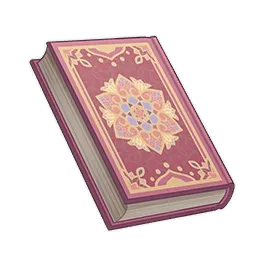
Scroll of Streaming Song (Chinese: 浮槃歌卷 Fúpán Gējuàn, "Scroll of Pushpa Song"; Japanese: プシュパの歌 Pushupa no Uta, "Songs of Pushpa") is a three-volume Sumeru Book Collection released in Version 3.0, shelved in the House of Daena library at the Sumeru Akademiya. Each volume's in-game description identifies the work in identical terms: "A torn page discovered in the desert ruins and retrieved by researchers from the Vahumana school of the Akademiya. The author of this page has yet to be confirmed." [1]
The identical retrieval note on all three volumes is the formal notation of the Akademiya's Vahumana school. The Vahumana Darshan, the school of humanities and sociology among the Six Darshans, takes in damaged primary sources from the desert ruins of the Great Red Sand, annotates them where the modern Akademiya can identify the referents, and records marginal notes on redacted names where it cannot. Three single-page volumes carry an unusual load. The primary text is fragmentary, the named entities are partly redacted, and the only attested link to wider lore runs through a single phrase in Vol. 2 that the Princess uses to refuse the Mistress's challenge. [5]
Vol. 1: the Mistress's offer and the scholars' marginalia
Vol. 1 opens in medias res with the Mistress of Pushpavatika addressing the Princess: "Praise be to the Winged One, lord over all the kingdoms of the land. I am a spirit created at the beginning, I am a flickering illusion, I am the shimmering light that flows from the eyes of the creator. People in far-flung lands sing praises of your wisdom. I wonder then if you could help me to unravel something that has long bewildered me? I will give you these spices, gold, and precious stones as a token of my appreciation if you can solve my three riddles." The Princess answers in the same key: "Praise be to the Winged One, the truth that rules over all the kingdoms of the land. I am the owner of yesterday and the master of tomorrow morning, but never have I seen beauty and elegance such as yours. Mistress of Pushpavatika, whatever doubts you may harbor in your mind, you may raise them with me without reservation. For these spices, gold, and precious stones, even when added together, cannot compare to the value of imparting knowledge." [1]
Alongside this dialogue, Vol. 1 carries the book's most revealing content, the editorial marginalia of two Akademiya scholars. Herbad of Haravatat Tafazzoli's Remarks: "The word in the first sentence, of which the meaning cannot be determined for the time being, could also be translated as 'farmland' or 'cemetery'." Herbad of Vahumana Yarshater's Remarks: "Many thanks for your comments, Master Tafazzoli. Now we're even more confused as to who the author of this book is writing about." [1] These notes from two Darshans, Haravatat and Vahumana, establish the book as primary text the modern Akademiya cannot fully decode. The linguistics school (Haravatat) cannot pin down what the words refer to, and the humanities school (Vahumana) cannot identify the author. The "Winged One" is unattested elsewhere in primary text, and the "Mistress of Pushpavatika" is named only here. [5]
Vol. 2: the rose, the universal law, and the "forbidden arts" line
Vol. 2 stages the first two of the Mistress's three riddles. Riddle 1: "What is cold as the dead while alive, yet gives warmth upon death?" The Princess answers: "You speak of the fragile rose of late spring. Even when covered in thorns, her beauty shines through. Her flowers plucked to make perfume, her stems snipped into the wicks of oil lamps. Lovers throughout history have been smitten by her, and even the king in red admires her beauty. But the rose has never pined for anyone. She merely withers with the new moon and morning dew." [1] The primary text does not say who the "king in red" is. Community readings range from a Khaenri'ahn figure of the Crimson Moon Dynasty to a separate sovereign associated with red, and the book does not settle it.
Riddle 2 is where the book turns: "What rises from the earth, then descends from the sky, no one has seen it, yet it sees all, as above, so below, and as at the bottom, so too, the top, yet only top to bottom may be, and never bottom to top?" The Princess answers: "You speak of the universal law created in heaven, the divine laws established in the beginning. No one has seen the eternal law, yet it governs all. One may only bow down and worship Vaana of the heavenly spirits - no arrogation, deception, or trickery is permitted. If one dares to imitate the forbidden arts, only calamity awaits at the edge of divine knowledge." [1]
This last sentence is the book's one cross-link to the Khaenri'ah story. A note glosses it: "The 'forbidden arts' may refer to the Art of Khemia or some aspect of how it works - Venti suggests that the practice of the Art of Khemia was among the reasons why Khaenri'ah was destroyed during the cataclysm 500 years ago." [2] The chain runs in layers: from the "forbidden arts" in the Princess's answer in Vol. 2, through Venti's framing in AQ Prologue Act IV and Breeze Amidst the Forest, to the Art of Khemia (the life-creation alchemy developed in the Crimson Moon Dynasty, the "major contributing factor behind the cataclysm and the fall of Khaenri'ah"), and on to the Cataclysm 500 years ago. [3] [4] The book touches the Khaenri'ah story only through that one prohibition. It names the rule the Khaenri'ahn Cataclysm broke, without naming Khaenri'ah itself.
Vol. 3: endless wisdom and the redacted civilization
Vol. 3 closes with the third riddle: "What cannot stop arrows, yet can stop destruction, cannot destroy armor, yet can destroy cities, does not submit to envoys from above, nor kingdoms down below, what can neither gods nor demons, for all their might, prevail over?" The Princess answers: "You speak of endless wisdom, it is what protects the civilization of (...). It will be reborn with (...), and remain eternal like (...). Even if the sands of time swirl beneath its feet, it will still remain like (...) ten million years after. The people will rejoice because of its (...), and it will (...) because of them." [1]
The (...) redactions in Vol. 3 are the book's most distinctive feature as a document. The primary text keeps the form of the Princess's answer but leaves empty the words that name the civilization. The Haravatat and Vahumana marginalia in Vol. 1 present this as a limit on recovering the words: the original words exist, but the modern Akademiya researchers cannot translate them. The community reading that maps "civilization of (...)" onto Khaenri'ah specifically remains uncertain; it rests on the parallels of "godless civilization built purely by humans", "endless wisdom" and "ten million years" with Dainsleif's "pride of humankind" framing. The redactions do not name Khaenri'ah, and the text deliberately preserves the gap. Alternative readings stay open: a pre-Apep Sumeru civilization, an unnamed sovereign-era polity, or a separate Hyperborean civilization entirely. [6]
How its redactions echo the Irminsul edits
As documents, the two books follow a similar pattern. The Scroll names the Vahumana researchers who retrieved it but redacts the Princess; the Folio of Foliage names Sunitha Cosamvi but refuses to write the goddess's true name. Both are pre-Cataclysm Sumeru fragments of primary text retrieved by the Akademiya, whose original entities are known to the author within the fiction and unknown (or refused) to the present-day reader. The Folio of Foliage is the documented primary-text witness for how the Irminsul edit works: its text rewrites itself after the AQ III Act V quest Where the Boat of Consciousness Lies, when Nahida removes Rukkhadevata, and parallel texts of Version 1 and Version 2 are preserved as the cleanest record of the edit. [8] The Scroll's redactions are not attested as traces of the Irminsul edit specifically. Its retrieval note reads "torn page discovered in desert ruins," not "Akademiya document rewritten by Nahida." But the documentary pattern is the same: an Akademiya text whose original referents are known to the source and unknown to the modern reader.
What the Scroll does not claim
It is not an attested Khaenri'ahn text. Its link to Khaenri'ah is the Vol. 2 "forbidden arts" phrase that Venti maps onto the Art of Khemia, a warning in a single phrase rather than a claim about who wrote it. The "Princess of (...)" is unnamed, the "civilization of (...)" is redacted, and the question of Khaenri'ah's two dynasties, the Crimson Moon and the Eclipse, goes untouched by the book's primary text. [9]
It makes no Sovereign, Archon, or Descender claim. The "Winged One" is not tied in primary text to any of the Seven Sovereigns, the Seven Archons, or the Four Descenders, "Vaana of the heavenly spirits" is named only here, and the book carries no weight on Sovereign or Descender questions.
It is not a dated text either. The primary text gives no in-book date for the composition. Pre-Cataclysm placement is plausible, since the "forbidden arts" prohibition pre-dates the Cataclysm's outcome, but the book leaves the dating open, and its retrieval note ("torn page discovered in desert ruins") dates the retrieval rather than the composition.
Nor is it a sister text to the Folio of Foliage as primary evidence of the Irminsul edit. The Folio of Foliage is the only Book Collection on the list of documents affected by Nahida's edit in AQ III Act V; the Scroll's redactions reflect the limits on recovering the words that Tafazzoli and Yarshater admit in the text, not attested traces of the Irminsul edit. The parallel holds at the level of documentary pattern, not mechanism. [8]
What remains is a three-volume torn page from the Sumeru desert in which a never-named Princess solves three riddles from a never-named Mistress. The modern Akademiya cannot tell who either of them is, and the only cross-link to wider lore is a single sentence about "forbidden arts" that Venti elsewhere ties to the Art of Khemia and the fall of Khaenri'ah. Everything past that is open canon.