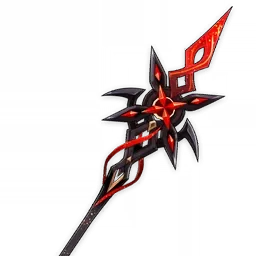
The Crimson Moon Dynasty is the older of Khaenri'ah's two known ruling dynasties, the line under which a "crimson moon" (the Iridescent Moon) shone over the subterranean kingdom before the Eclipse Dynasty supplanted it during the Archon War. Its priorities differed from the Eclipse Dynasty's. The Art of Khemia (life-creation alchemy) and the Beastmaster Knights (black-wolf "Darksprite" warbeasts created via alchemy) were Crimson Moon mainstays, later supplanted by the Eclipse Dynasty's mechanical engineering and research into forbidden knowledge. [1] [3]
The dynasty's most important institution is the original House of the Hearth, an orphanage founded at the suggestion of a Crimson Moon era sage to house "children who came from beyond this world" in anticipation of beings who could transcend the gods. Its pre-Cataclysm members included Perinheri, Hleobrant, and Angelica. Perinheri is the hero of the legend, a native of Khaenri'ah and in his day the leading figure among the Kingdom's knights. Hleobrant, Perinheri's best friend and a knight of the Crimson Moon era, is the Innamorato of the manuscript title Hleobranto Innamorato. Angelica was a Liyue-born foreign princess, the daughter of a priestly line, displaced when Morax, Deus Auri, defeated her nation; she refused to submit to the new Liyue god. Her chosen name means "one who is as a divine emissary," and the Perinheri footnotes note it may have been "Lady Miaoyin" or "Tianwang Nu" in the original Liyue naming. [2] [3]
The two-dynasty structure
Layer | Crimson Moon Dynasty | Eclipse Dynasty |
|---|---|---|
Era | Older; the original Khaenri'ahn ruling line | Later; supplanted Crimson Moon; ended at the Cataclysm under King Irmin |
Cosmological identity | The "crimson moon" / Iridescent Moon | The "dark sun" / Black Sun (黑日, Hēirì) |
Priorities | Art of Khemia + Beastmaster Knights + subterranean astrology via Sea-of-Stars reflection | Mechanical engineering + Ruin Machines + forbidden-knowledge research |
Pupil evidence | Red X-shaped pupils within black irises are specific to Crimson Moon descent | Four-pointed-star pupils are a general strong-Khaenri'ahn marker and do not establish Eclipse descent by themselves |
Named figures | Perinheri / Hleobrant / Angelica / Njord / Alf / an Alberich-Clan commander / Arlecchino's bloodline / Tholindis | King Irmin / Rerir (as Eclipse-Dynasty secret agent) / Dainsleif / Kaeya / Halfdan / Chlothar Alberich / Pierro |
Succession event | Fell with "the crimson moon set, and the dark sun descended into a yet darker dusk" (per Perinheri Vol. 1; pre-Perinheri (II); during the Archon War) | Fell during the Cataclysm 500 years ago |
The transition from Crimson Moon to Eclipse was a cultural pivot rather than a sudden dynastic coup. Per the Perinheri Vol. 2 footnote on the Darksprites, "alchemy and the Beastmaster Knights were a mainstay during the Crimson Moon Dynasty, but interest in mechanical engineering during the Eclipse Dynasty would cause it to fall behind." The shift away from life-creation alchemy, beast cultivation, and subterranean astrology toward mechanical engineering, Ruin Machine automation, and Abyssal forbidden knowledge is the central cultural split in Khaenri'ah's pre-Cataclysm history. [3]
The pupil distinction is asymmetric. Red X-shaped pupils remain specific evidence for the Crimson Moon bloodline. Four-pointed-star pupils show strong Khaenri'ahn heritage more generally; they cannot, without separate genealogical evidence, assign a person to the Eclipse Dynasty.
The Crimson-Moon-era orphanage - original House of the Hearth iteration
Perinheri Vol. 1 (also titled Hleobranto Innamorato) is framed as a legendary tale "based on a legendary story known throughout Khaenri'ah", so its accuracy is uncertain. Set during the Crimson Moon era, it gives this founding sequence: [2]
Due to the Kingdom's unique position, things from outside this world were always leaking into it. The Kingdom's weapons would wipe out the calamities slipping in, but what of all the other objects? Such as, say, a child who may have come from some destroyed world?
A sage proposed to the great ruler that an institution be established to receive such children. The primary text anticipates "gods from beyond the so-called ocean, or rather, beings who could transcend the gods." That resembles later Descender language, but the passage neither uses the term nor dates the proposal relative to the Primordial One's arrival. The ruler gave implicit permission, and the institution housed Khaenri'ahn orphans and foreign arrivals alike. [2]
The orphanage's rite in the Crimson Moon era, Perinheri's first remembered initiation, was built around a hearth-rebirth ritual: [2]
The young Perinheri's first memory was that of being asked by the grown-ups to crawl through a dark corridor. This passage might have been a chimney for winter fires, for it was filled with coal ash, and there was not a single crack in it through which smoke or light could pass through... When Perinheri reached the end at last, the exit had not opened yet. He knocked, only for the grown-ups to coldly ask: "Are you dead?"... Until he at least shouted, "Yes, I'm dead!"... Perhaps it was the fear brought on by the darkness combined with hunger and exhaustion, but Perinheri did indeed see an illusion. The crimson moon, hanging high in the pitch-dark night sky, suddenly turned around, revealing itself to be a titanic, horrified eye. The adults opened the door and embraced the soot-covered Perinheri: "You have traversed the fire of two worlds within the hearth, and here you are reborn."
This pronouncement of rebirth, the "fire of two worlds within the hearth", is the source of the modern House of the Hearth's name. The vision of the Iridescent Moon as a titanic, horrified eye is also an esoteric experience of the Crimson Moon era, close in spirit to the Khaenri'ahn astrologers' tradition of reading the reflected Sea of Stars, which "glimpsed in the inverted image of the false sky the origin of all the world's fate." [8]
Pierro implies, per Arlecchino's Character Story 5, that this orphanage of the Crimson Moon era is the original form of the present-day House of the Hearth, and that its line runs from the Crimson Moon era through the Eclipse Dynasty, the Cataclysm, and post-Cataclysm Fontaine to the modern Fatui-aligned House. Pierro is feasibly the one who re-established the institution under the Fatui in modern times. The primary text does not specify when or how the continuity was preserved across the change of dynasty and the Cataclysm, but Pierro's side asserts the line of descent. [4]
Bloodline + curse mechanism - Balemoon Bloodfire
The Crimson Moon Dynasty's bloodline marker is red X-shaped pupils within black irises, preserved in the iconography of the Crimson Moon's Semblance weapon, the designs of a handful of NPCs in Sumeru's desert world quests, and the depiction of Arlecchino's combat states aligned with the Crimson Moon. [8]
The lineage's signature combat power is named Balemoon Bloodfire (per Arlecchino's Vision Character Story). It is a curse running through the veins of Crimson Moon Dynasty descendants that draws on Abyssal energy and slowly corrupts the user. If the corruption ever reaches the user's heart, they become a completely different person. Arlecchino learned of this threshold and exercises extreme caution when using the curse. [5] [6]
The Balemoon Bloodfire is the lineage's signature. It makes a Crimson Moon descendant recognisable in combat and gives them access to Abyssal energy, a capability the Eclipse era pursued through mechanical engineering and forbidden knowledge rather than through the bloodline. It is also what allowed Peruere (the young Arlecchino) to absorb Clervie's shadow. Per the Fandom Clervie page, Peruere's "unique constitution" (her Crimson Moon Dynasty descent) is how Clervie's shadow merged with the other shadows the Balemoon Bloodfire flames had consumed over the years.
The Eclipse Dynasty's suppression of Crimson Moon descendants
Per the Fandom Khaenri'ahn Dynasties page, King Irmin, the last Vinster King of the Eclipse Dynasty, viewed the Crimson Moon Dynasty's surviving descendants as a threat to his rule and ordered all of them killed, including young and distant relatives. [1]
The material since Welkin Moon names two Crimson Moon descendants who survived:
- Arlecchino (born Peruere): Fourth of the Eleven Fatui Harbingers, a Crimson Moon Dynasty descendant, unaware of her own heritage until she met Pierro, who disclosed it to her. That disclosure is the personal root of her loyalty to Pierro, a former royal mage of the Eclipse court. Her Balemoon Bloodfire curse is the lineage's signature, and she is the most visible present-day Crimson Moon descendant in the canon. [4] [5] [11]
- Tholindis: part of a sub-branch of the Crimson Moon Dynasty, her family distantly related to the main line. She was on Irmin's list for pre-emptive assassination. Her fiancé Rerir was originally a secret agent of the Eclipse Dynasty whose primary mission was to hunt down and assassinate remaining Crimson Moon Dynasty descendants, Tholindis included. Rerir broke with Irmin over the order to assassinate Tholindis, and that break became one of the triggers for the raid Dainsleif convened to rescue Vedrfolnir, which became the Five Sinners event. [7] [6]
The rivalry between the Crimson Moon and Eclipse dynasties runs beneath present-day House of the Hearth politics (Arlecchino learned her heritage from Pierro, not through any Fatui inheritance) and beneath the Sinners of the Wild Hunt era (before he was a Sinner, Rerir's job was hunting Crimson Moon descendants). The split between the two dynasties actively drives several present-day character arcs; it is more than a difference of history and aesthetics.
Chapter VII Act IV: the Crimson Moon and Death
A Rekviem for the Underworld (Version 7.1) ties the dynasty's moon to the authority of Death. Arlecchino explains that "the authorities of Life, Death, Time, and Space all belonged to the moons," that "Of the three, the Iridescent Moon received the greatest share of the authority of Death," and that once the Heavenly Principles had reclaimed and redistributed those authorities, "the broken Crimson Moon merged with the Abyss, which simulated its former authority." The authority of Death, she says, now "resides within the Crimson Moon and its people's bloodline." The act speaks of the Crimson Moon and its "lineage" without naming the dynasty. [12] [13]
Khaenri'ah's scholars studied it too. Pierro says that "Back in the days of Khaenri'ah, the Universitas Magistrorum never ceased its research into the Crimson Moon," work that "under Hroptatyr's leadership was also focused on the Crimson Moon," and Hroptatyr's notebook records that "The Crimson Moon does possess an authority related to Death." Snezhnaya now builds a new Delusion on the same power, with Arlecchino, "a descendant of the Crimson Moon," as its key. [12]
The act also puts the dynasty's best-known institution on a new footing. As the terms of Arlecchino's cooperation, the House of the Hearth "will become an independent organization, no longer serving as a Fatui intelligence agency," "no more children will be trained as spies," and its members "will follow your leadership in the name of the Crimson Moon." Pierro says the deal "strikes at the fundamental contradiction of the House of the Hearth: the inseparable mix of love and exploitation." [12]
The bloodline page
The descendants of the dynasty also have a race page at Crimson-Moon-blooded, which handles the bloodline side. [10] That page holds the two bloodline traits: red X-shaped pupils within black irises, and the Balemoon Bloodfire curse drawing on Abyssal energy (per Perinheri Vol. 1+2 and Arlecchino's Vision Character Story). It also holds the roster of individual descendants (Arlecchino [Peruere] as the main case; Tholindis as a sub-branch case per Welkin Moon Act IV Part 1 "All Is Foretold") and sets out how the Crimson-Moon-blooded differ from the wider human population, from the hilichurls under the curse of the wilderness, and from the Five Sinners of the Eclipse era. [10]
The dynasty as a ruling line, its history, belongs here: its cultural priorities (the Art of Khemia, the Beastmaster Knights, subterranean Sea of Stars astrology), the succession line ("the crimson moon set, and the dark sun descended into a yet darker dusk"), the founding of the original House of the Hearth at a Crimson Moon era sage's suggestion and its hearth-rebirth ritual (per Perinheri Vol. 1), the Iridescent Moon cosmology of its tenure, and the suppression order under King Irmin. The race page says who they are; this page says what they did and what supplanted them.
Imagery and cosmological associations
The Iridescent Moon, the name of the crimson moon that shone over Khaenri'ah during the dynasty's tenure, has been visually associated with imagery of Khaenri'ah's disaster throughout the broader narrative: [9]
- The "We Will Be Reunited" story trailer depicts Lumine (as the Traveler's Sibling) recounting the Cataclysm under a sky that evokes the crimson moon.
- Ei's Plane of Euthymia, created after Ei witnessed the events at Khaenri'ah during the Cataclysm, carries crimson moon visual cues that map onto the dynasty's cosmological identity.
- The "La Luna Rossa" (Italian: The Red Moon) achievement, earned by completing the Safhe Shatranj chessboard in the ancient desert kingdom of Sumeru, references a "blood-red moon," which potentially ties the fall of Gurabad to conditions associated with the Crimson Moon Dynasty.
- Dainsleif's official introduction line "Chalk pursues gold [...] the eclipse is swallowed by the crimson moon" is a poetic allusion to the two dynasties. The original Chinese phrase 复仇 (fùchóu, "to take revenge") translates more directly as a story of revenge, and the dynasties' rivalry continues into the political imagination after the Cataclysm.
The Crimson Moon's Semblance weapon description references the cosmology of the inverted false sky, "the crimson moon's gleaming... an inverted reflection of the false sky." The weapon's iconography preserves the red X-shaped pupil motif of the dynasty's bloodline marker. [8]
What canon has not surfaced
- The dynasty's founding. Its origin, when it began, who its founding ruler was, and how the Iridescent Moon came to "shine" over the underground realm, is all held back.
- The cause of its fall. The succession line "the crimson moon set, and the dark sun descended into a yet darker dusk" and the Crimson Moon's Semblance reference to the cosmology of the inverted false sky suggest the fall involved some astrologer's cosmological reading, but the mechanism (a Sovereign-era event, a Heavenly Principles intervention, an internal Khaenri'ahn coup, or some mix) is not disclosed.
- Whether the orphanage's "beings who could transcend the gods" are the category later called Descenders. Released text identifies the Heavenly Principles as First and the player-character Traveler as Fourth, and Fandom counts Nibelung as Second. Saarelainen is the strongly implied Third candidate; Nibelung's re-entry as the reason for his numbering is inference. The Perinheri passage identifies none of them.
- Whether Crucabena was a Crimson Moon Dynasty descendant. Crucabena was Arlecchino's predecessor as Knave, and her Khaenri'ahn blood is established (per the Abyss Order page). It is not disambiguated whether she was a Crimson Moon Dynasty descendant in her own right, as opposed to an Eclipse Dynasty descendant who inherited the Crimson Moon framing through her role in the House of the Hearth.
- Other surviving Crimson Moon descendants. Arlecchino and Tholindis are the two named cases; no roster exists for the wider set who survived Irmin's suppression order and the Cataclysm. Rerir's career before he became a Sinner, hunting Crimson Moon descendants, suggests there were enough of them to warrant a dedicated program of Eclipse Dynasty agents.
- The Iridescent Moon's present-day status. Whether the crimson moon that shone over Khaenri'ah is the same as the broader Three Moons cosmology's failed moons, or a separate body, was not disambiguated before Chapter VII Act IV. There Arlecchino counts the Iridescent Moon among "the three" moons and speaks of "the broken Crimson Moon" merging with the Abyss; the passage implies, without quite stating, that they are one body, which is how Fandom's Iridescent Moon article reads it. [12] [9]
The Crimson Moon Dynasty is the older half of Khaenri'ah's dynastic history. It was the era of alchemy, beastmasters and astrology that anticipated offworld beings who could transcend gods, founded the orphanage that would eventually become the House of the Hearth, and was supplanted by the Eclipse Dynasty. The text does not prove that those anticipated beings were the later numbered Descenders. Two Crimson Moon descendants, Arlecchino and Tholindis, survive into the present record.
Deep dive
The race page Crimson-Moon-blooded carries the Balemoon Bloodfire mechanics, the roster of individual descendants, and how the bloodline differs from adjacent groups. Khaenri'ah covers the broader civilization the dynasty preceded, and House of the Hearth covers the post-Cataclysm institution that descends from the original of the Crimson Moon era. Arlecchino is the most visible present-day descendant, and Diluc surfaces the lineage through their acquaintance in Fontaine after AQ IV. The Descenders page holds the framework the orphanage was built to receive; Surtalogi covers Rerir's career as an Eclipse Dynasty agent hunting Crimson Moon descendants and his later status as a Sinner; and Heavenly Principles covers the present-day cosmology against the order before the Heavenly Principles, which the dynasty may have operated against.