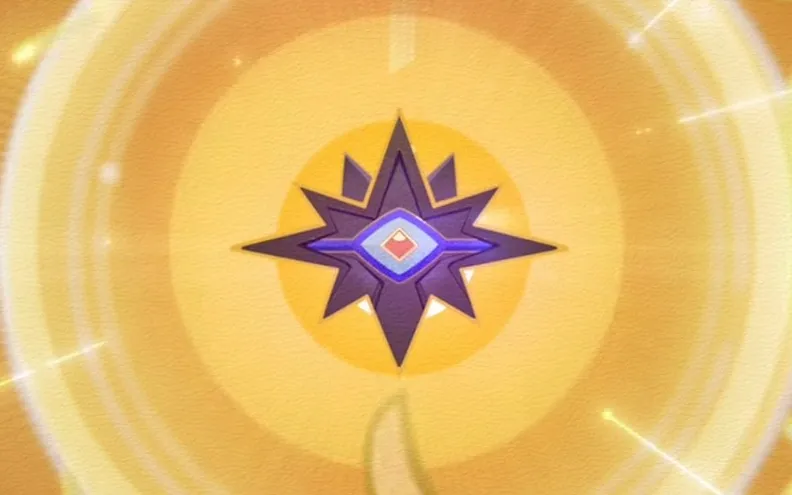
The Seven Pillars were the retainers of King Deshret, the desert god of ancient Sumeru. Their in-game notes give each a title: Heryshaf, "the Minister of Ministers, the Goat King"; Thoth, "the Scribe of Scribes, the Ibis King"; "the Captain of Captains, Sobek the Crocodile King"; "Saint Bennu, the Most-Radiant"; "Saint Shesepankh, the Most-Holy"; "Saint Hermanubis, the Greatest of Sages"; and Apep, the Dendro Dragon Sovereign, who carries the Pillar title only "in some corners of the world." [13] [12]
The roster is older than Song of the Welkin Moon. The weapon Dialogues of the Desert Sages already runs through the seven "sages" by name or title, from Heryshaf, "the head of the Seven Sages," to Hermanubis, "the last of the Seven Sages to be mentioned." What Welkin Moon Act IX adds is the living Pillars acting together again. [14] [1]
Who leads them
On the record, Heryshaf does. Dialogues of the Desert Sages calls him "The right hand of King Deshret, the head of the Seven Sages, the minister of ministers," and in Headlong Into the Sands Sethos says, "Records say he was the deputy king of the desert sands, chief among the Seven Pillars." His note makes him "the executor of King Deshret's authority" who "prefers to remain neutral." [14] [15] [13] [11]
Thoth's claim to the chair is his own. Nefer's character story remembers him boasting that he was "elevated to lead the great 'Seven Pillars of King Deshret,'" and Nefer "didn't believe these tales for a moment." His note says he "embodies the wisdom of King Deshret" and that "Certain texts record him as a flatterer and a god of deceit." [16] [13] [10]
Heryshaf, Thoth, and Sobek were also the trio King Deshret imprisoned in Aaru. Sethos calls them "the three retainers of Al-Ahmar," and Sobek says they were "once imprisoned for our iniquity." Fandom notes that the Chinese name for the three means "Three Sycophantic Ministers." [17] [12]
The seven
Pillar | Title | Where they stand by Welkin Moon Act IX |
|---|---|---|
Heryshaf | Minister of Ministers, the Goat King | Imprisoned in Aaru until Act IX. Thoth calls him "Goatie." |
Thoth | Scribe of Scribes, the Ibis King | Imprisoned in Aaru until Act IX; reached Nefer through a cat at his temple. |
Sobek | Captain of Captains, the Crocodile King | Imprisoned in Aaru until Act IX. Thoth calls him "Croco." |
Bennu | Saint, the Most-Radiant | An "intelligent construct" that guards the gates of Aaru; fell still after King Deshret's death. |
Shesepankh | Saint, the Most-Holy | An "intelligent construct" entrusted with "overseeing all the Jinn of the world"; fell still after King Deshret's death. |
Hermanubis | Saint, the Greatest of Sages | Dead. The only Pillar raised from humanity; he founded the Temple of Silence. Cyno votes as "Hermanubis's representative." |
Apep | Dragon King, the supreme spirit | Alive. King Deshret and the other Pillars gave her the title; she "dismisses it with disdain." |
"Goatie" and "Croco" are Thoth's nicknames for his two fellow prisoners, not extra Pillars. At the Mausoleum he says, "you've even put a smile on Goatie and Croco's faces," and Paimon's earlier description of Aaru as a prison "where the Goat King, Ibis King, and Crocodile King are locked up" names the same three. [17]
Apep, the Pillar who refused
King Deshret counted Apep among his Pillars. She never agreed. "Al-Ahmar would insist the Dendro Dragon Sovereign was one of us, but the dragon herself rejected that idea," Thoth says in Headlong Into the Sands, and he adds that "although there were Seven Pillars, one was forever absent." Her note says the title "was devised by King Deshret and the other six Pillars, and Apep herself dismisses it with disdain," and that the Dendro Dragon Sovereign "stands opposed to King Deshret." The weapon text puts it more briefly: Apep is the dragon "who never counted itself among the Seven." [15] [13] [14]
That refusal shapes the Act IX vote. Shesepankh asks "what is the point of a 'unanimous vote' when we know that the last of the Seven Pillars, the Dendro Dragon Apep, will never communicate with us?" Sobek answers that "Apep is, in fact, healing the Dendro Archon as we speak." [17] [3]
She is, in a parallel scene. After Nahida collapses from entering Irminsul, the Outlander brings her to Apep, who agrees to help because "to receive aid without repaying it would likewise tarnish a dragon's dignity" and restores her through the Heart of Oasis. [18] [3] [4]
The vote to reopen Aaru (Welkin Moon Act IX)
In Ancient Shadows Re-Emerge, the Akademiya needs Aaru opened, and that takes all seven. Thoth asks Nefer for the answer King Deshret wanted to his three questions, and she gives it: "Time." The three retainers are released and regain their true forms. [17] [9]
Heryshaf then wakes the other two. "Saint Bennu, responding to your call. Three Kings detected, initiating autonomous will...," Bennu announces, and Shesepankh answers the same way. "Opening Aaru requires the unanimous consent of the Seven Pillars," Bennu warns. When the two saints ask which of the three kings can vouch for Sobek's claim about Apep, Heryshaf names "the Ibis King, Thoth" and suggests they "simply let Thoth bear accountability." Shesepankh misses "the days when Hermanubis was still around" and then approves "the Goat King's proposal," and Bennu approves too. [17]
Heryshaf sums up the count: "Hermanubis's representative and the Dendro Dragon Apep made their choice ahead of time, while the Goat King, Ibis King, and Crocodile King have also granted permission to liberate Aaru." Then: "By the grace of His Majesty, guided by his wisdom and will... Let the gates of Aaru be reopened." The first soul to come out is Jebrael. [17] [1]
The Three Kings after Act IX
The three freed retainers keep working with Sumeru. In Act X, once Irminsul has been brought to a halt, Thoth, Sobek and Heryshaf each remark on the plan, and Nahida tells them: "I am grateful to you three for your help. Only thanks to you were we able to extend Aaru's interference capabilities to cover all terminals." [20]
In Version 7.2's World Quest From Trees to a Forest, Cyno announces that "The Akasha system will remain active for the duration of the operation. Supported by the power of the Three Kings, the Pari, and the Aranara, our communications network will cover Sumeru in its entirety." [21] He does not say who the Three Kings are. The saints hailed Heryshaf, Thoth and Sobek by that name in Act IX ("Three Kings detected"), so the reading fits, but the quest leaves it unstated. [17]
King Deshret is a separate god, not a Sovereign
King Deshret is a god, not one of the Seven Sovereigns. The Dendro Sovereign is Apep, whose note sets her "opposed to King Deshret." [13] [7]
Deshret also did not rule alone. "In an age where kings vied against one another for power, King Deshret allowed his throne to be shared with two others," says the artifact Amethyst Crown, which goes on to name a "Lord of Flowers"; the wiki's Sumeru pages identify the three as King Deshret, Greater Lord Rukkhadevata, and Nabu Malikata, the Goddess of Flowers. [19] [2] [6]
Two of those three echo into Act IX. Nahida is the Dendro Archon after Rukkhadevata, and Nicole reveals that the god remains the Fatui injected into Collei were "the remains of Nabu Malikata... the Goddess of Flowers." King Deshret's own legacy survives through the Pillars and Aaru rather than through a fragment-bearer. [8] [17] [1]
The Akademiya's sages, introduced in the same act
Act IX also introduces the Akademiya's current sages. "These gentlemen and I are the six current sages of the Akademiya," Naphis says; he and Baladhuri are "part of the old guard," and the four who took office after Azar fell are Alkindi of Spantamad, Firnas of Kshahrewar, Shakir of Rtawahist, and Rushd of Haravatat. Fandom lists Naphis as the Amurta Sage and Baladhuri as the Vahumana Sage. [18] [5]
Related
The act itself is covered in As All Falls to Emptiness. The three freed kings have their own pages, Thoth and Heryshaf, and the Pillar who refused is Apep. Nefer carries Thoth's gift and gives the answer that frees him; Nahida is the Dendro Archon Apep restores. The wider Sumeru history runs through Sumeru and the Sovereign-to-Archon transition, and the sages through Sumeru Akademiya.