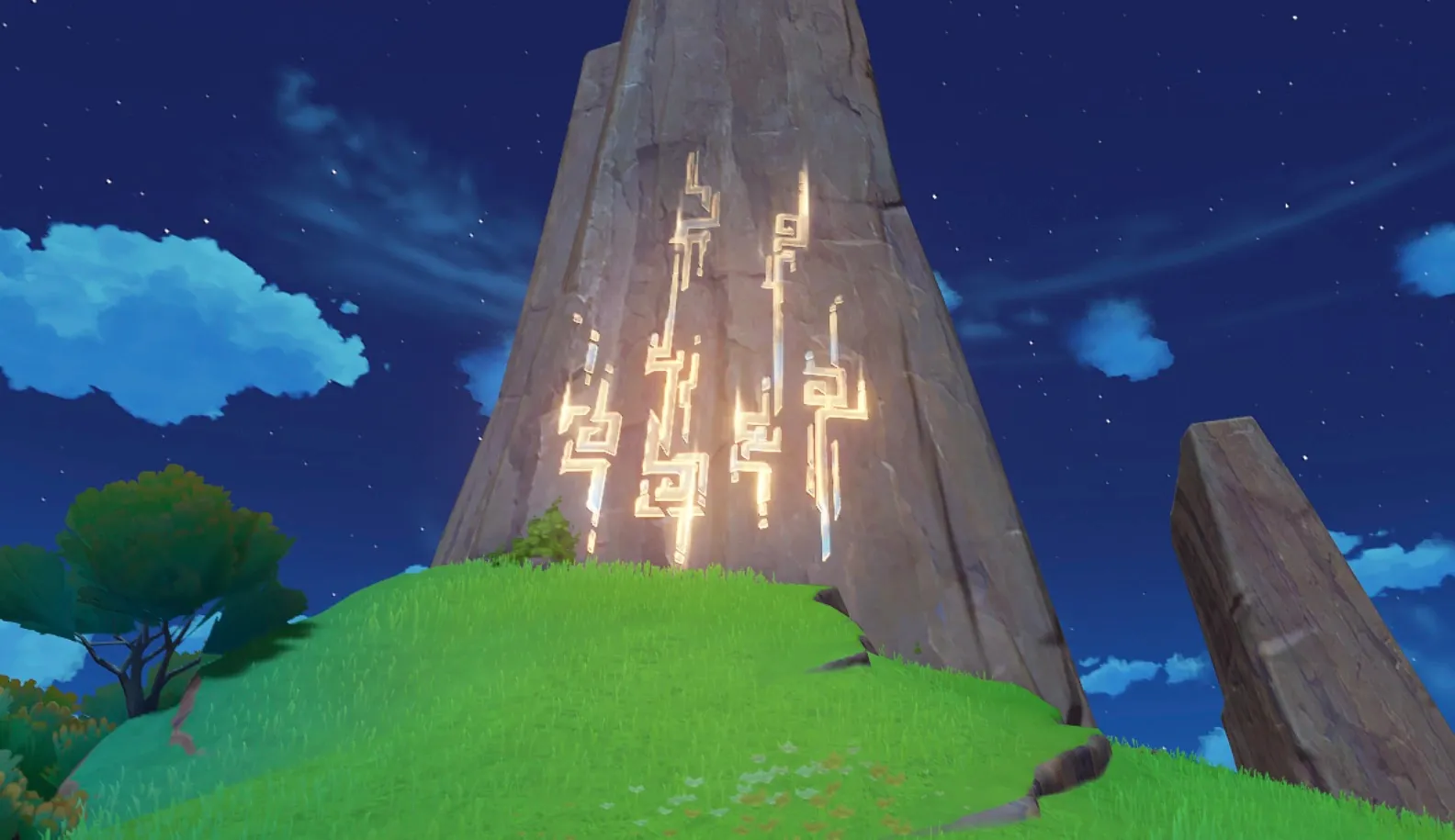
The Iridescent Inscription is the language of the ancient dragons of Natlan, a symbol system much like a programming language that the dragons' pre-human civilisation used to wield Phlogiston, Teyvat's primordial computronium. In present-day Natlan, Iridescent Inscriptions appear as glowing golden symbols carved into solid surfaces, floating freely in the air, or as broken fragments the Outlander interacts with by touching them. The inscription may then lead the player somewhere (Seelie-style), activate a mechanism, teleport the party, or display readable text. [1] [3]
The Iridescent Inscription is a deep dragon language, and it should be kept distinct from two neighbouring concepts. One is the Loom of Fate, with its three meanings (the Abyss Order's device, the pre-Cataclysm Khaenri'ahn concept, and the reading tied to the Heavenly Principles). The other is the Wayob, Natlan's tribal ancestral spirits, who already existed when the Children of Echoes used the inscription against the Abyss during the Cataclysm. The distinction matters because the inscription is a dragon language, not a device for engineering fate.
Primary-text disclosure
In-game text frames it this way: "Iridescent Inscriptions are the language that the ancient dragons of Natlan once used to wield the primal fire, Phlogiston." Since Phlogiston is a form of computronium (programmable matter considered the most efficient form of storing information), Iridescent Inscriptions are "essentially a programming language that allowed the dragons to manipulate matter at an atomic level." [1] [2]
Its uses are broad and not limited to sealing the Abyss. The dragons used Iridescent Inscriptions to:
- Record information. Various Phlogiston recordings exist in Natlan's ruins from the dragon civilisation. [2]
- Control all types of Secret Source Mechanisms. Per the 5.5 World Quest Where Once There Was a Calculation Array (Series Chronicler of the Crumbling City), Iridescent Inscriptions activate Secret Source Beam Cannons, Secret Source Servants, and Secret Source Dragon Idols. [7]
- Perform arithmetic calculations (per the same calculation-array chain).
- Convert Phlogiston between its different forms: Liquid Phlogiston, Solid Phlogiston, Gaseous Phlogiston, Spiritways.
- Change a dragon's own appearance (per the Chronicler of the Crumbling City chain).
- Create Spiritways, the dragon civilisation's Phlogiston transport network (per the A Finale Emberforged chain).
- Combat the Abyss. The primary text shows this use during the Cataclysm in the 5.0 Series Shadows of the Mountains, two chains set in Tequemecan Valley.
The inscription is therefore a general-purpose toolset, not an Abyss-sealing device the Children of Echoes happened to invent. The tribe deployed one inscription for sealing, but the language itself was used across the dragons' entire pre-human civilisation. Present-day Iridescent Inscriptions are "scattered across Natlan" and "not a common sight". Modern researchers have made "very little progress on deciphering them", and the Saurian Relics Association has issued at least one sizeable research bounty on inscription decipherment. [1] The language is legible to dragons and related creatures (per Little One's Saurian instinct for sensing the Inscription in Beneath the Crystal Rock) but largely inaccessible to modern humans without dedicated scholarship. [5]
Children of Echoes / Tequemecan Valley deployment
In the primary text, the Cataclysm-era use of an Iridescent Inscription to seal the Abyss is the sealing pillar of the Greater Shadow Pin at Tequemecan Valley. It appears in the 5.0 Series Shadows of the Mountains, whose two chains are Beneath the Crystal Rock and Peace to the Slumbering. [5] [4] [8]
The apparatus is an Iridescent Inscription mounted on a sealing pillar anchored by the Pin, inside a chamber coupled to Solid Phlogiston. During Beneath the Crystal Rock, the Children of Echoes storyteller Titu diagnoses the problem: "The Iridescent Inscription on it has lost its constraining powers... the Abyss's influence has squeezed it out of the stone pillar." The chain likens the inscription to an eggshell: "Think of the Inscription as an eggshell that has been shattered by the expanding Abyss. We'll need to find the broken shards and fix the shell - only then can the Abyss within be sealed away." [5] When Abyss pressure rises, the inscription's power fragments and slips off the Pin. The apparatus then has to be reassembled from scattered fragments retrieved from Solid Phlogiston Crystals, while the party fights Rockfond and Thundercraven Rifthound Whelps.
The Peace to the Slumbering part of the chain widens the picture. The inscription's central pillar is where the Abyss is sealed, and visible "Abyss leakage" attracts the inscription. The same surge of Abyss pressure that scattered the Lesser Shadow Pins above also shattered the power of the central Iridescent Inscription. The Outlander's party reassembles five Inscription Fragments and unseals the apparatus, granting a rest centuries overdue to the Khaenri'ahn soldiers Zephaniah and Irizar. They had been sealed alongside the Abyss through centuries of torment, as allies of the Children of Echoes against the Abyss. [4] [8]
The Children of Echoes are the Nanatzcayan tribe of Tequemecan Valley, Natlan. Their present-day mastery is Phlogiston Engraving, the human imitation descended from the dragons' original Iridescent Inscription language. Per Sundjatta's Phlogiston Forge Notes, an interactable woven scroll found outside Xilonen's workshop after the Flamelets quest step: "the techniques of phlogiston-forging originated from the ancient dragons. In their era, there existed a more marvelous forging method beyond present imagination, one that directly forged Phlogiston into different materials. Such mastery was witnessed by Sakkuk, and the founding pioneer, Ixquieh, earned her title as Hero of the Forged Flame by truly understanding how to smelt phlogiston itself. She was no dragon - but having had no parents to grant her a name, she named herself in draconic tongue and style." [6]
The Children of Echoes' present-day traditions of Phlogiston-forging and Name Engraving therefore descend from the ancient dragons' mastery of Phlogiston. They are inherited human imitation, not the tribe's own invention. Phlogiston Engraving is also far older than the Cataclysm-era sealing in Shadows of the Mountains. In Tracer No Tracing, Chikya traces its origin to "the days when Natlan was still ruled by a Pyro Dragon," when the Sage of the Stolen Flame stole the flaming seed of Phlogiston and humans began imitating the way dragons controlled it. [14] The chain's primary text consistently names the apparatus the "Iridescent Inscription" (the dragon language) rather than the "Phlogiston Engraving" (the human imitation), which places the sealing pillar on the older dragon-language layer. The Children of Echoes deployed what they inherited; they did not invent it.
Wayob successor framing
The Wayob are older than the Tequemecan seal. Per the Wayob page, the Wayob (Natlan's tribal ancestral spirits) coalesced during a period of Abyssal pressure after Xiuhcoatl awakened. Legba explains this in To the Night, What is the Night's: "The Wayob also gradually took shape during that time, totems and consciousnesses created by the congregation of each tribe's living and dead." [9] The seal came much later, during the Cataclysm five centuries ago. In Titu's telling, the Night Kingdom was badly damaged in that disaster and "The Wayob could not hear the tribes' cries...". In the end the tribe's warriors and Saurians "found a way to use the Iridescent Inscription" to seal the Abyss. [5]
Traore's Boundary Marker Inscription in Peace to the Slumbering is left "to seek instruction from the ancestors and Wayob". By the chain's own primary text, that places Traore after the Wayob formed, and with him the sealing at the Greater Shadow Pin that he presided over with the Khaenri'ahn pair. The inscription deployment is therefore:
- Written in the older dragon language: the sealing pillar uses the Iridescent Inscription, not the Phlogiston Engraving of the tribe's Name Engravers, even though Phlogiston Engraving already existed.
- Later than the Wayob's formation: the Children of Echoes who deployed the apparatus worked within the Wayob framework that arose after Xiuhcoatl, with Traore explicitly invoking the Wayob alongside ancestors.
The language and the seal sit at different points in this order. The Iridescent Inscription itself is older than its human imitation, Phlogiston Engraving, and as the language of the ancient dragons it is probably older than the Wayob too, though no source dates it against them directly. The Tequemecan seal that uses it is much younger than the Wayob. The obsidian medium in To the Night, What is the Night's is not an older layer either. Legba calls it "An ancient tool by which our forebears made contact with the Wayob," and adds that "Today, a stable connection has been established with the Night Kingdom, and so a medium has long been unnecessary." [15] It belongs to the Wayob era, which began in the days after Xiuhcoatl awoke. The Iridescent Inscription is probably the oldest of these layers. [9] [11]
The handoff between layers is not a clean replacement. The Wayob did not "replace" the Iridescent Inscription; they coalesced alongside the older layer and took on the protection of the tribes by other means (Ancient Names, providing Nightsoul, Wayob Manifestation). The Tequemecan seal shows the two layers working together: Traore's people built it in the dragons' language long after the Wayob formed, he sought the Wayob's instruction in his tablet, and he left his Boundary Marker Inscription expecting future Children of Echoes to find the seal still active. The Iridescent Inscription is probably the deeper layer of the two.
What the Iridescent Inscription is not
The Iridescent Inscription is a deep, ancient dragon language. It is distinct from all three meanings of the Loom of Fate, and those distinctions matter. [10]
- Not the Abyss Order's device and the Sibling's project. The Loom of Fate's first meaning is the Abyss Order's operation or device: Chlothar Alberich's "Loom of Fate" naming for Caribert, the device for weaving Ley Lines that followed the Hydro Throne, the Sibling's negotiation with Yohualtecuhtin over the Night Kingdom in AQ V Act VI, and the Atlas of the New World. The Iridescent Inscription is not a device of the Khaenri'ahn Abyss Order; it is the language of Natlan's dragon civilisation, older than both Khaenri'ah and the Abyss Order.
- Not the pre-Cataclysm Khaenri'ahn engineering concept. The Loom of Fate's second meaning is the pre-Cataclysm Khaenri'ahn language for engineering fate (references connected to Surtalogi; the Welkin Moon Act IV material on the Vedrfolnir rescue and the stolen Abyssal share). The Iridescent Inscription does not engineer fate; it programs Phlogiston. It controls matter and does not rewrite destiny.
- Not the Heavenly Principles reading, in which the Loom is Teyvat's operating system. The Loom of Fate's third meaning is the shorthand used in theories for the deeper layer of rules behind Teyvat's prophecies, curses, Vision distribution, and divine restrictions. The Iridescent Inscription does not modify that layer of rules; it works within the Phlogiston that the Heavenly Principles used as the basis for Elemental energy (per Yohualtecuhtin's disclosure in AQ V Act IV "Beneath the Secret Source"). [2]
The Iridescent Inscription, then, is the dragons' programming language for Phlogiston. During the Cataclysm one instance of it sealed the Abyss, one use among its many functions; the Children of Echoes inherited it; and it is strictly distinct from all three fate-engineering meanings the Loom of Fate page preserves. Conflating them, especially through the inscription's use against the Abyss, would turn a language into a device for engineering fate, which the primary text does not support. Fighting the Abyss is one application of a general-purpose toolset, not a parallel to the ambitions of the Abyss Order's Loom as a device.
Open questions
- Whether the Cataclysm-era deployment in Shadows of the Mountains was authored by the ancient dragons and inherited by the Children of Echoes, or co-authored by the tribe drawing on the dragon-lineage instinct of Tepetlisaurus Saurians. The chain's primary text consistently names the apparatus the Iridescent Inscription (the dragon language), but Traore's Boundary Marker Inscription, written by the Children of Echoes, sits alongside it. The language is the dragons'; the tribe's contribution to the specific deployment is partial.
- Why the tribe sealed the Abyss in the dragons' language. Phlogiston Engraving goes back to the days of the Pyro Dragon's rule, long before the Cataclysm, yet the sealing in Peace to the Slumbering uses the Iridescent Inscription, and neither chain says why.
- Whether the modern Saurian Relics Association's research bounty on Iridescent Inscription decipherment has produced any decipherments. Modern researchers have made very little progress, and the chain's primary text does not report any decipherment.
- Whether Yohualtecuhtin or other Night Kingdom entities are still fluent in the dragon language, or whether they work strictly through the Wayob, who took shape in the days after Xiuhcoatl awoke. Two such entities speak to the Outlander: the "Beast With Fur Like That of Night" in Peace to the Slumbering and the "Projection of an Obsidian Tablet" in To the Night, What is the Night's. Fandom lists both among the Night Kingdom entities that "may be Wayob". [16] Neither quest shows a Night Kingdom entity using Iridescent Inscriptions directly. [4] [15]
The Loom of Fate's three meanings are sorted out at The Loom of Fate. The primary text runs mainly through Peace to the Slumbering and Beneath the Crystal Rock, the successor framework through Wayob, and the Saurians' dragon lineage through Saurians. The Phlogiston background is linked under Further Reading, Natlan regional context is at Natlan, and the order of the Heavenly Principles that the inscription pre-dates is at Heavenly Principles.