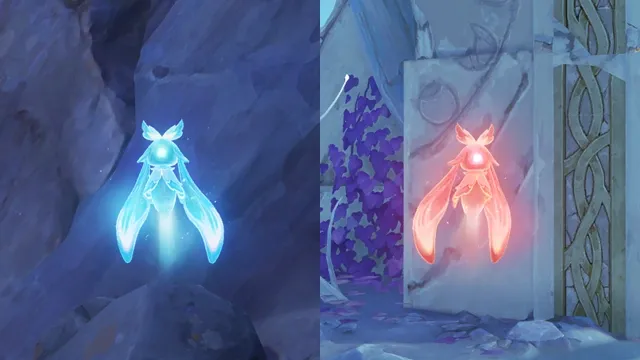
Kuuhenki are the small kuuvahki-state creatures of Nod-Krai, beings empowered by polarised kuuvahki energy. [1] They show up in two ways: as a transient form the player can briefly take by soaking up kuuvahki near kuuvahki-influenced flora, and as native Nod-Krai wildlife that manifests the kuuhenki form in certain strong-kuuvahki areas. [2]
The energy the form runs on is covered at Kuuvahki, and Nod-Krai's regional cosmology at Nod-Krai. [2] [3]
What it is
A kuuhenki is a small kuuvahki-native elemental lifeform, the shape a being takes once it is sufficiently saturated by kuuvahki, Nod-Krai's exclusive pre-elemental energy. [2] The game frames them as polarised-kuuvahki-empowered beings: not a baseline species in the way adepti, hilichurls, or melusines are, but a state a sufficiently saturated entity can enter, drawing on the red-and-blue polarity system behind Nod-Krai's broader empowered-state mechanic. [1]
The form arrives two ways. As a player transformation, a character who has lingered near kuuvahki-influenced plants long enough to build up kuuvahki energy can briefly take kuuhenki shape to move faster and glide, with Moonshine Violet passes giving an extra vertical boost mid-flight. [2] As native fauna, certain Nod-Krai wildlife in strongly saturated areas manifests the kuuhenki form on its own rather than entering it transiently. [1]
Cosmological context
The kuuhenki form is downstream of the broader kuuvahki cosmology. Kuuvahki is "a state of light before dispersion takes place," one of the two primordial Light-realm energies alongside Phlogiston that the seven elements emerged from. [2] Per AQ Song of the Welkin Moon Act VIII "True Moon" Part 1 ("The First Sliver of Moonlight"), kuuvahki is literally the discarded body of the Fatui Harbinger Columbina, scattered across Nod-Krai after she split her being into three, soul, body, and Trilune authority, to escape the Three Moons sisters' timeless Lunar-Palace confinement. [2]
Kuuhenki are therefore Nod-Krai-specific by their very makeup. The form only manifests where kuuvahki saturation is sufficient, and present-day kuuvahki abundance is bound to Nod-Krai by the same body-distribution event that laid the energy down. [3] Its intensity, and so the threshold at which a kuuhenki can appear, scales with the Frost Moon's proximity to Teyvat, the only one of the Three Moons that remains intact, per the AQ Welkin Moon Act I disclosure that kuuvahki is strongest when the Frost Moon is closest. [2]
Player transformation mechanic
At the gameplay surface, the transformation unlocks once a character has lingered long enough near a kuuvahki-influenced plant to build up enough kuuvahki energy. This is the flora-saturation path, the Nod-Krai plant mechanic. [1] The transformation is a mobility tool: the character briefly takes kuuhenki form to traverse terrain and fly, with Moonshine Violet passes adding a vertical boost mid-flight. [2]
The mechanic runs on the same energy as the broader Nod-Krai empowered-state polarity system: red and blue kuuvahki infusion, with same-colors-repel and opposite-colors-attract object interaction, and Strong Kuuvahki Environments that grant empowered state on entry. [2] Kuuhenki transformation is a deeper draw on that saturation than the surface object-handling, with the energy carrying the character's whole form rather than just their grip on a polarised object. The full polarity mechanic, the Moonlane transportation network, and the kuuvahki currents are covered on the Kuuvahki page. [2]
Native-fauna manifestation
Native Nod-Krai fauna in some regions also manifests kuuhenki form. [1] This fits the broader Nod-Krai ecological adaptation to kuuvahki saturation the kuuvahki page discusses: many regional creatures, Longplume Ibises, Blunthorn Rhinos, and Rock Crabs among them, carry kuuvahki-influenced body parts that respond to a character's empowered-state polarity-infusion, and can be startled but not killed by kuuvahki interaction. [2]
Native kuuhenki are the deeper end of that same adaptation: in strongly saturated areas, certain wildlife holds the kuuhenki form on its own rather than slipping into it briefly. Which native fauna can sustain the form, and whether the wild kuuhenki and the player-transformation kuuhenki are biologically the same thing or two expressions of the same energy, primary text has not yet surfaced.
How kuuhenki differ from adepti and Frostmoon Scions
Kuuhenki sit in a different category from the two groups people most often place beside them, the adepti and the Frostmoon Scions.
Kuuhenki are not adepti
The adepti are illuminated through Morax-blessings, Liyue's Mighty and Illuminated Adepti contract, and the Sub-Space Creation power Rex Lapis grants as part of the adeptal illumination. Their energy is adeptal, their pathway runs through Morax, and they are Liyue-specific apart from diaspora exceptions. Kuuhenki run on a different energy, kuuvahki rather than adeptal power, and on no Morax channel at all. The split is one of origin and cosmology: kuuhenki are kuuvahki-state Nod-Krai beings, adepti are Morax-illuminated Liyue beings. The two are not neighbours, even though both fall under the broad umbrella of non-human Teyvat beings.
Kuuhenki are not Frostmoon Scions
The Frostmoon Scions are Nod-Krai's indigenous human religious community, a pre-Cataclysm devotional institution that worships Kuutar (the Scions' own name for Columbina) and maintains the Statues of the New Moon across the region. [4] They share Nod-Krai with kuuhenki and revere the same kuuvahki; their liturgy calls it "the blessing of the Moon Goddess," and Hyperborean-lineage chemistry runs through specific Scion bloodlines. But the Scions are human and kuuhenki are kuuvahki-state creatures. The Scions interact with kuuvahki devotionally; kuuhenki are made of it, or at least take their form from enough of it. The two differ in what they are, not just in how they relate to a shared kuuvahki cosmology.
That difference is grounded in the Reputation system through Silvermoon Hall: Selenic Chronicles, the Nod-Krai Reputation system at Silvermoon Hall on Hiisi Island, anchored on Columbina in her Damselette persona. The kuuhenki regulars, among them the painter Maalaus and the Record-Keeping Kuuhenki who fronts the records-access mechanic, gather in the Damselette parlour as its audience, and Columbina introduces Maalaus in The Artist By the Moon's Side (I) (Part I, Luna I 6.0) with the gloss "This little one, Maalaus, was one of the first kuuhenki born." That confirms Maalaus is a kuuhenki, not a Frostmoon-Scion artisan: the Maalaus historical-record canvases are a kuuhenki-authored record about Frostmoon-Scion devotion, not evidence of a Frostmoon-Scion artisan within the clergy. In the same scene, Paimon's narration cites Lauma's authority on the Frostmoon-Scion record ("Lauma said your birth was recorded by the Frostmoon Scions"), making Lauma the off-stage Frostmoon-Scion record-keeper while the on-stage parlour audience is kuuhenki. The encounter keeps the kuuhenki and Frostmoon-Scion distinction intact in primary text. [5] [6]
What we don't know
- Whether the player-kuuhenki form and the native-fauna kuuhenki form are biologically equivalent or two distinct manifestations. Primary text frames both as the same substrate-level operation; whether they are the same form or two distinct expressions of the kuuvahki substrate is not on screen.
- Whether all Nod-Krai native fauna can manifest kuuhenki, or only specific species in specific saturation zones. Primary text says only "native fauna in some Nod-Krai areas," and the geographic and species-level distribution is unconfirmed.
- Whether the kuuhenki form persists outside the Frost Moon-proximity-correlated kuuvahki-intensity window. The substrate's intensity scales with Frost Moon distance per the kuuvahki page; whether the form is durable when intensity is low is unstated.
- Whether kuuhenki are a "race" in the cosmologically discrete sense the melusine, hilichurl, or adeptus categories are, or are better classified as a transient kuuvahki-state rather than a species. The "kuuvahki-state creatures" framing suggests the latter, and this page hedges accordingly.
- Whether kuuhenki exist anywhere outside Nod-Krai. The phenomenon is Nod-Krai-specific by substrate; canon has not surfaced kuuhenki outside the region, and the body-distribution event that anchors the substrate is itself Nod-Krai-bound.