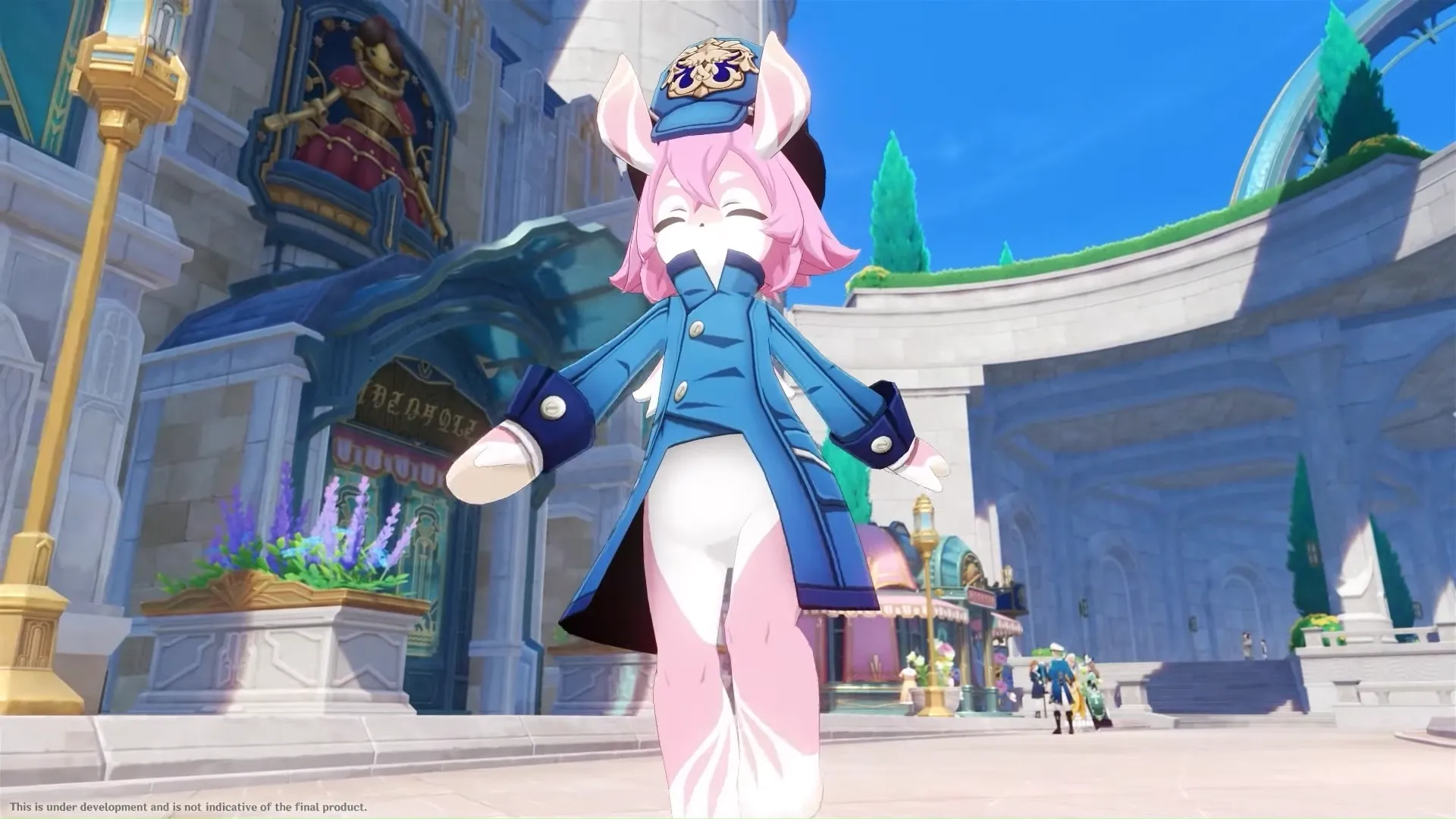
Melusines are the small, all-female, amphibious humanoid race native to Fontaine. They are roughly faun-like: bipedal, short, with mitten-like hands, stubby feet, large tails, "feelers" on their heads resembling sea-slug rhinophores, and human-like head hair. [1] In the game they are the friendly faces at the Aquabus stops, the Marechaussee Phantom desk, and the Meropide infirmary. In the lore they are a new species that came into being in the post-Cataclysm era, born from the wounds of the great beast Elynas during a clash between two organizations. The present-day Hydro Sovereign Neuvillette later discovered them and championed them into full Fontainan citizenship.
Their wider story is told elsewhere: the Hydro Sovereign they look to as a father (Neuvillette), one of the first melusines and the exception who lives in human form (Sigewinne), and the primary-text source for the ancient ban on becoming human, which Neuvillette ties to Egeria (Sigewinne's Nereides Chapter). [14] [15] [16]
Origin: born from Elynas's wounds
The melusines came about by chance, not by design. In Ancient Colors Act III ("Blue Longing of Heart and Moon"), around 400 years ago the Marechaussee Hunters and members of the Narzissenkreuz Ordo were locked in a battle inside the body of the great beast Elynas. During the battle, "someone" caused an explosion that killed many and drove the mechanical components of clockwork meka through Elynas's body. The melusines were eventually born from these wounds, and the meka components became "tokens," small mechanical artifacts each melusine carries, with no two alike. [2] [3] [1]
So melusines are not a Sovereign-era species designed and instituted into Fontaine from above. They are a post-Cataclysm species whose origin is tied to a specific clash between two organizations (Marechaussee Hunters versus the Narzissenkreuz Ordo) and a specific weapons accident inside a specific giant beast. The clockwork-meka tokens are the residue of that accident: Mamere's token is a runed mechanical component that lets her interact with and repair the Seymour clockwork meka, who recognises it as his lost "artificed clockwork relay module," while Aeval's token is a shard of a sword. [3] [1]
Elynas's consciousness regarded the melusines as his own daughters. He taught them how to establish a home, Merusea Village, hidden among the remains of his own body, and enabled them to grow and live happily within him. As time passed, the melusines could no longer hear Elynas's voice; by the start of the game's events only Mamere could hear him, and after Mamere befriended the Traveler she could no longer hear him either. [1] The folkloric etymology echoes the paternal relationship: in European legend, Elynas was a fictional king of Albany and the father of Mélusine.
Their shared origin shows in one quiet biological tell. Breacher Primuses do not attack melusines, because both were born from Elynas's body. [1]
Neuvillette discovered them, championed them into citizenship
By Carole's recollection in Neuvillette's Diluvies Chapter, the melusines stayed in Merusea Village for almost twenty years before they met Neuvillette, who responded to their wish and brought them to the Court of Fontaine. [6] [1] [17]
The arrival was not smooth. Fontainians were initially hesitant to accept melusines into their society. A contemporary surge in "strange incidents" coincided with Neuvillette's recent appointment as Iudex, some Fontainians rejected the idea of two species coexisting, and others considered the melusines monsters. Carole became one of the few melusines to venture outside Merusea Village. Five years after she did so, hardliners opposed to Neuvillette's reforms lured and framed her for murder, and Carole sacrificed herself to prove her innocence. The trial of Vautrin that followed, in which Vautrin feigned anger to test and ultimately prove Neuvillette's impartiality, became the turning point in Fontainian acceptance of the melusines. [1] [6]
In the aftermath, Neuvillette helped pass a law declaring all melusines are to be addressed with she/her pronouns rather than it/its, and harsh punishments were imposed on anyone who treated them as monsters. By the events of the game, essentially every Fontainian is willing to protect a melusine from danger. [1]
This is the on-screen source for the protections around melusines in present-day Fontaine. An ancient law, which Neuvillette now thinks most likely Egeria's, guards the human form against other species changing into it; Neuvillette's reforms after the Vautrin trial guard the melusine form against mistreatment. [26] Reading the two as one system that works from opposite ends is an interpretation; the primary text does not join them.
A "new sort of Hydro Vishap species"
Per Neuvillette's Character Story 3, Neuvillette recognises the melusines as both his dependents and successors, believing them a great example of a "new sort of Hydro Vishap species." [4] [1]
That framing presents them not as a brand-new humanoid creation but as successors within the Hydro Vishap line Neuvillette presides over as the present-day Hydro Sovereign. One case shows the Vishap-melusine link directly. Pahsiv, a unique Primordial Bathysmal Vishap, can take on a melusine form at will, with the tufted tail and ear-like feelers of a standard Variant 2 melusine but the skin patterns and pupils of a Bathysmal Vishap. [1]
The primary text leaves open how literally to take "Hydro Vishap species." Reading it as a strict biological claim (melusines are literally a Hydro Vishap subspecies) overstates it. Reading it as a kinship claim (melusines are the successors to the Hydro-Vishap line that Neuvillette heads) is the safer one. Older versions of the wiki's Neuvillette and Sigewinne pages framed Neuvillette as having created the melusines, "fragments of his Sovereign essence given humanoid form." The literal disclosure doesn't support that; the primary text frames Neuvillette as the father-figure who recognises the melusines as his own and protects them, not as their biological maker, and those pages now say so. How literally to read "Hydro Vishap species" stays open.
Neuvillette's place among the Hydro Sovereigns, and the arc of reclaiming his Authority that opened with the restoration of his power in AQ IV V and Apep's confirmation in Welkin Moon Act IX, are covered at Seven Sovereigns and Neuvillette. [21] [14]
The ancient species-change prohibition
At the close of the Sigewinne Nereides Chapter, at her teacher's empty tomb, Neuvillette explains: "Long before I became Iudex, there was an ancient law in Fontaine that prohibited any attempt to transform another species into a human." He and most researchers once believed it was imposed "due to ethical concerns," but "now, it seems more likely that the law was nothing more than an insurance policy," a way for Egeria (not Focalors) to keep her people "insulated from the truth." Tying the law to Egeria, and that motive, is his present reading, not a record from Egeria. [5] [16] [26]
Neuvillette dates the law only as "Long before I became Iudex." If it is Egeria's, it pre-dates the melusine race by at least a century: Egeria, the first Hydro Archon and never a Sovereign, was killed at Tunigi Hollow during the Cataclysm 500 years ago, and melusines emerged from Elynas's wounds about 400 years ago. [25] [1] Either way its wording covers "another species" in general, protecting the human form against transition from any other species, rather than melusines specifically. [20]
The on-screen enforcement of the law is the Sigewinne case. Sigewinne is among the first melusines, born over 400 years ago. In the Nereides Chapter, to cure a sick human friend whose parents refused to let a melusine treat her, she used a potion left to her by her teacher, a human traveling doctor whom the children she treated thought "was a witch" (the witch of the fairy-tale she tells the Traveler at the start of the chapter). The teacher had "discovered a strange disease, one I suspect that every Fontainian suffers from," and called the potion "an accidental discovery." Sigewinne broke the law in doing so, served a sentence at the Fortress of Meropide "hundreds of years ago", and stayed after release, eventually becoming head nurse. [5] [26]
Fandom counts Sigewinne as the exception among melusines: she has a "special body" which makes her physiologically similar to a human, the result of the potion, and she has stayed in that form ever since by her own choice. [1] Her case shows the law was enforced. The chapter does not spell out the truth Neuvillette thinks it guarded; in Archon Quest IV Act V Neuvillette has already said that the previous Hydro Archon, Egeria, "poured Primordial Seawater into the Oceanids' blood vessels, creating humanoid mimics in the process." [28] [25]
For the human side and the fuller picture of Egeria's protection, see the Humans page. [22]
Biology, longevity, senses
The game presents melusines as biologically distinct from humans in several ways:
- Longevity. Several melusines, including Sigewinne and Kiara, are among those born over 400 years ago, placing them among the original generation born from Elynas's wounds. [1] This is not absolute immortality; melusines can live for centuries but still age. Enghiene found that age had impaired her ability to wield firearms, retired from the Special Security and Surveillance Patrol, and later described the experience behind her as 150 years of service. [10] [11]
- Sensory differences. Melusines possess senses of perception stronger than those of humans, which is why the Marechaussee Phantom is mainly composed of melusines. [1] They can see colors beyond the human spectrum, and their senses of vision and taste are different enough that humans are sometimes confused or disgusted by their preferences (Mamere's art is incomprehensible to most humans; Sigewinne's infirmary cooking with Slime Condensate and Frog meat is called "mystery meat" and an "ill omen" by Fortress of Meropide inmates).
- Combat capability. Small stature and limited dexterity generally constrain melusine combat, but not universally. Marine cleared several Natlan monster nests, one containing seven times the estimated number of monsters, and some melusines can wield rifles with exceptional skill. Their mitten-like hands still prevent them from using pistolets. [1] [9] [10] [12]
- Diet. Melusines consume Tidalga (a Fontainan aquatic plant) but also enjoy the wide variety of human food. They require sleep like other biological beings and react to coffee and tea as humans do. [1]
- Currency. The melusines of Merusea Village value scrap mechanical parts, called components (Strange Parts in the underlying game economy), as currency, for their aesthetic quality and their abundance in the area. That abundance itself traces back to the clockwork-meka explosion they were born from. Melusines exchange components for goods and give them to one another as tokens of gratitude.
- All female. Melusines are an all-female species. [1] Per the legal reform Neuvillette led after the Vautrin trial, they are addressed with she/her pronouns.
There are two main variants. Variant 1 has a fluffy tail, curled horn-like feelers, and a skin pattern of small flowers. Variant 2 has a long tufted tail, ear-like feelers, and striped skin patterns. Each melusine has a unique combination of variant type, skin colour(s), pupil style, and hairstyle. A small number deviate from the standard combinations, such as Elphane (Variant 1 with Variant 2 leg patterns) and Manaia (Variant 2 with Variant 1 leg patterns). [1]
Institutional roles: Marechaussee Phantom and Fortress of Meropide
Melusines are embedded across Fontaine's investigative, legal, and medical institutions. Two places stand out for how many melusines work there.
Marechaussee Phantom: the melusine investigators
The Marechaussee Phantom, the elite investigative force of the Court of Fontaine, is mostly melusines. [1] In the Questioning Melusine and Answering Machine world-quest series, the agent is the Melusine Talochard, working a case off duty with Curve, whom Euphrasie calls "a special investigations drone belonging to the Marechaussee Phantom." At the end Curve's recorded analysis, played back through Sir Arthur, says Talochard "Will be the best agent in the Marechaussee Phantom!" [8] [29] [30] [18]
Fandom gives the reason so many Phantom agents are melusines: "their powerful eyesight and ability to perceive more than ordinary humans." [31] The Phantom finds the culprits, and the Special Security and Surveillance Patrol arrests them. In the Roses and Muskets event its captain, Chevreuse, puts it this way: "Our job is to apprehend the perpetrators... finding them is really up to the Marechaussee Phantom." [32]
For the Marechaussee Phantom's history (Cassiodor / the Golden Hunter's Marechaussee Hunters after Remuria; the Narzissenkreuz Institute's collapse and the Alain Guillotin / Mary-Ann Guillotin recruitment; the clash among Elynas's remains), see the Marechaussee Phantom page.
Fortress of Meropide: Sigewinne's medical infrastructure
The Fortress of Meropide, Fontaine's underwater prison under Wriothesley as Duke, houses the melusine medical staff under Sigewinne as head nurse. Per her character lore and the Nereides Chapter, she runs the Meropide infirmary and inmates receive care during her tenure. In Beauty Expert, the chapter's first part, she has the Traveler pretend to be sick to scare Luc, a guard's young son, into taking his bitter medicine, "a technique I learned from my teacher." [5] [15] [33]
Pairing melusine senses with medical work fits as neatly as the Phantom's investigative pairing. In the Nereides Chapter, the face-swapping scheme behind the lotion Butterfly Dew ran on a potion whose key component "is the fluid left behind by dissolved Fontainians"; Sigewinne explains that "Before the flood, all Fontainians were Oceanids, physiologically speaking," and that since the flood they "can no longer provide the source material for this potion, nor reap its benefits." [27] [7]
Wriothesley's role as Duke is covered at Wriothesley, and Sigewinne's life at Sigewinne.
Court of Fontaine workplace integration
Beyond those two places, melusines fill a broad range of Fontainian civilian roles: Aquabus guides (Navia Line, Clementine Line, and multiple route-segment guides), Gardes in Palais Mermonia, and scattered jobs across the Court of Fontaine. Many melusines who work in the Court choose to live there "because it's so much more convenient," while others (like Sedile) return to Merusea Village on vacation. [1]
How melusines differ from adjacent race-categories
Melusines don't fit any of the race categories of Fontaine, Liyue, or the other regions. Three contrasts matter.
Melusines are not adepti
Per HoYoverse Developer Insight #4 ("Vigilant Yaksha" / Xiao) and the adepti race page, the higher-purpose doctrine restricts the adeptus category to non-humans, and the formal path to becoming one runs through Morax's blessings, the contracts behind Liyue's Mighty and Illuminated Adepti, and Sub-Space Creation power "granted by Rex Lapis as part of the illumination." [23]
Melusines belong to the Hydro Sovereign's household; Neuvillette's restored Authority underwrites both their legal protection and his recognition of them as a successor species. They don't run on Morax's blessings, Sub-Space Creation, or adeptal energy. The difference is one of origin and allegiance: melusines are Fontaine's successors in the Hydro Vishap line, under the Hydro Sovereign, while adepti are Liyue's illuminated beings raised by Morax's blessings. [23]
Melusines are not hilichurls
The curse of the wilderness that turned Khaenri'ahn humans into hilichurls is a Cataclysm-era event that reshaped an existing human population at the species level, a punishment handed down by the authority of the Heavenly Principles. [24]
The contrast with melusines is sharp. Melusines were born, not reshaped, out of a post-Cataclysm accident, and they hold protected citizenship (the protections of Neuvillette's era, beside an older law against changing into human form) where hilichurls hold a cursed status. Between them they show how far species-level change can reach in either direction: hilichurls a population degraded as punishment, melusines a new people born and protected.
Melusines are not humans
Humans live under Visions, the Archon hierarchy, and Irminsul's memory, which the Humans page reads together as the Heavenly Principles' way of managing them (that page's reading, not a stated rule), and carry a "higher purpose" per HoYoverse Developer Insight #4. [22]
Melusines are different. They don't hold Visions, and they aren't administered by an Archon the way Liyue's adepti are; they belong to the Hydro Sovereign's household under Neuvillette's protection. Irminsul does record them (every Teyvat-born being is recorded; only Descenders are immune, as the Traveler page lays out). [22]
The ancient law against transforming another species into a human, which Neuvillette ties to Egeria, draws the line between humans and melusines most cleanly. Under it, changing into a human is forbidden; the Nereides Chapter does not say whether the reverse change is. [26]
What we know
- Melusines were born from Elynas's wounds about 400 years ago, during the Marechaussee Hunter / Narzissenkreuz Ordo battle, when an explosion drove clockwork-meka components through Elynas's body. [2] [1]
- Elynas was their conceptual father; his consciousness taught them to establish Merusea Village inside his remains, and by the start of the game's events only Mamere could still hear him. [1]
- Each melusine carries a unique "token," a mechanical component from the clockwork-meka explosion they were born from. [3]
- Neuvillette discovered them after they had lived in Merusea Village for almost twenty years and responded to their wish by bringing them to the Court of Fontaine. [6] [1]
- Carole's sacrifice and the Vautrin trial reformed Fontainian acceptance of the melusines; the legal reforms after the trial mandate she/her pronouns and harsh punishments for treating melusines as monsters. [1]
- Neuvillette recognises melusines as a "new sort of Hydro Vishap species" and as both his dependents and successors per Character Story 3. [4]
- An ancient Fontainan law "prohibited any attempt to transform another species into a human." Per the Sigewinne Nereides Chapter, Neuvillette now thinks it "more likely" an insurance policy of Egeria's to keep her people "insulated from the truth"; the motive is his reading. [5] [26]
- Sigewinne broke the law to save a sick human friend, served a Fortress of Meropide sentence, and chose to stay in human form afterward; Fandom counts her as the exception among melusines. [5] [1]
- Melusines cluster in two places: the Marechaussee Phantom's investigators and the Fortress of Meropide's medical staff under Sigewinne. [8]
- Melusines are all female, with centuries-long but age-affected lifespans, stronger-than-human perception, colour vision beyond the human range, and non-human dietary and taste preferences. Small stature and dexterity generally constrain combat, but Marine and rifle-skilled melusines establish clear exceptions; pistolets remain difficult because of their hands. [1] [9] [10] [11]
- Pahsiv, a Primordial Bathysmal Vishap, can take melusine form at will, a clear case of the Vishap-melusine link Neuvillette's "Hydro Vishap successor species" framing points at. [1]
- Breacher Primuses do not attack melusines, because both were born from Elynas's body, a quiet tell of their shared origin. [1]
What we don't know
- What "truth" the ancient law kept Fontainians from, if Neuvillette's reading is right. The Nereides Chapter does not say; its teacher says only that she "discovered a strange disease, one I suspect that every Fontainian suffers from." The likeliest referent is the origin AQ IV Act V discloses, Oceanids given "humanoid bodies" by Egeria, but no line in the chapter makes that link. [26] [28]
- Whether the ban on changing species works both ways. Melusine-to-human is the on-screen case; human-to-melusine is not addressed in the primary text. The question stays open.
- How literal "Hydro Vishap species" is biologically. Neuvillette's Character Story 3 is suggestive but does not say whether melusines share biology with Bathysmal and surface Vishaps at the genetic or cellular level, or only as recognised kin.
- Whether every melusine was born from Elynas's wounds, or whether the species can reproduce on its own. Birth from Elynas's wounds is the only origin the game gives; whether new melusines can appear without him is not addressed.
Melusines are not Neuvillette's manufactured daughters. They are an accident, a species that emerged from the wounds of a dead giant beast after a battle inside his remains. That beast tried to raise them as his own, and Neuvillette later found them and brought them home. Their citizenship in Fontaine is the result of work done by Elynas, Carole, and Neuvillette. An older law against becoming human is, in Neuvillette's reading, Egeria's cover for a secret about what Fontainians really are.