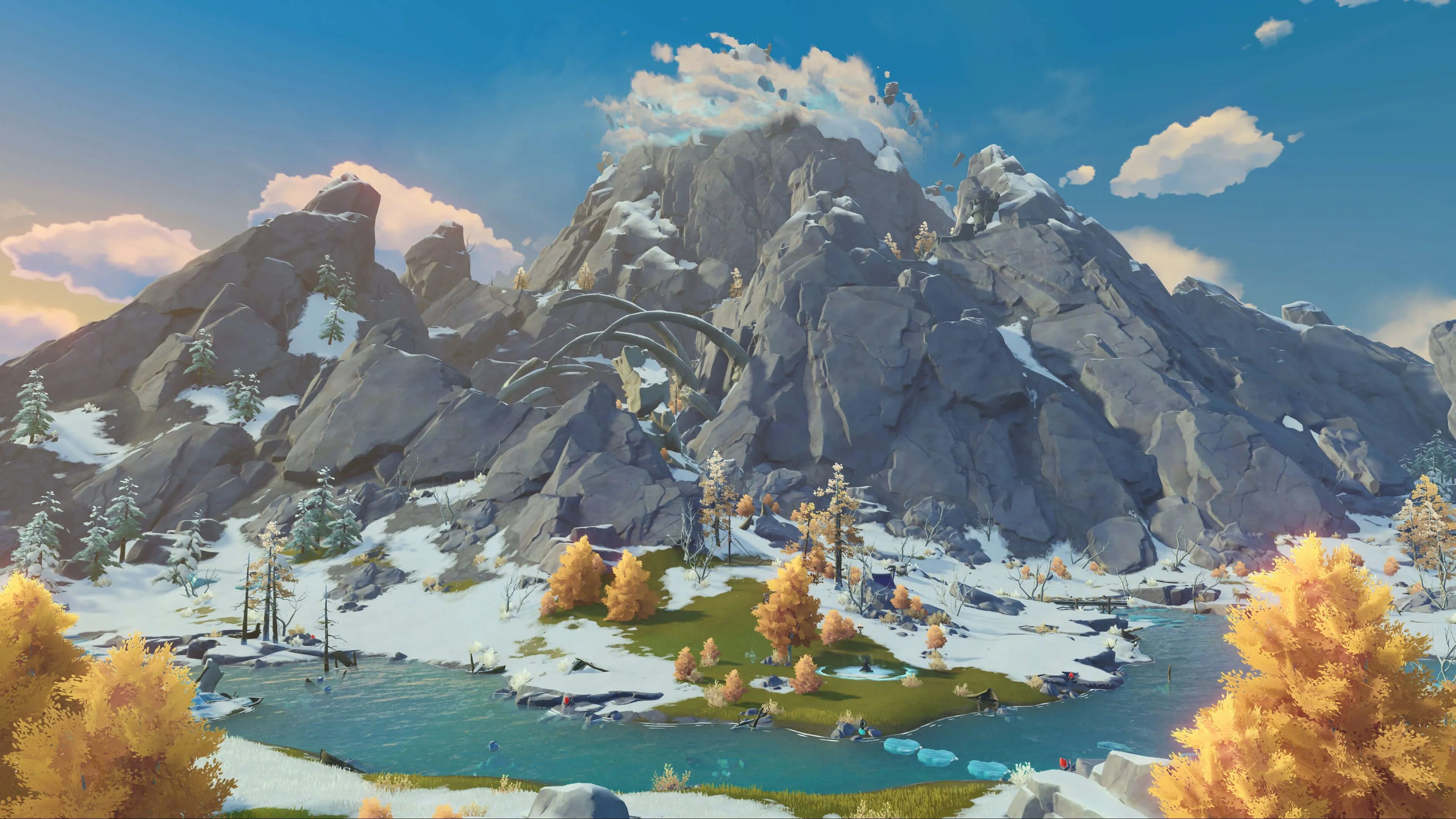
A snow-capped mountain sub-region of Mondstadt, released in patch 1.2 and named for the body of the Abyssal dragon Durin, slain in mid-air by Dvalin and fallen here during the Cataclysm. Before that, the mountain was called Vindagnyr and held the kingdom of Sal Vindagnyr, destroyed in deep antiquity when the Skyfrost Nail fell from Celestia. Durin's blood revived a long-dead Irminsul tree, dyed Wyrmrest Valley red, and gave the mountain its modern name; present-day expedition work is led by Albedo.
Overview
Dragonspine is the snow-capped mountain sub-region in the south-east of Mondstadt, introduced through viewpoints from the Manor of Daybreak and the Sea of Clouds in version 1.0 and released alongside the Chalk Prince and the Dragon event in patch 1.2 (December 2020). It is "historically known as Vindagnyr" and "was named Vindagnyr prior to Durin's fall." The modern name replaced the old one after the Cataclysm, set within living memory by the body of the Abyssal dragon Durin that fell on it. Before that fall the mountain carried the name of the kingdom that ruled it, Sal Vindagnyr, "an ancient, now ruined mountain kingdom located on the mountain of Vindagnyr." [1] [2]
Dragonspine carries the residue of two very different catastrophes, separated by thousands of years and belonging to two different cosmological orders. The older one, from deep antiquity, is the Skyfrost Nail strike that destroyed Sal Vindagnyr. That strike is Mondstadt's entry in the list of six Heavenly Nail strikes, alongside Tsurumi Island, The Chasm, Mt. Damavand (also Eternal Oasis or the Desert of Hadramaveth), the Night Kingdom over Natlan, and Hyperborea.
The later one, from the Cataclysm five hundred years ago, is the descent and slaying of the Khaenri'ahn-built Abyssal dragon Durin, whose blood seeped into the Ley Lines, dyed Wyrmrest Valley red, revived the long-dead Irminsul now called the Frostbearing Tree, and renamed the mountain. The two events run on entirely different footings and should not be conflated. A third, lighter layer is the present day: Albedo's field-research camp and the Princeps Cretaceus Chapter Story Quest, which stages the Chief Alchemist's investigation of his mother Rhinedottir's pre-Cataclysm work and touches both Durin's remains and the buried residue of Khaenri'ahn alchemy expeditions. [16] [17] [20] Version 7.2 adds a present-day layer of its own: the Skyfrost Nail is the source of Mondstadt's share of the Holy Soil phenomenon. [27]
Geography
Dragonspine has six subareas: [1]
- Entombed City – Ancient Palace, "an ancient city that lies silent beneath the eternal ice," the capital and palace of Sal Vindagnyr. It hosts the present-day Draco Rubedo Chapter (Durin SQ) Act I sub-quest The Solution of Fate. [6] [2]
- Entombed City – Outskirts, the ruin-belt around the buried capital, and the site of one of the three ice-orbs formed by shards of the Skyfrost Nail, which froze the terrain on impact ("one deep in the Starglow Cavern, another in an underground chamber near the outskirts of the city, and the third shattered the white tree"). [2]
- Skyfrost Nail, the summit subarea, "located at Dragonspine's summit" and unlocked only during the World Quest In the Mountains. Before the quest, attempting to scale the mountain triggers a "unique Out of Bounds reaction before the player is teleported away." After it, the restored Nail "ascends to remain aloft over the mountain summit." [3] [24] In Version 7.2 it is where Mondstadt's Hallowing comes from and where its Trial of Usurpation is held (see below). [27]
- Snow-Covered Path, the central plateau approach and home of the Frostbearing Tree point of interest. [4]
- Starglow Cavern, "a large, icy cave at the heart of Dragonspine," named after the luminescent blue Starglow plants that blanket its interior. It is one of the three sites where shards of the Skyfrost Nail came to rest, and the place where the Scribe Ukko made their final carving after burying the Princess. [1] [2]
- Wyrmrest Valley, the south-eastern valley that "holds the remains of the great dragon Durin, namely his skull, ribcage, and heart. In some areas, the dragon's blood has dyed the ground a deep red color." Today the valley is heavily occupied by Fatui Skirmishers (a mix of Cryogunner Legionnaire, Cryo Cicin Mage, Geochanter, Pyroslinger, Anemoboxer, and Electrohammer types), evidence that the Tsaritsa's vanguard is also interested in Durin's residue. [5]
Notable points of interest within those subareas: [1]
- Albedo's Campsite, a small laboratory outpost between Entombed City – Ancient Palace and Outskirts, used by Albedo for his Dragonspine field research and the staging site for Princeps Cretaceus Chapter Act I camp scenes. [7]
- Durin's Core, the "still-beating heart of the Abyssal dragon Durin," sitting in Wyrmrest Valley. It "exudes an ominous vitality that can turn a Strange Tooth into an Empowered Dragontooth, and also serves as a source of warmth," evidence that 500 years on the heart is still working rather than inert. [5]
- Frostbearing Tree, the "new sprout of an ancient Irminsul Tree that was destroyed by the Skyfrost Nail" in Snow-Covered Path, revived by Durin's blood and bloomed after the Traveler shattered its Ancient Rime in In the Mountains. Offering Crimson Agates raises its Gratitude tier, and its final fruit, "in memory of the people who died there," is the Frostbearer catalyst weapon, "to be carried by the one that enacts justice on the world." [4] [24]
- Mural Room, a sealed chamber near Entombed City – Ancient Palace containing "three large frescoes painted by the Princess of Sal Vindagnyr, two of which are identical." It is opened via the Hidden Exploration Objective Dragonspine's Glacial Secret and holds the Snow-Tombed Starsilver Imunlaukr abandoned there. Mural 1 also depicts Celestia "moored" above the Skyfrost Nail, an unusual primary-text record of Celestia anchoring itself to one of its own Nails at the moment of deployment. [16]
Dragonspine's environmental hazards are unlike anywhere else. The whole sub-region is affected by Subzero Climate: grass does not burn, and the active character accumulates a Sheer Cold gauge that drains HP over time when full, mitigable only via Goulash and sources of warmth. Ancient Rime blocks "cannot be melted with Pyro attacks" and gate puzzle progression; the only solvent is empowerment from a nearby Scarlet Quartz vein. The patch 1.2 release also introduced the Cryo Hypostasis as the regional weekly-rotation boss, while the Defense Mechanisms site is an encounter with Khaenri'ahn Ruin Machines rather than a boss of divine rank. Before 1.2, Dragonspine existed in-game as a subarea belonging to Windwail Highland but was unreachable under normal conditions. [1]
History
Deep antiquity: the founding and flourishing of Sal Vindagnyr
The earliest Dragonspine inhabitants were a refugee population that arrived "several thousand years ago": "a group of refugees from a land of snow and strife came upon a lush, green mountain. They erected a monument on its peak and established a civilization there, naming it Sal Vindagnyr." They built their capital at the Entombed City – Ancient Palace, "and for a while, the kingdom prospered, and the people enjoyed the blessings of Celestia." The primary-text figures are the chief priest Varuch; his daughter, known only as "the Princess," born beneath the great white tree that would later be the Frostbearing Tree; the scribe Ukko; and the outlander hero Imunlaukr. The Princess "received certain blessings, which included the ability to foresee events in the future," a faculty she expressed through fresco-work. One pre-fall fresco recorded "a black dragon filling the land with a cloud of scarlet poison," a prophetic dream that anticipates Durin's Cataclysm-era arrival five hundred years later. "During the cataclysm five hundred years ago, the princess' dream came true." [2] [3]
The Skyfrost Nail strike (~6000 years ago)
The fall is dated to "Around 6000 years ago, Celestia cast down the Skyfrost Nail upon Sal Vindagnyr." The Skyfrost Nail itself is "one of several Celestial Nails cast down by the Heavenly Principles," and Sal Vindagnyr sits alongside Hyperborea and Lang-Gan in the roster of "decimated multiple human civilizations" that the deployment of the Nails produced. The Nail "descended over the summit, blanketing the area in a blizzard" and "would later fragment into three pieces, with one piece falling over and killing the Irminsul tree now known as the Frostbearing Tree." The other two fragments deposited as ice-orbs deep in Starglow Cavern and in an underground chamber near the Entombed City – Outskirts. [4] [8] [3] [2]
The fall broke the kingdom on a slow timer. Imunlaukr, "seemingly quite close with the princess," received the Snow-Tombed Starsilver greatsword from her and left to seek a remedy. Head priest Varuch "perished during his last attempt to climb the summit and entreat the heavens," and the Princess "died next to" the dying white tree after picking "the most complete branch" and taking it "to a small nearby island to try to graft it onto another tree." The scribe Ukko buried her and made a final carving in Starglow Cavern, with last recorded words that were "a curse towards the heavens and towards Imunlaukr, whom they believed had abandoned Sal Vindagnyr," and a hope that "the new nation without gods" would "eventually have what it took to stand against this world." When Imunlaukr at last returned, "only to discover that everyone had already died," he abandoned the Snow-Tombed Starsilver in the Mural Room and left Vindagnyr for a land of war. His descendants, the Imunlaukr Clan, lived around Mondstadt by the end of the Archon War, becoming a prominent founding clan that worshipped both Barbatos and the God of Time (Istaroth, name in reverse "Htoratsi") alongside the Gunnhildr and Lawrence Clans. They are the bridge from the deep antiquity of the Nail strike into modern Mondstadt. [2] [3] [10]
The Cataclysm and Durin's fall (~500 years ago)
The second layer is the Cataclysm-era arrival of Durin, strictly Durin (Historical), the Humus-classified Abyssal dragon Rhinedottir built. He is distinct from the present-day playable Durin the Hexenzirkel later authored as a story alternative. (The Durin page disambiguates this in detail: the original Durin attacked Mondstadt and fell on Dragonspine, while the playable Durin is the Andersdotter-authored synthetic human who integrated into present-day Mondstadt society.) The record anchors the event: "During the cataclysm five hundred years ago, the princess' dream came true: the black, corrupted dragon Durin descended upon the land, where he was slain by Dvalin and his corrosive powers sealed using Vindagnyr's unnatural cold. As Durin's blood flowed into the land, the undying white tree spread its roots to absorb it." Another account gives the slaying location: "Around 500 years ago, the Abyssal dragon Durin was slain by Dvalin over Dragonspine." [9] [21] [23] [2] [4] [22]
The dragon's body broke across the upper mountain. The post-fall inventory in Wyrmrest Valley is "his skull, ribcage, and heart," with the heart still beating (Durin's Core, "the still-beating heart of the Abyssal dragon Durin"). Durin's "poisonous" blood saturates the terrain and the Ley Lines beneath it, and its effect on the long-dead Irminsul that is now the Frostbearing Tree was to revive it: the tree "finally bloomed once more," though "tainted with the malevolent energy of the Abyss, as the newborn tree is described as having a thirst for more power," with red branches where typical Irminsul glow blue. The same blood is distilled in mineral form as the Crimson Agate the Traveler collects across Dragonspine and offers back to the tree. [5] [1] [4]
In the same Cataclysm window the record notes a third layer unique to Dragonspine: "the kingdom of Khaenri'ah entered a conflict against Celestia, only to emerge the loser. Its automatons, the Ruin Machines, entered the region of Dragonspine. Some Ruin Guards can be found around the land, whose combined records can be deciphered to read 'For the nation, we can't forgo this skyborne power, but we failed.'" The skyborne power phrase links the Khaenri'ahn arrival to the confrontation with the Heavenly Principles rather than to Durin alone, and the Ruin Guards remain combat encounters in the present day. [2] [18]
Present-day: patch 1.2 and the In the Mountains / Princeps Cretaceus arc
Knowledge of all three layers is lost in modern Mondstadt: "Knowledge about this ancient nation was lost over the years, and attempts to uncover the mystery surrounding Dragonspine's abnormal climate met little progress before the Traveler's arrival." The 1.2 patch is the re-opening: the Knights of Favonius dispatch Albedo and an expedition team to set up the mountain camp, and the World Quest In the Mountains walks the Traveler through reassembling the three shards of the Skyfrost Nail (the same shards that froze Starglow Cavern, the Outskirts underground chamber, and the Irminsul), after which the restored Nail "ascends to remain aloft over the mountain summit" and the Frostbearing Tree begins to accept Crimson Agate offerings. [2] [3] [24] [4]
The parallel on-screen arc is Albedo's Princeps Cretaceus Chapter (V1.2). Act I runs from Sucrose pointing the Outlander to Albedo at Timaeus' stall, to Rosaria and Barbara at the base of the mountain, to Albedo recognising the Outlander as the Honorary Knight of the Stormterror affair and inferring that they come from another world. It closes on a battery of five experiments and the discovery of a mysterious script in Withering Glory. The chapter's closing carries unusual weight for a V1.2 SQ. Albedo concludes the Outlander is "like an ordinary person in Teyvat" under Teyvat's natural laws, describes himself as "different sediment," and voices the "rely on them to stop me if that time ever comes" apprehension about losing control. The delivery of Rhinedottir's letter and the reveal of the Heart of Naberius are not staged here; both are deferred to later canon (in particular AQ Interlude Chapter Act IV Paralogism Part 3 The Gardener, V5.6). Dragonspine is where that later material about Rhinedottir is staged. [7] [25] [20]
Version 7.2: the Hallowing and the trial
In Chapter VII Act VI the Skyfrost Nail is Mondstadt's Nail of Retribution in the Holy Soil phenomenon. The Guiding Notes added in Version 7.2 file it as "One of the Nails of Retribution. Located at Dragonspine's summit, which houses the ruins of the ancient realm Sal Vindagnyr." [29] Kaeya counts it lucky that the Nail is "at the very top of Dragonspine," because the Hallowing "started far enough away from the city to give us time to respond." The Knights of Favonius close the approach, since "the Hallowing is spreading, and the Dragonspine region is highly dangerous at the moment," and hilichurls build fortifications that face the mountain rather than the city. On the slopes Venti hears "dissonant voices upon the wind." When the Traveler listens, the voices weep and cry out: "Run! Get away from the Nail of Retribution!" [27] [28]
Venti places them. "Those voices likely belonged to the people of Sal Vindagnyr, an ancient civilization that once existed in this place. It was destroyed thousands of years ago." The Nail's power "is attempting to reset the world," so "some of the information recorded in the Ley Lines is leaking out," as "anguished voices on the wind, or even as the full-fledged monsters we're facing." His account of the mountain agrees with the older record above: "This place used to be a verdant paradise. It was the fall of the Skyfrost Nail that changed the environment and buried all vestiges of Sal Vindagnyr beneath snow and ice." The hilichurls have no tie to that kingdom, but he thinks they are answering its voices. "They were once human, too," and with Khaenri'ah's fall behind them, "they probably thought the cataclysm was coming all over again." [27]
Mondstadt's trial is held inside the Nail. Varka plans to let "the turbulent air currents near Dragonspine fly me right up to the Skyfrost Nail on my wind glider," but Venti makes the climb on the wind instead, enters the Nail, and passes the Trial of Usurpation on the subject of "Freedom." [27] [28]
One mountain, two catastrophes
Dragonspine is Mondstadt's example of layered cosmological hazard, the same role Tsurumi plays in Inazuma. The layer from deep antiquity fits into the Heavenly Nail record as the Skyfrost Nail entry. It is the only Nail of the six strikes with a proper name, and the worked example of the Nails' wider pattern of effects: collapse of the weather system, Ley Line disorder, decimation of a nearby human civilisation, and a withered Irminsul tree. Dragonspine meets all four, with the Frostbearing Tree as the named tree. The closest parallel in another region is Tsurumi Island's Pre-Thunderbird civilisation, which worshipped Celestia and was annihilated by an unnamed Nail strike of the same kind. The text on the Pre-Thunderbird Civilization names Sal Vindagnyr as the comparison ("much like Sal Vindagnyr"). [16] [15] [12]
The Cataclysm-era layer belongs in the Cataclysm page's row on Mondstadt, alongside Rostam's death, Arundolyn's break, and Rosalyne's transformation into the Crimson Witch. Durin himself is a Khaenri'ahn alchemical creation Rhinedottir built, so the Mondstadt half of the Cataclysm intersects with the Khaenri'ah half on Dragonspine: the Abyssal dragon falls and the Khaenri'ahn Ruin Machines arrive at the same mountain in the same window of time. This doubled Cataclysm-era damage is what gives Dragonspine its modern name. [17] [18] [23]
One hedge applies to who is responsible for the cold. The Skyfrost Nail strike uses cold as its tool for reshaping the land: the "unnatural cold" used both to bury the kingdom and later to seal Durin's "corrosive powers" when he was slain in the Cataclysm. This is the Heavenly Principles' tool, not a Cryo Sovereign's. Primary text leaves the Cryo Sovereign's seat among the Seven Sovereigns unnamed, and no primary text attributes the Skyfrost Nail to a Cryo Sovereign, nor to Surtalogi, the God of the Sky, who is distinct from the Cryo Sovereign despite occasional community conflation. Dragonspine's cold is therefore the effect of a Nail strike by the Heavenly Principles, with the Sovereigns silent on this site. [2] [11]
Connected pages
The parent region is Mondstadt, whose five sub-regions are Starfell Valley, Galesong Hill, Windwail Highland, Brightcrown Mountains, and Dragonspine; before 1.2, Dragonspine was a subarea of Windwail Highland. Its parallel in the list of Heavenly Nails is Tsurumi Island, the Inazuman entry among the six strikes, whose Pre-Thunderbird Civilization worshipped Celestia "much like Sal Vindagnyr" and was annihilated by an unnamed Nail strike of the same kind. The primary-text spine runs through In the Mountains (the V1.2 chain that restores the Skyfrost Nail) and Princeps Cretaceus Chapter (Albedo's V1.2 research arc).
On the Cataclysm side, Durin disambiguates the playable Andersdotter Durin from the Cataclysm-era historical Durin in Wyrmrest Valley, Dvalin slew him, Rhinedottir created both Durin and Albedo, and Albedo leads the field research. The related lore-concept pages are Heavenly Nail, The Cataclysm, Khaenri'ah, Irminsul (the precedent that the Frostbearing Tree was an Irminsul), and Seven Sovereigns (where the Cryo Sovereign's seat is left unnamed). The timeline gives the two eras separate entries: The Heavenly Nails Fall for the fall of Sal Vindagnyr (~6,000 years ago) and the Cataclysm for Durin's death (~500 years ago).
Open questions
Why Celestia struck Sal Vindagnyr is unrecorded. The Nail "fell from Celestia for unknown reasons." Nails suppress "powers that shouldn't exist in Teyvat" (Nahida's Sapientia Oromasdis Act II disclosure), a category that includes Forbidden Knowledge and Abyssal corruption, but whether Sal Vindagnyr harboured either is unconfirmed. The kingdom's earlier flight from a "land of ice and snow" is suggestive without closing the loop on what the strike was responding to. [3] [16]
What Ukko's "new nation without gods" refers to is also open. The phrase is prophetic in tenor, and Khaenri'ah is the closest referent, since the record follows it immediately with the post-Cataclysm Khaenri'ah passage. Whether the prophetic curse is about Khaenri'ah (which falls more than a thousand years later), a foreshadowing of the Imunlaukr Clan's own Mondstadt politics, or non-specific, is unresolved in primary text. [2]
The Mural Room's "angel" in Mural 1 is unidentified: "The left half of Mural 1 in the Mural Room depicts an angel, perhaps a divine envoy from Celestia, granting the priest-kings of Sal Vindagnyr something." Whether the figure is one of the Angels, an intermediary on the level of a Sybilla, or some other divine envoy is unspecified, and the "atomic symbol" triquetra reading of the figure's gift is a Fandom community reading rather than a primary-text identification. [2] [13]
Finally, what Khaenri'ah's "skyborne power" refers to is undecided. The decoded records of the Ruin Guards, "For the nation, we can't forgo this skyborne power, but we failed," are the strongest single piece of evidence that the Ruin Guards on Dragonspine arrived there deliberately rather than by chance. Residue of the Skyfrost Nail is the obvious candidate, but the records "may also be related to the fall of Khaenri'ah, from where Ruin Guards originate," leaving the question open. [1]
World Quests
- In the Mountains · Patch 1.2