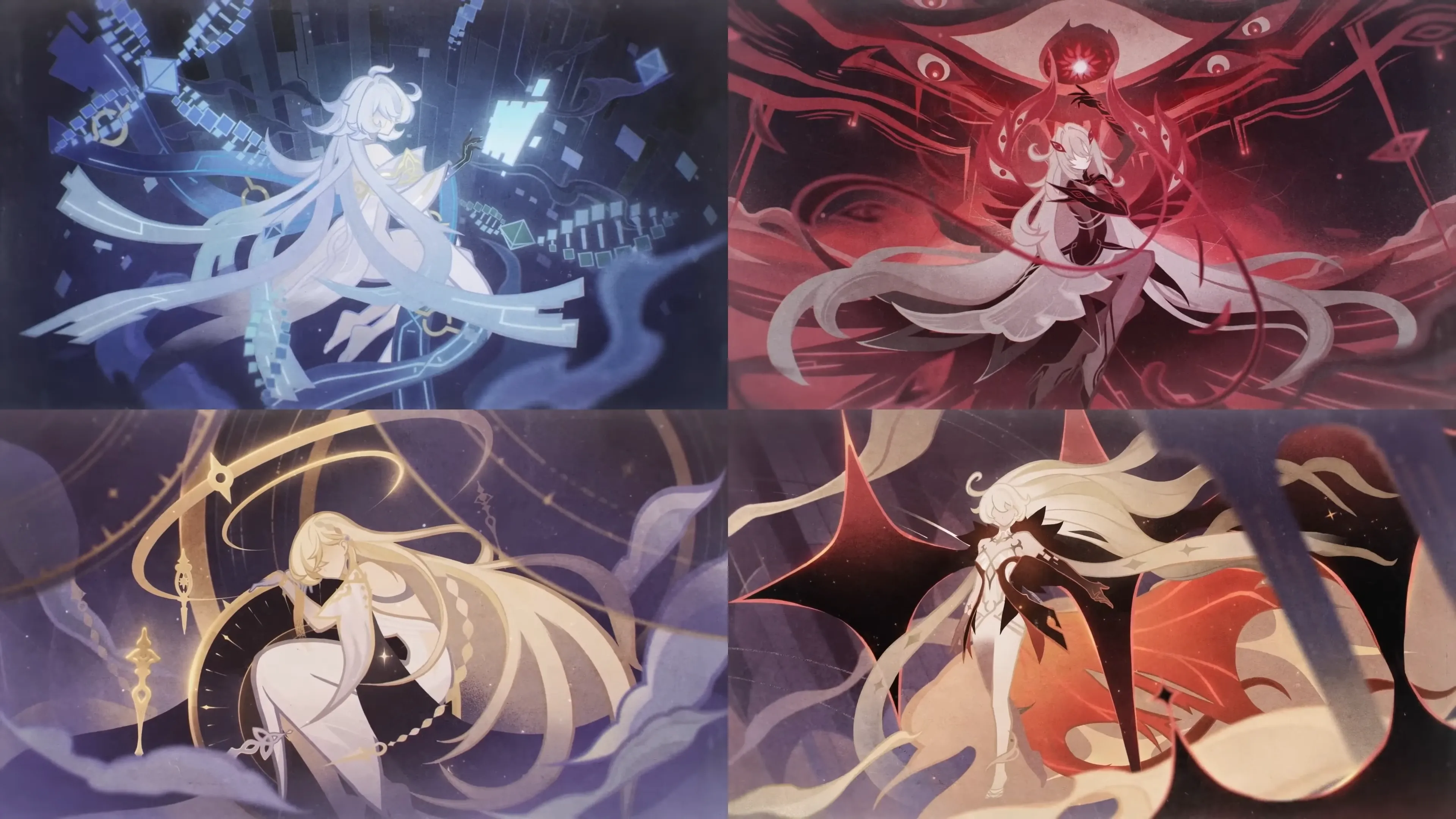
A Shade is one of four gods the Heavenly Principles created in their first forty years on Teyvat, the years of war between the Principles' arrival from the sea of stars and the defeat of the Seven Sovereigns. They were made to fight that war and to govern the world's eternal laws on their absent master's behalf. [2] They are Naberius (Ruler of Life), Ronova (Ruler of Death), Istaroth (Ruler of Time), and Asmoday (Ruler of Space). Older Khaenri'ahn texts call them the Four Great Rulers; modern usage calls them the Four Shades. They outstrip the Seven Archons by an order of magnitude: Istaroth is described as a "higher power" next to Makoto the late Electro Archon, and Ronova has called the Tsaritsa's authority "paltry." [1]
They reside in Celestia and hold periodic meetings. In the Gods' Limits teaser Ronova says that since the Heavenly Principles made them Shades, "Not one of us has ever missed a meeting," yet Asmoday is absent from the one the teaser shows, and the others do not know where she is. They prefer not to be named by living beings, even by the Seven, and operate in shadow rather than direct address, true to their title. [3]
The Shades deal directly with figures in the mortal world when the world's eternal laws are at stake. The clearest case is Nahida's audience with three of the Shades during AQ Song of the Welkin Moon Act X "Truth Amongst the Pages of Purana," in Part 3, the quest of the same name. With the Pyro Gnosis in hand, Nahida came before three figures the game labels the Ruler of Death, the Ruler of Time and the Ruler of Life, whom Fandom names as Ronova, Istaroth, and Naberius. The Ruler of Death asked the Dendro Archon whether she was "certain" she wished to destroy Irminsul, which "represents both your roots and your finest accomplishments"; Nahida answered that it "has been corrupted beyond redemption." [15] Fandom's summary says the three Shades then granted her permission to burn it, though no line of the dialogue says so. [11] Even so, three Shades weighed in on an Archon's act against the record of the world's memory. The timeline has a wrinkle. Naberius is fused with Rhinedottir as of the Paralogism Interlude (5.6), and in the Gods' Limits teaser Rhinedottir attends the Shades' meeting in Naberius's place. [16] In Chapter VII Act IV the game calls Rhinedottir "the Ruler of Life" outright. [13] The Act X audience gives its third speaker only that title, so the name Naberius there is Fandom's reading. The released story does not say whether the voice is Naberius's, Rhinedottir's, or the two together.
The four, by law
Law | Shade | Status (post-Cataclysm) |
|---|---|---|
Life | Naberius - Mother of Gods and Mortals; Maadteraahka to the Frostmoon Scions; Envoy of Celestia; created Egeria to be the new heart of the Primordial Sea after the original Hydro Dragon was deposed | Captive within Rhinedottir, who devoured the Heart of Naberius after its discovery (per AQ Interlude Chapter Act IV "Paralogism", 5.6). Naberius's consciousness persists as a suppressed but present moral counterweight; Rhinedottir now acts as Ruler of Life and attends Shade meetings in her place. [4] |
Death | Ronova - Mother of the Underworld; Tuonetar to the Frostmoon Scions; pre-Cataclysm sang alongside the angels; deployer of the immortality curse on the Khaenri'ahns; architect of the rules for Natlan's reconstruction through the Night Kingdom after the War of Funerary Flame | Active. Censured by HP for helping Natlan too much with the Night Kingdom rebuild and the framework of the Pilgrimage of the Return of the Sacred Flame; "succumbed to self-pity" in the immediate aftermath; re-engaged with mortal politics in the era after Mavuika's Cataclysm pact (AQ V Act V "When All Becomes a Monument"). In Chapter VII Act IV (Version 7.1), Celestia reclaimed her Authority of Death after her killings in Snezhnaya went unrevived; she was then defeated, and her survival is uncertain. In Act V (Version 7.2) she is blamed for setting off the Hallowing, and Pierro believes her "almost certainly dead," which no line confirms. [5] [6] [13] [17] |
Time | Istaroth - Kairos in Enkanomiya; Tokoyo Ookami in Narukami-style rendering; Laimelea to the Frostmoon Scions; Mother of Time; Ad Oblivione; possibly associated with erosion (the "curse of time"); the Shade with the deepest preserved pre-Archon worship | Alive and active, though withdrawn. Gave fragments of her power to a young Anemo elemental spirit named Barbatos at the Thousand Winds Temple before he became the Anemo Archon. Suspended Zibai's fragmented soul in stasis after Lang-Gan was destroyed by a Celestial Nail. The only Shade who answered Enkanomiya's prayers after the city's fall. Speculated (in the Gods' Limits Celestia meeting) that Asmoday may have defected. In Chapter VII Act V Alice, speaking for herself and other "seekers," calls her "our supporter Istaroth" and says she has forbidden them to take part in the conflict between Snezhnaya and the Heavenly Principles. [10] [17] |
Space | Asmoday - Ruler of Space; Sustainer of Heavenly Principles; creator of the Temple of Space and its Domain Keepers (Melanta + Nihilita); separator of the Traveler twins during their attempted departure in the AQ Prologue cinematic | Defected, on Fandom's reading. [1] Absent from the Shades' meeting in the Gods' Limits teaser; her whereabouts are unknown to the other Shades. In Chapter VII Act IV the Tsaritsa reports seeing her in a Snezhnayan blizzard with a hooded figure. In Act V Alice says "She's missing, after all," and uses the Esoptron in her Temple under her identity. Per the WQ chain A Long Day in the Mountains (chapter 3 "The Final Judgment"), abandoned the Temple of Space and its Domain Keepers; Melanta destabilised and self-destructed in her absence. Melanta's gender-variable question strongly implies Asmoday chose the Traveler's Sibling as the "new master" Ronova mentions, but the relationship's terms and motive are unstated. [8] [7] [13] |
The Shades are not the Heavenly Principles' equals. They are servants created to govern Teyvat's metaphysical laws. [5] The Sustainer of Heavenly Principles is therefore a Shade, not the Heavenly Principles themselves. The silver-haired figure who blocked the Traveler twins' departure is Asmoday in the Sustainer role, not Phanes / the Primordial One. Her later absence, which Fandom reads as a defection, does not establish that she impersonates Heaven, rules as a regent, or operates without authorization. [1]
Per-Shade profiles
Naberius - Ruler of Life
Naberius's pre-Cataclysm role was foundational. According to The Byakuyakoku Collection Vol. 2, after the Heavenly Principles arrived from the sea of stars Naberius helped create animals, plants, and humans, the ground-level work of building a habitable world. After the Primordial Sea's original heart (the Hydro Dragon) was deposed, Naberius created Egeria to be the new heart of the Primordial Sea. The Frostmoon Scions remember her as Maadteraahka ("origin woman"), with veneration extending to Hyperborea and Sal Vindagnyr.
Her current condition is the most altered of the four Shades. At some point after the Cataclysm, Albedo and Rhinedottir discovered the Heart of Naberius in a dungeon (per Albedo's Character Story 4). Shortly afterwards Rhinedottir devoured the heart and inherited Naberius's powers and duties as Ruler of Life. Naberius then lost her agency, and Rhinedottir began attending the routine Shade meetings in Celestia in her place. [4] Per the Gods' Limits teaser, Naberius's consciousness persists within their shared mind and continues to voice disapproval of Rhinedottir's actions from within. In the combined figure, Rhinedottir is the one who acts and Naberius is a suppressed but present moral counterweight.
Before the fusion, her work created two of the longest-running cosmological lineages in the world: the animal, plant, and human world, and Egeria, who gave her Oceanid followers human form and later became the first Hydro Archon. [14] Since the fusion, her role runs through Rhinedottir's projects as a Sinner (alchemy, the Primordial Human Project, the Khaenri'ahn cycle).
Chapter VII lets her speak at length. In Act III's prism memory she urges Rhinedottir to accept Ronova's plan, since "Part of the responsibility we bear as the Four Shades is to eliminate risks within the established rules." In Act IV she interrupts Rhinedottir's meeting with the Tsaritsa throughout and, once the trap is sprung, wants the Tsaritsa punished; Rhinedottir declines. See Naberius. [12] [13]
Ronova - Ruler of Death
Ronova's law is exceptionally elastic: she can define the form of death for any entity in Teyvat, or deny it altogether. That is how she cast the curse of immortality on full-blooded Khaenri'ahns during the Cataclysm. She made no distinction in whom she cursed, even though the Five Sinners of Khaenri'ah and King Irmin were the actual primary culprits. [6] Per Capitano (AQ V Act V), the curse was a Shade's response to the Sinners' specific exploitation of Abyssal power; Khaenri'ah's general population paid the price.
The Natlan AQ brought her pre-Cataclysm history to light. During the War of Funerary Flame, Natlan's ley lines sustained extensive damage; Ronova instructed the Lord of the Night (Yohualtecuhtin) to reconstruct them via the Night Kingdom. She also negotiated a pact with Xbalanque, the first Pyro Archon, under which Natlanese could use her authority to become Pyro Archons through the Pilgrimage of the Return of the Sacred Flame. Under its terms, those who used her powers would eventually die, and Ronova would deny involvement if challenged. [5]
The Heavenly Principles censured her for this, because the rules she had built for Natlan overstepped a Shade's authority. After the censure she "succumbed to self-pity" and became increasingly indifferent to the land's fate. She re-engaged in the aftermath of Mavuika's pact. When Mavuika used Ronova's powers to thwart Gosoythoth's Abyssal invasion, Ronova demanded payment. The Lord of the Night and Capitano had arranged in advance a sacrifice built on a curse paradox (Capitano's immortality against Ronova's claim on a life). Ronova chose to uphold her rules by letting the paradox resolve: Capitano died, and Yohualtecuhtin gained eternal life. [6] She also honored her bet with Xbalanque, allowing him to visit present-day Natlan in Mausau's body for a single day after his side prevailed.
At the Gods' Limits Celestia meeting Ronova was the Shade who proposed acting while the Heavenly Principles slept: "For lack of a direct order / I say it's time we intervened," then, "To the extent permitted by the 'rules.'" She became the Shade seen most on screen and the one most willing to engage directly in mortal politics. [3]
Chapter VII shows both the method and its limit. In Act III's prism memory Ronova explains that "during this period of slumber, Celestia only monitors our actions periodically," so killings that Rhinedottir reverses before the next check incur no sin. In Act IV the Tsaritsa held Rhinedottir in a hall where time ran slower until that window passed. Rhinedottir then reports that "Celestia has detected this incident, and thus, a directive has been provided," ordering her to resurrect the victims, and Celestia reclaimed Ronova's Authority of Death. "They stripped it from me, just like that," Ronova says. Rhinedottir afterwards declines to punish the Tsaritsa because Celestia is "keeping a close eye" on her and Naberius as possible accomplices. The Traveler, Pierro, and Dainsleif then defeated Ronova, and whether she survived is uncertain. See Ronova for the full account. [12] [13]
Version 7.2 makes her the suspect behind the Holy Soil phenomenon without bringing her back on screen. Pierro's first thought is "It must be Ronova's doing... Then, we failed in our duty to destroy her completely." Alice calls it "Her final act of revenge," and Nicole reasons that "Ronova went rogue." The Esoptron's readout cites her title, not her name: "As witnessed by the Ruler of Death, the Holy Soil phenomenon is currently in effect, triggered by the Embryonic-Ichoric-Telluric-Rudiment." Whether that means Ronova, whose authority Celestia reclaimed, is not said. Pantalone passes on Pierro's view that she "is almost certainly dead by this point," and nothing in Acts V or VI confirms it. [17]
Istaroth - Ruler of Time
Istaroth's position is the most quietly preserved. Like the other Shades, she predates the Archons and dates from the same forty years of war. Her authority is over memory and forgetting: she remembers everything and allows everything to be forgotten. All living beings are equal to her, both in value and insignificance. [10]
She is the only Shade whose pre-Archon worship tradition still survives across multiple regions of present-day Teyvat:
- In Mondstadt, she was worshipped alongside Barbatos in his early days; three prominent clans (Gunnhildr, Imunlaukr, Lawrence) all worshipped both. She gave a young Anemo elemental spirit named Barbatos fragments of her own power and authority at the Thousand Winds Temple before he became the Anemo Archon. Her worship there was suppressed during the Lawrence Clan's corrupt period and further fragmented after the Great Fire of Fall Equinox reduced the Mondstadt Library to a sixth of its former size; today her legacy survives mostly in the phrase "winds of time."
- In Enkanomiya, after the city fell into the depths and the Heavenly Principles and the other Shades stopped answering, Istaroth alone continued to answer. Out of reverence her worshippers refused to say her true name and called her Kairos or Tokoyo Ookami; the scribes of Tokoyo Ookami dedicated themselves to recording history and the passage of time in the lightless land. Her power of "undying wind" was recognised as one of Enkanomiya's two major elemental forces alongside the Bathysmal Vishaps' water. The Sentou Ceremony, Bokuso Box, and Light Realm Sigils are tied to Istaroth.
- In Lang-Gan, she suspended Zibai's fragmented soul in stasis after Lang-Gan was destroyed by a Celestial Nail during the War of Funerary Flame.
- In Inazuma, Ei believes Istaroth may have assisted Makoto in manipulating time to plant the Sacred Sakura; both she and Yae Miko found Makoto unable to accomplish this on her own.
- In Nod-Krai, she is venerated as Laimelea by the Frostmoon Scions per Hymns of the Far North Vol. 1.
She is possibly associated with erosion, the "curse of time" that affects all beings in Teyvat. At the Gods' Limits Celestia meeting, Istaroth was the Shade who speculated that Asmoday had defected, a reading Ronova subsequently sharpened. She does not appear on screen in Chapter VII Acts I-VI; in Act IV Naberius calls that idea "an idea Istaroth had on a whim." See Istaroth. [3] [13]
In Act V Alice speaks of her as a patron. "As seekers, we have the right and responsibility of maintaining the world's border and exploring the life and knowledge in the universe. To this end, our supporter Istaroth, the Ruler of Time, has expressly forbidden us from inserting ourselves into the conflict between Snezhnaya and the Heavenly Principles." She calls herself "Istaroth's little helper, who gets away with all her antics because someone upstairs is looking out for her," and reads the ban loosely: "Meddle away, if you must — just don't implicate me." Who else the seekers are, the act does not say. [17] [18]
Asmoday - Ruler of Space / Sustainer of Heavenly Principles
Of the four, Asmoday's role has the greatest practical consequences and does the most to destabilise the cosmos. Her authority is over space, and her role as Sustainer of Heavenly Principles is the Shade role most visible to mortals across the entire Archon Quest.
Before the Cataclysm she created the Temple of Space, a domain that stores entities and items; once taken there, they can never die. She also created the Domain Keepers (named Melanta and Nihilita) to maintain it. [7] She left the Temple at an unspecified point. Melanta's question to Asmoday changes between her and him with the unchosen twin. This strongly implies that the Traveler's Sibling is the new master Asmoday chose, though the exact terms and motive are not stated.
Asmoday's most prominent moment on screen took place 500 years ago. When the Traveler and their sibling attempted to leave Teyvat to escape the Cataclysm, Asmoday, using the Sustainer of Heavenly Principles title, blocked their path. She denounced the "arrogation of mankind," summoned swarms of dark red cubes (visually similar to the cubes that ravaged Khaenri'ah), and trapped each twin individually. [8] The Traveler fell into a deep sleep lasting 500 years; the sibling awoke earlier and eventually became the leader of the Abyss Order. The whole setup of the AQ Prologue follows from that event.
Asmoday does not appear in AQ IV Act V Masquerade of the Guilty. Neuvillette and the Traveler subdue the All-Devouring Narwhal, and Neuvillette never confronts Asmoday in Fontaine. [9]
That she defected is Fandom's reading. [1] In the Gods' Limits teaser Istaroth only asks, "She just switched sides?" and Ronova sharpens it: "...She loves her new master more than her own self..." [3] Per the WQ "The Final Judgment" she has abandoned the Temple of Space and, seemingly, the duties her creator imposed on her. Melanta destabilised and self-destructed. Asmoday's portals have been seen closing during the twins' attempted reunion in Natlan and at the exit from the Temple of Space, which suggests she still actively watches events that matter to her.
Chapter VII places her in Snezhnaya. In Act IV the Tsaritsa tells Rhinedottir that, while subduing a beast that had brought "an unrelenting snowstorm," she saw a hooded figure and "the other... I'm certain it was Asmoday" at the heart of the storm, before "Asmoday then used the power of space, and the two of them disappeared." The offer of this information is what brought Rhinedottir to Zapolyarny Palace. Rhinedottir wonders whether the hooded figure is Asmoday's "new master"; the dialogue does not identify it. [12] [13]
In Act V she is spoken of, not seen. Barred by Istaroth from meddling, Alice decides to act in another Shade's name: "sorry, Asmoday, but we'll have to step on your toes instead... I doubt she'll mind, though. She's missing, after all." "The Temple of Space is Asmoday's territory," Alice says, and the Esoptron waiting there, a terminal "Built by the Heavenly Principles," answers any of the four: "Each of the Four Shades has the right to perform queries using the terminal. It'll be safest if we use it under Asdmoday's identity, that way no one else will be implicated." (The game spells the name "Asdmoday" in that line.) Alice frames her first query "In the name of the owner of this place." The act says nothing about where Asmoday is, why she left, or whom she serves. [17] [18]
Post-Cataclysm fracture
For the cosmology after Fontaine, what matters most about the Shades is that three of the four are in irregular states relative to the mandate the Heavenly Principles originally gave them.
- Naberius is captive within a mortal alchemist, one of the Five Sinners of Khaenri'ah, whose own allegiance is unclear.
- Asmoday is missing ("She's missing, after all," Alice says in Chapter VII Act V). Istaroth has wondered whether she "just switched sides," and Fandom reads her absence as a defection. [17] [3] [1] Her portals close during the reunion of the Sibling and the Traveler and at the exit from the Temple of Space. That suggests she was watching, but it does not establish that she blocked either scene. Melanta's wording strongly points to the Sibling as her new master, while the arrangement itself remains unexplained.
- Ronova was censured, sank into self-pity, and then re-engaged with mortal politics on her own initiative, including a suggestion at a Celestia meeting that the Shades intervene because the Heavenly Principles had been inactive for so long. In Version 7.1 Celestia reclaimed her Authority of Death, and she was then defeated in battle; her survival is uncertain. In Version 7.2 she is blamed for the Hallowing, and whether she lives is still unconfirmed.
Only Istaroth is in something like her original posture, periodically compassionate, periodically bored, still attending meetings and preserving her own worship traditions. She is the one Shade who has neither gone missing, been captured, nor been censured.
The implication for the Tsaritsa's plan remains open. The released story has not identified Asmoday as the Tsaritsa's actual war target, nor said that the seven-Gnosis project is aimed at the Sustainer rather than the Heavenly Principles or some wider order. The creator-god remains dormant and, per the Sibling's voicelines, will wake at some point; the exact target and mechanism of the Tsaritsa's project are still unrevealed.
What canon has not surfaced
- The Heavenly Principles' wake-up trigger. The Sibling has said they will; whether action by a Shade is required to trigger it is open.
- What Asmoday's implied choice of the Sibling means. Melanta's gender-variable line strongly identifies the Traveler's Sibling as the person Asmoday chose, but does not state whether she joined the Abyss Order, what authority the Sibling exercises over her, or why she left.
- The mechanism by which Rhinedottir devoured Naberius's heart. Albedo's line "she and Naberius are now one" describes the result, not the procedure; the game holds back the alchemical operation that allowed a Khaenri'ahn Sinner to ingest and inherit a Shade's organ.
- Whether the Heavenly Principles authorised any of the post-Cataclysm Shade trajectories. All four Shades' outcomes since the Cataclysm are presented as their own doing rather than authorised by the HP. But the HP have said nothing about the absence, and that silence is itself ambiguous.
- The Ruler of Reason / Circlet of Logos question. The match with artefact piece types suggests a fifth role at the Shades' level. Reading the HP as the fifth seat is one interpretation; other readings (a fifth Shade who has not appeared; a deliberate four-role design with no fifth) remain open.
- Where the Shades' authorities came from. In Chapter VII Act IV, Arlecchino says the authorities of Life, Death, Time, and Space once belonged to the moons, and that after the moons' demise the Heavenly Principles reclaimed them and redistributed them among the Four Shades. How that account fits the older one, in which the Shades were created in the Heavenly Principles' first forty years on Teyvat, is not explained. Who holds Ronova's reclaimed Authority of Death is also unstated, and the Esoptron's "As witnessed by the Ruler of Death" in Version 7.2 does not settle it. [13] [17]
- Who the "seekers" are. Alice speaks for seekers who maintain "the world's border" with Istaroth as their "supporter," and says no more. [17]
- Istaroth's relationship to Erosion. The "curse of time" idea is referenced across multiple sources, but how Erosion works has not been attributed to any Shade.
Put simply, the Heavenly Principles created four Shades to govern the laws of the world. One went missing, and another wonders whether she switched sides. One was eaten by an alchemist. One was censured, re-engaged, and in Version 7.1 lost her authority. The released story does not turn the missing Sustainer into a regent or assign her the absent creator's authority by default.
Deep dive
The Shades answer to an absent master, and that role belongs to the Heavenly Principles. Naberius's captivity after Paralogism is detailed in the Paralogism Interlude, and the Surtalogi page covers the framework of Khaenri'ahn Sinners that Rhinedottir belongs to. The Sustainer title comes from the opening cinematic, where the god who blocks the twins answers "Who're you!?" with "The sustainer of heavenly principles." In the Gods' Limits teaser an elderly woman says that "The Ruler of Space stopped the golden-haired twin travelers," and Fandom identifies that god as Asmoday. [8] [3] [1] For the Sovereign cosmology the Shades were built to fight, see Seven Sovereigns, and for the place their meetings convene, see Celestia.